 Learning Islam

Building a strong foundation in Islam requires more than scattered reading. Beginners and new Muslims often search for reliable sources that are clear, authentic, and firmly rooted in mainstream Sunni scholarship across Aqeedah, Tafseer, Hadith, Seerah, and Fiqh.
The most trusted books to learn about Islam introduce correct belief, explain the Quran with clarity, preserve authentic Hadith, detail the life of the Prophet ﷺ, and outline practical rulings of worship—offering a structured pathway into the five core Islamic sciences.
1- The Three Fundamental Principles by Ibn Uthaymeen
Before any other Islamic science is studied, Aqeedah must come first. Classical scholars across all four madhabs were unanimous on this point: a Muslim who does not understand the correct belief about Allah SWT, His names and attributes, and the fundamentals of Tawhid is building their entire Islamic practice on an unstable foundation.
Among all the best books to learn about Islam in the science of Aqeedah, the explanation of The Three Fundamental Principles by Shaykh Muhammad ibn Salih al-Uthaymeen stands as the most widely studied foundational Aqeedah text for beginners across the Sunni world.
The original text was written by Shaykh Muhammad ibn Abd al-Wahhab and addresses three questions that every Muslim will be asked in the grave: Who is your Lord? What is your religion? Who is your Prophet? These are not simple questions.
They require a structured and evidenced understanding of Tawhid, Islam, and the Prophetic mission that most Muslims unfortunately never receive in a systematic form.
Shaykh Ibn Uthaymeen’s explanation builds that understanding verse by verse and hadith by hadith in a format that a complete beginner can follow without any prior knowledge of the Islamic sciences.
Allah SWT says:
فَاعْلَمْ أَنَّهُ لَا إِلَٰهَ إِلَّا اللَّهُ {19}
FaAAlam annahu la ilaha illa Allahu {19}
So know, [O Muhammad], that there is no deity except Allah {19}
Surah Muhammad: 19
Allah SWT commands knowledge of Tawhid before any deed.
The Three Fundamental Principles addresses exactly that obligation in the most direct and accessible way available in English.
E Islamic Studies School’s Essential Islam Courses teach Aqeedah through this same foundational framework, guided by certified Islamic scholars who ensure every student builds their belief on verified evidence from the Quran and Sunnah.
Start Your Islamic Studies With a Free Trial in Our Essential Islam Courses
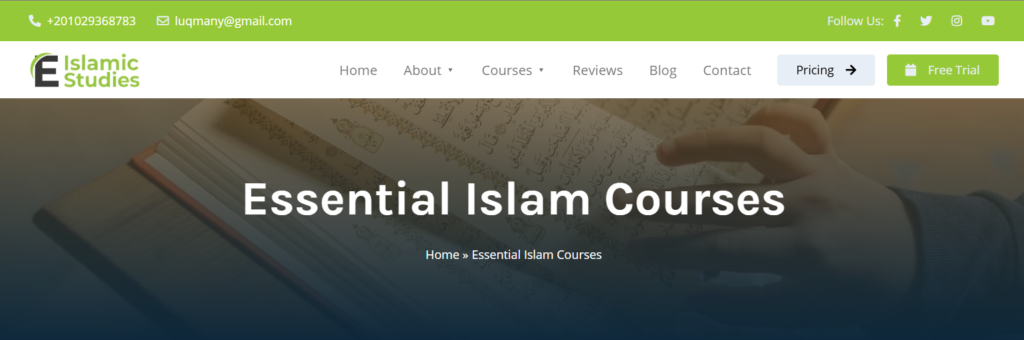
2- The Fundamentals of Tawheed by Dr. Bilal Philips
Once a beginner has studied The Three Fundamental Principles, they need a text that expands their Aqeedah knowledge into the areas where modern Muslims most commonly face confusion and deviation.
The Fundamentals of Tawheed by Dr. Bilal Philips is among the most important best books to learn about Islam in the science of Aqeedah for English-speaking Muslims precisely because it addresses the specific theological errors and misunderstandings that are most widespread in Western Muslim communities today.
Dr. Bilal Philips holds a Master’s degree in Islamic theology from the University of Riyadh and a PhD in Islamic theology from the University of Wales.
The book covers the three categories of Tawhid that Sunni scholars use to organize Islamic monotheism.
Tawhid al-Rububiyyah is the oneness of Allah SWT in His lordship over all creation. Tawhid al-Uluhiyyah is the oneness of Allah SWT in His right to be worshipped alone.
Tawhid al-Asma wal-Sifat is the oneness of Allah SWT in His names and attributes without comparison, alteration, denial, or likening Him to creation.
The section on Shirk is particularly valuable for Western Muslim beginners who encounter cultural practices from their families that may conflict with correct Aqeedah without anyone having explained why.
Dr. Philips addresses grave worship, seeking intercession from the dead, amulets, and fortune-telling with clear Quranic and Hadith evidence that a beginner can understand and act upon immediately.
Shots Videos from Courses
Deepen Your Islamic Knowledge
Join our comprehensive online courses and learn from qualified scholars today.
Book Your Free Trial3- Tafseer As-Sa’di
Every Muslim who wants to understand the Quran needs a Tafseer that is simultaneously scholarly reliable, theologically sound, and genuinely readable for a person who is not a specialist in the Arabic language or the Islamic sciences.
Tafseer As-Sa’di, written by Shaykh Abd al-Rahman ibn Nasir al-Sa’di رحمه الله (d. 1376 AH) and translated into English under the title Tafseer As-Sa’di: Enlightening the Mind, is by unanimous agreement among contemporary Sunni scholars the most suitable of all books to learn about Islam through Tafseer for a beginner at any level.
Shaykh al-Sa’di was a student of Shaykh Muhammad ibn Ibrahim Al al-Shaykh رحمه الله and was widely recognized during his lifetime as one of the greatest scholars of Tafseer in the Arabian Peninsula.
What distinguishes his Tafseer from classical works like Ibn Kathir is his deliberate choice to explain every verse in clear, direct language without lengthy chains of narration or extended scholarly debates that a beginner cannot follow.
He explains the meaning of each verse, draws out its theological implications, and connects it to practical Islamic conduct in a single flowing commentary that even a reader with no prior Tafseer knowledge can follow from the first page.
Allah SWT says:
كِتَابٌ أَنزَلْنَاهُ إِلَيْكَ مُبَارَكٌ لِّيَدَّبَّرُوا آيَاتِهِ وَلِيَتَذَكَّرَ أُولُو الْأَلْبَابِ {29}
Kitabun anzalnahu ilayka mubarakun liyaddabbaroo ayatihi waliyatathakkara oloo al-albab {29}
[This is] a blessed Book which We have revealed to you, [O Muhammad], that they might reflect upon its verses and that those of understanding would be reminded. {29}
Surah Sad: 29
True Tadabbur, deep reflection on the Quran, requires understanding what the verses actually mean.
Tafseer As-Sa’di makes that understanding available to every English-speaking Muslim regardless of their academic background, making it the single most important of all best books to learn about Islam through direct Quranic engagement for a beginner.
E Islamic Studies School’s Online Tafseer Course teaches students verse by verse Tafseer with the same methodology that Shaykh al-Sa’di used, guided by certified Islamic scholars who ensure students develop genuine Quranic understanding rather than surface-level familiarity.
Begin Your Tafseer Studies with a Free Tial
4- Ma’ariful Quran by Mufti Muhammad Shafi
Ma’ariful Quran by Mufti Muhammad Shafi (d. 1976) occupies a unique position among all books to learn about Islam through Tafseer because it is the only widely available English-language Tafseer that systematically connects Quranic verses to their Fiqh implications alongside their theological meaning.
Mufti Muhammad Shafi was the Grand Mufti of Pakistan and a senior graduate of Darul Uloom Deoband, one of the most prestigious traditional Islamic institutions in the world, and his eight-volume Tafseer represents the most comprehensive traditional Hanafi Tafseer available in the English language.
For a beginner who wants to understand not just what the Quran means theologically but what it requires practically in terms of Islamic rulings, Ma’ariful Quran is among the most valuable best books to learn about Islam.
Every passage that contains a legal ruling is explained with its Fiqh implications according to the Hanafi madhab alongside references to the positions of other madhabs where relevant, giving the reader a genuinely comprehensive picture of how classical Sunni scholarship understood and applied each verse.
The book is particularly strong in its treatment of the Makki and Madani distinction, the science of Asbab al-Nuzul, and the relationship between Quranic verses and the authentic Hadith that explain them.
Ma’ariful Quran treats them with the rigor of a traditional Islamic education while remaining accessible to an English-speaking reader who has never studied Tafseer before.
E Islamic Studies School’s Online Tafseer Course builds on exactly this comprehensive approach, teaching students to understand the Quran as classical scholars understood it.
Deepen Your Islamic Knowledge
Join our comprehensive online courses and learn from qualified scholars today.
Book Your Free TrialRead Also: The Best UK Schools to Learn Islam
5- The Forty Hadith of Imam al-Nawawi
The Forty Hadith compiled by Imam Yahya ibn Sharaf al-Nawawi (d. 676 AH) is not a modern introduction.
It is a classical Islamic text that has been taught continuously in traditional Islamic institutions since the thirteenth century, making it the most enduringly studied of all books to learn about Islam in the science of Hadith.
Al-Nawawi selected forty-two narrations that he identified as the most comprehensive foundations of the Islamic religion, covering Aqeedah, worship, ethics, social interaction, and spiritual development in a single concise collection.
What makes this one of the best books to learn about Islam for a complete beginner is precisely al-Nawawi’s selection criteria.
Every hadith represents what classical scholars identified as a foundational principle of the entire deen, meaning a Muslim who masters these forty-two narrations with their scholarly commentary has grasped the essential framework of authentic Islamic knowledge across all its major sciences.
Imam Ahmad ibn Hanbal رحمه الله said that the foundations of Islam revolve around three hadith, and two of those three are in al-Nawawi’s collection.
The Prophet ﷺ said:
“إِنَّ اللهَ كَتَبَ الْإِحْسَانَ عَلَى كُلِّ شَيْءٍ”
Inna Allaha kataba al-ihsana AAala kulli shay-in.
“Verily Allah has prescribed excellence (Ihsan) in all things.”
Sahih Muslim: 1955
This hadith, number seventeen in al-Nawawi’s collection, establishes that Islam demands excellence not just in worship but in every single act a Muslim performs, including how they treat animals and how they carry out the most mundane daily tasks.
The depth of implication in a single narration like this one is precisely why the Forty Hadith cannot simply be read. It must be studied with a qualified teacher.
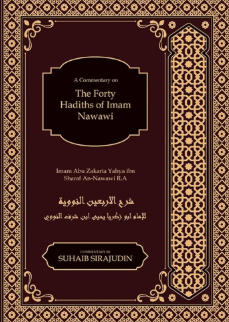
E Islamic Studies School’s Essential Islam Courses teach the Forty Hadith with full classical commentary in the same tradition that Islamic institutions have maintained for eight centuries.
Read Also: The Best Schools to Learn Islam
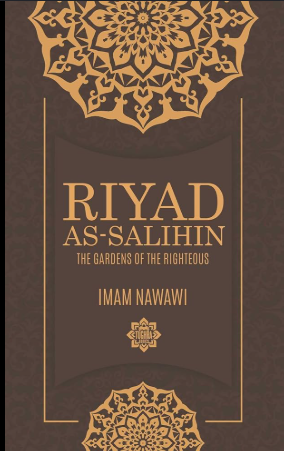
6- Riyad al-Salihin by Imam al-Nawawi
After completing the Forty Hadith, the natural progression in the science of Hadith for a beginner is Riyad al-Salihin, also by Imam al-Nawawi.
The title translates as Gardens of the Righteous, and the book is a comprehensive collection of authentic Hadith organized by topic, covering every dimension of Islamic conduct from the ethics of worship to the etiquette of eating, sleeping, greeting, dealing with neighbors, raising children, and preparing for death.
It is among the most beloved of all books to learn about Islam across the entire Sunni world and has been continuously taught in Islamic institutions across fourteen centuries.
What distinguishes Riyad al-Salihin from more advanced Hadith collections like Sahih Bukhari is al-Nawawi’s selection focus.
Every hadith in the collection was chosen for its direct practical relevance to a Muslim’s daily life and character development.
Al-Nawawi also begins each chapter with a relevant Quranic verse before presenting the Hadith, creating a consistent methodological link between the primary sources of Islamic legislation that trains the reader to always understand Sunnah in the light of the Quran.
The collection contains approximately 1,896 Hadith organized into 372 chapters, making it the most comprehensive of all best books to learn about Islam through the Sunnah at a level that a beginner can genuinely benefit from without specialist training.
A Muslim who reads through Riyad al-Salihin systematically with basic scholarly commentary will emerge with a comprehensive understanding of Islamic conduct across every area of their daily life.
Read Also: The Best Free Online Islamic Courses
7- The Sealed Nectar by Safi ur-Rahman al-Mubarakpuri Is the Award-Winning Seerah Every Muslim Must Read
The Sealed Nectar, known in Arabic as Al-Raheeq al-Makhtoom, by Shaykh Safi ur-Rahman al-Mubarakpuri رحمه الله is the single most widely read Seerah in the world today and the most recommended of all books to learn about Islam through the biography of the Prophet ﷺ at every level from beginner to advanced.
The book won first prize in the worldwide Seerah competition organized by the Muslim World League in Makkah in 1979, a competition that received entries from scholars across the entire Muslim world, placing The Sealed Nectar in a category of scholarly recognition that no other English-language Seerah can claim.
The book traces the life of the Prophet ﷺ from his lineage and the historical context of pre-Islamic Arabia through his birth, the beginning of revelation, the Makkan period of persecution, the Hijrah to Madinah, the major battles and expeditions, the conquest of Makkah, and the final days of the Prophet ﷺ before his death.
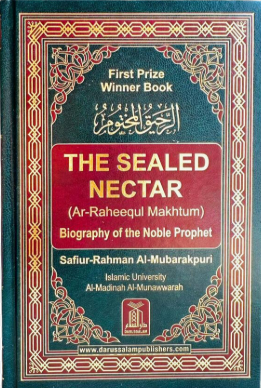
Every event is documented with references to classical primary sources and authentic Hadith, making it one of the most scholarly reliable of all books to learn about Islam through Seerah while remaining genuinely readable for a Muslim with no prior knowledge of Islamic history.
Allah SWT says:
لَّقَدْ كَانَ لَكُمْ فِي رَسُولِ اللَّهِ أُسْوَةٌ حَسَنَةٌ لِّمَن كَانَ يَرْجُو اللَّهَ وَالْيَوْمَ الْآخِرَ وَذَكَرَ اللَّهَ كَثِيرًا {21}
Laqad kana lakum fee rasooli Allahi oswatun hasanatun liman kana yarjoo Allaha waalyawma al-akhira wathakara Allaha katheeran {21}
There has certainly been for you in the Messenger of Allah an excellent pattern for anyone whose hope is in Allah and the Last Day and [who] remembers Allah often. {21}
Surah Al-Ahzab: 21
Understanding this pattern requires knowing the life in which it was lived with scholarly precision and authentic detail.
The Sealed Nectar provides exactly that, making it the most important of all best books to learn about Islam through the Prophetic biography for any Muslim at any stage of their Islamic education.
E Islamic Studies School’s Islamic History Course places every event in The Sealed Nectar within its complete theological and historical context, connecting the Seerah to the broader sweep of Islamic civilization in a way that no single book can achieve alone.
Start Learning Islamic History with a Free Trial
Read Also: How to Learn More About Islam as a Muslim
8- Fiqh al-Muyassar Gives Every Beginner the Most Practical Islamic Jurisprudence Book
Islamic Jurisprudence Made Easy, known in Arabic as Fiqh al-Muyassar, is a foundational Fiqh text prepared under the supervision of a committee of scholars at the Islamic University of Madinah and widely used across Sunni institutions worldwide as an introductory text in Islamic law.
Among all books to learn about Islam in the science of Fiqh for a complete beginner, it is the most balanced because it presents the rulings of Islamic law with reference to evidence from the Quran and Sunnah while acknowledging the positions of all four mainstream Sunni madhabs where they differ.
The book covers the complete rulings of Taharah including Wudu, Ghusl, and Tayammum with their conditions, pillars, and invalidators.
It then covers Salah with full detail of every pillar, obligation, and Sunnah of the prayer. It continues through Zakat, Sawm, and Hajj with the rulings every Muslim needs to fulfill these obligations correctly according to authenticated scholarly positions.
Every ruling is accompanied by its evidence from the Quran or authentic Hadith, training the reader from the very beginning to understand Islamic law not as arbitrary rules but as a divinely grounded system of worship.
The Prophet ﷺ said:
“صَلُّوا كَمَا رَأَيْتُمُونِي أُصَلِّي”
Salloo kama raaytumoonee osallee.
“Pray as you have seen me pray.”
Sahih al-Bukhari: 631
This hadith establishes that Islamic worship must be learned from verified scholarly transmission, not personal interpretation or cultural habit.
Fiqh al-Muyassar transmits exactly that scholarly tradition in a format accessible to every English-speaking beginner, making it one of the most practically essential of all best books to learn about Islam for any Muslim who wants to ensure their worship is correct according to authentic Sunni scholarship.
E Islamic Studies School’s Essential Islam Courses teach Islamic Fiqh through the same evidence-based methodology, with certified Islamic scholars ensuring every student’s worship is verified, corrected, and grounded in the Quran and Sunnah from their very first lesson.
Read Also: The Most Important Surahs to Learn
Our Students Reviews
Deepen Your Islamic Knowledge
Join our comprehensive online courses and learn from qualified scholars today.
Book Your Free TrialRead Also: How to Learn About Islam?
Take Your Islamic Knowledge Beyond Books With E Islamic Studies School
Every book on this list opens a door into one of the Islamic sciences. But books alone cannot replace a qualified teacher who corrects your understanding, answers your questions, and guides your progress through each science systematically.
At E Islamic Studies School, certified Islamic scholars with ijazah bring every science covered in these books to life through personalized one-on-one instruction with flexible scheduling that fits any lifestyle across any time zone.
Check out our top courses for Islamic Studies:
- Essential Islam Courses (Aqeedah, Fiqh, Hadith, Seerah)
- Online Tafseer Course
- Islamic History Course
- Tazkiyah Course
- Islam Classes for Kids
- Islam Classes for Adults
- Islam Classes for Sisters
- Alimah Course for Ladies
- Learning Islam for New Converts
Book your free class today to start learning Islamic studies
Conclusion
Authentic learning begins with sound Aqeedah, strengthened through accessible Tafseer and grounded in the verified words of the Prophet ﷺ. Each science supports the other, forming a complete framework rather than isolated areas of study.
Seerah connects belief to lived example, while Fiqh ensures worship aligns with Quranic guidance and authentic Sunnah. Together, these disciplines shape both understanding and daily practice with scholarly precision.
Selecting the right books to learn about Islam allows beginners and new Muslims to grow with confidence, clarity, and balance—establishing knowledge that is rooted in evidence, protected from deviation, and built for lifelong spiritual development.

Leave a Reply