 Learning Islam

Learning Arabic feels like an enormous mountain for most non-Arabic speaking Muslims. The question lingers quietly in many hearts: am I sinning by not knowing this language? The answer is more nuanced than a simple yes or no.
Islamic scholars have carefully distinguished between what is obligatory for every Muslim and what is praiseworthy but not required. This article clarifies the ruling on learning Arabic, identifies what is genuinely obligatory, and guides you toward a practical path forward.
Do You Have to Learn Arabic in Islam?
Learning Arabic entirely is not compulsory in Islam. However, learning the specific Arabic required for valid worship — primarily Salah — is obligatory upon every Muslim individual (fard ‘ayn).
Scholars of Usul al-Fiqh (principles of Islamic jurisprudence) classify obligations into fard ‘ayn (individual obligation) and fard kifayah (collective obligation). Learning conversational or scholarly Arabic falls under collective obligation at most.
Salah Cannot Be Valid Without Its Specific Arabic
The prayer cannot be performed without Surah Al-Fatiha recited in Arabic. The Prophet ﷺ said:
لَا صَلَاةَ لِمَنْ لَمْ يَقْرَأْ بِفَاتِحَةِ الْكِتَابِ
“There is no prayer for the one who does not recite the Opening of the Book (Al-Fatiha).” (Sahih Bukhari)
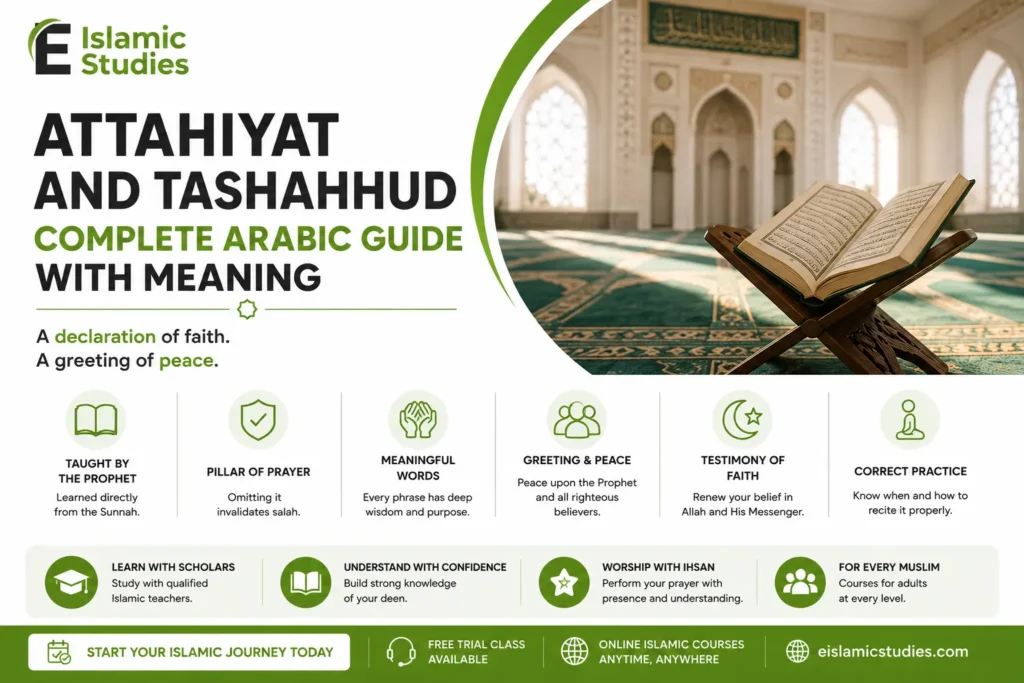
This hadith establishes that memorizing Al-Fatiha in Arabic is individually obligatory. The tashahhud, takbeer, and other essential adhkar of Salah similarly require their Arabic forms.
E Islamic Studies School’s Learning Islam for New Converts course specifically addresses this transition, offering structured guidance from certified scholars who walk new Muslims through Arabic recitation step by step.
Book a FREE Trial to Start Learning About Islam

Understanding Quran Through Qualified Translation Is Permissible
The consensus of classical scholars permits non-Arabic speakers to fulfill the obligation of reflecting on Quran through reliable translations and Tafseer explanations. This is why Tafseer sciences exist as a distinct Islamic discipline.
However, this permission does not eliminate the virtue of learning Arabic. It simply means that not knowing Arabic does not block you from Islamic learning or valid worship.
Shots Videos from Our Courses
Deepen Your Islamic Knowledge
Join our comprehensive online courses and learn from qualified scholars today.
Book Your Free TrialLearning Arabic Carries Enormous Spiritual and Intellectual Rewards
Even where scholars stop short of declaring full Arabic learning obligatory on every individual, the reward and benefit are undeniable.
The Prophet ﷺ said:
“The one who recites the Quran proficiently will be with the noble, obedient scribes (angels), and the one who recites it with difficulty, stammering through it, will have two rewards.” (Sahih Muslim 798)
This hadith encourages everyone, regardless of proficiency level. Struggling with Arabic recitation is itself rewarded.
1. Connecting Directly with the Words of Allah
Every translation of the Quran carries the translator’s interpretation. No English rendering fully captures the linguistic precision, rhetorical beauty, and layered meanings of the original Arabic.
When you understand even basic Quranic vocabulary, your Salah transforms. Words become alive. Scholars describe this shift as one of the most profound spiritual experiences accessible to a Muslim.
2. Preserving the Authenticity of Islamic Knowledge
Arabic literacy enables Muslims to access authentic Hadith collections, classical Fiqh texts, and Tafseer works in their original form. This guards against misquotation, mistranslation, and the distortion that sometimes enters Islamic content in other languages.
At E Islamic Studies School, our Online Tafseer Course bridges this gap beautifully — offering detailed verse-by-verse Tafseer explanations delivered in English by qualified scholars trained in classical Arabic sciences, ensuring you access authentic meanings without distortion.
Begin Your Tafseer Studies with a Free Trial

Read Also: The Best UK Schools to Learn Islam
Practical Steps Every Muslim Can Take to Fulfill Their Arabic Obligation
Since at minimum the Arabic of Salah is obligatory, and broader Arabic study is deeply recommended, a structured approach helps.
1. Prioritizing What Is Obligatory First
Begin with what is required: Al-Fatiha, the tashahhud, the essential supplications of Salah. These must be memorized in Arabic with correct pronunciation. Learn their meanings in parallel so your heart is engaged in worship.
2. Building Quranic Arabic Vocabulary Gradually
Research shows that the majority of Quranic words can be understood by mastering a modest number of foundational root words. This is an achievable goal for any committed student.
Read Also: The Importance of Learning Arabic in Islam
3. Engaging Qualified Teachers Rather Than Self-Study Alone
Self-study through apps or YouTube carries real risks — incorrect pronunciation, wrong grammatical understanding, and misinterpretation of Quranic terms. A qualified teacher corrects errors early before they become habits.
E Islamic Studies School’s Essential Islam Courses provide this structured, personalized guidance through certified scholars with ijazah (chains of scholarly authorization), ensuring every student builds authentic Arabic literacy from a sound foundation.
Start Your Islamic Studies With a Free Trial in Our Essential Islam Courses

| Learning Stage | Key Focus | Estimated Timeline |
| Stage 1 | Memorize and correct Salah Arabic | 1-2 months |
| Stage 2 | Learn Al-Fatiha word-by-word meaning | 2-4 weeks |
| Stage 3 | Basic Quranic vocabulary (50-100 words) | 2-4 months |
| Stage 4 | Quranic grammar fundamentals | 6-12 months |
| Stage 5 | Reading classical texts | 1-2 years |
Our Students Reviews
Deepen Your Islamic Knowledge
Join our comprehensive online courses and learn from qualified scholars today.
Book Your Free TrialRead Also: Benefits of Learning Arabic Islam
Begin Your Islamic Education at E Islamic Studies School Today
Learning Arabic at the obligatory level is within every Muslim’s reach. Beyond obligation, every step deeper into the language brings you closer to the words of Allah سبحانه وتعالى.
E Islamic Studies School offers:
- Certified scholars holding ijazah in Islamic sciences
- One-on-one personalized instruction tailored to your pace
- Flexible scheduling designed around your lifestyle
- Comprehensive courses from beginner Salah Arabic to advanced Tafseer
- Sister-taught classes available for female students
- Specialized programs for new converts, kids, adults, and advanced students
Book your free trial class today and start fulfilling your Islamic obligation with confidence.
Check out our top courses for Islamic Studies:
- Essential Islam Courses (Aqeedah, Fiqh, Hadith, Seerah)
- Online Tafseer Course
- Islamic History Course
- Tazkiyah Course
- Islam Classes for Kids
- Islam Classes for Adults
- Islam Classes for Sisters
- Alimah Course for Ladies
- Learning Islam for New Converts
Book your free class today to start learning Islamic studies

Conclusion
The ruling is clear: learning the Arabic required for Salah is individually obligatory, while broader Arabic literacy carries a collective duty and immense personal reward. Neither ignorance nor overwhelm should stop you from starting.
The scholars have always recognized that Muslims come from every nation and language. What matters is sincere effort, consistent learning, and access to authentic guidance. Begin with what is obligatory, then build from there.
Every word of Arabic you learn in pursuit of Allah’s pleasure is an act of worship in itself. The path is open, the obligation is defined, and the reward from Allah for sincere effort is certain, insha’Allah.



Leave a Reply