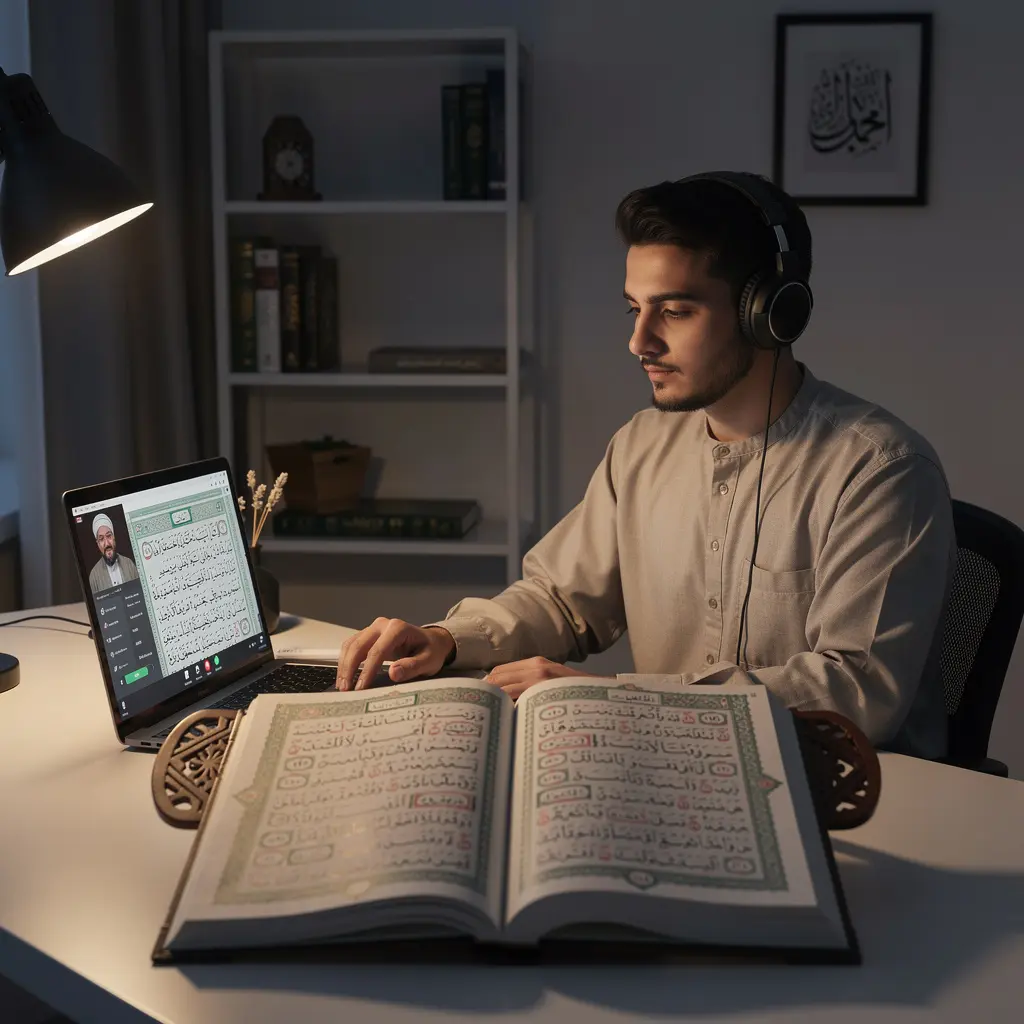
 Learning Islam

Standing in prayer can feel overwhelming when you are unsure whether every movement and word is correct. Many Muslims reach a point where they realize their Salah needs more than habit—it needs clarity, precision, and presence.
My journey taught me that learning Salah properly requires structure, beginning with purification, intention, and the essential conditions of validity, then moving through each pillar step by step until learning to pray Islam the right way becomes a lived, confident practice rooted in authentic scholarship.
1. Performing Wudu Correctly
Wudu is the ritual purification that every Muslim must complete before standing in Salah. Without valid Wudu, the prayer is invalid regardless of how perfectly every other step is performed.
Many Muslims who struggled to learn to pray in Islam properly discovered that their Wudu itself was the source of the problem, not their memorization or movements.
The Fard acts of Wudu are four, established directly from Surah Al-Maidah (5:6). The first is washing the face once completely.
The second is washing both arms including the elbows. The third is wiping part of the head with wet hands.
The fourth is washing both feet including the ankles. Every one of these must be completed for the Wudu to be valid.
The Prophet ﷺ said:
“لاَ تُقْبَلُ صَلاَةٌ بِغَيْرِ طُهُورٍ”
“Prayer is not accepted without purification.”
Sahih Muslim: 224a
Wudu is not a recommended step before Salah. It is a non-negotiable condition without which everything that follows is void.
The Sunnah acts that perfect the Wudu include beginning with Bismillah, washing the hands three times before starting, rinsing the mouth and nose three times, and repeating each washing three times.
E Islamic Studies School’s Essential Islam Courses cover Wudu in precise Fiqh detail, ensuring students build correct purification habits from their very first lesson with a certified Islamic scholar.
Start Your Islamic Studies With a Free Trial in Our Essential Islam Courses

2. Be Aware of The Conditions That Must Be Met for the Prayer to Be Valid
Before the prayer begins, a set of external conditions must be satisfied. These are called Shurut al-Salah in Fiqh terminology, and their fulfillment is what scholars mean when they say a prayer is sahih, meaning valid.
Neglecting any single condition invalidates the entire Salah regardless of how correctly everything else is performed.
| Condition | Arabic Term | What It Requires |
| Ritual Purity | Taharah | Valid Wudu or Ghusl as required |
| Purity of Body, Clothes, and Place | Nadhafah | Free from Najasah in all three |
| Covering the Awrah | Sitr al-Awrah | Navel to knee for men, full body for women except face and hands |
| Facing the Qiblah | Istiqbal al-Qiblah | Facing the direction of the Kaabah in Makkah |
| Entry of Prayer Time | Waqt | Each prayer has a defined time window that must have entered |
| Intention | Niyyah | Firm internal intention specifying which prayer is being performed |
Covering the Awrah is a condition many beginners overlook entirely. A man praying in shorts that do not cover the knee is praying in an invalid state according to the unanimous position of all four madhabs.
When you learn to pray islam through qualified scholarly instruction, these conditions are addressed from day one rather than discovered years later through trial and error.
3. Making the Correct Intention Before the Prayer Begins
The Niyyah, or intention, is what separates an act of worship from a mere physical movement. The majority of scholars across the four madhabs are explicit that Niyyah is an act of the heart alone. Verbalizing it is permissible but not obligatory.
The heart must be settled on which specific prayer is being performed before the opening Takbir is said.
Allah SWT says:
وَمَا أُمِرُوا إِلَّا لِيَعْبُدُوا اللَّهَ مُخْلِصِينَ لَهُ الدِّينَ حُنَفَاءَ وَيُقِيمُوا الصَّلَاةَ وَيُؤْتُوا الزَّكَاةَ ۚ وَذَٰلِكَ دِينُ الْقَيِّمَةِ {5}
Wa ma umiroo illa liyaAAbudoo Allaha mukhliseena lahu alddeena hunafaa wayuqeemoo assalata wayu/too azzakata wathalika deenu alqayyimati {5}
And they were not commanded except to worship Allah, [being] sincere to Him in religion, inclining to truth, and to establish prayer and to give zakah. And that is the correct religion. {5}
Surah Al-Bayyinah: 5
Sincerity begins with intention. Niyyah is what makes you stop performing Salah mechanically and start entering it consciously.
The intention must be made before or simultaneously with the opening Takbir, not after it has already begun.
Deepen Your Islamic Knowledge
Join our comprehensive online courses and learn from qualified scholars today.
Book Your Free Trial4. Saying the Opening Takbir to Enter the Prayer
The Takbirat al-Ihram is the verbal act that marks the official beginning of the Salah. It is called Ihram because once it is said, the worshipper enters a state in which all speech, movement, and actions outside the prayer become impermissible until the Tasleem concludes it.
This single Takbir is Fard according to the unanimous position of scholars across all four madhabs.
The Prophet ﷺ said:
“مِفْتَاحُ الصَّلَاةِ الطُّهُورُ وَتَحْرِيمُهَا التَّكْبِيرُ وَتَحْلِيلُهَا التَّسْلِيمُ”
“The key to prayer is purification; its beginning is takbir and its end is taslim.”
Sunan Abi Dawud: 61
The hands are raised to the level of the shoulders or earlobes simultaneously with saying Allahu Akbar. The eyes are directed toward the place of prostration.
The feet are shoulder-width apart. These are the established Sunnah of the Prophet ﷺ recorded in Sahih Bukhari and Sahih Muslim, and every one of them carries weight in the sight of Allah SWT.
5. Reciting Surah Al-Fatihah With Full Understanding in Every Rakah
Surah Al-Fatihah is the pillar of the prayer. The Prophet ﷺ said:
“There is no prayer for the one who does not recite the Opening of the Book.” (Sahih Bukhari).
This establishes its recitation as Fard in every rakah according to the majority of scholars including the Shafi’i, Maliki, and Hanbali madhabs.
Al-Fatihah is not merely a recitation. It is a conversation. Allah SWT says in the Hadith Qudsi narrated in Sahih Muslim that every verse the worshipper recites receives a direct divine response.
When you understand this reality, standing in Salah becomes something entirely different from mechanical repetition.
Errors in Al-Fatihah that change the meaning, known as Lahn Jali, can affect the validity of the recitation according to many scholars.
Anyone who genuinely wants to learn to pray islam at the level of correctness and presence it deserves will find that proper Tajweed instruction transforms every single rakah.
E Islamic Studies School’s Essential Islam Courses teach Al-Fatihah meaning by meaning, guided by certified Islamic scholars in live one-on-one sessions.
6. Reciting an Additional Surah After Al-Fatihah in the First Two Rakahs
After Al-Fatihah, a Surah or a minimum of three verses from the Quran is recited in the first two rakahs of every prayer. This is Wajib according to the Hanafi madhab and Sunnah Muakkadah according to the majority.
Omitting it intentionally in the first two rakahs requires Sujud al-Sahw in the Hanafi position.
The most commonly recited Surahs for beginners are the short Surahs of Juz Amma, from Surah Al-Nas back to Surah Al-Aala.
Selecting them based on meaning rather than habit alone transforms the experience of the prayer entirely.
E Islamic Studies School’s Online Tafseer Course teaches the meaning of every Surah you recite in Salah, giving your words genuine understanding and your heart genuine presence in every rakah you stand in.
Begin Your Tafseer Studies with a Free Tial

7. Performing the Ruku With Correct Posture and Dhikr
The Ruku is the bowing position and it is a Fard pillar of the prayer. The back must be straight and horizontal, the hands grip the knees firmly, and the head is neither raised nor lowered but kept level with the spine.
This precise posture is established from the authentic descriptions of the Prophet’s ﷺ prayer recorded by scholars of Hadith across multiple chains of narration.
The Dhikr of Ruku is Subhana Rabbiyal Adheem, Glory be to my Lord the Magnificent, repeated a minimum of three times.
The Hanafi madhab considers it Wajib, meaning its deliberate omission requires a compensatory prostration.
Rushing through Ruku without achieving stillness, known as Tuma’ninah, invalidates the Ruku entirely according to the unanimous position of all four madhabs. This is one of the most widespread and serious errors in the prayer of Muslims today.
8. Rising From Ruku and Achieving Full Stillness Before Moving Forward
The rising from Ruku is called Qiyam ba’d al-Ruku and it is a Fard pillar of the prayer in its own right.
The body must return to a fully upright standing position with complete stillness before the prostration begins. This stillness is called Tuma’ninah and its absence invalidates that pillar and potentially the entire prayer.
The following table shows the Dhikr of each transitional position and its scholarly ruling:
| Transition | Dhikr | Ruling |
| Rising from Ruku | Sami Allahu liman Hamidah | Wajib for Imam and individual, Sunnah for follower |
| After Standing Fully | Rabbana lakal Hamd | Sunnah Muakkadah |
| Going into Sujud | Allahu Akbar | Sunnah |
| Rising from first Sujud | Allahu Akbar | Sunnah |
| Rising from Tashahhud sitting | Allahu Akbar | Sunnah |
Every Takbir of transition is a moment of renewed awareness that you are moving through the presence of Allah SWT. This is not a mechanical sequence.
It is a structured act of worship in which every movement has a name, a ruling, and a spiritual purpose that scholars have preserved with extraordinary precision across fourteen centuries.
E Islamic Studies School’s Tazkiyah Course teaches students how to bring genuine spiritual presence into each of these transitional moments so that the entire Salah becomes an act of conscious connection rather than habitual movement.
Join Our Tazkiyah Course Today

9. Performing the Sujud Correctly on Seven Body Parts
The Sujud is the prostration and it is the closest a servant comes to Allah SWT in the entirety of the prayer.
Understanding this position changed everything about prayer at a deeper level, because it transformed the Sujud from a physical movement into the most anticipated moment of every rakah.
The Prophet ﷺ said:
“أَقْرَبُ مَا يَكُونُ الْعَبْدُ مِنْ رَبِّهِ وَهُوَ سَاجِدٌ فَأَكْثِرُوا الدُّعَاءَ”
“The nearest a servant comes to his Lord is when he is prostrating himself, so make supplication (in this state).”
Sahih Muslim: 482
The Sujud must be performed on seven body parts simultaneously. These are the forehead including the nose, both palms, both knees, and the bottoms of both feet with the toes pointing toward the Qiblah.
The Dhikr is Subhana Rabbiyal A’la repeated a minimum of three times. Full stillness must be achieved before rising.
No position in the prayer carries more spiritual weight than this one, and no position is more commonly rushed without awareness of what is being left behind.
10. Sitting Correctly Between the Two Prostrations
Between the two Sujud positions is a sitting position called the Jalsah bayna al-Sajdatayn. This sitting is a Fard pillar of the prayer, and full stillness must be achieved in it before the second prostration begins.
The Dhikr recited in this position is Rabbighfirli, meaning “My Lord, forgive me,” which is Sunnah Muakkadah according to the majority of scholars.
The sitting posture involves the left foot laid flat with the right foot upright, toes pointing toward the Qiblah. Many Muslims rush through this position without realizing it is a Fard pillar in its own right.
When you learn to pray Islam with scholarly guidance rather than imitation alone, these pillars receive the attention they deserve from the very beginning of your practice.
11. Reciting the Tashahhud Correctly in the Final Sitting
The Tashahhud is recited in the final sitting position of every prayer after the last rakah. It is Fard according to the Hanbali and Shafi’i madhabs and Wajib according to the Hanafi madhab.
The text begins with At-Tahiyyatu lillahi was-salawatu wat-tayyibat and includes the Shahadah and the Salawat upon the Prophet ﷺ known as the Ibrahimiyyah.
Reciting Salawat in the final sitting is the moment the worshipper joins Allah SWT and the angels in honoring the Prophet ﷺ.
This is one of the most elevated moments in the entire Salah.
E Islamic Studies School’s Islamic for Beginners Course connects students to the context of how these words were revealed and preserved, giving the Tashahhud a depth that memorization alone can never provide.
Begin Your Islamic Studies Path with a FREE Trial

Read Also: The Best Schools to Learn Islam
12. Concluding the Prayer With the Tasleem
The Tasleem is the act that formally concludes the Salah. It is performed by turning the head to the right and saying Assalamu Alaykum wa Rahmatullah, then turning to the left and repeating the same.
The first Tasleem is Fard according to the majority of scholars. The second is Sunnah Muakkadah.
Once the Tasleem is completed, the worshipper has exited the state of Ihram and the Salah is concluded.
The recommended post-prayer Adhkar begins immediately, including Astaghfirullah three times, then Subhanallah thirty-three times, Alhamdulillah thirty-three times, and Allahu Akbar thirty-three times, all established in Sahih Muslim.
Treating the post-prayer Adhkar as part of the worship experience rather than an afterthought is what distinguishes a Muslim who truly understands Salah from one who merely performs it.
Read Also: How to Learn About Islam?
Deepen Your Islamic Knowledge
Join our comprehensive online courses and learn from qualified scholars today.
Book Your Free TrialRead Also: The Most Important Surahs to Learn
Deepen Your Prayer Through Structured Islamic Courses at E Islamic Studies School
Learning the steps of Salah is the beginning, not the end. True mastery of prayer comes through understanding the Tafseer of every verse you recite, the spiritual purification that gives those recitations life, and the Islamic sciences that show you how this prayer has been preserved with extraordinary precision for over fourteen centuries.
At E Islamic Studies School, certified Islamic scholars with ijazah guide you through every dimension of Islamic worship through personalized one-on-one instruction with flexible scheduling that fits any lifestyle.
- Essential Islam Courses cover Salah within its complete Fiqh and Aqeedah context
- Online Tafseer Course teaches the meaning of every verse you recite in prayer
- Tazkiyah Course develops the spiritual presence that transforms Salah from movement into connection
- Islamic History Course connects you to fourteen centuries of preserved Islamic practice
Check out our top courses for Islamic Studies:
- Essential Islam Courses (Aqeedah, Fiqh, Hadith, Seerah)
- Online Tafseer Course
- Islamic History Course
- Tazkiyah Course
- Islam Classes for Kids
- Islam Classes for Adults
- Islam Classes for Sisters
- Alimah Course for Ladies
- Learning Islam for New Converts
Book your free class today to start learning Islamic studies

Conclusion
Correct prayer begins before the first Takbir. Valid Wudu, sincere intention, fulfilled conditions, and proper recitation of Al-Fatihah establish the structural integrity of every rakah from the very start.
Each pillar—Ruku, Sujud, stillness, Tashahhud, and Tasleem—carries specific rulings and spiritual depth. Understanding posture, required dhikr, and scholarly consensus transforms Salah from routine movement into deliberate worship.
Anyone determined to learn to pray Islam the right way must seek structured guidance, deepen their understanding of meanings, and cultivate presence alongside correctness—building a prayer that is sound in Fiqh, rich in reflection, and alive in the heart.
Related Articles
Learning Islam


Leave a Reply