 Learning Islam
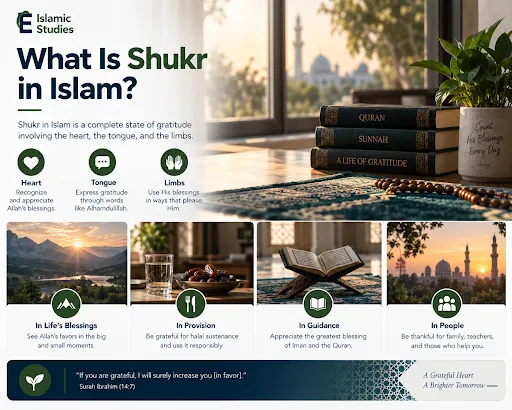
Shukr in Islam is one of the most frequently repeated concepts in the Quran and the Sunnah, yet many people only associate it with saying “Alhamdulillah.” Gratitude in Islam is far broader than a single phrase — it is a complete state involving the heart, the tongue, and the limbs.
This article explains what is shukr in a clear and sourced way: its linguistic and religious meaning, its three pillars, how it differs from hamd (praise), and what the Quran and authentic shukr hadith teach about it.
You will also find practical steps for building daily gratitude as taught by the Prophet (peace be upon him).
Whether you are new to Islamic studies or reviewing a core concept of the faith, understanding shukr is essential to building a grateful and content relationship with Allah.
Take Away — What You Will Learn
- The precise meaning of shukr in Arabic and in Islamic terminology.
- The three pillars of gratitude in Islam: heart, tongue, and limbs.
- The key difference between shukr and hamd.
- Quranic verses and shukr hadith that explain gratitude to Allah.
- Practical, daily ways to become one of the shakireen (grateful servants).
What Is Shukr in Islam?
Shukr (شكر) is the Arabic word for gratitude. In Islamic terminology, shukr means a servant’s recognition that every blessing comes from Allah, combined with praising Him for it and using that blessing in obedience to Him.
The scholar Ibn al-Qayyim defined shukr precisely as “the appearance of the effect of Allah’s blessing on the tongue of His servant through praise and acknowledgment, on his heart through witnessing and love, and on his limbs through submission and obedience.”
This definition explains why shukr is treated as a complete act of worship, not a single statement of thanks.
The word shukr also carries an older linguistic meaning: it describes an animal that grows visibly healthy even from a small amount of food.
Islamic scholars use this image to explain gratitude in worship. A grateful heart flourishes even from small blessings, because it recognizes their true value rather than taking them for granted.
The Three Pillars of Shukr in Islam
True shukr (gratitude) in Islam is more than simply saying Alhamdulillah. Scholars explain that complete gratitude involves three interconnected dimensions: gratitude of the heart, gratitude of the tongue, and gratitude through one’s actions.
Together, these ensure that a believer not only recognizes Allah’s blessings internally, but also praises Him for them and uses those blessings in ways that please Him.
Gratitude is therefore a complete way of living that shapes a person’s thoughts, words, choices, and relationship with Allah. It reminds the believer that every blessing, whether great or small, comes from Allah and should be acknowledged with humility, sincerity, and obedience.
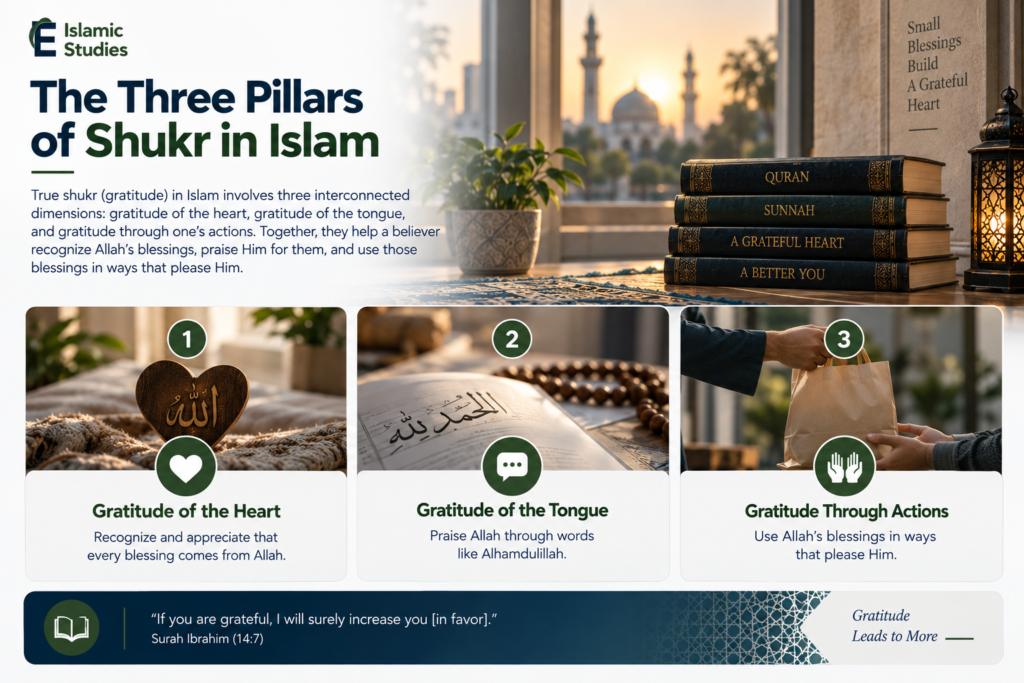
1. Gratitude of the Heart
Gratitude of the heart begins with sincerely recognizing that Allah is the true source of every blessing a person possesses. Wealth, health, knowledge, family, safety, opportunities, abilities, and success are ultimately gifts from Allah, even when they are obtained through considerable personal effort.
This does not mean denying the importance of hard work or personal responsibility. Rather, the believer recognizes that the ability to work, the opportunities available, and the results themselves were all made possible by Allah.
This inward recognition protects the heart from entitlement and excessive self-reliance, replacing them with humility and awareness of one’s continuous dependence upon Allah.
2. Gratitude of the Tongue
Gratitude of the tongue means praising Allah for His blessings and acknowledging His favors verbally.
Expressions such as Alhamdulillah allow the believer to connect the blessings they experience with the One who provided them, rather than treating those blessings as something ordinary or automatically deserved.
Allah says:
وَأَمَّا بِنِعْمَةِ رَبِّكَ فَحَدِّثْ
“And as for the favor of your Lord, report it.”
Mentioning Allah’s blessings should be done with gratitude rather than pride or boasting. The purpose is not to demonstrate superiority over others, but to recognize Allah’s generosity and give Him the praise that belongs to Him.
In this way, gratitude of the tongue becomes an outward expression of what the heart already acknowledges.
3. Gratitude of the Limbs
Gratitude of the limbs means demonstrating thankfulness through the way Allah’s blessings are actually used.
If Allah grants a person wealth, knowledge, health, influence, skills, or time, complete shukr involves directing those gifts toward lawful and beneficial purposes rather than using them in ways that displease Him.
The Quran illustrates this practical dimension of gratitude in Allah’s command to the family of Dawood (David):
اعْمَلُوا آلَ دَاوُودَ شُكْرًا ۚ وَقَلِيلٌ مِّنْ عِبَادِيَ الشَّكُورُ
“Work, O family of David, in gratitude. And few of my servants are grateful.”
| Learn the Pillars of Worship in DepthUnderstanding concepts like the three pillars of shukr, with full evidence from the Quran and Sunnah, is part of the structured curriculum at E Islamic Studies Academy.Explore Distance Learning Programs |

Shukr vs Hamd: What Is the Difference?
Shukr and hamd are related but not identical. Hamd is praise of Allah offered in every situation in ease and in hardship mainly through the tongue and heart.
Shukr is broader: it is gratitude expressed through the heart, tongue, and physical actions, and it is specifically a response to a blessing that has been received.
| Aspect | Shukr (Gratitude) | Hamd (Praise) |
| Expressed through | Heart, tongue, and limbs (action) | Tongue and heart only |
| When it applies | In response to a specific blessing received | In every situation, in ease and in hardship |
| Physical worship linked to it | Sujud ash-shukr (prostration of gratitude) is prescribed | There is no equivalent prostration of hamd |
This is also why sujud ash-shukr (the prostration of gratitude) exists as a recognized act of worship when a Muslim receives good news, while there is no separate “prostration of hamd,” since hamd is offered in every circumstance, not only in response to a specific favor.
See Our Islamic Studies Classes in Action
Take a look at a sample lesson and see how our interactive online classes help students learn Islamic Studies in a clear, engaging, and supportive environment.
Deepen Your Islamic Knowledge
Join our comprehensive online courses and learn from qualified scholars today.
Book Your Free TrialWhy Is Gratitude in Islam So Important?
Gratitude in Islam is important because Allah has directly linked it to an increase in blessings and has warned against ingratitude. The Quran states this relationship clearly:
وَإِذْ تَأَذَّنَ رَبُّكُمْ لَئِن شَكَرْتُمْ لَأَزِيدَنَّكُمْ وَلَئِن كَفَرْتُمْ إِنَّ عَذَابِي لَشَديدٌ
“If you are grateful, I will surely increase you [in favor]; but if you deny, indeed, My punishment is severe.”
Allah also commands gratitude directly, tying it to worship rather than treating it as optional good manners:
فَاذْكُرونِي أَذْكُرْكُمْ وَاشْكُروا لِي وَلَا تَكْفُرونِ
“So remember Me; I will remember you. And be grateful to Me and do not deny Me.”
| Go Deeper Into Quranic Themes Like GratitudeE Islamic Studies Academy runs dedicated workshops that explore Quranic concepts such as shukr in more detail, with guided discussion and qualified teachers.See Upcoming Workshops |
Shukr Hadith: What Does the Prophet (peace be upon him) Teach About Gratitude?
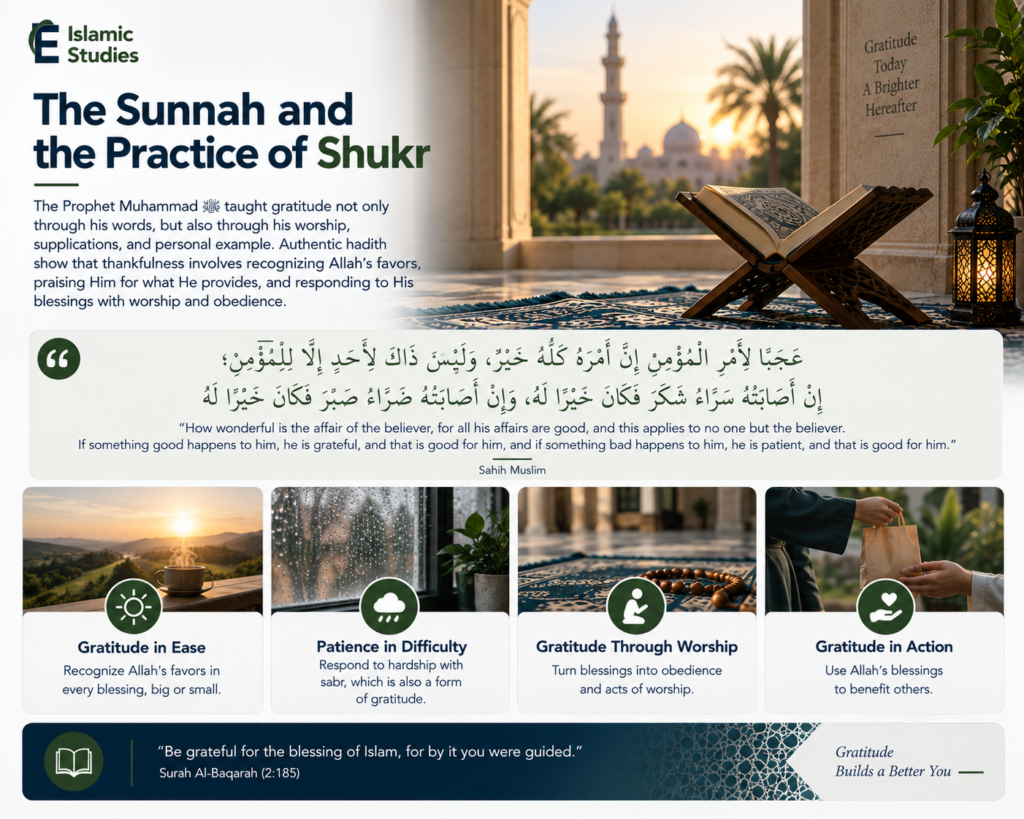
The Sunnah provides a practical picture of what shukr looks like in a believer’s everyday life. The Prophet Muhammad ﷺ taught gratitude not only through his words, but also through his worship, supplications, and personal example.
Authentic hadith show that thankfulness involves recognizing Allah’s favors, praising Him for what He provides, and responding to His blessings with worship and obedience.
These teachings also demonstrate that gratitude is not limited to moments of ease or material abundance. A believer develops shukr as an ongoing attitude toward Allah, recognizing His blessings and using them in ways that please Him.
The following authentic hadith illustrate several important ways in which the Prophet ﷺ taught and practiced gratitude.
Sisters looking for a learning environment designed specifically for them can find a dedicated track as well:
Explore Islamic Classes for Sisters

The Believer’s Affair Is Always Good
Gratitude gives the believer a balanced way of responding to changing circumstances. Islam teaches that faith is not demonstrated only when life is easy; it also shapes the way a Muslim responds when difficulties arise.
In times of ease, the appropriate response is shukr, while hardship calls for sabr (patience). In both situations, the believer has an opportunity to draw closer to Allah and gain reward.
عَجَبًا لِأَمْرِ الْمُؤْمِنِ إِنَّ أَمْرَهُ كُلَّهُ خَيرٌ، وَلَيْسَ ذَاكَ لِأَحَدٍ إِلَّا لِلْمُؤْمِنِ؛ إِنْ أَصَابَتْهُ سَرَّاءُ شَكَرَ فَكَانَ خَيرًا لَهُ، وَإِنْ أَصَابَتْهُ ضَرَّاءُ صَبَرَ فَكَانَ خَيرًا لَهُ
“How wonderful is the affair of the believer, for all his affairs are good, and this applies to no one but the believer. If something good happens to him, he is grateful, and that is good for him. If something bad happens to him, he is patient, and that is good for him.”
“Should I Not Be a Grateful Servant?”
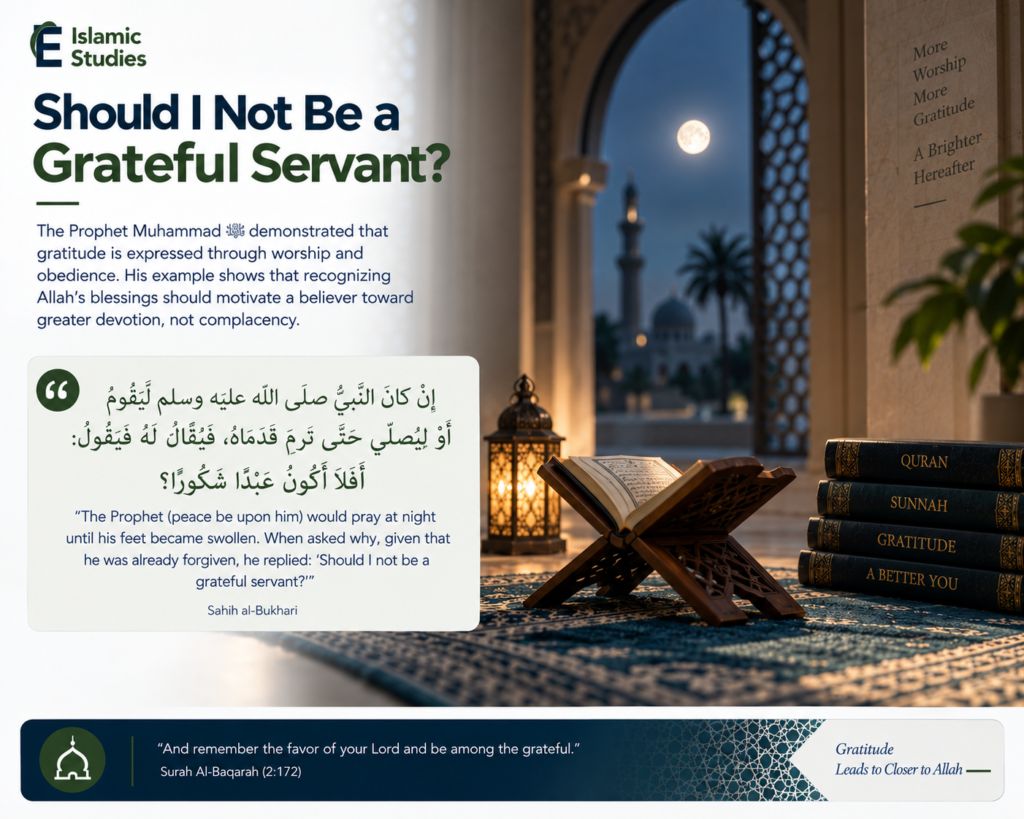
The Prophet Muhammad ﷺ demonstrated that gratitude is not limited to words of praise; it can also be expressed through worship and obedience.
Although Allah had granted him an exceptionally honored status, he continued to devote himself to voluntary prayer.
His example shows that recognizing Allah’s blessings should motivate a believer toward greater worship rather than complacency.
إِنْ كَانَ النَّبِيُّ صلى الله عليه وسلم ليَقُوم أَوْ ليُصَلِّي حتَّى تَرِمَ قَدَمَاهُ، فيُقَالُ لَهُ فيَقُولُ: أَفَلَا أَكُونُ عَبْدًا شَكُورًا؟
The Prophet (peace be upon him) would pray at night until his feet became swollen. When asked why, given that he was already forgiven, he replied: “Should I not be a grateful servant?”
Sahih al-Bukhari and Sahih Muslim
Gratitude Extends to Animals
Islamic teachings also demonstrate that acts of mercy toward Allah’s creation can carry tremendous reward.
Compassion is not restricted to interactions with other people; kindness toward animals is also recognized and rewarded by Allah.
The following hadith illustrates how a seemingly simple act of mercy toward a thirsty animal became the reason for a person’s forgiveness.
بَيْنَا رَجُلٌ يَمْشِي فَاشْتَدَّ عَليهِ الْعَطَشُ، فَنَزَلَ بئرًا فَشَرِبَ منها، ثمَّ خَرَجَ فإذَا هُوَ بِكَلْبٍ يَلْهَثُ يَأْكُلُ الثَّرَى مِنَ العَطَشِ، فَقَالَ: لَقَدْ بَلَغَ هَذَا مِثْلَ الَّذِي بَلَغَ بِي، فَمَلأَ خُفَّهُ ثمَّ أَمْسَكَهُ بِفيهِ، ثمَّ رَقِيَ فَسَقَى الكَلْبَ، فَشَكَرَ اللهُ لَهُ فَغَفَرَ لَهُ
A man walking on a road became severely thirsty. He found a well, went down into it, drank, and came out to find a dog panting from thirst. He filled his shoe with water, held it in his mouth, and gave the dog water. Allah appreciated this act and forgave him.
Sahih al-Bukhari and Sahih Muslim
How Can a Muslim Practice Shukr Daily?
Gratitude in Islam is meant to be practiced, not only understood. The Quran and Sunnah give several concrete habits a Muslim can build into daily life.
- Reciting the dua taught to Mu’adh ibn Jabal after every prayer: “Allahumma a’inni ‘ala dhikrika wa shukrika wa husni ‘ibadatik” (O Allah, help me remember You, thank You, and worship You well).
- Performing sujud ash-shukr (the prostration of gratitude) upon receiving good news, as the Prophet (peace be upon him) used to do.
- Praying Salat al-Duha (the mid-morning voluntary prayer), which the Prophet (peace be upon him) linked to gratitude for the body’s joints and blessings.
- Practicing qana’ah (contentment) with what Allah has provided, rather than constantly comparing one’s blessings to others.
- Deliberately reflecting on Allah’s blessings, including the senses and faculties most people take for granted.
This last point is directly rooted in the Quran, where Allah reminds people of blessings they rarely think to thank Him for:
وَاللّهُ أَخْرَجَكُمْ مِّن بُطُونِ أُمَّهَاتِكُمْ لَا تَعْلَمُونَ شَيْئًا وَجَعَلَ لَكُمُ السَّمْعَ وَالْأَبْصَارَ وَالْأَفْئِدَةَ لَعَلَّكُمْ تَشْكُرونَ
“And Allah has extracted you from the wombs of your mothers not knowing a thing, and He made for you hearing, vision, and hearts that perhaps you would be grateful.”
Allah also connected gratitude to Luqman’s wisdom, showing that recognizing this responsibility is itself a sign of insight:
وَلَقَدْ آتَيْنَا لُقْمَانَ الْحِكْمَةَ أَنِ اشْكُرْ لِلّهِ وَمَن يَشْكُرْ فَإِنَّمَا يَشْكُرُ لِنَفْسِهِ
“And We had certainly given Luqman wisdom [and said], ‘Be grateful to Allah.’ And whoever is grateful is grateful for [the benefit of] himself.”
Read Also: What Is Istighfar in Islam?
Watch a Sample Islamic Studies Class
See how our teachers explain Islamic concepts in an engaging and easy-to-understand way, helping students build knowledge and confidence.
Deepen Your Islamic Knowledge
Join our comprehensive online courses and learn from qualified scholars today.
Book Your Free Trial| Build These Habits in a Supportive Learning Space New Muslims and sisters who want to build gratitude and worship habits with structured guidance can join E Islamic Studies Academy’s dedicated classes.View Classes for New Converts |
Deepen Your Understanding of Gratitude in Islam
Understanding shukr is only the first step; real growth happens when you study these concepts consistently, with proper guidance and structure.
At E Islamic Studies Academy, you’ll learn directly from qualified scholars who explain the Quran, authentic hadith, and classical Islamic scholarship in a way that’s clear, accurate, and easy to apply to daily life.
Our Islamic Courses
- Islam Classes for Adults
- Islam Classes for Sisters
- Alimah Course for Ladies
- Islam Classes for Kids
- Learn Islam for Beginners
- Learning Islam for New Converts

Conclusion
Shukr in Islam is a complete act of worship built on three pillars: acknowledging Allah’s blessings in the heart, praising Him with the tongue, and using every blessing in obedience through the limbs. It is distinct from hamd, which is offered in every circumstance, while shukr responds specifically to a received favor.
The Quran ties gratitude directly to an increase in blessings, and the shukr hadith of the Prophet (peace be upon him) shows that gratitude shapes how a believer responds to both ease and hardship.
Building daily habits from the dua after prayer to reflecting on one’s senses and faculties turns this concept into lived practice.
Frequently Asked Questions
What does shukr mean in Islam?
Shukr means gratitude to Allah, expressed through acknowledging a blessing in the heart, praising Allah for it with the tongue, and using it in obedience through one’s actions and limbs.
What is the difference between shukr and hamd?
Shukr is gratitude expressed through the heart, tongue, and limbs in response to a specific blessing, while hamd is praise of Allah offered through the tongue and heart in every situation, whether favorable or difficult.
What are the three pillars of shukr?
The three pillars are gratitude of the heart (recognizing Allah as the source of a blessing), gratitude of the tongue (praising and mentioning the blessing), and gratitude of the limbs (using the blessing in obedience to Allah).
Is there an authentic hadith describing gratitude in the believer’s life?
Yes. Suhaib reported that the Prophet (peace be upon him) said the believer’s affair is always good: gratitude when blessed with good, and patience when tested with hardship, as recorded in Sahih Muslim.
What is sujud ash-shukr?
Sujud ash-shukr is a single prostration performed when a Muslim receives good news or a clear blessing, following the example of the Prophet (peace be upon him), and it does not require the usual conditions of prayer such as facing the qiblah.
How can I become more grateful to Allah every day?
Practical steps include reciting the dua for gratitude after each prayer, performing sujud ash-shukr when appropriate, praying Salat al-Duha, practicing contentment (qana’ah), and regularly reflecting on blessings like health and the senses.







Leave a Reply