 Learning Islam
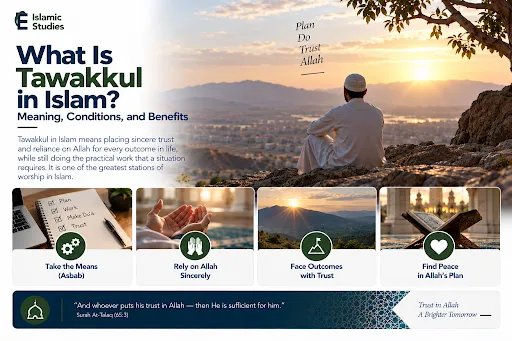
Tawakkul in Islam means placing sincere trust and reliance on Allah for every outcome in life, while still doing the practical work that a situation requires. It is one of the greatest stations of worship in Islam, and some scholars describe it as half of the religion itself.
Many people confuse tawakkul with passivity, assuming it means sitting back and waiting for outcomes to happen. In reality, true tawakkul combines sincere reliance on Allah with genuine effort, using the means (asbab) that Allah has placed in this world.
Take Away — What You Will Learn
- The exact meaning of tawakkul in Islam and how it differs from mere passivity (tawakul).
- The scholarly definitions of tawakkul given by Ibn Abbas, Imam Ahmad ibn Hanbal, and Ibn Rajab.
- The three conditions required for tawakkul to be sincere and correct.
- Key Quranic verses and hadith that describe and command tawakkul.
- The real benefits tawakkul brings to a believer’s heart, provision, and daily life.
What Is Tawakkul in Islam?
Tawakkul is the sincere reliance of the heart on Allah alone in seeking benefit and warding off harm, in matters of both this world and the Hereafter. It rests on the belief that no one truly gives, withholds, benefits, or harms except Allah.
Linguistically, the scholar Ibn Manzur explains in Lisan al-Arab that “tawakkul” comes from entrusting one’s affair to someone else out of confidence in their sufficiency.
To rely (tawakkala) on Allah means to hand over one’s affairs to Him, trusting fully in His care.
Grasping terms like tawakkul in their original Arabic context is far easier once a student has a real foundation in the language itself.
This is one reason learning Arabic is considered so important in Islam it opens direct access to the Quran, hadith, and classical scholarly texts without relying only on translation.

Scholarly Definitions of Tawakkul
Several early scholars offered precise definitions of tawakkul that clarify what it truly means for the heart:
- Ibn Abbas (may Allah be pleased with him): Tawakkul is trusted in Allah. True tawakkul means trusting in Allah and in what He has, because it is greater and more lasting than anything you currently possess.
- Imam Ahmad ibn Hanbal: Tawakkul is cutting off any anticipation of, or despair over, what people can give or withhold.
- Ibn Rajab al-Hanbali (in Jami’ al-Ulum wal-Hikam): Tawakkul is the heart’s sincere reliance on Allah in securing benefit and warding off harm in worldly and religious affairs. A believer is not truly relying on Allah unless this is joined with trust, good expectation of Him, and full submission to His command.

Definitions like these are the product of centuries of scholarly reasoning. Scholars derive precise meanings for spiritual and legal concepts through disciplined methods such as ijtihad (independent scholarly reasoning) and, in matters of jurisprudence, istihsan (juristic preference) the same careful methodology that shaped how tawakkul itself came to be defined and understood.
The Three Levels: Tawakkul, Tasleem, and Tafweed
Ibn al-Qayyim explains in Madarij al-Salikin that reliance on Allah has three ascending levels. At the level of tawakkul, the heart rests on Allah’s promise.
At the level of tasleem (submission), a person is content simply knowing Allah is aware of their situation.
At the level of tafweed (entrusting), a person is fully satisfied with whatever Allah decrees, without needing anything further.
Ibn al-Qayyim further states that tawakkul is half of the religion, the other half being inabah (turning to Allah in repentance and worship).
Tawakkul is the means of seeking help, and inabah is the worship itself together, they touch every aspect of a believer’s religious life.
Tawakkul Is Not the Same as Passivity (Tawakul)
A common misunderstanding is confusing tawakkul with tawakul abandoning effort and calling it trust in Allah.
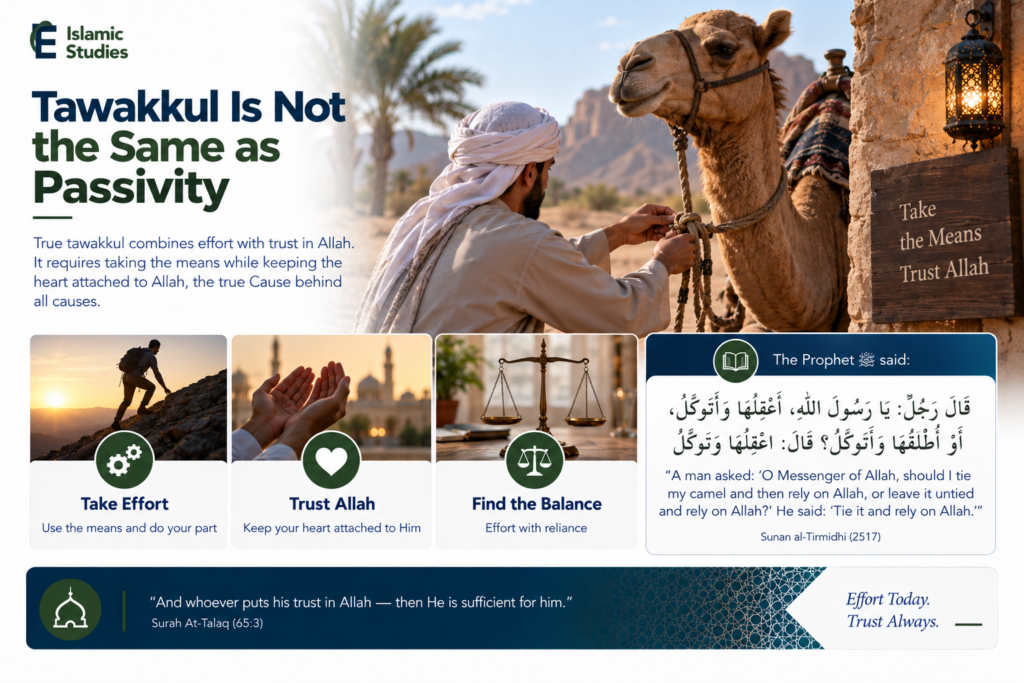
True tawakkul is not laziness. It requires the physical limbs to work and take the appropriate means, while the heart remains attached to Allah, the true Cause behind all causes.
This balance is illustrated in a well-known hadith. A man asked the Prophet ﷺ whether he should tie his camel and then rely on Allah, or leave it untied and rely on Allah. The Prophet’s ﷺ reply made the correct approach unmistakably clear.
قَالَ رَجُلٌ: يَا رَسُولَ اللَّهِ، أَعْقِلُهَا وَأَتَوَكَّلُ، أَوْ أُطْلِقُهَا وَأَتَوَكَّلُ؟ قَالَ: اعْقِلْهَا وَتَوَكَّلْ
“A man said: ‘O Messenger of Allah, should I tie my camel and rely on Allah, or leave her untied and rely on Allah?’ He said: ‘Tie her, and rely on Allah.'”
Jami’ at-Tirmidhi, Hadith 2517 (graded Hasan by Al-Albani)
Treating passivity as though it were a higher form of worship is a subtle danger, since it can drift toward practices with no basis in the Quran or Sunnah.
Islam warns clearly against bid’ah introducing new practices into the religion without evidence and mistaking laziness for tawakkul is exactly this kind of misunderstanding.
The Three Types of People in Relation to Tawakkul
People can approach tawakkul (reliance on Allah) in very different ways depending on how they understand the relationship between trusting Allah and taking practical means.
Some rely heavily on their own efforts while neglecting dependence on Allah, while others misunderstand tawakkul as abandoning necessary action altogether.
The balanced Islamic approach brings the two together: taking appropriate means while keeping the heart sincerely reliant upon Allah for the outcome.
- Those who abandon the means entirely: They claim reliance on Allah but make no effort, mistaking laziness for tawakkul. This approach was criticized by early Muslim scholars, since it confuses tawakkul with tawakul.
- Those who rely only on the means: They place their trust entirely in worldly causes, forgetting the One who truly controls benefit and harm. This view treats causes as independently powerful, which contradicts the Islamic understanding of tawheed.
- Those who combine reliance on Allah with taking the means: Their limbs work and take the permitted means, while their heart remains attached to Allah, the true Cause behind every cause. This is the correct, balanced path taught by the Quran and Sunnah.
See Our Islamic Studies Classes in Action
Take a look at a sample lesson and see how our interactive online classes help students learn Islamic Studies in a clear, engaging, and supportive environment.
Deepen Your Islamic Knowledge
Join our comprehensive online courses and learn from qualified scholars today.
Book Your Free TrialThe Conditions for True Tawakkul
True tawakkul is more than simply saying that one trusts Allah. It requires a balanced state of the heart in which a believer depends sincerely upon Allah while still taking the appropriate and lawful means available to them.
Scholars therefore identify several essential conditions that distinguish genuine tawakkul from passivity, carelessness, or excessive dependence on worldly causes.
a. Sincerity of Intention
True tawakkul begins with directing the heart’s reliance entirely toward Allah. A believer may seek help from other people, use available resources, earn money, make plans, and take practical steps, but none of these should become the ultimate object of dependence.
Wealth, influence, skills, and human assistance are only means; their ability to benefit a person remains subject to Allah’s will. Tawakkul therefore means using these means responsibly while trusting Allah alone to determine the final outcome and provide what is best.
b. Taking the Means (Asbab)
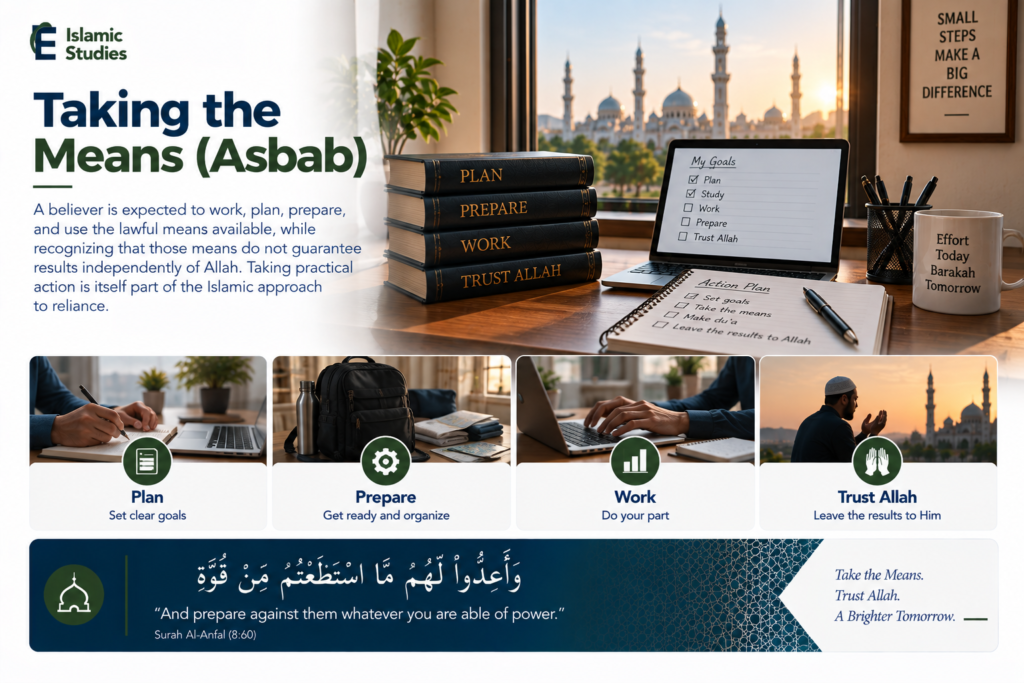
A believer is expected to work, plan, prepare, and use the lawful means available, while recognizing that those means do not guarantee results independently of Allah. Taking practical action is itself part of the Islamic approach to reliance.
The Quran demonstrates this principle by commanding believers to prepare and make use of their available capabilities:
وَأَعِدُّوا لَهُم مَّا اسْتَطَعْتُم مِّن قُوَّةٍ
“And prepare against them whatever you are able of power.”
C. Certainty and Contentment with Allah’s Decree
True tawakkul continues even after a person has done everything within their ability. Once the appropriate effort has been made, the believer entrusts the outcome to Allah and accepts His decree, rather than allowing disappointment to destroy their trust in Him.
The result may differ from what they hoped or planned, but they remain certain that Allah’s knowledge and wisdom are greater than their own.
This contentment does not mean that a person cannot feel sadness or disappointment; rather, it means maintaining trust in Allah and continuing to respond to His decree with patience, faith, and submission.

Tawakkul in the Quran
Tawakkul appears throughout the Quran in many different life situations, showing that reliance on Allah is meant to accompany every aspect of a believer’s life, not only moments of hardship.
| Context | Quranic Reference |
|---|---|
| Worship | Surah Hud (11:123) |
| Calling people to Islam (Da’wah) | Surah At-Tawbah (9:129) |
| Provision (Rizq) | Surah At-Talaq (65:2-3) |
| Judgment and disputes | Surah Ash-Shura (42:10) |
| Facing hardship or conflict | Surah Al Imran (3:159) |
| Migration (Hijrah) | Surah An-Nahl (16:41-42) |
| Covenants and promises | Surah Yusuf (12:66) |
Two examples show how directly the Quran ties tawakkul to provision and to steadiness of heart.
Reading these verses alongside their tafseer reveals additional layers of meaning that a translation alone cannot fully capture, including the circumstances of revelation and how early scholars understood each ayah.
وَمَن يَتَّقِ اللَّهَ يَجْعَل لَّهُ مَخْرَجًا * وَيَرْزُقْهُ مِنْ حَيْثُ لَا يَحْتَسِبُ ۚ وَمَن يَتَوَكَّلْ عَلَى اللَّهِ فَهُوَ حَسْبُهُ
“And whoever fears Allah, He will make for him a way out, and will provide for him from where he does not expect. And whoever relies upon Allah, then He is sufficient for him.”
فَإِذَا عَزَمْتَ فَتَوَكَّلْ عَلَى اللَّهِ ۚ إِنَّ اللَّهَ يُحِبُّ الْمُتَوَكِّلِينَ
“And when you have decided, then rely upon Allah. Indeed, Allah loves those who rely upon Him.”
Deepen Your Islamic Knowledge
Join our comprehensive online courses and learn from qualified scholars today.
Book Your Free Trial
Read Also: What Is Istighfar in Islam?
Tawakkul in the Sunnah
The Prophet ﷺ also described tawakkul directly, highlighting its deep connection to provision and the importance of placing complete trust in Allah.
Through his teachings, he showed that true reliance on Allah does not mean abandoning effort or remaining passive. Instead, a believer takes the necessary steps, works toward their goals, and then places their trust in Allah regarding the outcome.
The Sunnah also connects tawakkul with Allah’s provision, reminding Muslims that رزق ultimately comes from Him alone.
The Prophet ﷺ further emphasized the spiritual value of sincere reliance on Allah, associating complete tawakkul with the highest levels of faith and the greatest rewards in the Hereafter.
These teachings encourage believers to free themselves from excessive anxiety about the future while continuing to fulfill their responsibilities and trust in Allah’s wisdom and plan.
لَوْ أَنَّكُمْ تَتَوَكَّلُونَ عَلَى اللَّهِ حَقَّ تَوَكُّلِهِ لَرَزَقَكُمْ كَمَا يَرْزُقُ الطَّيْرَ تَغْدُو خِمَاصًا وَتَرُوحُ بِطَانًا
“If you were to rely upon Allah with true reliance, He would provide for you as He provides for the birds: they go out hungry in the morning and return full in the evening.”
Jami’ at-Tirmidhi, Hadith 2344 (also narrated by An-Nasa’i)
The Prophet ﷺ also described a group of 70,000 believers who will enter Paradise without being brought to account, describing one of their key qualities as reliance on Allah:
هُمُ الَّذِينَ لَا يَسْتَرْقُونَ وَلَا يَتَطَيَّرُونَ وَلَا يَكْتَوُونَ وَعَلَى رَبِّهِمْ يَتَوَكَّلُونَ
“They are those who do not ask others to perform ruqyah for them, do not believe in bad omens, do not seek cauterization, and rely upon their Lord alone.”
At E Islamic Studies Academy, the Essential Islamic Courses teach students the foundational knowledge of Aqeedah and Fiqh that every Muslim needs — including how Islamic rulings are derived, applied, and protected from misuse.
Read Also: What Is Riya in Islam?

Read Also: What Is Ihsan in Islam?
How the Early Muslims Practiced Tawakkul
The early generations of Muslims understood tawakkul as exerting full effort according to one’s ability, and then leaving the outcome to the One who truly controls it.
This understanding did not lead to passivity; it produced remarkable determination in both peace and difficulty.
They worked, planned, and strove in every area of life, then entrusted the results to Allah with contentment, viewing this combination as both a source of strength and a form of worship.
Read Also: What Is Baraka in Islam?
Watch a Sample Islamic Studies Class
See how our teachers explain Islamic concepts in an engaging and easy-to-understand way, helping students build knowledge and confidence.
Deepen Your Islamic Knowledge
Join our comprehensive online courses and learn from qualified scholars today.
Book Your Free TrialDeepen Your Understanding of Tawakkul with E Islamic Studies Academy
Understanding tawakkul in depth, its conditions, its Quranic foundations, and its practical application is easier with structured guidance.
E Islamic Studies Academy offers guided Islamic studies courses that walk students through core concepts like tawakkul, tawheed, and Islamic ethics with qualified teachers.
Courses are available for every learner, including dedicated classes for ladies, live workshops, and structured tafseer study so there is a suitable path whatever your schedule or learning style.
Our Islamic Programs
- Islamic Distance Learning Programs
- Islamic Courses Workshops
- Intensive Islamic Course
- Islam Crash Course
- Learning Islam Level 1 Online
- Darse Nizami / Traditional Alim Courses

Conclusion
Tawakkul in Islam is the heart’s sincere reliance on Allah alone, joined with genuine effort and use of the lawful means available.
It is not laziness, and it is not reliance on causes alone; it is the balanced combination the Quran and Sunnah both describe.
By fulfilling its conditions of sincerity, taking the means, and contentment with Allah’s decree — a believer gains steadiness of heart, protection from Satan, and the sufficiency of Allah in every affair, in this life and the next.
Frequently Asked Questions
What does tawakkul mean in Islam?
Tawakkul means the heart’s sincere reliance on Allah alone for benefit and protection from harm, in worldly and religious affairs, while still taking the lawful means available.
Is tawakkul the same as giving up effort?
No. Tawakkul requires working and taking appropriate means; abandoning effort while calling it tawakkul is actually tawakul, a mistaken and criticized approach.
What is the difference between tawakkul and tawakul?
Tawakkul combines heartfelt trust in Allah with real effort and use of means. Tawakul is passivity — abandoning effort and mistakenly calling that trust in Allah.
What are the conditions of tawakkul?
Three conditions are commonly mentioned: sincerity of reliance on Allah alone, taking the permitted means, and contentment with whatever Allah decrees afterward.
Which Quranic verse best describes tawakkul?
Surah At-Talaq (65:3) states that whoever relies upon Allah will find Him sufficient, directly linking reliance on Allah to sufficiency in all affairs.
What did the Prophet ﷺ teach about tying one’s camel?
He taught a man to tie his camel and then rely on Allah, showing that taking practical precautions and trusting Allah with the outcome go together, not against each other.








Leave a Reply