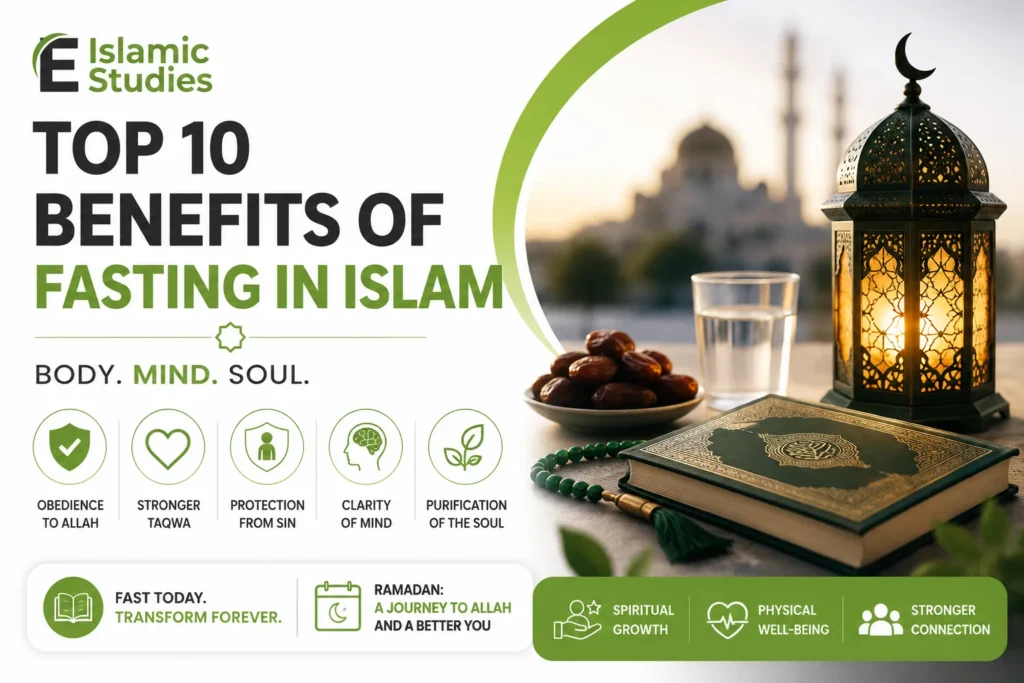
Top 10 Benefits of Fasting in Islam – Body, Mind, and Soul
Many Muslims struggle to understand why fasting feels so spiritually powerful. The benefits of fasting in Islam go far beyond skipping meals — they purify the soul, discipline the body, and bring the believer closer to Allah. This is why Allah declares in the Quran that fasting is good for you.
Sawm is one of the five pillars of Islam, yet millions approach it without fully grasping its transformative potential. When you understand both the spiritual benefits of fasting in Islam and its worldly gains, every fast becomes a meaningful act of worship — not just a physical exercise in restraint.
1- Obeying Allah’s Command Is the First Reward
Fasting in Ramadan is fard — a binding obligation that every capable Muslim must fulfill. What makes this obligation especially significant is that sawm was not prescribed exclusively for Muslims.
Earlier nations were commanded to fast as well, establishing it as a universal act of submission woven into the fabric of human spiritual history across all prophetic missions.
Abandoning the Ramadan fast deliberately, without a valid Islamic excuse, is considered a major sin in Islamic jurisprudence. Understanding the weight of this command deepens your commitment to it. Allah clarifies this command directly:
Every fast is a private act between the believer and Allah alone. No one else can verify that you are truly fasting, which makes sawm one of the most sincere expressions of faith a Muslim can offer.
This sincerity is what causes Allah to honor fasting above many other acts of worship and reserve its reward exclusively for Himself.
Many beginners find it hard to connect with this command because they lack foundational Islamic knowledge. At E Islamic Studies Academy, the Learn Islam for Beginners course was designed precisely for this — to help you build a confident relationship with your faith from the ground up.
Taqwa is often translated as “God-consciousness” or “piety,” and it refers to living every moment with the awareness that Allah sees you, hears you, and knows your innermost intentions.
One of the deepest spiritual benefits of fasting in Islam is that it directly cultivates this awareness in the believer’s heart — not through lectures or reminders, but through lived daily experience.
When a fasting Muslim refrains from eating in private, where no one is watching, they do so purely because Allah commanded it. This private obedience is the very essence of taqwa. Fasting also exposes the believer’s weakness and dependence on their Creator.
The hunger and thirst felt during the fast are constant reminders that human beings are fragile — while Allah needs nothing and is never weakened. This recognition builds humility and deepens the believer’s connection to Allah throughout every fasting hour.
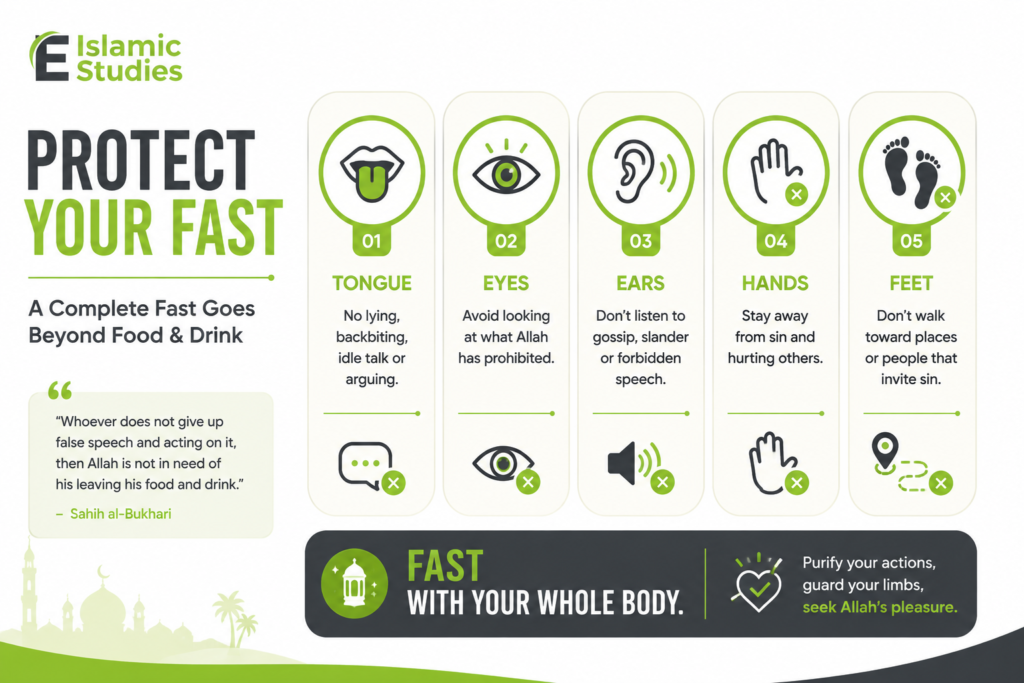
Among the most powerful fasting benefits Islamic tradition has preserved is the description of sawm as a “junnah” — a shield or protective armor against sin. A true fast does not only mean abstaining from food and drink. It means guarding every limb and faculty from wrongdoing throughout the fasting hours.
The Prophet Muhammad, peace be upon him, identified the specific limbs and behaviors that must be guarded during a complete and valid fast:
Protecting the tongue from backbiting, lying, idle speech, and arguing.
Guarding the eyes from looking at what Allah has prohibited.
Restraining the ears from listening to gossip, slander, and forbidden speech.
Keeping the hands away from wrongdoing and transgression against others.
Preventing the feet from walking toward places or people that invite sin.
When a believer maintains all of these restraints together, the fast becomes a complete spiritual shield. The Prophet, peace be upon him, addressed this directly:
“Al-siyamu junnatun, fa idha kana yawmu sawmi ahadikum fala yarfuth wala yaskhab.”
“Fasting is a shield. If any one of you is observing a fast, let him not utte obscene a fast, let him not utter obscene talk or raise his voice in anger.”
At E Islamic Studies Academy, the Tazkiyya Course teaches students how to purify the soul and guard the limbs from sin — exactly the internal work that gives fasting its full spiritual power.
4- Allah Reserves an Unlimited Reward for Every Fast
Most acts of worship in Islam are rewarded in multiples — ten times, seven hundred times, or more. But fasting stands alone because Allah declares that its reward belongs exclusively to Him, and He will give it without measure or limit.
This is among the most awe-inspiring spiritual benefits of fasting in Islam that every Muslim should reflect on deeply. The scholars explain that Allah attributed fasting directly to Himself for two key reasons:
Fasting is the only act of worship that is completely invisible to others — making it impossible to perform for show or reputation.
Fasting requires the believer to exercise all three types of patience simultaneously: patience in obeying Allah, patience in avoiding what He has forbidden, and patience in bearing the physical hardship of hunger and thirst.
Because fasting encompasses all of these dimensions, Allah honored it by taking its reward upon Himself — and He rewards from His infinite divine generosity, not from human deserving. The scholars added that this unlimited reward is connected to the Quranic verse:
Take a look at a sample lesson and see how our interactive online classes help students learn Islamic Studies in a clear, engaging, and supportive environment.
Deepen Your Islamic Knowledge
Join our comprehensive online courses and learn from qualified scholars today.
5- Physical Health Improves Significantly During Fasting
The benefits of fasting in Islam are not limited to the spiritual dimension. Scientific research has consistently confirmed that Islamic fasting produces measurable improvements in physical health. The following table summarizes the key health benefits documented in published studies:
Health Area
Documented Benefit
Cardiovascular Health
Reduced risk of heart disease and improved lipid profile
Blood Sugar
Lower insulin resistance and improved glucose control
Body Weight
Significantly lower body weight and fat percentage during and after Ramadan
Immune System
Decreased inflammatory markers including leukocytes and monocytes
Digestive System
Rest and renewal of the digestive system, improving long-term function
Cholesterol
Lower cholesterol levels as a natural result of the fasting process
Ramadan fasting has also shown measurable benefits for patients with type 2 diabetes, including improvements in glucose control and reductions in body weight and waist circumference.
These physical results emerge naturally from the fasting process — without any special diet or medical intervention — which reflects the wisdom embedded in this divine prescription.
At E Islamic Studies Academy, the Online Tafseer Course helps students understand the Quranic wisdom behind commands like fasting — connecting the revealed text to every dimension of human life.
One of the most socially transformative fasting benefits Islamic practice produces is the growth of genuine empathy. When a Muslim who lives comfortably experiences hunger and thirst throughout the day, something shifts internally.
Hunger stops being an abstract concept associated with poverty and becomes a lived personal reality — even if only for the hours of a single fast. This experience motivates believers to give generously, support those in need, and take the suffering of others seriously.
It is no coincidence that Zakat al-Fitr — the obligatory charity given at the end of Ramadan — is directly tied to the fasting month. Fasting creates the emotional and spiritual conditions that make giving feel natural rather than forced.
7- Sunnah Fasts Multiply Your Rewards Year-Round
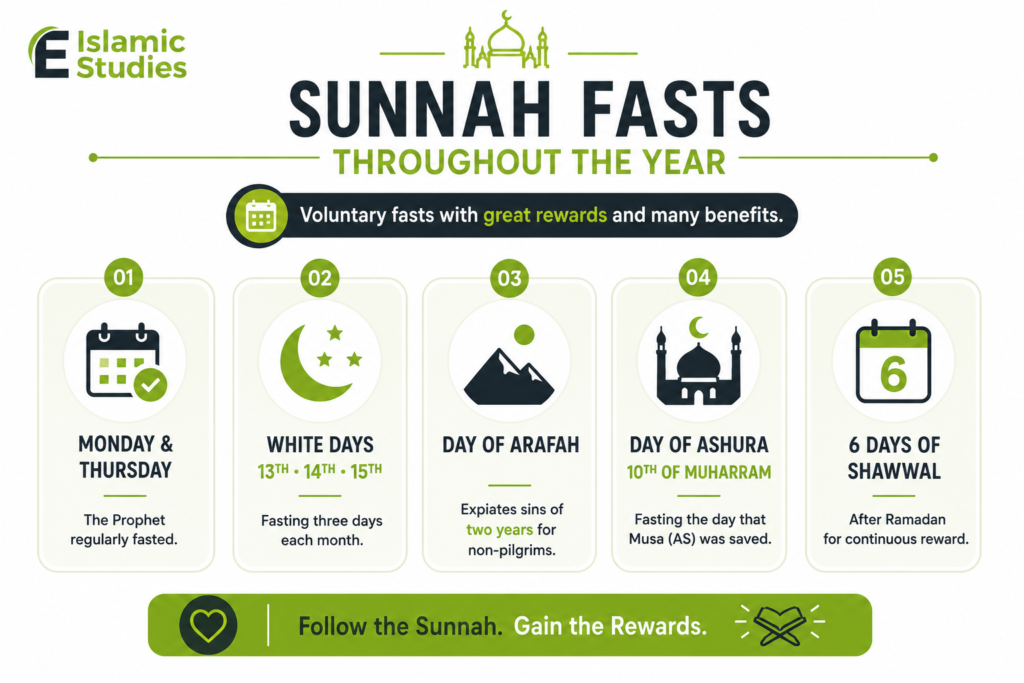
The benefits of fasting in Islam are not confined to Ramadan alone. The Prophet Muhammad, peace be upon him, observed voluntary fasts throughout the year and taught his companions to do the same. These Sunnah fasts carry their own independent rewards and serve multiple spiritual purposes. The established Sunnah fasts include:
Fasting every Monday and Thursday, as the Prophet regularly observed.
Fasting the White Days — the 13th, 14th, and 15th of each Islamic month.
Fasting the Day of Arafah, which expiates sins of two years for non-pilgrims.
Fasting the Day of Ashura on the 10th of Muharram.
Fasting six days of Shawwal after Ramadan.
The Prophet, peace be upon him, explained the spiritual purpose behind his Monday and Thursday fasts:
8- The Gate of Ar-Raiyan Opens Only for Those Who Fast
Among all the gates of Paradise, one is reserved exclusively for those who fasted. No one else will enter through it — not those who gave charity, not those who prayed — only the fasting believers. This exclusive honor represents one of the most remarkable spiritual benefits of fasting in Islam and stands as a powerful motivation for every Muslim who wishes to attain Paradise.
The Prophet Muhammad, peace be upon him, described this gate in clear and direct terms:
“There is a gate in Paradise called Ar-Raiyan, and those who observe fasts will enter through it on the Day of Resurrection and none except them will enter through it.”
When the last fasting person enters, the gate will close and no one else will pass through it. This hadith alone should inspire every Muslim to take their fasting seriously — in Ramadan and beyond.
At E Islamic Studies Academy, the Islamic History Course traces the traditions of fasting across Islamic civilization, showing how generations of Muslims earned this honor.
The social dimension of fasting is among the most visible yet underappreciated fasting benefits Islamic communities experience. Ramadan creates a shared rhythm of life that unites millions of Muslims across the globe — waking together for suhoor, breaking fast together at iftar, standing side by side in tarawih prayers, and giving charity simultaneously.
This collective experience builds bonds that transcend geography, language, and background. The following table compares individual fasting with communal fasting to illustrate the social dimension of sawm:
Aspect
Individual Fasting
Communal Fasting in Ramadan
Motivation
Personal discipline
Shared obligation and support
Iftar
Alone or with family
Extended community gatherings
Prayer
Individual salah
Congregational tarawih
Charity
Personal decision
Community-wide zakat and sadaqah
Emotional experience
Private spiritual state
Collective sense of belonging and unity
This communal rhythm reinforces the Islamic understanding that worship is not purely a private matter — it has social consequences that strengthen the entire ummah.
10- Ramadan Offers a Complete Annual Spiritual Reset
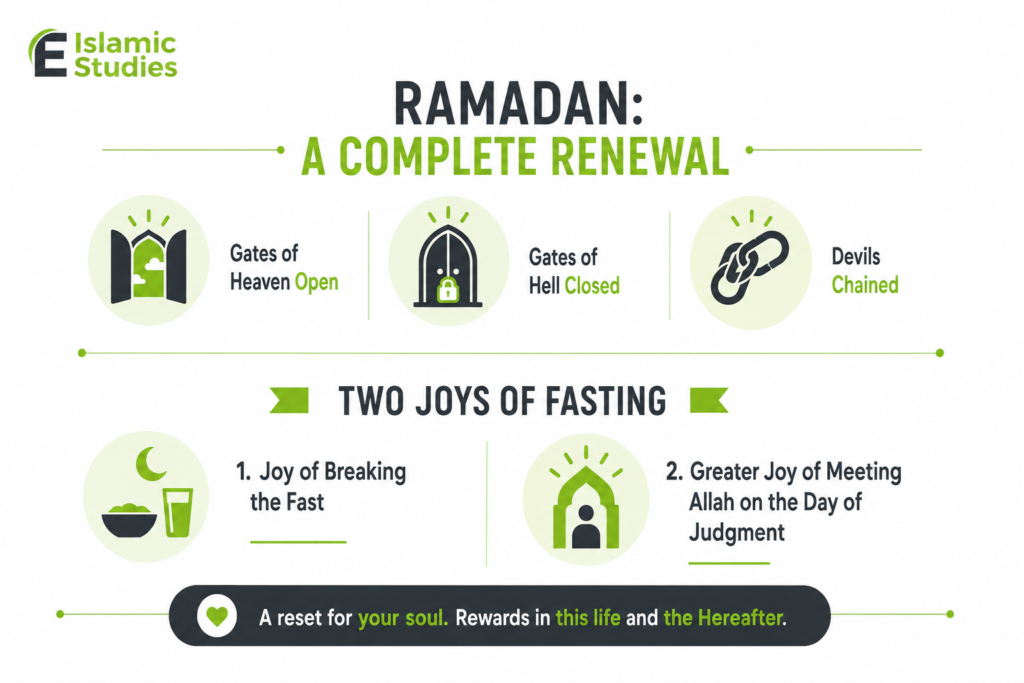
Every year, Ramadan arrives as a complete renewal opportunity for the Muslim believer. Gates of heaven are opened, gates of hell are closed, and the devils are chained — creating an environment uniquely conducive to worship, repentance, and spiritual growth.
This annual reset is one of the most comprehensive fasting benefits Islamic tradition describes, because it addresses not just individual acts of worship but the believer’s entire spiritual state.
The fasting believer experiences two distinct moments of joy that the Prophet Muhammad, peace be upon him, described explicitly: the joy at the moment of breaking the fast, and the far greater joy of meeting Allah on the Day of Judgment, pleased with the fasting they observed.
These two joys — one in this world and one in the next — frame fasting as a complete act that spans both lives and delivers rewards in both dimensions of human existence.
Watch a Sample Islamic Studies Class
See how our teachers explain Islamic concepts in an engaging and easy-to-understand way, helping students build knowledge and confidence.
E Islamic Studies Academy Gives You Real Islamic Education
Thousands of Muslims worldwide want to deepen their knowledge of Islam but struggle to find qualified scholars, flexible schedules, and structured programs that fit their lives. E Islamic Studies Academy was built to solve exactly this problem.
The academy offers one-on-one live sessions with qualified Islamic scholars who are grounded in classical sciences including Aqeedah, Fiqh, Sarf, Nahw, and Tafseer. Students progress through structured levels from complete beginner foundations all the way to advanced traditional Alim-level scholarship.
Dedicated programs exist for women, new converts, children, adult learners, and sisters who prefer female-led instruction. Flexible scheduling covers all global time zones, and a free trial class is available before any commitment.
The benefits of fasting in Islam are comprehensive — they purify the soul, discipline the body, build empathy, strengthen communities, and open exclusive gates of Paradise. Sawm is far more than hunger; it is a complete act of worship that transforms the believer in this world and the next. Begin your fasting journey with knowledge and intention.
Frequently Asked Questions
What are the main benefits of fasting in Islam?
The benefits of fasting in Islam include spiritual purification, taqwa development, physical health improvements, unlimited divine reward, and exclusive entry through the gate of Ar-Raiyan in Paradise.
What are the spiritual benefits of fasting in Islam specifically?
The spiritual benefits of fasting in Islam include closeness to Allah, cultivation of taqwa, protection from sin, expiation of past sins, and earning a reward that Allah Himself reserves without limit.
Do fasting benefits in Islam apply outside Ramadan?
Yes. Fasting benefits Islamic believers year-round through Sunnah fasts observed on Mondays, Thursdays, the White Days, the Day of Arafah, Ashura, and the six days of Shawwal.
What happens if a Muslim fasts but commits sins throughout the day?
The Prophet warned that a person who does not abandon lying and evil actions while fasting gains nothing from their fast except hunger and thirst. A complete fast requires guarding all limbs from sin.
Is there a difference between fasting in Ramadan and voluntary fasting?
Yes. Ramadan fasting is fard — obligatory for every capable Muslim. Voluntary fasting is Sunnah and earns additional rewards, but missing it carries no sin. Both share the same core spiritual benefits.
What does Islam say about the physical benefits of fasting?
Research confirms that Islamic fasting reduces inflammation, lowers cholesterol, improves heart health, regulates blood sugar, and supports sustainable weight management — all as natural outcomes of the fasting process.
 Learning Islam









Leave a Reply