 Learn Arabic

Millions of Muslims perform worship every day without fully understanding what makes it accepted by Allah. The answer lies almost entirely in niyyah. Niyyah in Islam is not a ritual phrase spoken before prayer — it is the internal orientation of the heart that determines whether an act is worship or mere habit, whether it earns reward or falls hollow before Allah.
This guide covers the complete meaning of niyyah, its two types in Islamic scholarship, its importance in prayer, how to make it correctly, and the consequences of corrupting it. Every Muslim who wants their worship to truly count before Allah must understand this subject.
1- What Niyyah Means in Arabic and Islamic Law
The word niyyah comes from the Arabic root meaning intention, purpose, or aim. In its linguistic sense, it refers to the conscious direction of the will toward a specific goal.
In Islamic law, niyyah carries a more precise meaning: the deliberate determination of the heart to perform a specific act of worship, directed purely toward Allah, distinguishing that act from all other purposes.
Niyyah is not a spoken phrase and not a ritual formula. It lives entirely in the heart — where no human eye can reach — which is precisely why scholars describe it as one of the most sincere acts a Muslim can perform.
This invisibility is also what makes niyyah so theologically significant: since only Allah sees it, an act performed with a sincere niyyah is by definition one that cannot be faked for human consumption.
Allah establishes the centrality of sincere intention in the Quran directly:
“وَمَا أُمِرُوا إِلَّا لِيَعْبُدُوا اللَّهَ مُخْلِصِينَ لَهُ الدِّينَ “
Wa ma umiru illa liya’budu Allaha mukhlisina lahu al-din.
“And they were not commanded except to worship Allah, [being] sincere to Him in religion.”
Many Muslims want to understand foundational Islamic concepts like niyyah with real scholarly depth. At E Islamic Studies Academy, the Essential Islamic Courses cover Aqeedah and Fiqh foundations — including the correct understanding of intention — through one-on-one sessions with qualified scholars.
Read also: Adhan Words Meaning: Complete Arabic and English Guide

Learn your religion from its foundations today.
2- The Hadith That Made Niyyah the Foundation of Islam
The importance of niyyah in Islam is established by the single most foundational hadith in the entire tradition of Islamic scholarship. Imam Al-Bukhari opened Sahih Al-Bukhari — the most authentic book after the Quran — with this hadith, placing it as the preface before everything else.
Imam Al-Shafi’i stated that it comprises one-third of all Islamic knowledge. Imam Ahmad identified it as one of the three hadiths upon which the entire religion rests:
“إِنَّمَا الأَعْمَالُ بِالنِّيَّاتِ، وَإِنَّمَا لِكُلِّ امْرِئٍ مَا نَوَى، فَمَنْ كَانَتْ هِجْرَتُهُ إِلَى دُنْيَا يُصِيبُهَا أَوْ إِلَى امْرَأَةٍ يَنْكِحُهَا فَهِجْرَتُهُ إِلَى مَا هَاجَرَ إِلَيْهِ”
“The reward of deeds depends upon the intentions and every person will get the reward according to what he has intended. So whoever emigrated for worldly benefits or for a woman to marry, his emigration was for what he emigrated for.”
This hadith was narrated by Umar ibn Al-Khattab, may Allah be pleased with him — the second Caliph and one of the most influential companions of the Prophet. The story behind it is reported by scholars: a man migrated from Makkah to Madinah not for the sake of Islam but to marry a woman named Umm Qays.
The Prophet established through this real-life example a universal principle — that the same outward action carries entirely different weight before Allah depending solely on what the heart intended.
Read also: Voluntary Fasting Days in Islam You Should Know
3- The Two Types of Niyyah Every Muslim Must Know
Classical Islamic scholarship divides niyyah into two distinct categories, each serving a different function. Understanding both is essential for every Muslim who wants to know how their intentions affect the validity and reward of their deeds.
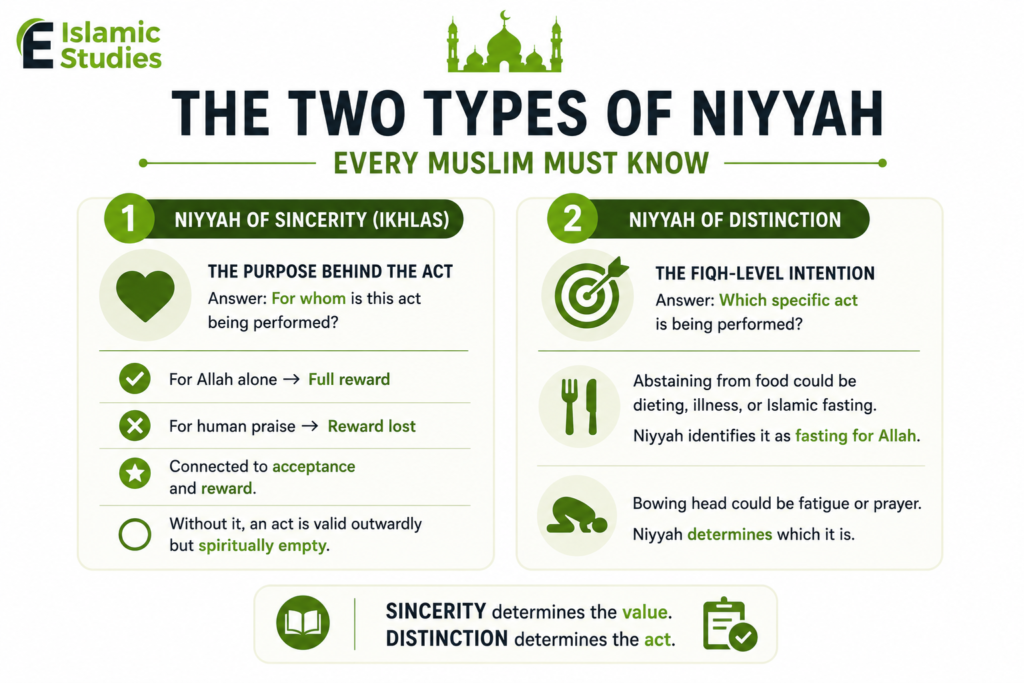
The first type is the niyyah of sincerity, known as ikhlas, which refers to the purpose behind an act. This answers: for whom is this act being performed? An act performed purely for Allah carries full reward. An act performed for human praise is corrupted at the level of sincerity. This type is connected to acceptance and reward — an act without it may be outwardly valid but spiritually empty.
The second type is the niyyah of distinction, which is the Fiqh-level intention that differentiates one act of worship from another and separates worship from mere habit. This answers: which specific act is being performed? Abstaining from food could be dieting, illness, or Islamic fasting.
The niyyah of distinction identifies the act as fasting for Allah. A person bowing their head could be doing so out of fatigue or in prayer — the niyyah of distinction determines which it is. The following table clarifies how these two types differ:
| Type | Question It Answers | Connected To | Effect If Missing |
| Niyyah of Sincerity (Ikhlas) | For whom is this act performed? | Acceptance and reward | Act is valid but earns no reward |
| Niyyah of Distinction (Fiqh) | Which specific act is this? | Validity of worship | Act may not count as the intended worship |
Read also: Top 10 Rules of Fasting in Islam Every Muslim Must Know
See Our Islamic Studies Classes in Action
Take a look at a sample lesson and see how our interactive online classes help students learn Islamic Studies in a clear, engaging, and supportive environment.
Deepen Your Islamic Knowledge
Join our comprehensive online courses and learn from qualified scholars today.
Book Your Free Trial4- The Importance of Niyyah in Prayer
The importance of niyyah in prayer is more precisely defined in Islamic jurisprudence than in any other act of worship. Scholars across all four schools — Hanafi, Maliki, Shafi’i, and Hanbali — agree that prayer without a valid niyyah is entirely invalid. The physical motions of standing, bowing, and prostrating without the heart’s conscious alignment with the intention of prayer produce no prayer at all in the sight of Allah.
The niyyah for prayer requires at minimum that the heart is aware of which specific prayer is being performed, that it is obligatory, and that it is being done for Allah. The niyyah must coincide with the opening takbeer — Allahu Akbar. A niyyah formed significantly before or after the opening does not fulfill the condition according to the majority of scholars.
The Prophet Muhammad, peace be upon him, established the inseparable connection between the heart and the validity of worship:
“«إِنَّ اللَّهَ لَا يَنْظُرُ إِلَى صُوَرِكُمْ وَلَا إِلَى أَجْسَادِكُمْ، وَلَكِنْ يَنْظُرُ إِلَى قُلُوبِكُمْ وَأَعْمَالِكُمْ»”
“Allah does not look at your appearances or your bodies, but He looks at your hearts and your deeds.”
At E Islamic Studies Academy, the Islamic Classes for Adults teach the complete practical Fiqh of prayer — including the correct niyyah for each prayer — through structured scholar-led sessions.
Read also: What Is Bid’ah in Islam? Definition, Types, and Evidence

Pray with correctness and confidence today.
5- How to Make Niyyah for Prayer Correctly
The question of how to make niyyah for prayer is among the most commonly asked — and the answer from classical scholarship is far simpler than most people expect. Niyyah requires no spoken formula, no specific Arabic words, and no verbal announcement. It is entirely and sufficiently an act of the heart.
The correct method for making niyyah follows these principles agreed upon across all major schools:
- The niyyah is formed in the heart only. It does not need to be spoken aloud, whispered, or repeated.
- It must specify which prayer is being performed. Before Fajr, the heart knows this is the Fajr prayer. This awareness is the complete niyyah.
- It must be present at the moment of saying Allahu Akbar to begin the prayer.
- Speaking the niyyah aloud is permitted by some scholars as a focusing aid but is not a condition, not a requirement, and not an established Sunnah from the Prophet himself.
- Enumerating every detail of the prayer is not required. Knowing one is performing the obligatory Dhuhr prayer for Allah is entirely complete.
The simplicity of correct niyyah reflects a fundamental Islamic principle: Allah looks at the heart, not at elaborate external formulas. The same principle applies to fasting — the Prophet established that the niyyah for Ramadan fasting must be formed before Fajr each night, either by waking for suhoor with the intention of fasting or by consciously making the intention before sleeping.
Read also: What Is Istihsan in Islam? Definition, Types, and Evidence
6- Niyyah Transforms Ordinary Actions into Worship
One of the most practically transformative aspects of niyyah in Islam is its power to elevate routine daily actions to the level of worship. A Muslim who performs any permissible action with the conscious intention of pleasing Allah earns genuine divine reward for that action — even if it looks identical to what anyone else might do.
The Prophet Muhammad, peace be upon him, confirmed this principle:
“إِنَّكَ لَنْ تُنْفِقَ نَفَقَةً تَبْتَغِي بِهَا وَجْهَ اللَّهِ إِلَّا أُجِرْتَ عَلَيْهَا حَتَّى مَا تَجْعَلُ فِي فَمِ امْرَأَتِكَ”
“You will be rewarded for whatever you spend for Allah’s sake even if it were a morsel which you put in your wife’s mouth.”
This means a Muslim who eats to maintain health for worship, works to provide for family as an Islamic obligation, or rests to regain energy for prayer — all earn reward through niyyah. The action itself does not change. What changes entirely is its value before Allah. Allah confirms in the Quran:
“قُلْ إِنَّ صَلَاتِي وَنُسُكِي وَمَحْيَايَ وَمَمَاتِي لِلَّهِ رَبِّ الْعَالَمِينَ”
Qul inna salati wa nusuki wa mahyaya wa mamati lillahi Rabb il-‘alamin.
“Say, “Indeed, my prayer, my rites of sacrifice, my living and my dying are for Allah, Lord of the worlds.”
Read also: What Is Ijma in Islam? Definition, Types, and Evidence
7- Riya — The Corruption That Destroys Niyyah
The most dangerous threat to niyyah in Islam is riya — performing acts of worship with the intention of gaining praise or recognition from people rather than seeking Allah’s pleasure. Scholars describe riya as a form of minor shirk, and the consequences it carries are among the most severe described in any hadith.
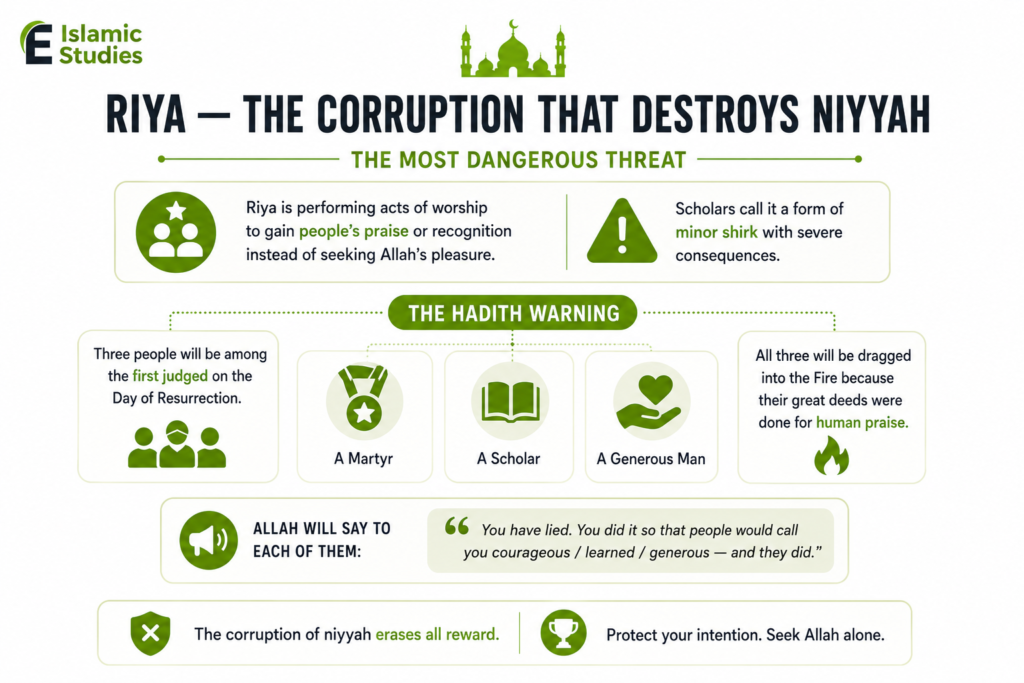
The Prophet narrated that three people will be among the first judged on the Day of Resurrection — a martyr, a scholar, and a generous man — all dragged into the Fire because their magnificent deeds were performed for human praise. Allah will say to each of them: “You have lied. You did it so that people would call you courageous / learned / generous — and they did.” The corruption of niyyah erased their reward entirely, as recorded in Sahih Muslim.
The Prophet also established through a sacred hadith:
“أَنَا أَغْنَى الشُّرَكَاءِ عَنِ الشِّرْكِ مَنْ عَمِلَ عَمَلاً أَشْرَكَ فِيهِ مَعِي غَيْرِي تَرَكْتُهُ وَشِرْكَهُ
I am the One, One Who does not stand in need of a partner. If anyone does anything in which he associates anyone else with Me, I shall abandon him with one whom he associates with Allah.
If riya enters an act midway, scholars differ. Imam Ahmad and Ibn Jarir Al-Tabari hold that if the original intention was sincere and the riya was fleeting and repelled, the act is not invalidated. If riya persists without being repelled, the reward is diminished or nullified depending on the scholarly position.
At E Islamic Studies Academy, the Tazkiyya Course teaches students how to purify the heart from diseases like riya and build sincere niyyah across all acts of worship.

Purify your intentions and your worship today.
8- What Happens When Niyyah Is Incomplete or Mixed
Islamic scholarship addresses many real-world situations where a Muslim’s niyyah is incomplete, mixed, or unclear. The following table outlines the most common situations and their ruling:
| Situation | Ruling |
| Act performed purely for Allah | Full reward and acceptance |
| Act performed purely for human praise (riya) | No reward, may carry punishment |
| Act begun sincerely with riya entering briefly and repelled | Valid and rewarded |
| Act performed for Allah with a secondary worldly benefit | Valid but reward is diminished |
| Act performed with no niyyah of distinction | Invalid — does not count as the intended worship |
| Good deed intended but prevented by genuine inability | Full reward written as if completed |
| Bad deed intended but not carried out | No sin written |
The last two points reflect one of the most remarkable aspects of the Islamic niyyah system. The Prophet confirmed: “Whoever intends to do a good deed but does not do it, Allah writes it for him as a complete good deed.” This divine mercy rewards the orientation of the sincere heart even when circumstances prevent action.
Read also: What Is Kafir in Islam? Definition and Complete Guide
Watch a Sample Islamic Studies Class
See how our teachers explain Islamic concepts in an engaging and easy-to-understand way, helping students build knowledge and confidence.
Deepen Your Islamic Knowledge
Join our comprehensive online courses and learn from qualified scholars today.
Book Your Free TrialE Islamic Studies Academy Brings You Qualified Islamic Knowledge
Thousands of Muslims worldwide want to understand Islam at the level of real scholarship — not surface-level answers, but the depth that transforms how they worship and live. E Islamic Studies Academy provides one-on-one live sessions with qualified scholars grounded in classical Islamic sciences including Aqeedah, Fiqh, Sarf, Nahw, and Tafseer. Programs are structured from complete beginner foundations through to advanced traditional Alim-level scholarship.
Dedicated courses exist for women, new converts, children, adult learners, and sisters seeking female-led instruction. All global time zones are covered, and a free trial class is available before any commitment.
Our Islamic Courses
- Islam Classes for Adults
- Islam Classes for Sisters
- Alimah Course for Ladies
- Islam Classes for Kids
- Learn Islam for Beginners
- Learning Islam for New Converts
Our Islamic Programs
- Islamic Distance Learning Programs
- Islamic Courses Workshops
- Intensive Islamic Course
- Islam Crash Course
- Learning Islam Level 1 Online
- Darse Nizami / Traditional Alim Courses
Register at E Islamic Studies Academy today.
Deepen Your Islamic Knowledge
Join our comprehensive online courses and learn from qualified scholars today.
Book Your Free TrialConclusion
Niyyah in Islam is the heart of every act of worship. It determines whether deeds are accepted, rewarded, or void before Allah. Understanding its two types, its role in prayer, how to make it correctly, and how to protect it from riya is not optional — it is the foundation upon which every act of worship either stands or falls. Correct your niyyah, and every prayer, fast, and good deed carries the weight it deserves before Allah.
Frequently Asked Questions
What is niyyah in Islam?
Niyyah in Islam is the conscious inner intention of the heart that determines the purpose, validity, and reward of every act of worship. It lives in the heart and does not need to be spoken aloud.
Why is the importance of niyyah in prayer so emphasized?
Without a valid niyyah, prayer is entirely invalid regardless of how perfectly the physical movements are performed. Imam Al-Bukhari placed the niyyah hadith first in his entire collection to establish this primacy.
How to make niyyah for prayer intention in Islam?
The heart must be consciously aware of which prayer is being performed and that it is for Allah. This awareness at the moment of saying Allahu Akbar is a complete and valid niyyah — no spoken words are required.
Can daily actions become worship through niyyah?
Yes. Any permissible action performed with the sincere intention of pleasing Allah becomes an act of worship that earns divine reward, including eating, working, and resting.
What is riya and how does it affect niyyah?
Riya is performing worship to be seen and praised by people rather than for Allah. It is a form of minor shirk that can erase the reward of even the greatest deeds entirely, as established in Sahih Muslim.
Related Articles
Learn Arabic








Leave a Reply