What Is Bid’ah in Islam? Definition, Types, and Evidence
Few topics in Islamic jurisprudence generate more disagreement than bid’ah. The word is used constantly — and misused just as constantly. The bid’ah definition determines whether a Muslim’s act of worship is rejected or accepted, and whether scholars of different schools fundamentally disagree or simply use terms differently.
This guide covers the complete bid’ah definition from both scholarly positions, the hadiths on innovation, the five-category division, and where scholars genuinely agree and disagree — based on Dar al-Ifta al-Misriyyah, the official website of Sheikh Ibn Baz, and verified Sunni sources.
Bid’ah in Islam Has Two Distinct Meanings — Linguistic and Legal
Linguistically, bid’ah means everything introduced without a prior example. Arabic uses it broadly — the Quran applies it to Allah: “Badi’u al-samawati wal-ard” — the Originator of the heavens and earth. This linguistic meaning carries no judgment of prohibition whatsoever.
In Islamic legal terminology, the bid’ah definition becomes more specific and restricted. Sheikh Ibn Baz defined it as: “Every act of worship introduced by people that has no basis in the Book, the Sunnah, or the practice of the four Rightly Guided Caliphs.”
This legal definition restricts bid’ah to the religious domain — acts of worship specifically. Ibn Baz explicitly stated that bid’ah in the Sharia sense does not apply to worldly transactions. A transaction that conforms to the Sharia is a valid contract. A transaction that contradicts it is a void contract. Neither is called bid’ah in the Sharia sense — because they are not acts of worship.
The Prophet Muhammad, peace be upon him, established the foundational principle:
At E Islamic Studies Academy, the Essential Islamic Courses teach students the foundational knowledge of Fiqh and Aqeedah — including the correct understanding of bid’ah and its boundaries.
The Every Innovation Is Misguidance Hadith — Its Full Text and Meaning
The most cited hadith on bid’ah is from the hadith of al-‘Irbad ibn Sariyah, in which the Prophet, peace be upon him, said:
“«فَعَلَيْكُمْ بِسُنَّتِي وَسُنَّةِ الْخُلَفَاءِ الرَّاشِدِينَ الْمَهْدِيِّينَ مِنْ بَعْدِي، تَمَسَّكُوا بِهَا وَعَضُّوا عَلَيْهَا بِالنَّوَاجِذِ، وَإِيَّاكُمْ وَمُحْدَثَاتِ الْأُمُورِ! فَإِنَّ كُلَّ مُحْدَثَةٍ بِدْعَةٌ، وَكُلَّ بِدْعَةٍ ضَلَالَةٌ»” Fa’alaykum bi-sunnati wa sunnati al-khulafa’ al-rashidina al-mahdiyyina min ba’di, tamas-saku biha wa ‘addu ‘alayha bil-nawajidh, wa iyyakum wa muhdathati al-umur! Fa-inna kulla muhdathatin bid’atun, wa kulla bid’atin dalalah. “You must follow my Sunnah and the Sunnah of the Rightly Guided Caliphs after me. Hold fast to it and bite onto it with your molars. Beware of newly introduced matters — for every newly introduced matter is a bid’ah, and every bid’ah is misguidance.” [Musnad Ahmad / Abu Dawud / Al-Tirmidhi / Ibn Majah — Sahih]
Man sanna fil-Islami sunnatan hasanatan falahu ajruha wa ajru man ‘amila biha… wa man sanna fil-Islami sunnatan sayyi’atan kana ‘alayhi wizruha wa wizru man ‘amila biha. “Whoever introduces a good practice in Islam will have its reward and the reward of those who act upon it… Whoever introduces a bad practice in Islam will bear its burden and the burden of those who act upon it.”
Take a look at a sample lesson and see how our interactive online classes help students learn Islamic Studies in a clear, engaging, and supportive environment.
Deepen Your Islamic Knowledge
Join our comprehensive online courses and learn from qualified scholars today.
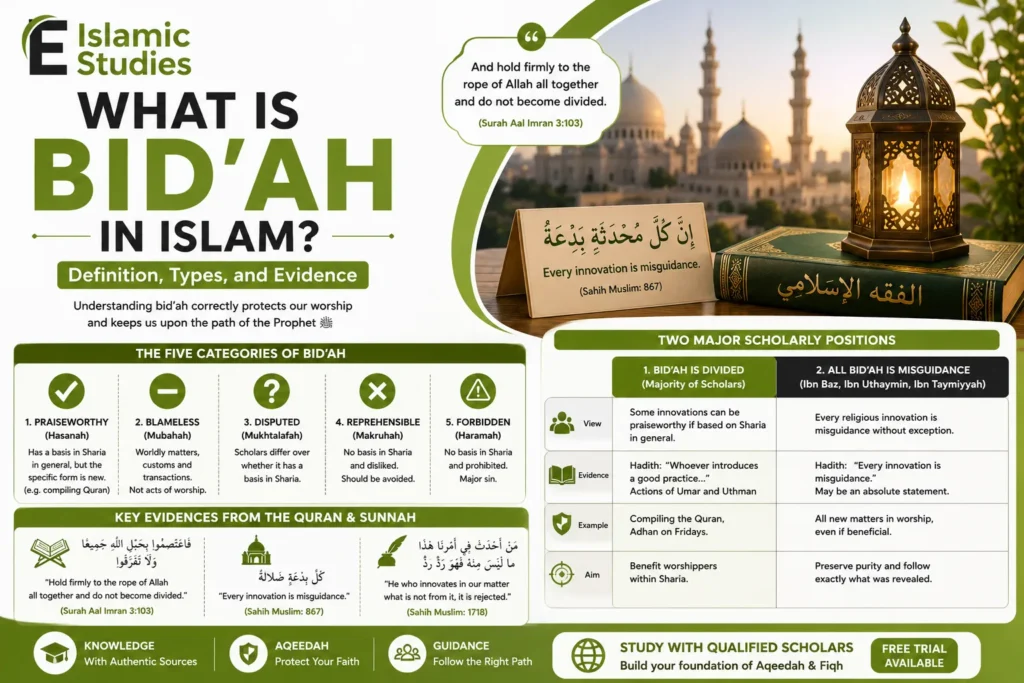
Two Major Scholarly Positions on the Bid’ah Definition
The scholars divide into two main positions — and understanding both precisely is essential:
Aspect
Position One — Division of Bid’ah
Position Two — All Bid’ah Is Misguidance
Main scholars
Imam Al-Shafi’i, Al-‘Izz ibn Abd al-Salam, Al-Nawawi, Dr. Ali Jum’a
Ibn Baz, Ibn ‘Uthaymin, Ibn Taymiyya
Their claim
Bid’ah divides into praiseworthy and blameworthy
Every religious innovation is misguidance without exception
Evidence
“Whoever introduces a good practice” hadith, actions of Umar and Uthman
“Every innovation is misguidance” — kullu means without exception
How they explain Umar’s tarawih
A praiseworthy bid’ah — he called it that himself: “What a good bid’ah this is”
Not bid’ah — its origin is established in the Sunnah
Point of agreement
Both agree that bid’ah contradicting Sharia principles is rejected
Both agree worldly matters are not bid’ah in the Sharia sense
Dar al-Ifta al-Misriyyah — Dr. Ali Jum’a — explained: “The meaning of ‘every innovation is misguidance’ is what came against the established principles of the Sharia and contradicted the correct methodology of Islam — not every newly introduced matter whatsoever.”
Ibn Baz stated the opposite position: “Every introduced matter in religion is bid’ah and every bid’ah is misguidance — this is a general ruling that admits no exception in religious matters.”
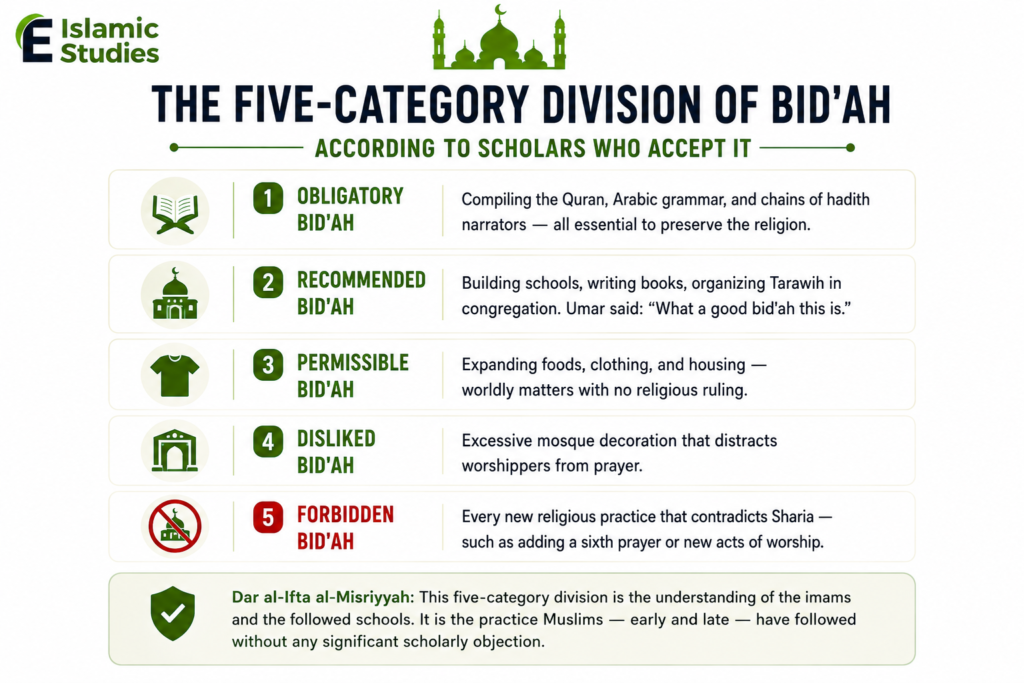
The Five-Category Division of Bid’ah According to Scholars Who Accept It
Scholars who accept praiseworthy bid’ah — including Imam Al-Shafi’i, Al-‘Izz ibn Abd al-Salam, and Al-Nawawi — apply the five Sharia rulings to it:
Obligatory Bid’ah
Compiling the Quran into a single volume, developing the science of Arabic grammar to protect the Quran from linguistic corruption, and establishing the chains of hadith narrators. None of these had a specific prior example — yet all are obligatory to preserve the religion.
Recommended Bid’ah
Building schools of Islamic learning, writing books of Islamic scholarship, and establishing organized Tarawih in congregation. Umar ibn Al-Khattab gathered the people for Tarawih in congregation and called it: “What a good bid’ah this is.”
Permissible Bid’ah
Expanding the variety of foods, clothing, and housing beyond what existed in the early period — these are worldly matters that carry no religious ruling of prohibition.
Disliked Bid’ah
Decorating mosques excessively in a way that distracts worshippers from their prayer without reaching prohibition.
Forbidden Bid’ah
Every newly introduced religious practice that contradicts an established Sharia principle — such as adding a sixth obligatory prayer, innovating new pillars of worship not established by the Prophet, or practices rooted in non-Islamic beliefs.
Dar al-Ifta al-Misriyyah confirmed: this five-category division is the understanding of the imams and the followed schools of jurisprudence. It is the practice that Muslims — early and late — operated upon without any significant scholarly objection.
The Actions of the Companions Prove That Not Every New Matter Is Rejected
The strongest historical evidence for praiseworthy bid’ah comes from the companions themselves — the generation the Prophet described as the best of all generations.
Uthman ibn Affan, may Allah be pleased with him, introduced the second adhan on Friday — the first adhan before the khutbah — to alert the people of Madinah when the city had expanded. This was a new adhan with no direct prior example in the time of the Prophet. Yet no companion objected, and it became standard practice.
Umar ibn Al-Khattab, may Allah be pleased with him, gathered the people for tarawih prayer in congregation — twenty rak’ahs — and explicitly called it a good bid’ah. The Prophet had prayed tarawih in congregation for a few nights and then stopped, fearing it would become obligatory. After the Prophet’s death, that fear no longer applied — so Umar revived congregation without the fear that had caused its discontinuation.
These two examples — both accepted by the companions without objection — form the core argument of those who accept praiseworthy bid’ah.
At E Islamic Studies Academy, the Islamic History Course provides students with the full historical context of the companion era — including how Islamic practice developed after the Prophet’s death under the Rightly Guided Caliphs.
Bid’ah Is Restricted to Acts of Worship — Not Worldly Matters
Both scholarly positions agree on this point: bid’ah in the Sharia sense applies only to acts of worship — not to worldly transactions, customs, and daily life.
Ibn Baz stated this explicitly: “Bid’ah in the Sharia is restricted to religious matters. As for worldly transactions — a transaction that conforms to the Sharia is a valid contract, and one that contradicts it is a void contract. Neither is called bid’ah in the Sharia sense.”
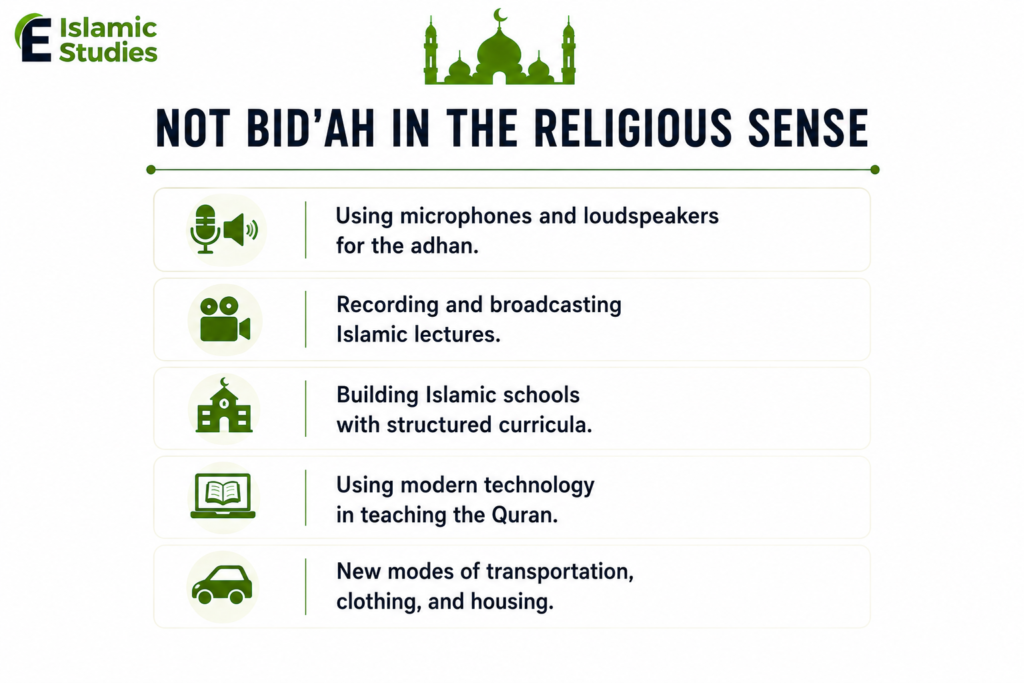
This means the following are not bid’ah in the religious sense:
Using microphones and loudspeakers for the adhan.
Recording and broadcasting Islamic lectures.
Building Islamic schools with structured curricula.
Using modern technology in teaching the Quran.
New modes of transportation, clothing, and housing.
All of these fall under worldly matters — and the default ruling for worldly matters is permissibility unless a specific Sharia text prohibits them.
At E Islamic Studies Academy, the Online Tafseer Course helps students understand the Quranic foundations behind Islamic legal concepts — including how scholars derive the principle that the default in worldly matters is permissibility.
E Islamic Studies Academy Brings You Authentic Islamic Knowledge
Thousands of Muslims worldwide want to understand Islamic jurisprudence — including complex concepts like bid’ah — at the level of real classical scholarship grounded in Sunni methodology. E Islamic Studies Academy provides one-on-one live sessions with qualified scholars trained in classical Islamic sciences including Aqeedah, Fiqh, Sarf, Nahw, and Tafseer. Programs run from complete beginner foundations through traditional Alim-level scholarship. Dedicated courses exist for women, new converts, children, adult learners, and sisters seeking female-led instruction. All global time zones are covered and a free trial class is available before any commitment.
The bid’ah definition is one of the most debated concepts in Islamic jurisprudence — yet the real disagreement between scholars is narrower than it appears. Both positions agree that religious innovations contradicting Sharia principles are rejected. Both agree that worldly new matters are not bid’ah in the religious sense. The dispute centers on whether new religious matters rooted in established Sharia principles constitute praiseworthy bid’ah or simply represent the Sunnah applied to new circumstances. Understanding both positions correctly protects Muslims from both excessive permissiveness and excessive restriction.
Frequently Asked Questions
What is bid’ah in Islam?
Bid’ah in Islam is every newly introduced act of worship that has no basis in the Quran, Sunnah, or the practice of the four Rightly Guided Caliphs — as defined by the majority of classical scholars.
What does the every innovation is misguidance hadith mean?
The every innovation is misguidance hadith refers to innovations that contradict established Sharia principles. Scholars who accept praiseworthy bid’ah say it does not cover every newly introduced matter — only what contradicts Islamic methodology.
What is the bid’ah definition according to Ibn Baz?
The bid’ah definition according to Ibn Baz is: every act of worship introduced by people with no basis in the Book, the Sunnah, or the practice of the four Rightly Guided Caliphs. He held that every such innovation is misguidance without exception.
Is bid’ah restricted to acts of worship?
Yes. Both scholarly positions agree that bid’ah in the Sharia sense applies only to acts of worship — not to worldly matters, transactions, or customs. New worldly matters are not called bid’ah in the religious sense.
What are the five types of bid’ah according to scholars who accept its division?
Scholars who accept the division classify bid’ah as obligatory, recommended, permissible, disliked, or forbidden — applying the five Sharia rulings to newly introduced matters based on their relationship to established Islamic principles.
 Learning Islam











Leave a Reply