 Learning Islam
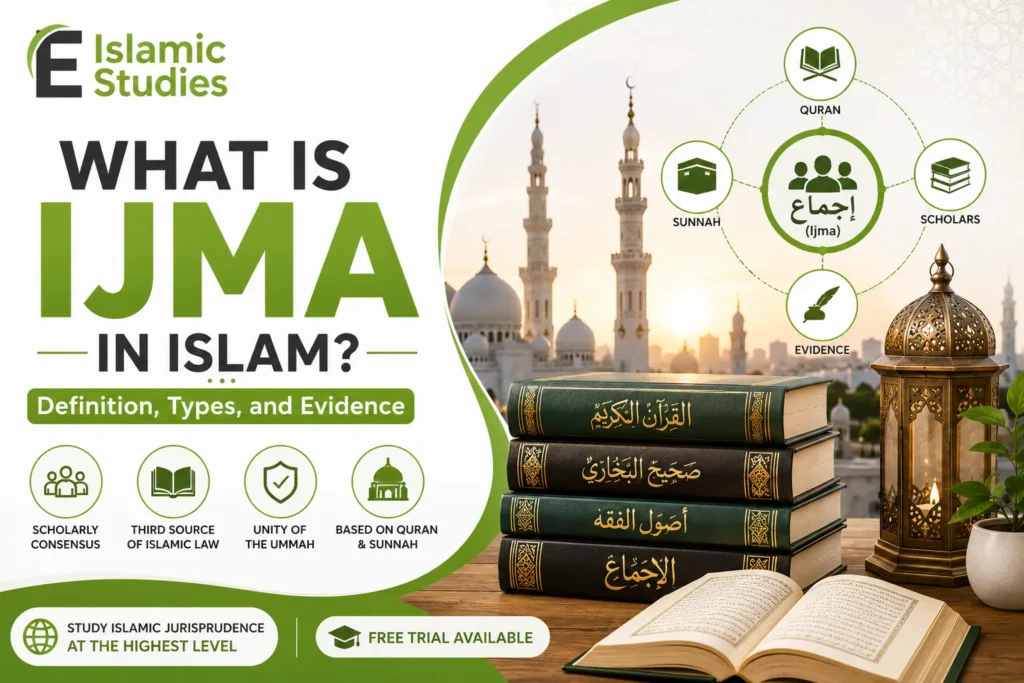
When scholars across the Muslim world agree on a ruling, that agreement carries a weight unlike any individual scholarly opinion. Ijma in Islam is the formal scholarly consensus that serves as the third source of Islamic law — coming after the Quran and Sunnah in authority and binding every Muslim who learns of it.
This guide covers the complete ijma definition, its linguistic and legal meanings, the Quranic and prophetic evidence for its authority, its two types, its conditions, and the ongoing scholarly debate about its application. All content is drawn exclusively from verified Sunni sources including IslamQA, Islamweb, the Egyptian Ministry of Awqaf, and Arabic Wikipedia’s Fiqh entries.
Ijma in Islam: Linguistic and Legal Definition
The word ijma carries two meanings in Arabic. The first is determination and resolve — as in the Quranic statement where Allah quotes the people of Nuh: “So resolve upon your plan” — meaning, firm up your intention.
The second meaning is agreement and concurrence — as when people are said to have “reached ijma” on a matter, meaning they agreed upon it. Both meanings derive from the Arabic root for “gathering,” since determination involves gathering one’s thoughts and agreement involves gathering people’s views.
In Islamic legal terminology, the ijma definition established by the classical scholars and adopted by the majority is: the agreement of the mujtahids of the Muslim community, after the death of the Prophet Muhammad, peace be upon him, in any era, on any Sharia ruling.
This definition contains several precise exclusions that scholars have carefully explained:
- The word “agreement” excludes any matter where even a single qualified scholar dissents — one dissenting mujtahid prevents the formation of binding ijma.
- The word “mujtahids” excludes the general public and non-scholars — their agreement or disagreement carries no weight in establishing ijma.
- The phrase “Muslim community” excludes the consensus of non-Muslim scholars or scholars of other religions.
- The phrase “after the death of the Prophet” excludes agreements made during his lifetime, since those derived their authority from the Sunnah itself — not from ijma.
- The phrase “on a Sharia ruling” excludes agreement on purely rational, customary, or linguistic matters from the technical category of ijma as a legal source.
At E Islamic Studies Academy, the Traditional Alim Courses guide advanced students through the complete discipline of usul al-fiqh — including ijma, its definition, conditions, and application across all chapters of Islamic law.
Read also: What Is Qiyas in Islam?

Study Islamic jurisprudence at the highest level today.
The Quranic and Prophetic Evidence for Ijma Islamic Jurisprudence
Ijma in Islam is not a later scholarly invention — it has direct support from the Quran and the authenticated Sunnah. Scholars across all four Sunni schools have cited multiple evidences for its authority.
The most frequently cited Quranic evidence is:
“وَمَن يُشَاقِقِ الرَّسُولَ مِن بَعْدِ مَا تَبَيَّنَ لَهُ الْهُدَىٰ وَيَتَّبِعْ غَيْرَ سَبِيلِ الْمُؤْمِنِينَ نُوَلِّهِ مَا تَوَلَّىٰ وَنُصْلِهِ جَهَنَّمَ ۖ وَسَاءَتْ مَصِيرًا
Wa man yushaqiqi al-Rasula min ba’di ma tabayyana lahu al-huda wa yattabi’ ghayra sabili al-mu’minina nuwallih ma tawalla wa nuslih Jahannam wa sa’at masira.
“And whoever opposes the Messenger after guidance has become clear to him and follows other than the way of the believers – We will give him what he has taken and drive him into Hell, and evil it is as a destination.”
Imam Al-Shafi’i was the first to use this verse as evidence for ijma, and scholars after him unanimously followed his reasoning. The verse makes “following other than the way of the believers” equally as condemned as opposing the Messenger — establishing that the agreed path of the believing scholars is itself an authoritative source.
Read also: What Is Ijtihad in Islam?
A second Quranic evidence:
“وَكَذَٰلِكَ جَعَلْنَاكُمْ أُمَّةً وَسَطًا لِّتَكُونُوا شُهَدَاءَ عَلَى النَّاسِ ”
Wa kadhalika ja’alnakum ummatan wasatan litakunu shuhada’a ala al-nas.
“And thus we have made you a just community that you will be witnesses over the people.”
Scholars explain that making this community witnesses over others implies that their collective testimony — their agreement — is accepted and authoritative.
From the Sunnah, the most powerful evidence for ijma in Islam is the direct prophetic guarantee:
“«إِنَّ أُمَّتِي لَنْ تَجْتَمِعَ عَلَى ضَلاَلَةٍ فَإِذَا رَأَيْتُمُ اخْتِلاَفًا فَعَلَيْكُمْ بِالسَّوَادِ الأَعْظَمِ”
“My nation will not unite on misguidance, so if you see them differing, follow the great majority.”
Scholars note that while individual hadiths on this theme may be transmitted through single chains, the shared meaning — the infallibility of the Muslim community’s collective agreement — is established through multiple channels that together reach the level of mass-transmitted knowledge.
Read also: What Is Qiyas in Islam? Definition, Pillars, and Types
The Two Types of Ijma in Islamic Jurisprudence
Ijma Islamic jurisprudence recognizes two established types, distinguished by how the scholars’ agreement is expressed:
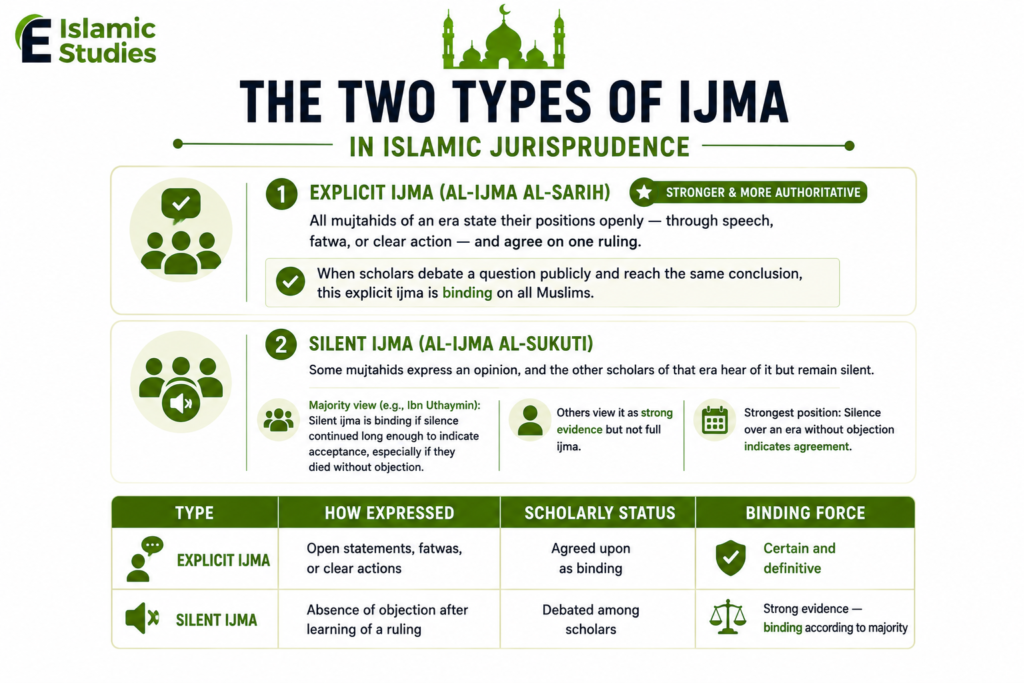
Explicit Ijma (Al-Ijma Al-Sarih):
This occurs when all mujtahids of an era state their positions openly — through speech, fatwa, or clearly observable action — and all of these positions agree on a single ruling. This is the stronger and more authoritative form of ijma. When scholars issue fatwas, debate a question publicly, and arrive at a shared conclusion, the result is explicit ijma that is binding on all Muslims.
Silent Ijma (Al-Ijma Al-Sukuti):
This occurs when some mujtahids express an opinion and the remaining scholars of that era hear of it but remain silent — neither explicitly agreeing nor explicitly objecting. Scholars differ on the weight of this type.
The majority position, including that of Sheikh Ibn Uthaymin based on sources from IslamQA, is that silent ijma can constitute binding ijma if the scholars remained silent long enough to indicate acceptance, particularly if they died without having objected.
Others consider it a strong evidence short of full ijma. The strongest position is that silence combined with the passing of an era without objection indicates agreement.
The following table summarizes the key differences:
| Type | How Expressed | Scholarly Status | Binding Force |
| Explicit Ijma | Open statements, fatwas, or clear actions | Agreed upon as binding | Certain and definitive |
| Silent Ijma | Absence of objection after learning of a ruling | Debated among scholars | Strong evidence — binding according to majority |
See Our Islamic Studies Classes in Action
Take a look at a sample lesson and see how our interactive online classes help students learn Islamic Studies in a clear, engaging, and supportive environment.
Deepen Your Islamic Knowledge
Join our comprehensive online courses and learn from qualified scholars today.
Book Your Free TrialThe Two Categories of Ijma by Certainty
Beyond the two types, classical scholars — most prominently Sheikh al-Islam Ibn Taymiyya — divided ijma in Islam into two levels based on how certain its existence can be confirmed:
Definitive Ijma (Qat’i):
This is ijma that is known with certainty because it concerns matters that are universally recognized as part of the religion by necessity — such as the obligation of the five prayers, the prohibition of adultery, and the obligation of Zakat.
No qualified scholar across any generation has disputed these, and anyone who denies them after being properly informed is judged accordingly. This category is not subject to scholarly debate.
Probable Ijma (Zanni):
This is ijma established through scholarly investigation and inference — the scholar examines the opinions of past scholars in a question and finds no recorded dissent.
Ibn Taymiyya notes that this type carries weight and can be used as evidence, but it cannot override a clearly established Quranic text or authenticated hadith, since the absence of known dissent does not guarantee that dissent did not exist.
Sheikh Ibn Uthaymin, as recorded in his Usul al-Fiqh work cited by IslamQA, adds a critical principle: the Muslim community cannot collectively agree on something that contradicts a clear, unabrogated, authentic Sharia text. If a claim of ijma appears to contradict such a text, the scholar must examine whether the text is unclear, possibly abrogated, or whether the claim of ijma itself is unverified.
The Conditions for Valid Ijma in Islam
For a scholarly consensus to constitute binding ijma in Islam, several conditions must be fulfilled. Scholars from Islamweb and the Egyptian Ministry of Awqaf sources identify these as follows:
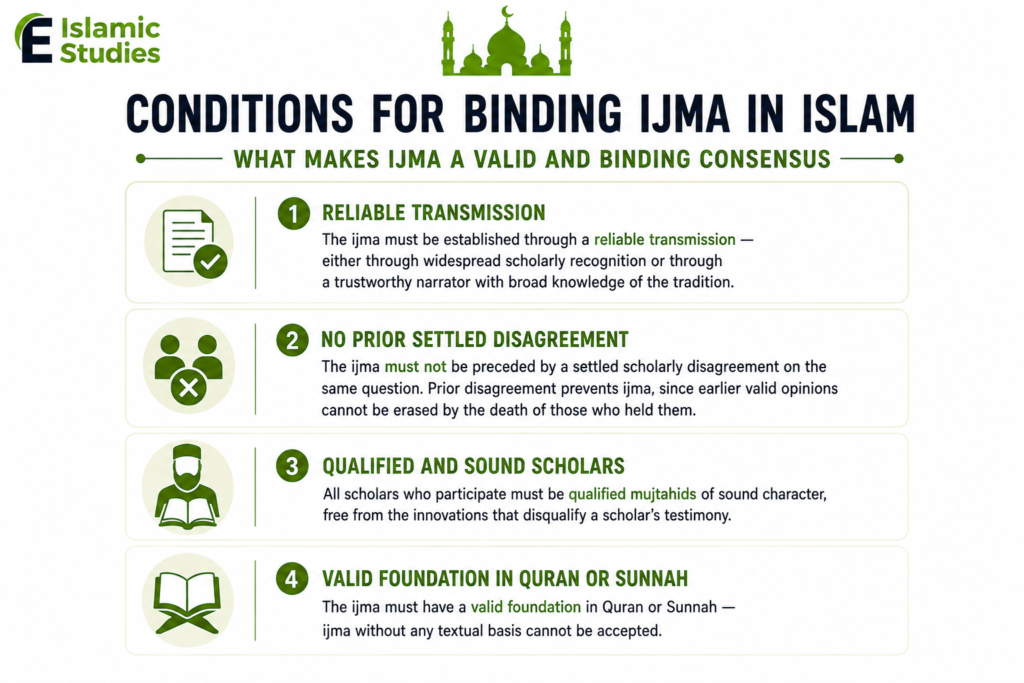
- The ijma must be established through a reliable transmission — either through widespread scholarly recognition or through a trustworthy narrator with broad knowledge of the scholarly tradition.
- The ijma must not be preceded by a settled scholarly disagreement on the same question — prior established disagreement prevents ijma from forming, since the existence of earlier valid scholarly opinions cannot be erased by the death of those who held them.
- All scholars who participate must be qualified mujtahids of sound character, free from the innovations that disqualify a scholar’s testimony.
- The ijma must have a valid foundation in Quran or Sunnah — ijma without any textual basis cannot be accepted.
The following scholars and groups are excluded from constituting ijma:
- The general public and non-scholars, regardless of how large their number.
- Scholars of a single school, city, or region — the ijma of the Maliki school, the scholars of Medina, or the scholars of Kufa alone does not constitute binding ijma for the entire community.
- Scholars of innovated sects whose innovations remove them from the mainstream Sunni community.
What Ijma Achieves — Its Juristic Function
The fundamental juristic function of ijma in Islam is to elevate a ruling from the level of probability to the level of certainty. The Egyptian Ministry of Awqaf scholars explain this precisely: texts from the Quran and Sunnah often carry probabilistic meanings — they are subject to multiple interpretations, possible abrogation, or questions about their transmission.
When the community of qualified scholars reaches ijma on how to understand and apply such a text, that agreement transforms the ruling from probabilistic to definitive.
An example cited in classical sources: the Quranic verse commanding believers to perform ablution when rising for prayer could linguistically be understood in multiple ways. The ijma of the Muslim community established that this means ablution must precede prayer — transforming a grammatically possible uncertainty into a settled, binding ruling.
Sheikh al-Islam Ibn Taymiyya explicitly criticized later scholars who reversed this order — beginning with the search for ijma before consulting the primary texts — and described this as a deviation from the method of the Prophet’s companions and righteous predecessors.
At E Islamic Studies Academy, the Online Tafseer Course helps students understand Quranic texts — including the verses that establish the authority of ijma — in their full classical scholarly context.

Understand Islamic legal sources through the Quran today.
Historical Development of Ijma in Islamic Scholarship
Ijma in Islam developed through four distinct historical periods, each with its own character:
- The era of the Companions — when the Caliphs gathered senior scholars to consult on new matters. Abu Bakr assembled them to address the Ridda wars and the compilation of the Quran. Umar convened them regarding the plague in Syria, the distribution of conquered lands, and the appointment of his successor. Their agreements became the foundational examples of scholarly consensus.
- The era of the Successors — when scholars dispersed across the Islamic world into Syria, Iraq, Egypt, and Khorasan, making comprehensive consensus harder to achieve. Attention shifted toward collecting hadiths and developing school-based jurisprudence.
- The era of the founding imams — when Imam Malik emphasized the practice of the people of Medina and Imam Abu Hanifa emphasized the scholars of Kufa, each recognizing localized ijma as a starting point for broader consensus.
- The era of the established schools — when the four major Sunni schools systematized ijma as a formal source of law, documented existing consensus in specialized works, and scholars began to be held accountable for violating established agreements.
At E Islamic Studies Academy, the Islamic History Course traces the development of Islamic jurisprudence across these historical periods, connecting the evolution of legal scholarship to the lived history of the Muslim community.

Learn the history behind Islamic scholarship today.
Watch a Sample Islamic Studies Class
See how our teachers explain Islamic concepts in an engaging and easy-to-understand way, helping students build knowledge and confidence.
Deepen Your Islamic Knowledge
Join our comprehensive online courses and learn from qualified scholars today.
Book Your Free TrialE Islamic Studies Academy Brings You Qualified Islamic Knowledge
Thousands of Muslims worldwide want to understand foundational concepts like ijma at the level of real classical scholarship. E Islamic Studies Academy provides one-on-one live sessions with qualified scholars trained in classical Islamic sciences including Aqeedah, Fiqh, Sarf, Nahw, and Tafseer.
Programs run from complete beginner foundations through traditional Alim-level scholarship. Dedicated courses exist for women, new converts, children, adult learners, and sisters seeking female-led instruction. All global time zones are covered and a free trial class is available before any commitment.
Our Islamic Courses
- Islam Classes for Adults
- Islam Classes for Sisters
- Alimah Course for Ladies
- Islam Classes for Kids
- Learn Islam for Beginners
- Learning Islam for New Converts
Our Islamic Programs
- Islamic Distance Learning Programs
- Islamic Courses Workshops
- Intensive Islamic Course
- Islam Crash Course
- Learning Islam Level 1 Online
- Darse Nizami / Traditional Alim Courses
Register at E Islamic Studies Academy today.
Deepen Your Islamic Knowledge
Join our comprehensive online courses and learn from qualified scholars today.
Book Your Free TrialConclusion
Ijma in Islam is a precisely defined, evidence-based source of Islamic law that preserves the religion across generations. Its ijma definition — the agreement of all qualified scholars of an era — distinguishes it from mere scholarly opinion, regional custom, or majority vote. Understanding ijma and its conditions is essential for every Muslim who wants to engage seriously with Islamic jurisprudence and protect their faith from unfounded claims of consensus.
Frequently Asked Questions
What is ijma in Islam?
Ijma in Islam is the agreement of all qualified mujtahid scholars of the Muslim community in any era on a Sharia ruling — serving as the third source of Islamic law after the Quran and Sunnah.
What is the ijma definition in Islamic jurisprudence?
The ijma definition is: the agreement of the mujtahids of the Muslim community, after the Prophet’s death, in any era, on any Sharia ruling — whether expressed openly or indicated by universal silence without objection.
What are the two types of ijma in Islamic jurisprudence?
Ijma Islamic jurisprudence recognizes explicit ijma — where scholars openly state their agreement — and silent ijma — where scholars learn of a ruling and remain silent without objection across an entire era.
Can ijma contradict the Quran or Sunnah?
No. The Muslim community cannot collectively agree on something that contradicts a clear, unabrogated, authentic Sharia text. Any apparent contradiction signals an error in the claim of ijma, not a flaw in the text.
Is ijma still possible today?
Definitive ijma on matters known by necessity — such as the five prayers and prohibition of major sins — remains valid and binding. Ijma on more specific legal questions is possible but difficult to establish, requiring scholarly investigation across all qualified mujtahids of the era.






Leave a Reply