 Learning Islam
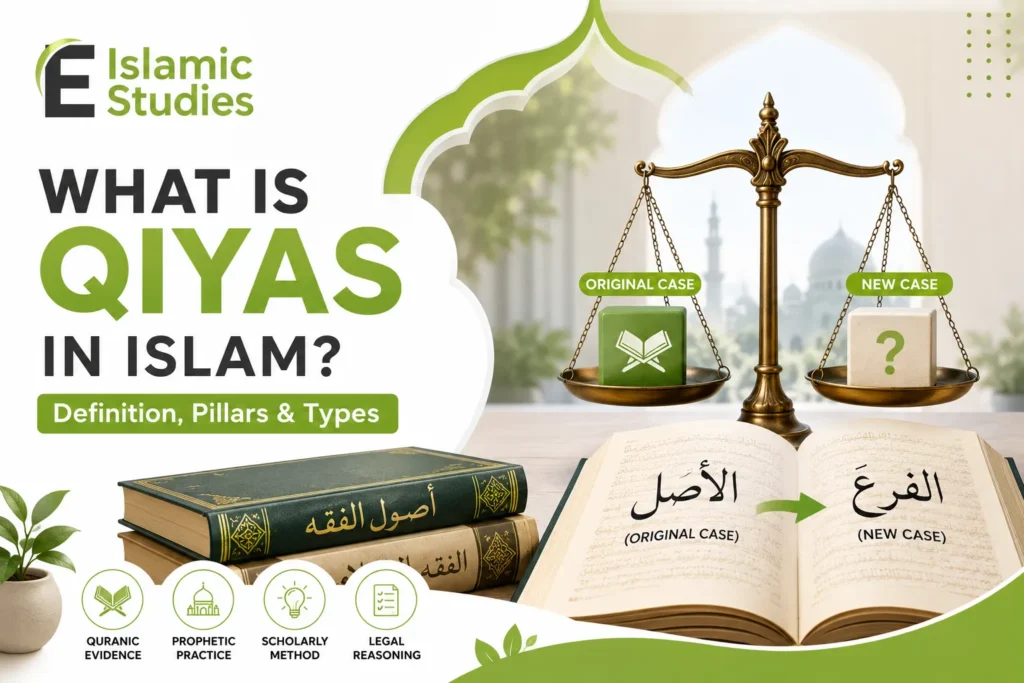
When new situations arise that the Quran and Sunnah did not address explicitly, Islamic scholarship cannot remain silent. Qiyas in Islam is the established juristic tool that allows qualified scholars to derive rulings for new cases by connecting them to existing ones through a shared underlying cause.
This guide covers the complete qiyas definition, its four pillars, its types, its Quranic and prophetic evidence, and real scholarly examples — drawn entirely from verified Sunni sources including Islamweb, the Egyptian Ministry of Awqaf, and Al-Aluka.
Qiyas in Islam – Linguistic and Legal Definition
The word qiyas carries two related meanings in Arabic: measurement and equality. Ibn Manzur in Lisan al-Arab explains that qiyas refers to determining the measure of one thing by comparing it to another. It is also used to mean equating two things — whether tangibly or conceptually.
In Islamic legal terminology, the qiyas definition established by the usul scholars is more precise. The Shafi’i scholars and leading investigators defined it as: “Extending a known ruling to another known ruling in affirming or negating a judgment through a unifying element shared between them in ruling or attribute.”
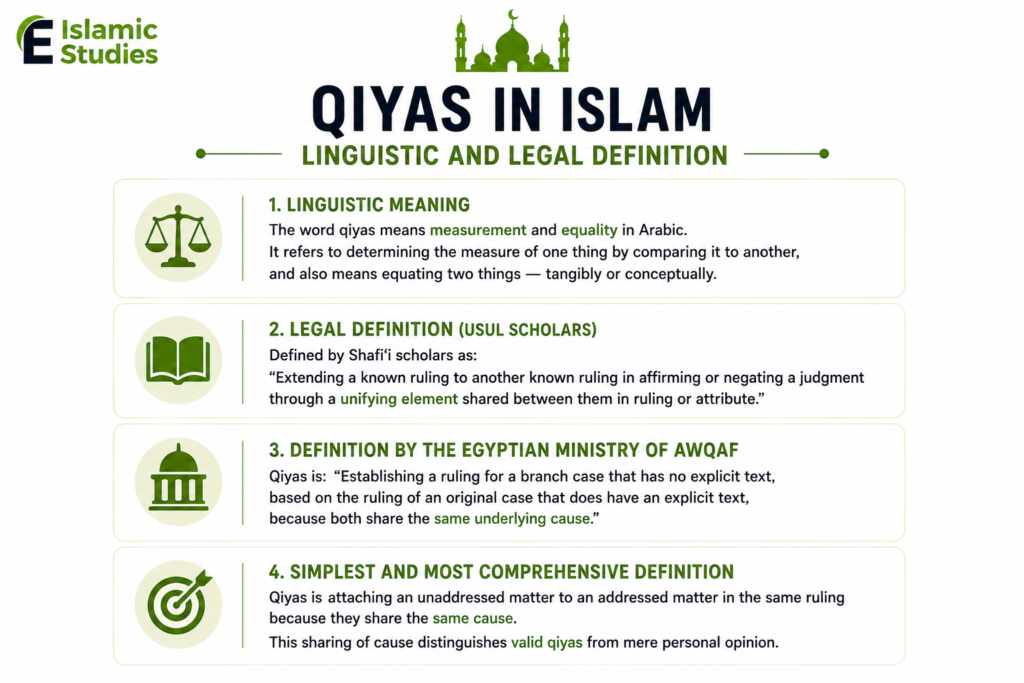
The Egyptian Ministry of Awqaf platform defines qiyas concisely: “Establishing a ruling for a branch case that has no explicit text, based on the ruling of an original case that does have an explicit text, because both share the same underlying cause.”
The simplest and most comprehensive qiyas definition in Islamic jurisprudence is therefore: attaching an unaddressed matter to an addressed matter in the same ruling because they share the same cause. This sharing of cause is what distinguishes valid qiyas from mere personal opinion.
Read also: What Is Ijtihad in Islam?
The Quranic and Prophetic Evidence for Qiyas Islamic Jurisprudence
Qiyas in Islam is not a later scholarly invention — it has direct textual support from the Quran and from prophetic practice. Scholars across all four Sunni schools have cited the following evidences:
From the Quran, Allah commands those with insight to draw lessons from observable realities:
“فَاعْتَبِرُوا يَا أُولِي الْأَبْصَارِ”
Fa’tabiru ya uli al-absar.
“So take warning, O people of vision.”
Scholars explain that the word i’tibar — from the root meaning to cross over — carries the same meaning as qiyas: crossing from the ruling of the established case to the ruling of the new case. This makes the verse a direct Quranic authorization for analogical reasoning.
Allah also commands referring disputed matters to qualified reasoners:
“وَلَوْ رَدُّوهُ إِلَى الرَّسُولِ وَإِلَىٰ أُولِي الْأَمْرِ مِنْهُمْ لَعَلِمَهُ الَّذِينَ يَسْتَنبِطُونَهُ مِنْهُمْ”
Wa law radduhu ila al-Rasuli wa ila uli al-amri minhum la’alimahu alladhina yastanbitunahu minhum.
“if they had referred it back to the Messenger or to those of authority among them, then the ones who [can] draw correct conclusions from it would have known about it.”
The word yastanbitun — to draw out — refers precisely to the scholarly work of deriving rulings from evidences, which includes qiyas.
From the Sunnah, the Prophet himself practiced and approved analogical reasoning. When a man asked whether he could fast on behalf of his deceased mother, the Prophet responded:
“أُمِّي مَاتَتْ، وَعَلَيْهَا صَوْمُ شَهْرٍ، أَفَأَقْضِيهِ عَنْهَا قَالَ ” نَعَمْ ـ قَالَ ـ فَدَيْنُ اللَّهِ أَحَقُّ أَنْ يُقْضَى”
“My mother died and she ought to have fasted one month (for her missed Ramadan). Shall I fast on her behalf?” The Prophet (ﷺ) replied in the affirmative and said, “Allah’s debts have more right to be paid.”
This is an explicit prophetic example of qiyas — the Prophet connected the obligation of fasting to the obligation of repaying a debt, linking them through a shared cause. The companions also practiced qiyas consistently.
Ali ibn Abi Talib recommended eighty lashes for the one who drinks wine by reasoning that intoxication leads to false speech, which connects it to the punishment for slander — a direct example of companion-level qiyas preserved in historical sources.
At E Islamic Studies Academy, the Online Tafseer Course provides students with the tools to understand Quranic verses like these in their full juristic context — connecting revealed text to legal methodology.
Read also: What Is Kafir in Islam?

Understand the Quranic foundations of Islamic law today.
See Our Islamic Studies Classes in Action
Take a look at a sample lesson and see how our interactive online classes help students learn Islamic Studies in a clear, engaging, and supportive environment.
Deepen Your Islamic Knowledge
Join our comprehensive online courses and learn from qualified scholars today.
Book Your Free TrialThe Four Pillars of Qiyas in Islam
Qiyas in Islam cannot be performed without all four of its pillars being present and correctly identified. If any pillar is missing or invalid, the qiyas itself is invalid. Scholars across all schools agree on these four:
| Pillar | Arabic Term | Definition |
| Original Case | Al-Asl / Al-Maqis ‘alayh | The case whose ruling is established by Quran, Sunnah, or ijma |
| New Case | Al-Far’ / Al-Maqis | The new case with no explicit ruling, which is being connected to the original |
| Ruling of the Original | Hukm al-Asl | The specific Sharia ruling that applies to the original case |
| Shared Cause | Al-‘Illa | The common attribute or reason present in both cases that justifies giving them the same ruling |
The most cited example used by scholars to illustrate all four pillars is the qiyas of intoxicants on wine:
- Original case: wine, whose prohibition is established explicitly in Surah Al-Ma’idah verse 90.
- New case: all other intoxicating substances not mentioned in the Quran.
- Ruling of the original: prohibition.
- Shared cause: intoxication — the ability to remove the faculty of reason.
Because every intoxicating substance shares the cause of intoxication with wine, it receives the same ruling of prohibition through valid qiyas.
Read also: What Is Ijtihad in Islam? Definition and Complete Guide
The Types of Qiyas in Islamic Jurisprudence
Qiyas Islamic jurisprudence recognizes several established types, classified according to different criteria. The main classifications used by classical scholars are:
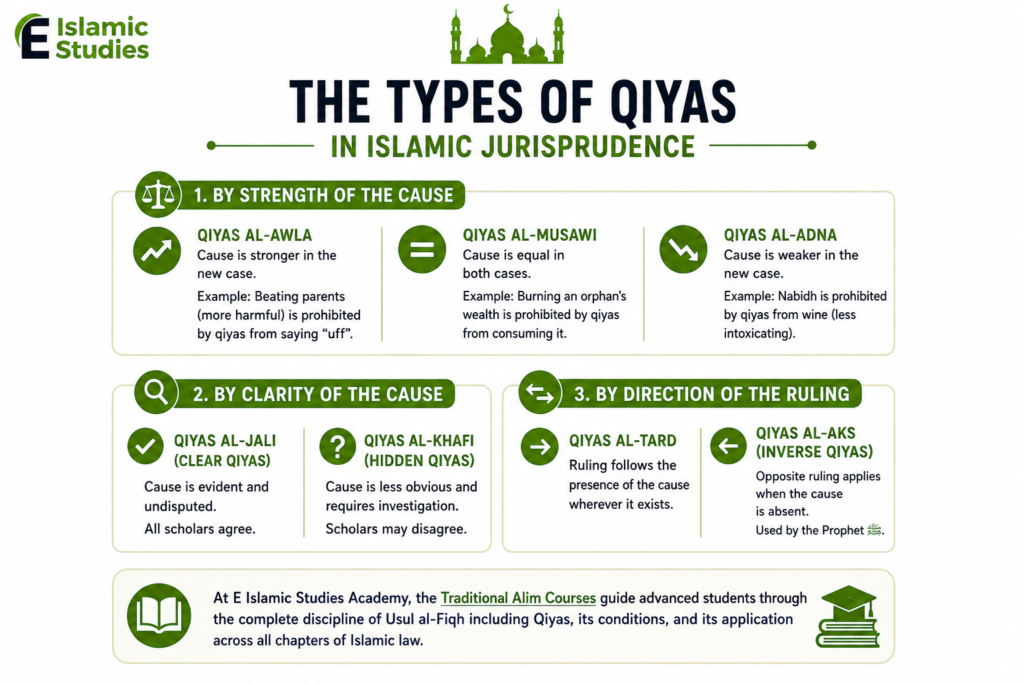
By the strength of the cause in the new case compared to the original:
- Qiyas al-Awla — the cause is stronger in the new case than in the original, making the ruling even more obvious. Example: prohibiting physical abuse of parents is derived by qiyas from the Quranic prohibition of saying “uff” to them. Beating is clearly more harmful than a sound, so the ruling of prohibition applies with greater force.
- Qiyas al-Musawi — the cause is equal in both cases. Example: prohibiting burning the wealth of an orphan is derived by qiyas from the Quranic prohibition of consuming it. The cause — destroying the orphan’s wealth unjustly — is equally present in both actions.
- Qiyas al-Adna — the cause is weaker in the new case than in the original. Example: qiyas of nabidh on wine in prohibition, where the intoxicating effect may be considered less pronounced. This type is the most debated among scholars.
By clarity of the shared cause:
- Qiyas al-Jali (clear qiyas) — the shared cause is evident and undisputed, such as qiyas of striking parents on saying “uff.” All scholars recognize the cause immediately.
- Qiyas al-Khafi (hidden qiyas) — the shared cause is less obvious and requires scholarly investigation, making this type subject to scholarly disagreement in individual cases.
By the direction of the ruling:
- Qiyas al-Tard — the ruling follows the presence of the cause wherever it exists.
- Qiyas al-Aks (inverse qiyas) — the opposite ruling applies when the cause is absent. The Prophet used this when he said: “If placing it in something forbidden earns a sin, then placing it in something permitted earns a reward.”
At E Islamic Studies Academy, the Traditional Alim Courses guide advanced students through the complete discipline of usul al-fiqh including qiyas, its conditions, and its application across all chapters of Islamic law.

Study Islamic jurisprudence at the highest level today.
The Scholarly Position on Qiyas and Who Rejected It
The vast majority of Islamic scholars across all generations accepted qiyas in Islam as a valid and binding fourth source of Islamic law. Abu Bakr Al-Jassas, a major Hanafi jurist, stated: “There is no disagreement among the first generation, the successors, and those who followed them regarding the permissibility of ijtihad and qiyas on analogous matters.”
The minority positions that rejected qiyas include:
- Ibrahim ibn Sayyar al-Nazzam and some Mu’tazila scholars rejected it as a legal method.
- Dawud al-Zahiri and the Zahiri school rejected qiyas, insisting on adherence only to explicit texts.
- Twelver Shia scholars reject qiyas in Islamic jurisprudence as legally invalid, though they accept it as rationally possible.
The Sunni scholarly consensus — including Hanafi, Maliki, Shafi’i, and Hanbali scholars — is that qiyas is the fourth authoritative source of Islamic law, ranked after the Quran, Sunnah, and ijma. No text exists that prohibits it. All four founding imams practiced and taught qiyas as an essential tool of Islamic legal reasoning.
The Condition That Makes Qiyas Invalid
The most critical rule in all of qiyas Islamic jurisprudence is simple: qiyas cannot be performed where an explicit text already exists. The Egyptian Ministry of Awqaf scholars state explicitly that qiyas is used only when no text from Quran, Sunnah, or ijma addresses the matter.
Islamweb similarly clarifies: “Qiyas is the fourth foundational source, and it is used only when there is no text — there is no qiyas where a text exists.”
Performing qiyas to contradict a clear Quranic verse or authentic hadith is not jurisprudence — it is deviation. This boundary is what separates legitimate scholarly qiyas from personal whim, and it is the reason scholars required that the mujtahid master both the Quran and Sunnah before exercising any analogical reasoning.
At E Islamic Studies Academy, the Essential Islamic Courses teach students the foundational knowledge of Aqeedah and Fiqh that every Muslim needs — including how Islamic rulings are derived, applied, and protected from misuse.

Learn your faith with qualified scholars today.
Watch a Sample Islamic Studies Class
See how our teachers explain Islamic concepts in an engaging and easy-to-understand way, helping students build knowledge and confidence.
Deepen Your Islamic Knowledge
Join our comprehensive online courses and learn from qualified scholars today.
Book Your Free TrialE Islamic Studies Academy Brings You Authentic Islamic Knowledge
Thousands of Muslims worldwide want to understand Islamic jurisprudence — including foundational concepts like qiyas — at the level of real classical scholarship grounded in Sunni methodology. E Islamic Studies Academy provides one-on-one live sessions with qualified scholars trained in classical Islamic sciences including Aqeedah, Fiqh, Sarf, Nahw, and Tafseer.
Programs run from complete beginner foundations through traditional Alim-level scholarship. Dedicated courses exist for women, new converts, children, adult learners, and sisters seeking female-led instruction. All global time zones are covered and a free trial class is available before any commitment.
Our Islamic Courses
- Islam Classes for Adults
- Islam Classes for Sisters
- Alimah Course for Ladies
- Islam Classes for Kids
- Learn Islam for Beginners
- Learning Islam for New Converts
Our Islamic Programs
- Islamic Distance Learning Programs
- Islamic Courses Workshops
- Intensive Islamic Course
- Islam Crash Course
- Learning Islam Level 1 Online
- Darse Nizami / Traditional Alim Courses
Register at E Islamic Studies Academy today.
Deepen Your Islamic Knowledge
Join our comprehensive online courses and learn from qualified scholars today.
Book Your Free TrialConclusion
Qiyas in Islam is a precisely defined, evidence-based scholarly tool that allows Islamic law to address every new circumstance without departing from its revealed foundations. Its qiyas definition, four pillars, and types have been taught and practiced by the greatest scholars of Ahl al-Sunnah across fourteen centuries. Understanding it is essential for every Muslim who wants to comprehend how Islamic rulings are correctly derived and applied.
Frequently Asked Questions
What is qiyas in Islam?
Qiyas in Islam is the fourth source of Islamic law, used to extend the ruling of an established case to a new unaddressed case when both share the same underlying legal cause.
What is the qiyas definition in usul al-fiqh?
The qiyas definition is: attaching an unaddressed matter to an addressed matter in the same ruling because both share the same cause, as established by Quran, Sunnah, or ijma.
What are the four pillars of qiyas in Islamic jurisprudence?
The four pillars of qiyas Islamic jurisprudence are: the original case with an established ruling, the new case without an explicit ruling, the ruling of the original case, and the shared cause present in both cases.
Who rejected qiyas in Islamic jurisprudence?
The Zahiri school led by Dawud al-Zahiri and Twelver Shia scholars rejected qiyas. The overwhelming majority of Sunni scholars across all four major schools accept it as binding.
Can qiyas override a Quranic verse?
No. Qiyas is only valid where no explicit Quranic verse, authentic hadith, or scholarly consensus exists. Performing qiyas against a clear text is forbidden and invalid.
Related Articles
Learning Islam








Leave a Reply