 Learning Islam

Millions of Muslims complete Ramadan every year without fully knowing the rules of fasting in Islam — and some unknowingly break their fast or invalidate their worship without realizing it. Fasting is one of the five pillars of Islam, and like every pillar, it carries precise conditions that determine whether it is valid, void, or rewarded.
Understanding fasting rules Islam scholars have defined for over fourteen centuries is an obligation on every Muslim who fasts. This guide covers every essential rule clearly, from intention to what breaks your fast, so your worship is sound, accepted, and spiritually complete.
1- A Sincere Intention Before Fajr Makes the Fast Valid
The most foundational of all rules of fasting in Islam is the niyyah — the intention. A person who goes an entire day without eating or drinking, but made no conscious intention to fast, has not performed a valid Islamic fast. The intention is an act of the heart, not a spoken phrase, and it must be made before the true Fajr — the moment white light spreads across the horizon.
Scholars across all four major schools of Islamic jurisprudence agree that for Ramadan specifically, renewing the intention each night is the stronger and more cautious position, though some scholars hold that a single intention at the beginning of Ramadan covers the entire month.
For voluntary fasts, the Shafi’i and Hanbali positions permit making the intention after Fajr, provided no fast-nullifier has been committed since dawn. The Prophet Muhammad, peace be upon him, established the primacy of intention across all acts of worship:
“إِنَّمَا الأَعْمَالُ بِالنِّيَّاتِ، وَإِنَّمَا لِكُلِّ امْرِئٍ مَا نَوَى
” Innama al-a’malu bil-niyyat, wa innama likulli imri’in ma nawa.
“The reward of deeds depends upon the intentions and every person will get the reward according to what he has intended.”
A fast observed to avoid eating out of habit, to lose weight, or to protest something does not constitute a valid Islamic fast. The intention must be exclusively an act of submission and obedience to Allah.
Many beginners and new Muslims find it difficult to navigate the requirements of Islamic worship without proper foundational guidance. At E Islamic Studies Academy, the Learning Islam for New Converts course provides structured, authentic teaching tailored specifically to those beginning their Islamic journey.

Start fasting correctly from day one
Read also: Top 10 Benefits of Fasting in Islam – Body, Mind, and Soul
2- Not Every Muslim Is Obligated to Fast
Fasting in Ramadan is fard — obligatory — but only on Muslims who meet specific conditions. The fasting rules Islam scholars have defined include clear criteria for who must fast and who is legitimately exempt. Every Muslim household needs to understand these categories clearly.
Fasting is obligatory on a person who meets all of the following conditions simultaneously:
- Being a Muslim, since fasting is not required of non-Muslims.
- Having reached puberty, since children are not obligated, though they are encouraged gradually.
- Being mentally sound, since fasting does not apply to someone who has lost their mental faculties.
- Being physically capable, since illness that would be worsened by fasting grants a legitimate exemption.
- Not being in a state of menstruation or post-natal bleeding, since women in these states must break their fast and make up the days later.
The following table outlines the exempt categories and what each is required to do instead:
| Category | Ruling | Required Action |
| Traveler (minimum 48 miles / 80 km) | Permitted to break the fast | Make up missed days after Ramadan |
| Temporarily ill person | Permitted to break the fast | Make up missed days after recovery |
| Chronically ill with no hope of recovery | Permanently exempt | Pay fidyah for each missed day |
| Pregnant woman fearing harm | Permitted to break the fast | Make up days and/or pay fidyah |
| Nursing mother with little milk | Permitted to break the fast | Make up days and/or pay fidyah |
| Menstruating or post-natal woman | Must break the fast | Make up all missed days after Ramadan |
| Elderly person incapable of fasting | Permanently exempt | Pay fidyah for each missed day |
| Child below puberty | Not obligated | Encouraged gradually as capacity develops |
3- Fasting Begins at True Fajr and Ends at Maghrib
Among the most essential fasting rules Islam defines is the precise timing of the fast. The fast begins at true Fajr — when the white light of dawn spreads horizontally across the horizon — and ends at Maghrib, when the sun’s disk fully disappears below the horizon. This timing is established directly in the Quran:
“وَكُلُوا وَاشْرَبُوا حَتَّىٰ يَتَبَيَّنَ لَكُمُ الْخَيْطُ الْأَبْيَضُ مِنَ الْخَيْطِ الْأَسْوَدِ مِنَ الْفَجْرِ ۖ ثُمَّ أَتِمُّوا الصِّيَامَ إِلَى اللَّيْلِ ۚ”
Wa kulu wa ushrabu hatta yatabayyana lakumu al-khaytu al-abyadu mina al-khayti al-aswadi mina al-fajri thumma atimmu al-siyama ila al-layl.
“And eat and drink until the white thread of dawn becomes distinct to you from the black thread [of night].”
Suhoor is a confirmed Sunnah that the Prophet strongly encouraged — eating even a small amount before Fajr carries reward and blessing. Deliberately extending the fast beyond Maghrib without breaking it, a practice known as wisal, is explicitly prohibited in Islamic law. The correct time for Maghrib is when the sun’s disk disappears completely below the horizon, not merely when the sky begins to darken.
Read also: Attahiyat and Tashahhud: Complete Arabic Guide with Meaning
4- Eating and Drinking Intentionally Invalidates the Fast
The most recognized item on the list of things that will break your fast Islam defines is intentional eating or drinking. Any food or drink consumed deliberately during fasting hours nullifies the fast — regardless of quantity.
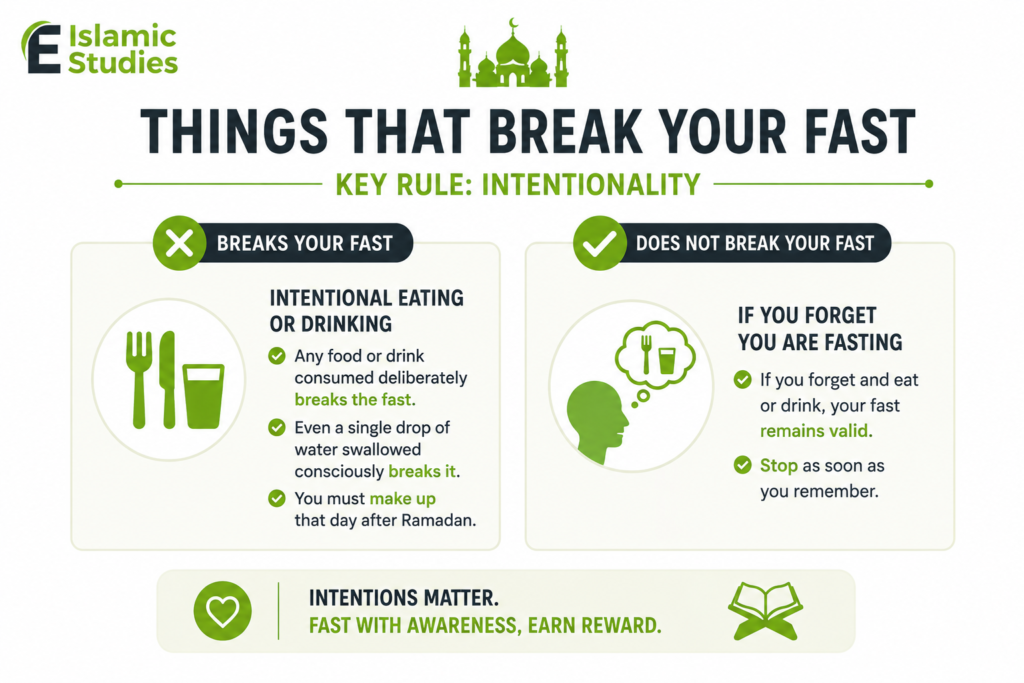
Even a single drop of water swallowed consciously breaks the fast and requires making up that day after Ramadan. The key distinction in fasting rules Islam scholars have consistently emphasized is intentionality. If a person forgets they are fasting and eats or drinks, their fast remains completely valid and they must simply stop as soon as they remember.
The Prophet Muhammad, peace be upon him, confirmed this:
“إِذَا نَسِيَ فَأَكَلَ وَشَرِبَ فَلْيُتِمَّ صَوْمَهُ، فَإِنَّمَا أَطْعَمَهُ اللَّهُ وَسَقَاهُ”
Man nasiya wa huwa sa’imun fa-akala aw shariba falyutimma sawmahu, fa-innama at’amahu Allahu wa saqahu.
“If somebody eats or drinks forgetfully then he should complete his fast, for what he has eaten or drunk, has been given to him by Allah.”
A person who is reminded by someone else that they are fasting must stop eating immediately. Continuing to eat after being reminded counts as deliberate consumption and breaks the fast. Smoking — including cigarettes, pipes, and electronic cigarettes — also falls under this category and breaks the fast based on the scholarly consensus.
At E Islamic Studies Academy, the Essential Islamic Courses provide structured Fiqh instruction covering the practical rules of fasting, prayer, and daily worship for every level of learner.
Read also: Niyyah in Islam: Meaning, Importance, and How to Make It
Understand every ruling with clarity today.
5- What Breaks Your Fast Islam Scholars Have Listed Beyond Food
One of the most important areas of what breaks your fast Islam defines involves actions that have nothing to do with eating or drinking. Many Muslims are entirely unaware of these, which makes this knowledge essential for every fasting person. The complete list of things that will break your fast Islam scholars have agreed upon is as follows:
- Intentional eating or drinking of any amount, including medicine taken orally.
- Deliberate smoking, including all forms of tobacco and electronic cigarettes.
- Intentional vomiting induced deliberately by the fasting person.
- Sexual intercourse between spouses during fasting hours.
- Intentional ejaculation outside of intercourse, achieved by any means during fasting hours.
- Deliberately inhaling thick dust or heavy smoke such that it reaches the throat — including exposure from demolition sites, flour mills, cement factories, or sandstorms without protective coverings.
- Applying a liquid enema, even if necessary for medical treatment.
- Deliberately remaining in a state of ritual impurity from sexual intercourse until after Fajr without performing ghusl or tayammum.
- The onset of menstruation or post-natal bleeding, even moments before Maghrib.
- Deliberately ascribing false statements to Allah or the Prophet, peace be upon him, according to some scholarly positions.
The following table compares actions that break the fast with similar actions that do not:
| Action | Breaks the Fast | Does Not Break the Fast |
| Deliberate eating or drinking | Yes | Forgetful eating or drinking |
| Deliberate vomiting | Yes | Involuntary vomiting |
| Sexual intercourse during fast | Yes | Kissing without arousal reaching climax |
| Liquid enema | Yes | Solid enema or suppositories |
| Inhaling thick smoke or dust deliberately | Yes | Thin dust rising from sweeping |
| Injecting medicine into a vein or muscle | No | N/A |
| Applying eye or ear drops | No | N/A |
| Swallowing one’s own saliva | No | N/A |
6- Intercourse During Fasting Hours Requires Major Expiation
Sexual intercourse between spouses during fasting hours is the most serious violation of the fast in Islamic law. It does not merely invalidate the day — it also obligates a major expiation known as kaffarah in addition to making up that day. This applies to both husband and wife.
The kaffarah for intercourse during a Ramadan fast must be performed in the following strict order — the next option is only valid when the previous one is genuinely impossible:
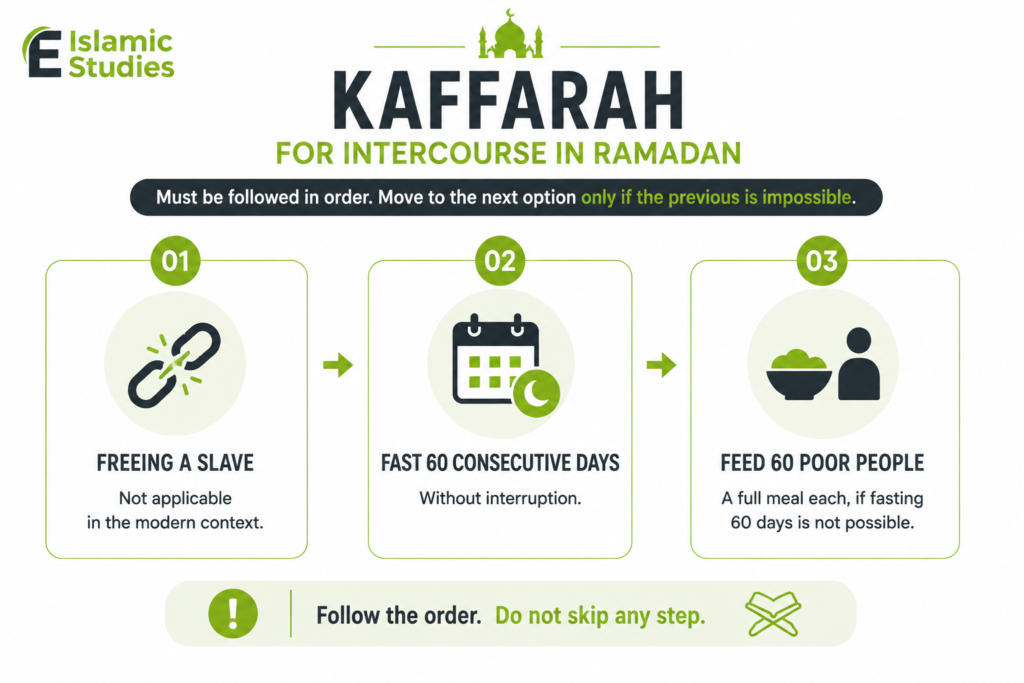
- Freeing a slave, which is not applicable in the modern context.
- Fasting sixty consecutive days without interruption.
- Feeding sixty poor people a full meal each, if fasting sixty days is not possible due to genuine inability.
Other forms of intimacy — such as kissing or touching — do not automatically break the fast. However, scholars advise that if a person fears losing control of themselves, they must avoid all physical contact during fasting hours entirely. If intimacy leads to ejaculation, the fast is broken and must be made up, with kaffarah required if the person knew this would be the likely outcome.
At E Islamic Studies Academy, the Online Tafseer Course connects students to the Quranic verses behind every Islamic obligation, including fasting, through qualified scholars grounded in classical Tafseer sciences.

Deepen your understanding of Islamic obligations today.
7- Ritual Purity Before Fajr Is a Condition of a Valid Fast
Among the fasting rules Islam makes binding is the requirement that a fasting person must not deliberately remain in a state of janabah — ritual impurity resulting from intercourse or ejaculation — after Fajr arrives.
If a person becomes impure during the night and Fajr arrives before they perform ghusl or tayammum, their fast is invalidated if the remaining in that state was deliberate. The following situations each carry different rulings that every Muslim must know:
- A person who performs ghusl before Fajr after night intercourse fasts validly, and the fast counts.
- A person who wakes after Fajr having had a nocturnal emission during sleep fasts validly — this was involuntary and does not affect the fast.
- A menstruating woman whose period ends at night must perform ghusl before Fajr — if she forgets, some scholars hold her fast is still valid, while others require her to make it up out of caution.
- A person who cannot find water must perform tayammum — dry ablution using clean earth — before Fajr to preserve the validity of their fast.
These distinctions between deliberate and involuntary states are central to fasting rules Islam has defined with great precision across fourteen centuries of jurisprudence.
See Our Islamic Studies Classes in Action
Take a look at a sample lesson and see how our interactive online classes help students learn Islamic Studies in a clear, engaging, and supportive environment.
Deepen Your Islamic Knowledge
Join our comprehensive online courses and learn from qualified scholars today.
Book Your Free Trial8- Specific Actions During the Fast Are Permitted Without Question
Understanding what does not break your fast is equally important as knowing what does. Many Muslims unnecessarily worry about actions that Islamic jurisprudence has explicitly confirmed as permissible. The following actions are all permitted during fasting hours without nullifying the fast:
- Bathing, swimming, or showering, provided water is not deliberately swallowed.
- Using a toothbrush and toothpaste, provided the person spits out all rinse water afterward.
- Using a miswak at any time during the day.
- Rinsing the mouth for wudu, without excessive gargling that risks swallowing water.
- Rinsing the nose for wudu, without exaggerating the inhalation of water.
- Applying eye drops, ear drops, or contact lenses — these do not reach the stomach through a normal pathway.
- Injections of medicine into a vein or muscle, even if they alleviate hunger or thirst.
- Using perfume and fragrances, though smelling fragrant plants is considered disliked by some scholars.
- Tasting food while cooking to check seasoning, provided nothing is swallowed.
- Swallowing saliva naturally collected in the mouth.
9- Missing a Fast Carries Its Own Rules for Making It Up
The fasting rules Islam establishes do not conclude when Ramadan ends. Every day missed from Ramadan due to a valid excuse must be made up before the next Ramadan arrives. This obligation is established in the Quran, which instructs those who were ill or traveling to fast “a number of other days” to replace what they missed.
The rules governing missed fasts and their makeup include the following important points:
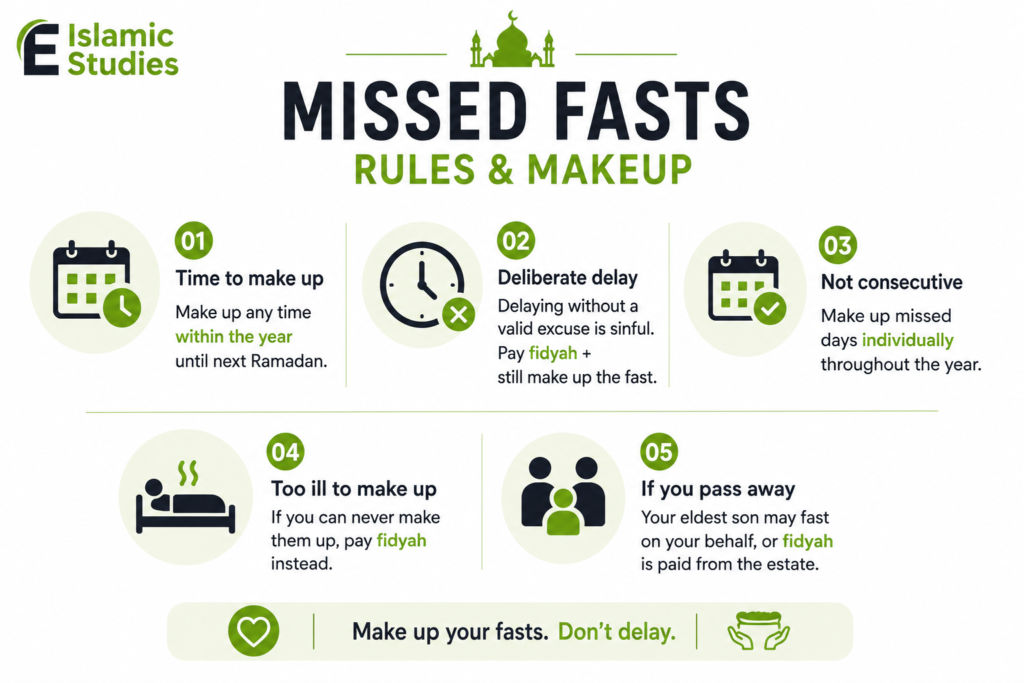
- Missed days do not need to be made up immediately — the entire year until the following Ramadan is available.
- Deliberately delaying the makeup without a valid excuse until the next Ramadan arrives is sinful and requires paying fidyah — feeding one poor person for each missed day — in addition to still making up the fast.
- Missed days can be made up individually throughout the year and do not need to be consecutive.
- A person who misses days and then becomes too ill to ever make them up pays fidyah instead.
- A person who dies with unfulfilled makeup fasts may have their eldest son fast on their behalf, or fidyah may be paid from the estate.
- A person must not observe voluntary Sunnah fasts while they still have outstanding makeup fasts from Ramadan — the obligation takes priority.
10- Guarding the Limbs Fulfills the Complete Purpose of Fasting
The final and most spiritually significant of all fasting rules Islam defines is the obligation to guard every limb from sinful behavior throughout the fasting day. A Muslim who abstains from food and drink but spends their fast lying, backbiting, watching forbidden content, or arguing has preserved the outer form of the fast — but has lost much of its reward and may have rendered it spiritually empty.
The Prophet Muhammad, peace be upon him, warned explicitly about this:
“مَنْ لَمْ يَدَعْ قَوْلَ الزُّورِ وَالْعَمَلَ بِهِ فَلَيْسَ لِلَّهِ حَاجَةٌ فِي أَنْ يَدَعَ طَعَامَهُ وَشَرَابَهُ”
Man lam yada’ qawla al-zuri wal-‘amala bihi, fa-laysa lillahi hajatun fi an yada’a ta’amahu wa sharabahu.
“Whoever does not give up forged speech and evil actions, Allah is not in need of his leaving his food and drink (i.e. Allah will not accept his fasting.).”
The specific behavioral obligations every fasting Muslim must actively maintain throughout the day include:
- Protecting the tongue from lying, backbiting, false testimony, and obscene language.
- Guarding the ears from listening to backbiting, slander, and forbidden speech.
- Lowering the gaze from everything Allah has prohibited, including on screens and devices.
- Controlling anger and responding to provocation with patience and restraint.
- Keeping the hands from any form of transgression against others.
These restraints do not nullify the fast if violated, but they strip it of its spiritual reward and diminish its value before Allah. Scholars of Islam across all generations have described the complete fast as one that guards both the body and every limb simultaneously — the physical and the behavioral dimensions inseparable.
At E Islamic Studies Academy, the Tazkiyya Course teaches students how to purify the soul and guard every limb from sin — the precise internal work that gives fasting its complete spiritual power and makes every fast count before Allah.

Purify your fast from the inside today.
Watch a Sample Islamic Studies Class
See how our teachers explain Islamic concepts in an engaging and easy-to-understand way, helping students build knowledge and confidence.
Deepen Your Islamic Knowledge
Join our comprehensive online courses and learn from qualified scholars today.
Book Your Free TrialE Islamic Studies Academy Gives You Qualified Islamic Knowledge
Thousands of Muslims worldwide want to understand Islamic rulings properly but struggle to find qualified scholars, structured programs, and flexible schedules that genuinely fit their lives. E Islamic Studies Academy was built precisely to solve this problem for Muslim learners everywhere.
The academy offers one-on-one live sessions with qualified scholars grounded in classical Islamic sciences including Aqeedah, Fiqh, Sarf, Nahw, and Tafseer. Programs are structured from complete beginner foundations through to advanced traditional Alim-level scholarship.
Dedicated courses exist for women, new converts, children, adult learners, and sisters who prefer female-led instruction. All global time zones are served, monthly progress reports are provided after every session, and a free trial class is available before any commitment is required.
Our Islamic Essentials Courses
- Essential Islam Courses
- Online Tafseer Course
- Islamic History Course
- Tazkiyah Course
- Online Qirat Course
- Quran Tafseer Classes for Beginners — Introductory Interpretation
- Online Tafseer Classes in English
- Self-Paced Tafseer Course — Flexible Learning Programs
- Aqidah Course — Islamic Creed and Theology Classes
- Online Seerah Course — Life of Prophet Muhammad Classes
- Akhlaq Course — Islamic Ethics and Character Development
Our Fiqh Courses
- Online Fiqh Course — Islamic Jurisprudence Classes
- Fiqh Class for New Muslims — Beginners Fiqh
- Fiqh of Marriage Course — Islamic Marriage Jurisprudence
- Comparative Fiqh Course — Comparing Islamic Schools
- Fiqh of Salah Course — Prayer Jurisprudence
- Hanafi Fiqh Course — Hanafi School Jurisprudence
- Maliki Fiqh Course — Maliki School Jurisprudence
- Shafi Fiqh Course — Shafi School Jurisprudence
- Hanbali Fiqh Course — Hanbali School Jurisprudence
Register at E Islamic Studies Academy today.
Deepen Your Islamic Knowledge
Join our comprehensive online courses and learn from qualified scholars today.
Book Your Free TrialConclusion
The rules of fasting in Islam are precise, comprehensive, and grounded in clear Quranic and prophetic evidence. Knowing what breaks your fast, who is exempt, and how to guard your limbs ensures your fast is both legally valid and spiritually complete. A sound fast requires sound knowledge — and every Muslim deserves to worship with confidence and clarity.
Frequently Asked Questions
What are the basic rules of fasting in Islam?
The rules of fasting in Islam require a sincere intention before Fajr, abstaining from all nullifiers from Fajr to Maghrib, and guarding the limbs from sinful behavior throughout the fast.
What breaks your fast Islam defines beyond food and drink?
What breaks your fast Islam includes deliberate vomiting, sexual intercourse, deliberate ejaculation, inhaling thick smoke or dust, liquid enema, remaining in ritual impurity until Fajr, and onset of menstruation.
Is the complete list of things that will break your fast Islam teaches only about eating?
No. The list of things that will break your fast Islam defines includes ten distinct categories — eating and drinking are only the first two. Scholars have documented all categories in classical Fiqh texts.
Do fasting rules Islam defines apply during voluntary fasts outside Ramadan?
Yes, the same rules apply to voluntary fasts. The one difference is that the intention for a voluntary fast may be made after Fajr, provided no nullifier has been committed since dawn.
Can a sick person follow different fasting rules in Islam?
A person whose illness is worsened by fasting is permitted to break their fast and make up the days after recovery. A person with a permanent condition pays fidyah instead and is not required to make up the days.
Related Articles
Learning Islam








Leave a Reply