 Learning Islam
Every generation of Muslims faces questions the early texts did not address explicitly. Ijtihad in Islam is the scholarly mechanism that allows qualified jurists to derive rulings for new circumstances from established Islamic evidences.
This guide covers the complete ijtihad definition in Islamic law, its Quranic and prophetic evidence, its types, the conditions a mujtahid must meet, and when ijtihad is obligatory, recommended, or forbidden — all based exclusively on Sunni scholarly sources conforming to the methodology of Ahl al-Sunnah wal-Jama’ah.
What Is Ijtihad in Islam — Linguistic and Legal Definition
The word ijtihad derives from the Arabic root J-H-D, meaning effort, striving, and maximum exertion. Linguistically, ijtihad means to expend full capacity toward achieving a desired goal.
In Islamic legal terminology, the ijtihad definition is more precise. Imam Al-Ghazali defined it as “the total expenditure of effort made by a jurist for the purpose of obtaining the religious rulings of the Sharia.” Other usul scholars defined it as “the exertion of a jurist’s full capacity to determine a Sharia ruling from its specific evidences.”
The ijtihad definition in Islamic law rests on two essential pillars:
- The mujtahid — the qualified scholar performing the legal reasoning.
- The mujtahad fih — the legal question being addressed through that reasoning.
What is ijtihad in Islam in practical terms? It is the disciplined scholarly process by which qualified jurists apply established principles — including qiyas, istihsan, maslaha, and other usul tools — to derive rulings that conform to the objectives and evidences of the Sharia.
At E Islamic Studies Academy, the Online Tafseer Course gives students deep engagement with the Quranic foundations that underpin all Islamic legal reasoning.

Build your foundation in Islamic scholarship today.
The Quranic and Prophetic Evidence for Ijtihad in Islam
Ijtihad in Islam is not a human addition to the religion — it has explicit support in both the Quran and authenticated Sunnah. Allah commands those in authority to judge by what He has revealed:
“إِنَّا أَنزَلْنَا إِلَيْكَ الْكِتَابَ بِالْحَقِّ لِتَحْكُمَ بَيْنَ النَّاسِ بِمَا أَرَاكَ اللَّهُ”
Inna anzalna ilayka al-kitaba bil-haqqi litahkuma bayna al-nasi bima araka Allah.
“Indeed, We have revealed to you, [O Muhammad], the Book in truth so you may judge between the people by that which Allah has shown you.”
The most direct prophetic evidence is the hadith of Mu’adh ibn Jabal, may Allah be pleased with him. When the Prophet sent him to Yemen, he asked how he would judge. Mu’adh replied: by the Book of Allah, then the Sunnah, then — if neither contained a ruling — “I will exert my reasoned judgment and spare no effort.” The Prophet approved this answer explicitly. This narration is recorded by Abu Dawud and Al-Tirmidhi.
Read also: What Is Kafir in Islam?
The Prophet also established the reward for ijtihad:
“إِذَا حَكَمَ الْحَاكِمُ فَاجْتَهَدَ ثُمَّ أَصَابَ فَلَهُ أَجْرَانِ، وَإِذَا حَكَمَ فَاجْتَهَدَ ثُمَّ أَخْطَأَ فَلَهُ أَجْرٌ”
“If a judge gives a verdict according to the best of his knowledge and his verdict is correct (i.e. agrees with Allah and His Apostle’s verdict) he will receive a double reward, and if he gives a verdict according to the best of his knowledge and his verdict is wrong, (i.e. against that of Allah and His Apostle) even then he will get a reward.”
Why Ijtihad in Islam Is Necessary
The necessity of ijtihad in Islam arises from two unavoidable realities that scholars have consistently identified across all generations:
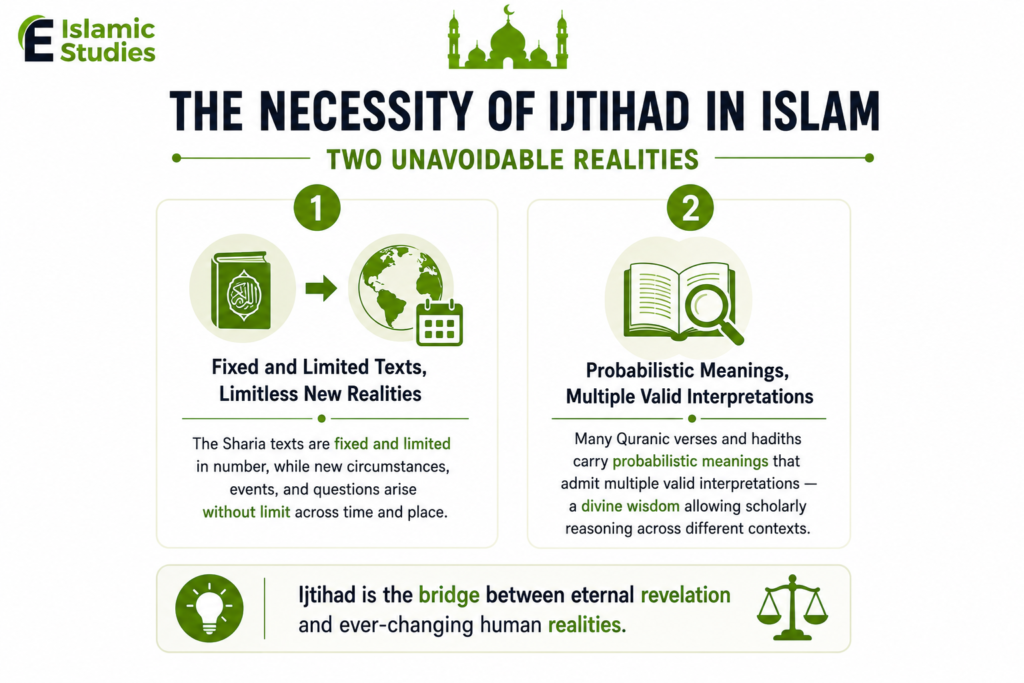
- The Sharia texts are fixed and limited in number, while new circumstances, events, and questions arise without limit across time and place.
- Many Quranic verses and hadiths carry probabilistic meanings that admit multiple valid interpretations — and this is itself a divine wisdom, creating room for scholarly reasoning across different contexts.
These two realities make ijtihad not merely permitted but essential. The Egyptian Ministry of Awqaf has formally stated: “Ijtihad is necessary in the present time because of the abundance of new events and the limited scope of explicit texts.”
Imam Al-Ghazali identified usul al-fiqh, hadith, and Arabic as the three greatest disciplines of ijtihad — without all three, a scholar cannot validly perform legal reasoning on new questions.
The Two Types of Ijtihad and Their Definitions
Classical scholars divided ijtihad in Islam into two major categories based on the degree of independence in the scholar’s reasoning:
| Type | Definition | Characteristic |
| Absolute Ijtihad (Mutlaq) | The scholar reasons independently across all chapters of Fiqh without binding themselves to any school | Sets his own usul and methodology |
| Restricted Ijtihad (Muqayyad) | The scholar reasons within the usul and framework of a specific school | Bound by the imam’s principles |
Absolute ijtihad was the practice of the four founding imams — Abu Hanifa, Malik, Al-Shafi’i, and Ahmad ibn Hanbal. Each established his own methodology for deriving rulings from evidences.
Restricted ijtihad itself has three further levels:
- Ijtihad within the school — the scholar follows the imam’s usul but may differ in individual branches.
- Ijtihad in the school — the scholar derives new rulings not explicitly addressed by the imam, using the imam’s established principles.
- Ijtihad in fatwa — the scholar identifies the strongest opinion within the school and issues rulings accordingly.
At E Islamic Studies Academy, the Traditional Alim Courses guide advanced students through the complete methodology of usul al-fiqh and classical Fiqh reasoning at the level of traditional scholarship.

Study classical Islamic scholarship with qualified scholars today.
See Our Islamic Studies Classes in Action
Take a look at a sample lesson and see how our interactive online classes help students learn Islamic Studies in a clear, engaging, and supportive environment.
Deepen Your Islamic Knowledge
Join our comprehensive online courses and learn from qualified scholars today.
Book Your Free TrialThe Seven Conditions a Mujtahid Must Meet
The ijtihad definition in Islamic law specifies that not every Muslim is qualified to perform ijtihad. Scholars established seven conditions that must all be present before a scholar’s reasoning is considered valid:
- Knowledge of the Quran — specifically its legal verses, their meanings, their occasions of revelation, and their relationship to other rulings. Imam Al-Ghazali, Al-Razi, and Ibn Qudama all identified approximately five hundred Quranic verses directly related to legal rulings.
- Knowledge of the Sunnah — including the chain of narrators, the levels of hadith authenticity, the occasions of hadiths, and which hadiths relate specifically to legal rulings. The scholar need not memorize every hadith but must know where to locate them.
- Knowledge of ijma — the scholar must know which issues have scholarly consensus so he does not issue a ruling that contradicts it.
- Knowledge of Arabic — including grammar, morphology, rhetoric, and the tools needed to distinguish between explicit and implicit meanings, general and specific texts, and literal and figurative usage.
- Knowledge of abrogation — the scholar must know which Quranic verses or hadiths have been abrogated so he does not base rulings on a superseded text.
- Knowledge of usul al-fiqh — the principles of Islamic jurisprudence are the foundation of ijtihad. Without mastery of usul, the scholar cannot extract rulings methodically from evidences.
- Knowledge of qiyas — analogical reasoning is the primary tool of independent legal derivation. The mujtahid must understand its pillars, conditions, types, and the methodology of identifying shared causes between established and new cases.
The Egyptian Ministry of Awqaf adds — based on disputed scholarly opinion — knowledge of Islamic theology, Fiqh branches, personal integrity, and logic as additional conditions some scholars have required.
When Ijtihad Is Obligatory, Recommended, or Forbidden?
Classical scholars categorized the status of ijtihad in Islam based on circumstances. The following table outlines each category clearly:
| Status | When It Applies |
| Fard ‘Ayn (individual obligation) | When a mujtahid faces a personal matter requiring a ruling, or when he alone is available and the moment is pressing |
| Fard Kifaya (communal obligation) | When multiple mujtahids exist and a question arises — if one answers, the rest are absolved |
| Mandub (recommended) | When the question is hypothetical and not yet an actual case requiring immediate resolution |
| Haram (forbidden) | When a definitive Quranic text, authentic hadith, or scholarly consensus already addresses the matter |
The most important rule is the last: ijtihad is completely forbidden where clear revelation already exists. Performing ijtihad against a decisive text is not scholarship — it is deviation. Imam Al-Shafi’i, Imam Ahmad, and scholars of all four schools unanimously held that authentic hadith is self-sufficient as evidence and requires no additional validation from the practices of any region or generation.
The Forms of Ijtihad Used in Deriving Rulings
What is ijtihad in Islam when applied practically? Scholars use several established methodological tools, each with its own conditions and scope:
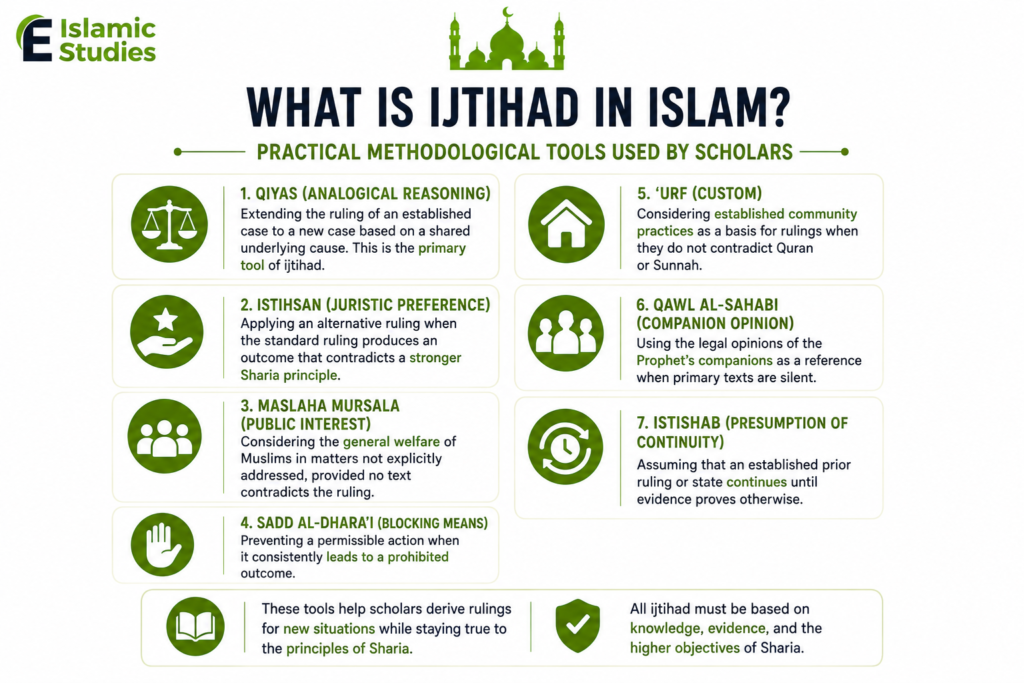
- Qiyas (analogical reasoning) — extending the ruling of an established case to a new case based on a shared underlying cause. This is the primary tool of ijtihad.
- Istihsan (juristic preference) — applying an alternative ruling when the standard ruling produces an outcome that contradicts a stronger Sharia principle.
- Maslaha mursala (public interest) — considering the general welfare of Muslims in matters not explicitly addressed, provided no text contradicts the ruling.
- Sadd al-dhara’i (blocking means) — preventing a permissible action when it consistently leads to a prohibited outcome.
- ‘Urf (custom) — considering established community practices as a basis for rulings when they do not contradict Quran or Sunnah.
- Qawl al-sahabi (companion opinion) — using the legal opinions of the Prophet’s companions as a reference when primary texts are silent.
- Istishab (presumption of continuity) — assuming that an established prior ruling or state continues until evidence proves otherwise.
At E Islamic Studies Academy, the Essential Islamic Courses teach students the foundational knowledge of Aqeedah and Fiqh that every Muslim needs to understand how Islamic rulings are correctly derived.
Understand your faith with scholarly depth today.
Individual and Collective Ijtihad in Islamic History
Ijtihad in Islam has been practiced both individually and collectively throughout Islamic history. The companions performed individual ijtihad and consulted each other on new questions. The Caliphs Abu Bakr, Umar, and Uthman wrote to their governors about religious matters, ensuring correct application of Sharia across the expanding Muslim world.
Collective ijtihad — when qualified scholars of an era gather and reach a unified ruling on a new matter — holds a higher status than individual ijtihad. When all qualified mujtahids of an age agree on a ruling, that agreement becomes ijma and carries binding authority second only to Quran and Sunnah.
However, scholars have stipulated that collective ijtihad only rises to the level of ijma when it genuinely includes all qualified scholars of that era — not merely a majority. A ruling issued by a group of scholars without involving all qualified mujtahids remains valid scholarly ijtihad but does not constitute binding consensus.
Modern institutions such as the Islamic Fiqh Academies in Muslim-majority countries represent a contemporary form of collective ijtihad — though scholars note that these bodies have not yet achieved the full conditions required for their decisions to constitute binding ijma.
Watch a Sample Islamic Studies Class
See how our teachers explain Islamic concepts in an engaging and easy-to-understand way, helping students build knowledge and confidence.
Deepen Your Islamic Knowledge
Join our comprehensive online courses and learn from qualified scholars today.
Book Your Free TrialE-Islamic Studies Academy Offers You Authentic Islamic Scholarship
Thousands of Muslims worldwide want to understand Islamic jurisprudence — including foundational concepts like ijtihad — at the level of real scholarship grounded in classical Sunni methodology.
E Islamic Studies Academy provides one-on-one live sessions with qualified scholars trained in classical Islamic sciences including Aqeedah, Fiqh, Sarf, Nahw, and Tafseer. Programs run from complete beginner level through traditional Alim-level scholarship.
Dedicated courses exist for women, new converts, children, adult learners, and sisters seeking female-led instruction. All global time zones are covered and a free trial class is available before any commitment.
Our Islamic Courses
- Islam Classes for Adults
- Islam Classes for Sisters
- Alimah Course for Ladies
- Islam Classes for Kids
- Learn Islam for Beginners
- Learning Islam for New Converts
Our Islamic Programs
- Islamic Distance Learning Programs
- Islamic Courses Workshops
- Intensive Islamic Course
- Islam Crash Course
- Learning Islam Level 1 Online
- Darse Nizami / Traditional Alim Courses
Register at E Islamic Studies Academy today.
Deepen Your Islamic Knowledge
Join our comprehensive online courses and learn from qualified scholars today.
Book Your Free TrialConclusion
What is ijtihad in Islam? It is the living scholarly mechanism that allows qualified Muslim jurists to derive correct rulings for every age — rooted entirely in Quran, Sunnah, and the established principles of Ahl al-Sunnah wal-Jama’ah. Understanding the ijtihad definition and its conditions protects Muslims from false claims to religious authority and helps every Muslim appreciate the depth and rigor of Islamic jurisprudence.
Frequently Asked Questions
What is ijtihad in Islam in simple terms?
What is ijtihad in Islam? It is the maximum scholarly effort of a qualified jurist to derive an Islamic ruling from its evidences when the Quran and Sunnah contain no explicit text addressing the matter.
What is the ijtihad definition in Islamic law?
The ijtihad definition in Islamic law is the full exertion of a qualified jurist’s capacity to determine a Sharia ruling based on the Quran, Sunnah, and established juristic principles — specifically for matters not addressed by explicit texts or consensus.
Who is qualified to perform ijtihad?
A mujtahid must master the Quran’s legal verses, the Sunnah, scholarly consensus, Arabic language, abrogation, usul al-fiqh, and qiyas. All seven conditions must be fulfilled before ijtihad is valid.
Is ijtihad still practiced today?
Yes. Ijtihad in Islam has never ceased despite historical debates. Qualified scholars continue to exercise ijtihad on new matters, and Islamic Fiqh Academies in Muslim countries practice collective ijtihad on contemporary questions.
When is ijtihad forbidden?
Ijtihad is completely forbidden when a decisive Quranic text, authentic hadith, or scholarly consensus already addresses the matter. Performing ijtihad against established evidence is a deviation, not scholarship.







Leave a Reply