 Learning Islam
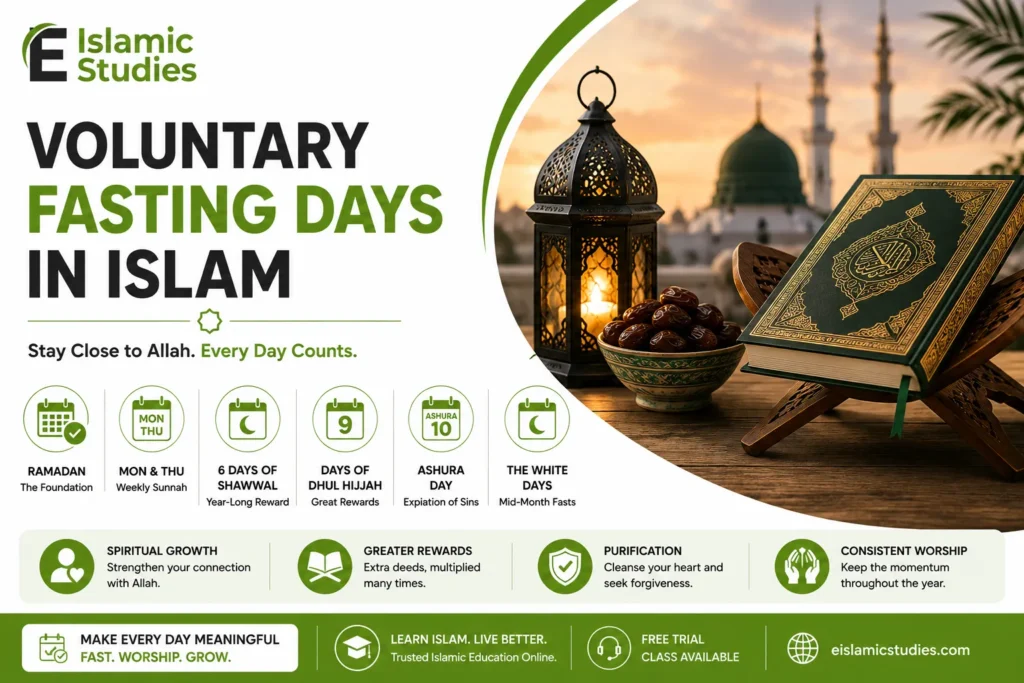
Many Muslims treat fasting as a Ramadan-only practice — and miss an entire year of extraordinary rewards. Voluntary fasting days in Islam are one of the most spiritually powerful yet consistently overlooked acts of worship, offering forgiveness, closeness to Allah, and rewards that the Prophet Muhammad, peace be upon him, described in vivid and specific terms.
This guide covers every established category of voluntary fasting in Islam — the days, the hadith evidence behind each, the rewards, and the days when fasting is completely forbidden. Every Muslim who wants to maintain the spiritual momentum of Ramadan throughout the year will find exactly what they need here.
1- Voluntary Fasting Builds on Ramadan’s Foundation
Ramadan is the obligatory pillar, but voluntary fasting days in Islam serve as the bridge that keeps its spiritual momentum alive throughout the year. Classical scholars have consistently described nafl fasting as the act that prevents the heart from reverting to its pre-Ramadan state.
Without it, the discipline, consciousness of Allah, and control over the nafs built in Ramadan diminish steadily within weeks of Eid. The theological basis for voluntary worship is rooted in a well-known sacred hadith that the Prophet, peace be upon him, conveyed from Allah:
“«مَا تَقَرَّبَ إِلَىَّ عَبْدِي بِشَىْءٍ أَحَبَّ إِلَىَّ مِمَّا افْتَرَضْتُ عَلَيْهِ، وَمَا يَزَالُ عَبْدِي يَتَقَرَّبُ إِلَىَّ بِالنَّوَافِلِ حَتَّى أُحِبَّهُ»”
“My slave comes nearer to Me, is what I have enjoined upon him; and My slave keeps on coming closer to Me through performing Nawafil (praying or doing extra deeds besides what is obligatory) till I love him.”
Voluntary fasting is among the most intimate of all nafl acts because it is the only worship Allah described as belonging exclusively to Him. This alone sets it apart from every other voluntary deed a Muslim can perform.
Many Muslims want to build a consistent voluntary worship routine but lack the structured Islamic knowledge to do so correctly. At E Islamic Studies Academy, the Islamic Classes for Adults are designed to provide exactly this — structured, scholar-led instruction in Islamic worship for adult learners at every level.
Read also: Top 10 Rules of Fasting in Islam Every Muslim Must Know

Build your worship with confidence today.
2- Mondays and Thursdays Are the Most Consistent Sunnah Fast
The most established weekly voluntary fasting days in Islam are Monday and Thursday. The Prophet Muhammad, peace be upon him, observed these fasts with remarkable consistency — and when asked about them, he gave two distinct and complementary reasons that make these the most well-supported voluntary fasts in the entire Sunnah.
The fasting on Monday and Thursday hadith that explains the first reason is:
“”«تُعْرَضُ الأَعْمَالُ يَوْمَ الاِثْنَيْنِ وَالْخَمِيسِ فَأُحِبُّ أَنْ يُعْرَضَ عَمَلِي وَأَنَا صَائِمٌ »”
“Tu’radu al-a’malu yawma al-ithnayn wal-khamis, fa uhibbu an yu’rada amali wa ana sa’im.”
“Deeds are presented on Monday and Thursday, and I love that my deeds be presented while I am fasting”
The second reason connects Monday specifically to the Prophet’s own birth and the beginning of revelation — making it a day of special significance in Islamic history. When asked about fasting on Monday, the Prophet, peace be upon him, said: “That is the day on which I was born and the day on which I received revelations.” This is recorded in Sahih Muslim.
The fasting on Monday and Thursday hadith tradition also establishes that Allah forgives every Muslim on these two days of presentation — with the only exception being those who are in a state of mutual boycott and estrangement.
This divine forgiveness is tied directly to the day itself, making these fasts an opportunity for spiritual cleansing that repeats every single week.
Read also: Top 10 Benefits of Fasting in Islam – Body, Mind, and Soul
3- Fasting Six Days of Shawwal Completes the Year’s Reward
Among all voluntary fasting days in Islam, fasting 6 days of Shawwal stands out for the magnitude of its reward relative to the effort required. Observed in the month immediately following Ramadan, these six days combine with the thirty days of Ramadan to produce a reward equivalent to fasting an entire year — based on the principle that each good deed is multiplied tenfold.
The Prophet Muhammad, peace be upon him, confirmed this reward in an authentic hadith:
“مَنْ صَامَ رَمَضَانَ ثُمَّ أَتْبَعَهُ سِتًّا مِنْ شَوَّالٍ كَانَ كَصِيَامِ الدَّهْرِ” .
“He who observed the fast of Ramadan and then followed it with six (fasts) of Shawwal. it would be as if he fasted perpetually.
The following table compares the three main approaches scholars discuss for fasting 6 days of Shawwal:
| Approach | Method | Scholarly Ruling |
| Consecutive days | Fast six days back-to-back starting from the 2nd of Shawwal | Preferred by Hanafi and Shafi’i scholars |
| Spread across the month | Fast any six days throughout Shawwal | Valid and permissible by scholarly consensus |
| Combined with makeup days | Fast makeup days first, then Shawwal days | Required if a person has outstanding Ramadan makeup days |
One important ruling scholars emphasize: a person who has outstanding makeup fasts from Ramadan must complete those first before fasting 6 days of Shawwal voluntarily. The obligation takes priority over the recommended act.
At E Islamic Studies Academy, the Online Tafseer Course connects students to the Quranic and prophetic foundations behind all acts of worship, helping them understand not just what to do but why Allah prescribed it.
Read also: What Is Bid’ah in Islam? Definition, Types, and Evidence

Understand your worship more deeply today.
Read also: Attahiyat and Tashahhud: Complete Arabic Guide with Meaning
4- White Days Fasting Islam Recommends Every Single Month
White days fasting Islam refers to the practice of fasting on the 13th, 14th, and 15th of every lunar month — the days during which the full moon illuminates the night sky. These three days carry a consistent monthly reward that scholars have placed among the most reliable and sustainable voluntary fasting routines in the entire Sunnah.
The Prophet Muhammad, peace be upon him, commanded this practice directly:
“إِذَا صُمْتَ شَيْئًا مِنَ الشَّهْرِ فَصُمْ ثَلاَثَ عَشْرَةَ وَأَرْبَعَ عَشْرَةَ وَخَمْسَ عَشْرَةَ”.
“if you want to fast at any time during the monthm then fast on the thirteenth, fourteenth and fifteenth.”
Abu Huraira, may Allah be pleased with him, reported that the Prophet gave him three personal recommendations he committed to maintaining until death — and white days fasting was one of them, alongside two units of duha prayer and sleeping after witr. This narration in Sahih Al-Bukhari and Sahih Muslim demonstrates that white days fasting was not a casual recommendation but a consistent personal practice the Prophet valued enough to personally counsel his companions to maintain for life.
The reward of white days fasting Islam grants — equivalent to fasting the entire month — is based on the multiplication of each good deed tenfold. Three days multiplied by ten gives thirty, which equals a complete lunar month.
Repeated every month, this practice produces the reward of year-round fasting without the physical difficulty of actual continuous abstention.
5- The Day of Arafah Earns the Greatest Single-Day Reward
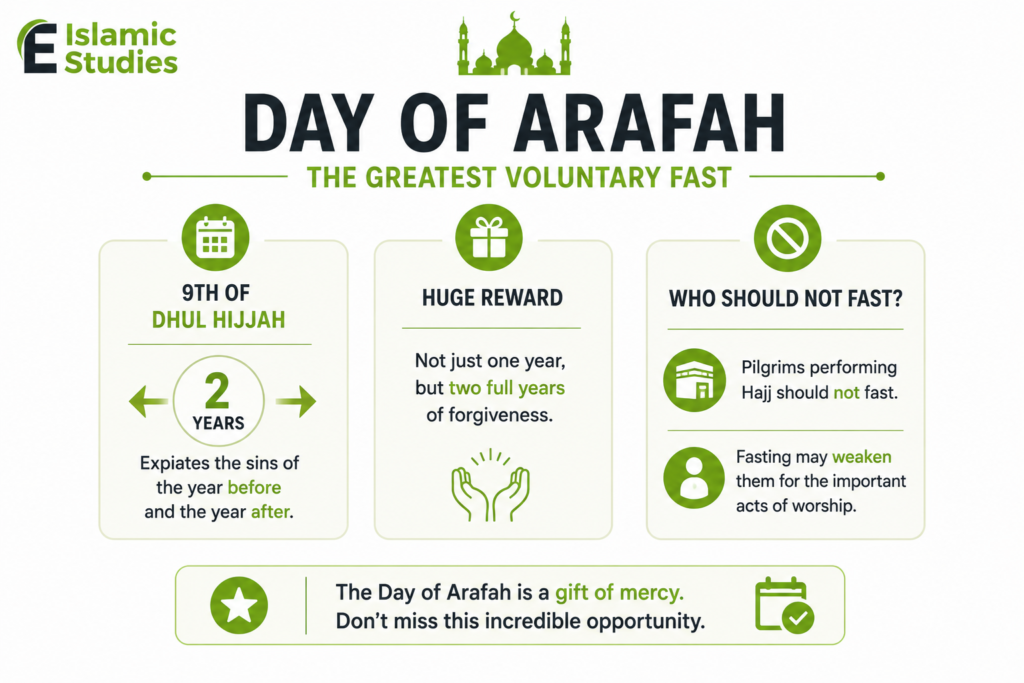
Among all individual voluntary fasting days in Islam, the Day of Arafah — the 9th of Dhul Hijjah — produces the single greatest reward available to Muslims who are not performing Hajj that year. Its reward is not just expiation for the current year but extends backward and forward simultaneously, covering two full years of sins.
The Prophet Muhammad, peace be upon him, established this reward explicitly:
“صِيَامُ يَوْمِ عَرَفَةَ أَحْتَسِبُ عَلَى اللَّهِ أَنْ يُكَفِّرَ السَّنَةَ الَّتِي قَبْلَهُ وَالسَّنَةَ الَّتِي بَعْدَهُ”
“Fasting on the Day of Arafah, I hope that Allah will expiate thereby the sins of the year before it and the year after it.”
An important ruling scholars have established: the Day of Arafah fast is specifically recommended for those who are not performing Hajj that year. A pilgrim standing at Arafah on that day should not fast, because the Prophet, peace be upon him, was not fasting when he performed the farewell Hajj, and because fasting might weaken the pilgrim for the essential acts of worship required at Arafah itself.
See Our Islamic Studies Classes in Action
Take a look at a sample lesson and see how our interactive online classes help students learn Islamic Studies in a clear, engaging, and supportive environment.
Deepen Your Islamic Knowledge
Join our comprehensive online courses and learn from qualified scholars today.
Book Your Free Trial6- Ashura and Tasu’a Carry Their Own Distinct Category of Expiation
The 10th of Muharram, known as Ashura, is among the most historically significant voluntary fasting days in Islam. The Prophet Muhammad, peace be upon him, found the People of the Book fasting this day when he arrived in Madinah — and was told they were honoring the day Allah saved Prophet Musa, peace be upon him, and his people from Pharaoh. The Prophet responded by having an even greater right to honor Musa, and he fasted and commanded the Muslims to fast.
The reward for fasting Ashura is established in a direct prophetic statement:
“صِيَامُ يَوْمِ عَاشُورَاءَ أَحْتَسِبُ عَلَى اللَّهِ أَنْ يُكَفِّرَ السَّنَةَ الَّتِي قَبْلَهُ”
“Fasting on the Day of Ashura, I hope that Allah will expiate thereby the sins of the year before it.”
To distinguish Muslim practice from that of the Jews who also fasted on this day, the Prophet, peace be upon him, intended to add the 9th of Muharram — known as Tasu’a — to the fast. His death came before the following year, but scholars unanimously recommend fasting both the 9th and 10th together. The three levels of observing Ashura fasting that scholars have established are:
- Fasting the 9th, 10th, and 11th of Muharram together.
- Fasting the 9th and 10th together — the most strongly recommended combination.
- Fasting only the 10th — valid but less complete than the above.
At E Islamic Studies Academy, the Islamic History Course provides students with the full historical and scholarly context behind events like Ashura, connecting Islamic history directly to worship and daily practice.

Learn the history behind your worship today.
7- The First Nine Days of Dhul Hijjah Are Among the Best for Fasting
The first ten days of Dhul Hijjah are described in an authentic hadith as the days most beloved to Allah for righteous deeds. Fasting during the first nine of these days — since the 10th is Eid al-Adha when fasting is forbidden — is a practice scholars strongly recommend, particularly for Muslims who are not performing Hajj that year.
The Prophet Muhammad, peace be upon him, identified these days as uniquely beloved:
“«مَا مِنْ أَيَّامٍ الْعَمَلُ الصَّالِحُ فِيهَا أَحَبُّ إِلَى اللَّهِ مِنْ هَذِهِ الْأَيَّامِ»”
“There are no days on which righteous deeds are more beloved to Allah than these days.”
The companions asked whether even jihad in the path of Allah does not compare, and the Prophet confirmed that even jihad does not surpass the value of righteous deeds performed in these specific days — with the sole exception of a man who gives his life and his wealth entirely in the path of Allah. Fasting during these days is therefore among the most highly rewarded acts a Muslim can perform for the spiritual value of the time itself.
8- Certain Days Are Completely Forbidden for Fasting
Every Muslim who observes voluntary fasting days in Islam must also know the days on which fasting is absolutely prohibited. Fasting on these days is not merely discouraged — it is haram, and a fast observed on any of them is invalid regardless of the intention behind it.
The five days forbidden for fasting are:
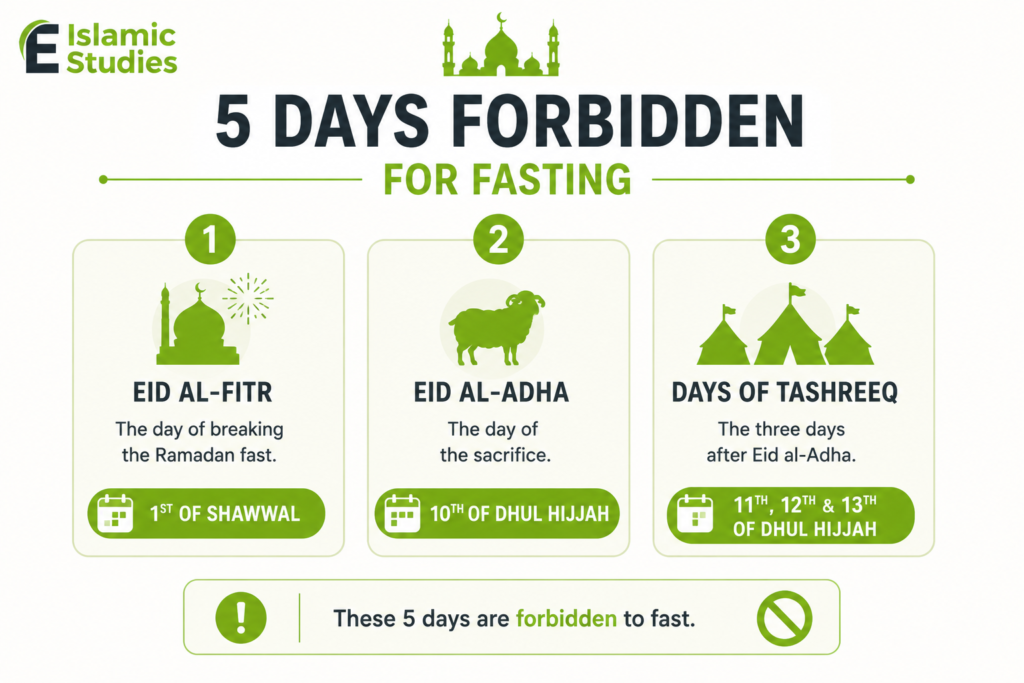
- Eid al-Fitr — the 1st of Shawwal, the day of breaking the Ramadan fast.
- Eid al-Adha — the 10th of Dhul Hijjah, the day of the sacrifice.
- The three days of Tashreeq — the 11th, 12th, and 13th of Dhul Hijjah.
The Prophet Muhammad, peace be upon him, prohibited fasting on Eid al-Fitr and Eid al-Adha explicitly, as narrated by Abu Sa’id al-Khudri and recorded in both Sahih Al-Bukhari and Sahih Muslim. The days of Tashreeq are days of eating, drinking, and remembering Allah — and the Prophet described them this way explicitly. The only exception for fasting on Tashreeq days applies to a Hajj pilgrim performing Hajj Tamattu’ who cannot find an animal to sacrifice and has no other option.
The following table summarizes all established voluntary fasting days alongside the forbidden days for clarity:
| Category | Days | Reward |
| Mondays and Thursdays | Weekly | Deeds presented to Allah while fasting |
| White Days | 13th, 14th, 15th of every lunar month | Equivalent to fasting the full month |
| Six days of Shawwal | Any 6 days in Shawwal | Equivalent to fasting the full year |
| Day of Arafah | 9th of Dhul Hijjah | Expiation of two years of sins |
| Ashura | 9th and 10th of Muharram | Expiation of one year of sins |
| First nine of Dhul Hijjah | 1st to 9th of Dhul Hijjah | Most beloved days for all righteous deeds |
| Eid al-Fitr | 1st of Shawwal | Forbidden — fasting is haram |
| Eid al-Adha | 10th of Dhul Hijjah | Forbidden — fasting is haram |
| Days of Tashreeq | 11th, 12th, 13th of Dhul Hijjah | Forbidden — except Hajj Tamattu’ exception |
9- The Alternating Day Fast Carries the Highest Daily Status
Among all voluntary fasting days in Islam, the alternating day fast — fasting one day and breaking the fast the next — holds the highest status in the hadith literature. The Prophet Muhammad, peace be upon him, described it as the most beloved fast to Allah among all voluntary fasting patterns.
This fast is known as the fast of Prophet Dawud, peace be upon him, and its superiority is recorded in an authentic statement:
“أَحَبُّ الصَّلاَةِ إِلَى اللَّهِ صَلاَةُ دَاوُدَ ـ عَلَيْهِ السَّلاَمُ ـ وَأَحَبُّ الصِّيَامِ إِلَى اللَّهِ صِيَامُ دَاوُدَ، وَكَانَ يَنَامُ نِصْفَ اللَّيْلِ وَيَقُومُ ثُلُثَهُ وَيَنَامُ سُدُسَهُ، وَيَصُومُ يَوْمًا وَيُفْطِرُ يَوْمًا”
“The most beloved prayer to Allah is that of David and the most beloved fasts to Allah are those of David. He used to sleep for half of the night and then pray for one third of the night and again sleep for its sixth part and used to fast on alternate days.”
The Prophet explicitly warned that this fast should not be taken on by those whose health, family responsibilities, or work cannot accommodate it. The companion who declared he would fast every single day without break was corrected by the Prophet — “There is no fast for one who fasts forever.” Sustainability in voluntary fasting is a principle the Sunnah has built directly into its guidance on this topic.
At E Islamic Studies Academy, the Tazkiyya Course helps students develop the consistent spiritual discipline that makes voluntary fasting sustainable — addressing the heart, the habits, and the long-term relationship with Allah that voluntary worship requires.

Build sustainable worship from the inside out.
10- Sha’ban Is the Most Overlooked Month for Voluntary Fasting
Among all voluntary fasting days in Islam, the month of Sha’ban stands out as the most consistently overlooked. The Prophet Muhammad, peace be upon him, fasted more in Sha’ban than in any month other than Ramadan — yet he specifically noted that people tend to neglect this month precisely because it falls between the sacred month of Rajab and the obligatory fasting of Ramadan.
Aisha, may Allah be pleased with her, observed this pattern directly and reported it:
“فَمَا رَأَيْتُ رَسُولَ اللَّهِ صلى الله عليه وسلم اسْتَكْمَلَ صِيَامَ شَهْرٍ إِلاَّ رَمَضَانَ، وَمَا رَأَيْتُهُ أَكْثَرَ صِيَامًا مِنْهُ فِي شَعْبَانَ”
I never saw Allah’s Messenger (ﷺ) fasting for a whole month except the month of Ramadan, and did not see him fasting in any month more than in the month of Sha’ban.
The Prophet explained this practice by noting that Sha’ban is the month in which deeds are raised to Allah — and he loved that his deeds be raised while he was fasting. Sha’ban therefore serves a dual function: it is both a period of elevated spiritual presentation before Allah and a natural ramp-up for the body and soul before the obligatory fasting of Ramadan begins.
Watch a Sample Islamic Studies Class
See how our teachers explain Islamic concepts in an engaging and easy-to-understand way, helping students build knowledge and confidence.
Deepen Your Islamic Knowledge
Join our comprehensive online courses and learn from qualified scholars today.
Book Your Free TrialE Islamic Studies Academy Connects You to Qualified Islamic Scholarship
Thousands of Muslims across the world want to worship with confidence — knowing their fasting, prayer, and daily practice are correct, grounded in authentic scholarship, and connected to real understanding. E Islamic Studies Academy was built to make this accessible for every Muslim, everywhere.
The academy offers one-on-one live sessions with qualified scholars grounded in classical Islamic sciences including Aqeedah, Fiqh, Sarf, Nahw, and Tafseer. Programs run from complete beginner foundations through to advanced traditional Alim-level scholarship.
Dedicated courses exist for women, children, new converts, adult learners, and sisters seeking female-led instruction. All global time zones are served, monthly progress reports are issued after every session, and a free trial class is available before any commitment.
Our Islamic Essentials Courses
- Essential Islam Courses
- Online Tafseer Course
- Islamic History Course
- Tazkiyah Course
- Online Qirat Course
- Quran Tafseer Classes for Beginners — Introductory Interpretation
- Online Tafseer Classes in English
- Self-Paced Tafseer Course — Flexible Learning Programs
- Aqidah Course — Islamic Creed and Theology Classes
- Online Seerah Course — Life of Prophet Muhammad Classes
- Akhlaq Course — Islamic Ethics and Character Development
Our Fiqh Courses
- Online Fiqh Course — Islamic Jurisprudence Classes
- Fiqh Class for New Muslims — Beginners Fiqh
- Fiqh of Marriage Course — Islamic Marriage Jurisprudence
- Comparative Fiqh Course — Comparing Islamic Schools
- Fiqh of Salah Course — Prayer Jurisprudence
- Hanafi Fiqh Course — Hanafi School Jurisprudence
- Maliki Fiqh Course — Maliki School Jurisprudence
- Shafi Fiqh Course — Shafi School Jurisprudence
- Hanbali Fiqh Course — Hanbali School Jurisprudence
Register at E Islamic Studies Academy today.
Deepen Your Islamic Knowledge
Join our comprehensive online courses and learn from qualified scholars today.
Book Your Free TrialConclusion
Voluntary fasting days in Islam offer every Muslim an extraordinary opportunity to earn rewards, seek forgiveness, and maintain the spiritual state of Ramadan across the entire year. From weekly Mondays and Thursdays to the annual Day of Arafah, each category is supported by authentic hadith and carries rewards the Prophet described in specific and powerful terms. Begin with one day this week — and build from there.
Frequently Asked Questions
What are the main voluntary fasting days in Islam?
The main voluntary fasting days in Islam include Mondays and Thursdays, white days, six days of Shawwal, the Day of Arafah, Ashura and Tasu’a, and the first nine days of Dhul Hijjah.
What does the fasting on Monday and Thursday hadith say?
The fasting on Monday and Thursday hadith states that deeds are presented to Allah on these two days, and the Prophet loved his deeds to be presented while he was fasting.
What is the reward for fasting 6 days of Shawwal?
Fasting 6 days of Shawwal after completing Ramadan equals the reward of fasting an entire year, based on the principle that each deed is multiplied tenfold — thirty plus sixty equals the full year.
What is white days fasting Islam recommends?
White days fasting Islam refers to fasting the 13th, 14th, and 15th of every lunar month. Three days fasted monthly produce the reward of fasting the entire month because each deed is multiplied tenfold.
Are there days when fasting is forbidden in Islam?
Yes. Fasting is completely forbidden on Eid al-Fitr, Eid al-Adha, and the three days of Tashreeq. Any fast observed on these days is invalid regardless of intention.







Leave a Reply