 Learning Islam

Of all the secondary tools of Islamic jurisprudence, istihsan in Islam is the most frequently debated. Critics dismissed it as personal preference. Supporters called it indispensable. The classical record shows the real dispute was almost entirely terminological — not substantive.
This guide covers the complete istihsan definition, its six types with examples, the scholarly positions on its authority, its distinction from legal dispensations, and why the Hanafi scholars named it istihsan specifically — all drawn from verified Sunni sources.
Istihsan in Islam — Linguistic and Legal Definition
The word istihsan derives from the Arabic root meaning beauty and goodness — to deem something preferable or good. In legal terminology, scholars offered three main definitions with different weights:
The first definition — “an evidence arising in the mind of the mujtahid that his expression cannot convey” — was criticized and rejected even by those who accept istihsan, because what cannot be expressed cannot be evaluated for soundness.
The second definition — “what the mujtahid deems good by his reason” — was also rejected. The Hanafi scholars themselves denied this was ever what Imam Abu Hanifa intended.
The third and accepted definition is: the mujtahid’s departure from the ruling applied to analogous cases toward a contrary ruling based on a stronger consideration. Imam Al-Ghazali said of this definition: “This is something no one denies.”
This definition resolves into two core elements. The first is preferring a hidden qiyas over an apparent qiyas when the hidden one is proven stronger in its effect. The second is excluding a specific case from a general rule based on a particular evidence that requires that exclusion.
The Egyptian Ministry of Awqaf scholars summarize it as: “Working with the stronger of two evidences, or taking a partial interest against a general principle.”
Why did the Hanafi scholars name it istihsan?
The Hanafi scholars used this name specifically to distinguish between two competing rulings. When a ruling follows the apparent qiyas that first comes to mind, they called it qiyas. When a ruling departs from that apparent qiyas in favor of a deeper, hidden qiyas — or a textual or customary basis — they called it istihsan. The distinction is not between evidence and no evidence, but between apparent evidence and deeper evidence. They named it istihsan because they found the departure from the obvious ruling to be the preferable and sounder choice.
At E Islamic Studies Academy, the Traditional Alim Courses guide advanced students through usul al-fiqh — including istihsan and its complete methodology.

Study Islamic jurisprudence at the highest level today.
The Six Types of Istihsan Islamic Jurisprudence Recognizes
Istihsan by Quranic Text:
Bequests would be invalid under qiyas because ownership cannot be transferred after death when ownership itself ceases. The Quran authorized bequests explicitly:
” مِن بَعْدِ وَصِيَّةٍ يُوصِي بِهَا أَوْ دَيْنٍ”
Min ba’di wasiyyatin yusa biha aw dayn.
“After any bequest he may have made or any debt.”
The text overrides the qiyas ruling — this departure is istihsan by Quranic text.
Istihsan by Ijma
The istisna’ contract — commissioning manufacture of a specific item at an agreed price — would be void under qiyas because the object does not exist at contracting. Scholars across all generations permitted it without objection, creating an ijma that overrides the qiyas ruling.
Istihsan by Hidden Qiyas
This is the most technically complex type. A case subject to two competing analogies — one apparent and one hidden — is resolved by preferring the stronger one in effect, not the more obvious one.
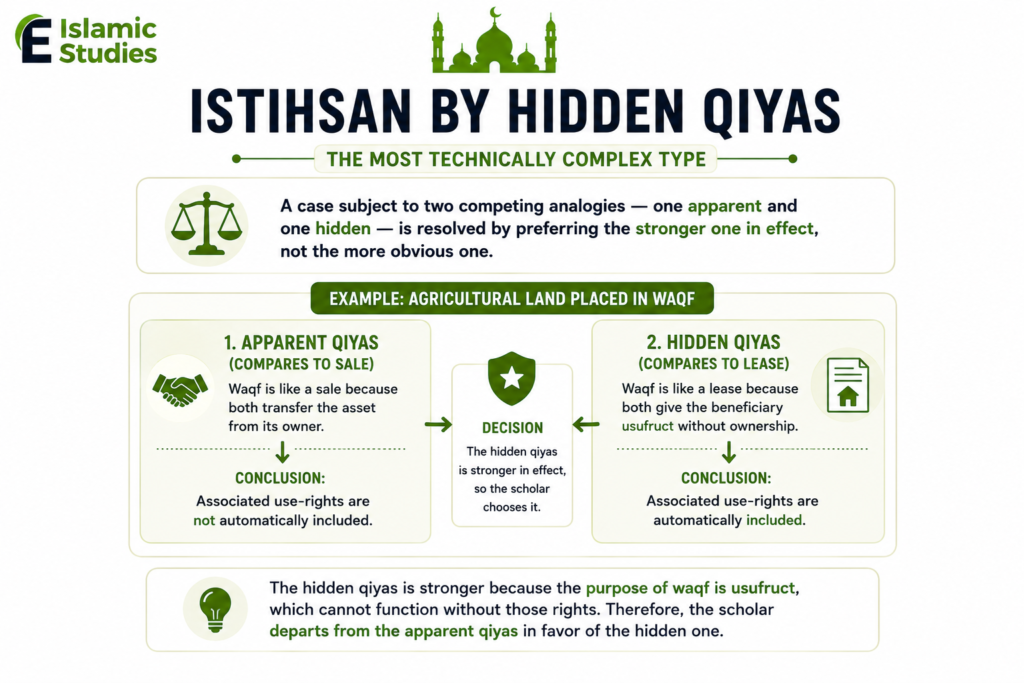
Example: agricultural land placed in waqf. The apparent qiyas compares waqf to a sale — since both transfer the asset from its owner — which means associated use-rights are not automatically included.
The hidden qiyas compares waqf to a lease — since both give the beneficiary usufruct without ownership — which means associated use-rights are automatically included. The hidden qiyas is stronger because the purpose of waqf is usufruct, which cannot function without those rights. The scholar departs from the apparent qiyas in favor of the hidden one.
Read also: What Is Ijma in Islam? Definition, Types, and Evidence
See Our Islamic Studies Classes in Action
Take a look at a sample lesson and see how our interactive online classes help students learn Islamic Studies in a clear, engaging, and supportive environment.
Deepen Your Islamic Knowledge
Join our comprehensive online courses and learn from qualified scholars today.
Book Your Free TrialIstihsan by Custom
The Hanafi general principle holds that conditions attached to a sales contract beyond the essential terms are void. However, conditions universally established by custom among people are permitted through istihsan — because commerce depends on honoring customary practices.
Istihsan by Public Interest
The Maliki school holds that a hired worker employed by multiple clients is a trustee not liable for damages without negligence. However, Maliki scholars applied istihsan to hold shared workers liable — because exempting them from liability would encourage negligence and harm clients who depend on their work.
Istihsan by Necessity
Contaminated wells would require complete cleaning under the general principle — often impossible in practice. Scholars permitted drawing a measured amount of water and treating the remainder as purified, through istihsan by necessity.
The following table summarizes all six types:
| Type | Basis | Classic Example |
| By Quranic Text | Direct textual authorization | Bequests permitted despite qiyas |
| By Ijma | Universal scholarly practice | Istisna’ manufacturing contract |
| By Hidden Qiyas | Stronger hidden analogy | Waqf land with use-rights |
| By Custom | Established social practice | Customary contract conditions |
| By Public Interest | Maslaha stronger than qiyas | Liability of shared hired workers |
| By Necessity | Hardship makes qiyas unworkable | Purification of contaminated wells |
The Schools and Their Positions on Istihsan
The Hanafi, Maliki, and Hanbali schools accept istihsan as a valid legal tool. Imam Malik stated: “Nine-tenths of knowledge is istihsan.” The Shafi’i and Zahiri schools and the Mu’tazila rejected it — but the precise scope of their rejection is critical to understand.
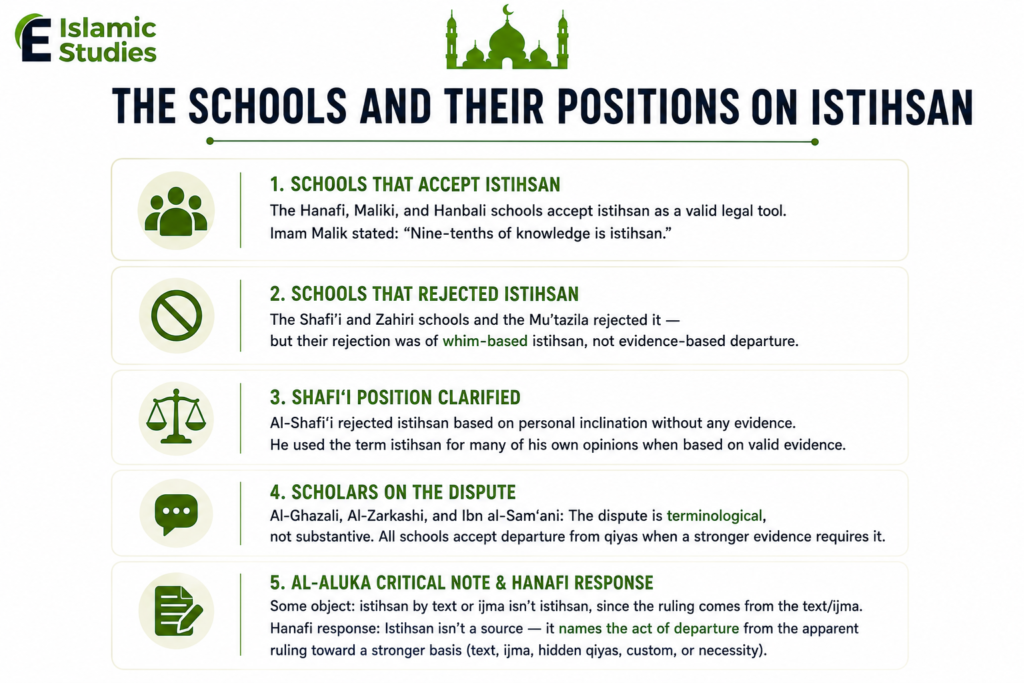
What Al-Shafi’i rejected was istihsan based purely on personal inclination without any recognized evidence. Al-Zarkashi documented nearly twenty Shafi’i legal opinions that Al-Shafi’i himself described using the word istihsan — proving that what he condemned was whim-based departure from qiyas, not evidence-based departure.
Al-Ghazali confirmed after presenting the correct istihsan definition: “The objection returns only to the word and the choice to name this type of evidence istihsan among other evidences.”
Al-Zarkashi and Ibn al-Sam’ani both concluded explicitly that the dispute between the schools is terminological — not substantive. Every school accepts departure from qiyas when a stronger evidence requires it. The disagreement is only about whether to call this departure istihsan.
A critical note from the Al-Aluka scholarship: some scholars objected that istihsan by text and istihsan by ijma are not really istihsan at all — because the ruling in those cases is established by the text or ijma directly, not by istihsan.
The Hanafi response is that istihsan is not a separate source establishing rulings — it is a name for the type of departure. The ruling is established by the text, ijma, hidden qiyas, custom, or necessity. Istihsan names the act of departure from the apparent ruling toward that stronger basis.
At E Islamic Studies Academy, the Online Tafseer Course helps students understand the Quranic verses behind Islamic legal reasoning — including those cited in establishing istihsan.

Connect your worship to scholarly understanding today.
Istihsan and Legal Dispensations — An Important Distinction
Istihsan in Islam and legal dispensations share a surface similarity — both involve departing from a general ruling in a specific case. However, they differ in a fundamental way that classical scholars explicitly identified.
A legal dispensation always produces a ruling that is lighter and easier than the original ruling — the dispensation relieves hardship. Istihsan does not have this restriction. The ruling reached through istihsan may be lighter than the general principle — as in permitting the istisna’ contract. But it may also be stricter — as in the Maliki position holding the shared worker liable for damages, which is a heavier ruling than the general principle of trustee non-liability.
This means istihsan is broader than legal dispensations. Every legal dispensation involves a type of departure from the general rule, but not every istihsan produces a lighter ruling or arises from hardship.
At E Islamic Studies Academy, the Essential Islamic Courses teach students the foundational knowledge of Fiqh — including how secondary tools like istihsan, maslaha, and dispensations are correctly distinguished and applied.

Build your Islamic knowledge with qualified scholars today.
Watch a Sample Islamic Studies Class
See how our teachers explain Islamic concepts in an engaging and easy-to-understand way, helping students build knowledge and confidence.
Deepen Your Islamic Knowledge
Join our comprehensive online courses and learn from qualified scholars today.
Book Your Free TrialE Islamic Studies Academy Brings You Authentic Islamic Scholarship
Thousands of Muslims worldwide want to understand Islamic jurisprudence at the level of real classical scholarship grounded in Sunni methodology. E Islamic Studies Academy provides one-on-one live sessions with qualified scholars trained in classical Islamic sciences including Aqeedah, Fiqh, Sarf, Nahw, and Tafseer.
Programs run from complete beginner foundations through traditional Alim-level scholarship. Dedicated courses exist for women, new converts, children, adult learners, and sisters seeking female-led instruction. All global time zones are covered and a free trial class is available before any commitment.
Register at E Islamic Studies Academy today.
Deepen Your Islamic Knowledge
Join our comprehensive online courses and learn from qualified scholars today.
Book Your Free TrialConclusion
Istihsan in Islam is a precisely defined, evidence-based tool of Islamic jurisprudence. Its istihsan definition, six types, and schools of acceptance all point to a disciplined scholarly practice grounded entirely in recognized Sharia sources. The dispute over its name should not obscure the substantive agreement among scholars: departure from apparent qiyas in favor of a stronger evidence is not only permitted — it is required.
Frequently Asked Questions
What is istihsan in Islam?
Istihsan in Islam is the mujtahid’s departure from a ruling applied to analogous cases toward a contrary ruling supported by a stronger evidence — such as text, ijma, hidden qiyas, custom, public interest, or necessity.
What is the istihsan definition in Islamic jurisprudence?
The istihsan definition accepted by classical scholars is: departing from the ruling applied to analogous cases toward a contrary ruling based on a stronger consideration. It resolves into preferring a hidden qiyas over an apparent one, or excluding a case from a general rule based on a specific evidence.
Which schools accept istihsan Islamic jurisprudence recognizes?
The Hanafi, Maliki, and Hanbali schools accept istihsan. The Shafi’i school rejected istihsan based on whim only — not istihsan grounded in recognized evidence. Classical scholars confirmed the dispute is terminological.
Is istihsan the same as legal dispensation?
No. Legal dispensations always produce a lighter ruling. Istihsan may produce a lighter or a stricter ruling than the general principle — making istihsan broader in scope than legal dispensations.
Is istihsan an independent source of Islamic law?
No. Istihsan is not a source establishing rulings independently. The ruling is established by the underlying evidence — text, ijma, qiyas, custom, or necessity. Istihsan names the act of departure from the apparent ruling toward that stronger basis.








Leave a Reply