 Learning Islam
Has your child ever asked you what Iman in Islam is, and you paused to find the right words? Many parents and adult learners recite “Amantu billahi” daily, yet few can explain it clearly.
In short, Iman is firm belief in the heart, declared by the tongue, and proven by the limbs. It is the second level of the religion, after Islam and before Ihsan.
This guide explains what Iman is in Islam in detail: its meaning, the six pillars of Iman, how it differs from Islam, and how to make it grow.
What You Will Learn
- A clear, scholar-backed answer to what Iman is in Islam.
- The Iman meaning in Islam, in Arabic language and in Shariah.
- The six pillars of Iman, explained simply for kids and adults.
- The difference between Iman and Islam according to Ahl al-Sunnah.
- Practical steps that increase your Iman every day.
What Is Iman in Islam?
Iman in Islam is true belief in Allah and everything He told us about. It is held with certainty in the heart, spoken with the tongue, and acted on with the body. It is belief that produces action, not a feeling alone.
When early scholars were asked what Iman is in Islam, Imam Ahmad answered: “Iman is speech and action; it increases and decreases.” Imam al-Shafi’i reported a consensus of the Companions on this definition.
Where Iman Sits in the Religion
The clearest answer to what is Iman in Islam comes from the Hadith of Jibril. In that hadith, Islam covers visible worship, Iman covers beliefs of the heart, and Ihsan is worshipping Allah as though you see Him.
قَالَ ” أَنْ تُؤْمِنَ بِاللَّهِ وَمَلاَئِكَتِهِ وَكُتُبِهِ وَرُسُلِهِ وَالْيَوْمِ الآخِرِ وَتُؤْمِنَ بِالْقَدَرِ خَيْرِهِ وَشَرِّهِ ”
The Prophet ﷺ said Iman is “to believe in Allah, His angels, His books, His messengers, the Last Day, and divine decree, its good and its bad” (Sahih Muslim 8).
Why Understanding Iman Matters
Knowing what is Iman in Islam shapes how a Muslim prays, behaves, and faces hardship. For children, it builds a confident Muslim identity. For adults, it turns routine worship into worship with presence.
Live Class in Action
Watch how our instructors interact with students in real time, focusing on interactive methods.
Deepen Your Islamic Knowledge
Join our comprehensive online courses and learn from qualified scholars today.
Book Your Free TrialIman Meaning in Islam
To fully answer what Iman is in Islam, scholars look at two angles: its meaning in the Arabic language and its meaning in Islamic terminology. Together they show that Iman is deeper than simple agreement.
a. The Linguistic Meaning of Iman
In Arabic, Iman comes from the root a-m-n, which carries the sense of safety, trust, and certainty. Linguists agree its core meaning is tasdiq: affirming something as true.
Yet Iman is more than knowledge. Iblis knew Allah exists but refused to submit, so his knowledge was not faith.
b. The Technical Meaning: Belief, Words, and Deeds
In Shariah, the answer to what is Iman in Islam according to Ahl al-Sunnah is belief in the heart, a statement on the tongue, and action with the limbs. Imam al-Baghawi said the Companions agreed that deeds are part of Iman.
In Surah al-Baqarah (2:143), Allah calls the believers’ prayers “your Iman,” showing that righteous actions count as faith.
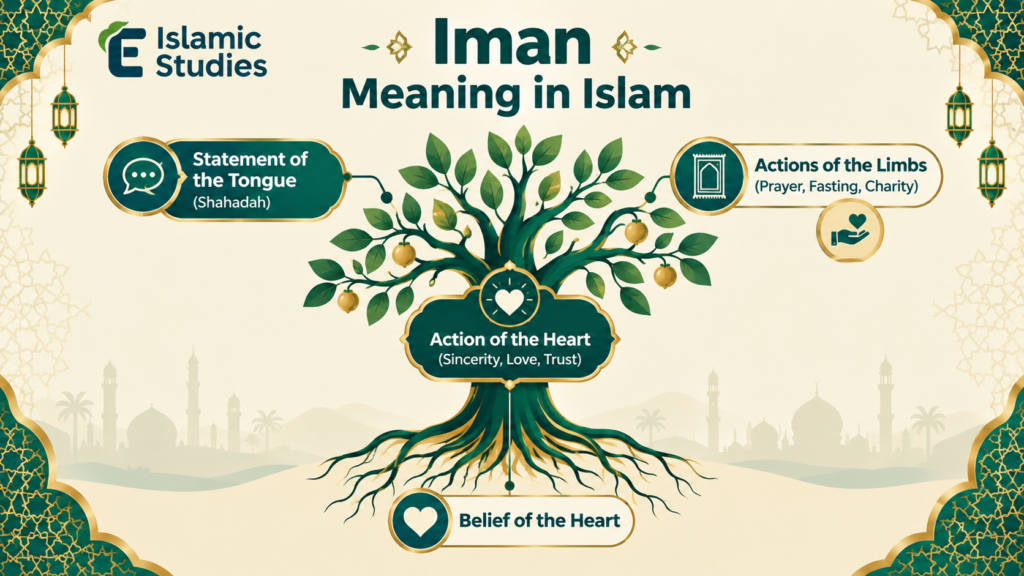
c. The Four Parts of Iman
Iman is not a single act; it is a complete structure that involves the inner self and the outer self together. This is why Ahl al-Sunnah say that faith is made of both words and deeds, from the heart and from the body. Scholars break their answer to what Iman is in Islam into four connected parts:
- Statement of the heart: firm belief without doubt.
- Statement of the tongue: declaring the Shahadah.
- Action of the heart: love, sincerity, fear, hope, and reliance on Allah.
- Action of the limbs: prayer, fasting, charity, and every good deed.
If belief in the heart is missing, the other parts bring no benefit. To study these foundations step by step, our Learning Islam Level 1 course covers Aqeedah basics with qualified teachers.
Six Pillars of Iman
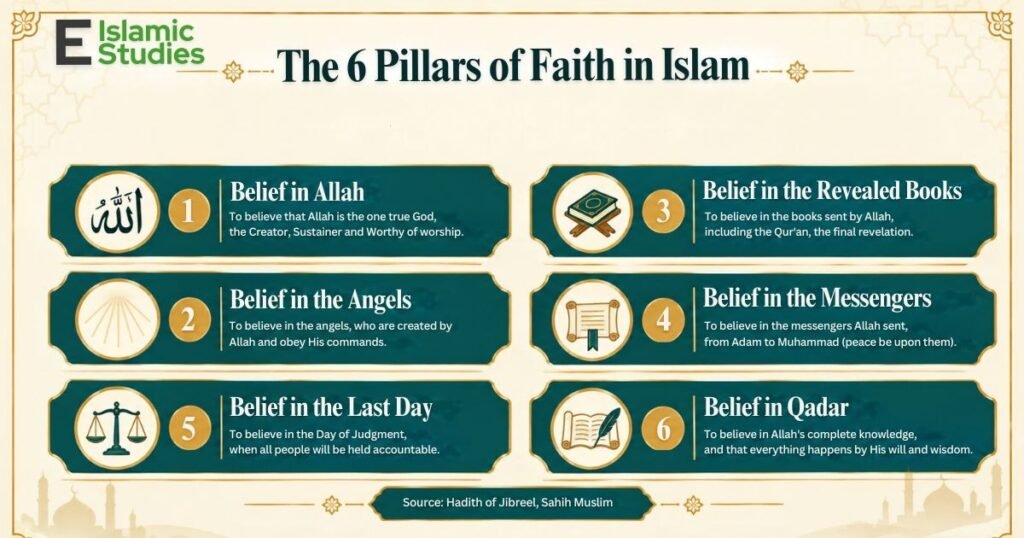
Any complete answer to what is Iman in Islam must include the six pillars of Iman. Allah mentions them in Surah an-Nisa (4:136), and the Prophet ﷺ listed all six in the Hadith of Jibril. Rejecting any one of them breaks a person’s faith.
- Belief in Allah: This means believing that Allah exists, that He is the only Creator and Lord, that He alone deserves worship, and that He has beautiful names and perfect attributes.
- Belief in the Angels: Angels are created from light and never disobey Allah. Muslims believe in all of them, including named ones like Jibril, who delivered revelation.
- Belief in the Revealed Books: Allah sent the Torah, the Zabur, the Injil, and the Quran to guide humanity. The Quran is the final book, and Allah has preserved it from any change.
- Belief in the Messengers: Muslims believe in every prophet Allah sent, from Adam and Nuh to Ibrahim, Musa, and Isa. Muhammad ﷺ is the final messenger, with no prophet after him.
- Belief in the Last Day: This includes resurrection, reckoning, Paradise, and Hellfire. Remembering the Hereafter keeps a believer honest and motivated.
- Belief in Divine Decree (Qadar): Everything happens by Allah’s knowledge, will, and decree, both what seems good and what seems bad. This belief brings peace in hardship and humility in success.
Teaching kids what is Iman in Islam works best with stories and repetition. Our Islamic classes for kids turn each of the six pillars of Iman into an engaging, age-appropriate lesson.
Iman in Islam vs. Islam: What Is the Difference?
A common follow-up to what Iman in Islam is is how it relates to Islam itself. Shaykh Ibn Baz explained the rule: when the two words appear together, they differ, and when one appears alone, it includes the other.
When They Are Mentioned Together
Islam refers to outward acts such as the Shahadah, prayer, zakah, fasting, and Hajj. Iman refers to the inner beliefs of the heart, as in the Hadith of Jibril.
The Quran shows this in Surah al-Hujurat (49:14). The Bedouins said “We believe,” and they were told to say “We have submitted,” because Iman had not yet entered their hearts.
When either word is used alone, it covers the whole religion, inward and outward. This is key to understanding what is Iman in Islam: every true believer is a Muslim, but not every Muslim has reached the full rank of Iman.
Experience Our Classrooms
Don’t just take our word for it—take a look inside! Watch the videos below to experience our engaging teaching methods and vibrant online classrooms firsthand.
Deepen Your Islamic Knowledge
Join our comprehensive online courses and learn from qualified scholars today.
Book Your Free TrialKey Characteristics of Iman in Islam
Understanding what Iman is in Islam also means knowing its qualities. Two features stand out in the Quran and Sunnah, and both affect daily life directly.
Iman Increases and Decreases
According to Ahl al-Sunnah, Iman grows with obedience and weakens with sins. It is not a fixed level that stays the same throughout life, and the Quran confirms this clearly:
إِنَّمَا ٱلْمُؤْمِنُونَ ٱلَّذِينَ إِذَا ذُكِرَ ٱللَّهُ وَجِلَتْ قُلُوبُهُمْ وَإِذَا تُلِيَتْ عَلَيْهِمْ ءَايَـٰتُهُۥ زَادَتْهُمْ إِيمَـٰنًۭا وَعَلَىٰ رَبِّهِمْ يَتَوَكَّلُونَ
“When His verses are recited to them, it increases them in faith” (Al-Anfal 8:2).
This verse links the growth of faith directly to remembering Allah and listening to the Quran. When a believer reflects on Allah’s words, the heart becomes softer, trust in Allah grows stronger, and Iman rises with it. Part of knowing what Iman in Islam is is realising that no one is stuck at one level. Every prayer and every act of repentance can raise your Iman.
Iman Has More Than Seventy Branches
Iman is not only a belief locked inside the heart; it shows up in what we say and how we treat others. The Prophet ﷺ described this in one hadith that groups all of faith into many connected branches. The Prophet ﷺ said:
” الإِيمَانُ بِضْعٌ وَسَبْعُونَ أَوْ بِضْعٌ وَسِتُّونَ شُعْبَةً فَأَفْضَلُهَا قَوْلُ لاَ إِلَهَ إِلاَّ اللَّهُ وَأَدْنَاهَا إِمَاطَةُ الأَذَى عَنِ الطَّرِيقِ وَالْحَيَاءُ شُعْبَةٌ مِنَ الإِيمَانِ ” .
“Iman has seventy-odd branches. The highest is saying La ilaha illa Allah, the lowest is removing harm from the road, and modesty is a branch of Iman” (Sahih Muslim 35).
So what is Iman in Islam beyond belief? This hadith shows that kindness, modesty, and good manners are all part of it.
Practical Ways to Increase Your Iman
Iman isn’t static — it rises and falls with what you feed it. These four habits are simple to start and powerful when kept consistent:
- Read and reflect on a few Quran verses daily.
- Guard the five daily prayers on time.
- Keep up the morning and evening adhkar.
- Learn authentic knowledge from qualified teachers.
Learning with a teacher makes a real difference. Our Islamic classes for adults and Tazkiyya course focus on purifying the heart and strengthening Iman.
Strengthen Your Faith with Our Online Islamic Courses
Knowing what Iman in Islam is is the first step; living it daily is the goal. At E Islamic Studies Academy, qualified scholars teach Aqeedah, Quran, and Islamic studies in clear, structured lessons.
Our one-to-one online classes fit your schedule, whether you are a busy parent, a working adult, a new Muslim, or a curious child. Each lesson is matched to the student’s level.
Our Islamic Essentials Courses
- Essential Islam Courses
- Online Tafseer Course
- Islamic History Course
- Tazkiyah Course
- Online Qirat Course
- Quran Tafseer Classes for Beginners — Introductory Interpretation
- Online Tafseer Classes in English
- Self-Paced Tafseer Course — Flexible Learning Programs
- Aqidah Course — Islamic Creed and Theology Classes
- Online Seerah Course — Life of Prophet Muhammad Classes
Start with the Learn Islam for Beginners program or book a free trial class today, and give your family a strong foundation in faith.
Deepen Your Islamic Knowledge
Join our comprehensive online courses and learn from qualified scholars today.
Book Your Free TrialConclusion
So, what is Iman in Islam? It is firm belief in the heart, declared by the tongue, and shown through action. In Arabic, it means affirmation and trust, and in Shariah, it joins belief, words, and deeds.
The six pillars of Iman are belief in Allah, His angels, His books, His messengers, the Last Day, and divine decree. Iman and Islam differ when they are mentioned together, yet each one includes the other when it is mentioned alone.
Iman also has many branches, from saying La ilaha illa Allah to removing harm from the road. This reminds every learner, young or old, that good character and small kind deeds are part of faith too.
The key takeaway about what is Iman in Islam: it is a living faith that grows with obedience and weakens with sins. Keep learning, keep practising, and keep turning back to Allah every day.
FAQs
Here are quick answers to common questions about what is Iman in Islam.
What is Iman in Islam in simple words?
Iman means believing in Allah and what He revealed with your heart, saying it with your tongue, and showing it through good actions.
What are the 6 pillars of Iman?
They are belief in Allah, His angels, His books, His messengers, the Last Day, and divine decree (Qadar), its good and its bad. They are listed in the Hadith of Jibril (Sahih Muslim 8).
What is the difference between Islam and Iman?
When the two are mentioned together, Islam means outward acts of worship and Iman means inner beliefs. When either is mentioned alone, it includes the whole religion.
Can Iman increase and decrease?
Yes. Ahl al-Sunnah teach that Iman increases with good deeds and decreases with sins, as Surah al-Anfal (8:2) and Surah al-Fath (48:4) show.
How do I explain what Iman is in Islam to a child?
Tell them Iman means loving and believing in Allah with your heart, saying it with your tongue, and proving it with kind actions. Then teach one pillar at a time through short stories.
One response to “What Is Iman in Islam? Meaning, Six Pillars, and How Faith Grows”
Leave a Reply
Related Articles
Learning Islam






[…] them become part of your daily life. Our Learning Islam Level 1 course takes beginners through the pillars of Iman and their evidence from the Quran and […]