 Learning Islam
Have you ever wondered who records every word you say, or who brought the Quran down to Prophet Muhammad ﷺ? The answer takes you straight to the second pillar of faith: belief in angels in Islam.
Belief in angels in Islam is not a side topic. Angels are mentioned in the Quran close to ninety times, and the Prophet ﷺ listed them right after belief in Allah when he defined faith in the famous Hadith of Jibril.
In this guide, you will learn what this belief means, what angels are made of, the names and duties of the best-known angels, and how this belief shapes a Muslim’s daily life. Everything here comes from the Quran, the authentic Sunnah, and trusted scholars.
Key Takeaways
- Belief in angels in Islam is the second of the six articles of faith.
- Angels are created from light, obey Allah perfectly, and do not eat, drink, sleep, or marry.
- Faith in angels covers four things: their existence, names, attributes, and duties.
- Jibril, Mikail, Israfil, the Angel of Death, and the Noble Scribes each carry a specific task.
- This belief builds awe of Allah, self-awareness, and inner peace.
Belief in Angels in Islam
Belief in angels in Islam means firmly accepting, without doubt, that angels are real beings created by Allah to worship Him and carry out His commands. They are not symbols or “inner forces,” as some philosophers claimed.
Allah says:
ءَامَنَ ٱلرَّسُولُ بِمَآ أُنزِلَ إِلَيْهِ مِن رَّبِّهِۦ وَٱلْمُؤْمِنُونَ ۚ كُلٌّ ءَامَنَ بِٱللَّهِ وَمَلَـٰٓئِكَتِهِۦ وَكُتُبِهِۦ وَرُسُلِهِۦ لَا نُفَرِّقُ بَيْنَ أَحَدٍ مِّن رُّسُلِهِۦ ۚ
“The Messenger has believed in what was revealed to him from his Lord, and so have the believers. All of them have believed in Allah and His angels and His books and His messengers” (Al-Baqarah 2:285).
What Does Belief in Angels in Islam Include?
Scholars explain that belief in angels in Islam rests on four parts:
- Their existence: accepting it with complete certainty.
- Their names: believing in those named, like Jibril and Mikail, and in all others in general.
- Their attributes: such as being created from light and never tiring of worship.
- Their duties: the tasks Allah has assigned to each of them.
Is Belief in Angels Obligatory?
Yes. Belief in angels in Islam is obligatory, and rejecting it is disbelief. Allah says:
قَبْلُ ۚ وَمَن يَكْفُرْ بِٱللَّهِ وَمَلَـٰٓئِكَتِهِۦ وَكُتُبِهِۦ وَرُسُلِهِۦ وَٱلْيَوْمِ ٱلْـَٔاخِرِ فَقَدْ ضَلَّ ضَلَـٰلًۢا بَعِيدًا ١٣٦
“Whoever disbelieves in Allah, His angels, His books, His messengers, and the Last Day has certainly gone far astray” (An-Nisa 4:136).
When Jibril asked the Prophet ﷺ about faith, he answered:
قَالَ فَأَخْبِرْنِي عَنِ الإِيمَانِ . قَالَ ” أَنْ تُؤْمِنَ بِاللَّهِ وَمَلاَئِكَتِهِ وَكُتُبِهِ وَرُسُلِهِ وَالْيَوْمِ الآخِرِ وَتُؤْمِنَ بِالْقَدَرِ خَيْرِهِ وَشَرِّهِ ” .
“That you believe in Allah, His angels, His books, His messengers, and the Last Day, and that you believe in divine decree, its good and its bad” (Sahih Muslim 8).
Studying the six articles of faith step by step helps them become part of your daily life. Our Learning Islam Level 1 course takes beginners through the pillars of Iman and their evidence from the Quran and Sunnah.
Live Class in Action
Watch how our instructors interact with students in real time, focusing on interactive methods.
Deepen Your Islamic Knowledge
Join our comprehensive online courses and learn from qualified scholars today.
Book Your Free TrialAngels in Islam: Their Nature and Attributes
Angels in Islam belong to the unseen world (al-ghayb). We cannot see them in their true form, yet the Quran and Sunnah describe them in detail. Knowing these attributes is a core part of belief in angels in Islam.
What Are Angels Created From?
Angels are created from light. The Prophet ﷺ said:
“ خُلِقَتِ الْمَلاَئِكَةُ مِنْ نُورٍ وَخُلِقَ الْجَانُّ مِنْ مَارِجٍ مِنْ نَارٍ وَخُلِقَ آدَمُ مِمَّا وُصِفَ لَكُمْ ” .
“The angels were created from light, the jinn were created from smokeless fire, and Adam was created from what has been described to you” (Sahih Muslim 2996).
Do Angels Eat, Sleep, or Have Gender?
No. Angels do not eat, drink, sleep, marry, or reproduce. Their nourishment, as scholars put it, is glorifying Allah:
يُسَبِّحُونَ ٱلَّيْلَ وَٱلنَّهَارَ لَا يَفْتُرُونَ
“They exalt Him night and day and do not slacken” (Al-Anbiya 21:20).
Allah rejected the pagan claim that angels are females (Az-Zukhruf 43:19). Sheikh Ibn Baz noted that angels appeared to people in the form of men, while the true nature of their creation is known only to Allah.
How Many Angels Are There?
Only Allah knows their number (Al-Muddaththir 74:31). Every day, seventy thousand angels enter Al-Bayt Al-Ma’mur in the seventh heaven and never return (Sahih al-Bukhari 3207).
Do Muslims Believe in Angels?
Yes, Islam fully believes in angels. People often search “do Muslims believe in angels” because the concept also exists in Judaism and Christianity. In Islam, though, it is a pillar of faith, and no Muslim’s Iman is complete without it.
The Islamic view stands out clearly. Angels are never worshipped, are not “daughters” of God, and cannot disobey Him. Allah describes them as
وَقَالُوا۟ ٱتَّخَذَ ٱلرَّحْمَـٰنُ وَلَدًا ۗ سُبْحَـٰنَهُۥ ۚ بَلْ عِبَادٌ مُّكْرَمُونَ ٢٦ لَا يَسْبِقُونَهُۥ بِٱلْقَوْلِ وَهُم بِأَمْرِهِۦ يَعْمَلُونَ ٢٧
“Honored servants. They do not precede Him in speech, and they act by His command” (Al-Anbiya 21:26-27).
Unlike humans and jinn, angels have no free will to sin: “They do not disobey Allah in what He commands them but do what they are commanded” (At-Tahrim 66:6).
Experience Our Classrooms
Don’t just take our word for it—take a look inside! Watch the videos below to experience our engaging teaching methods and vibrant online classrooms firsthand.
Deepen Your Islamic Knowledge
Join our comprehensive online courses and learn from qualified scholars today.
Book Your Free TrialIslamic Angels: Names and Duties
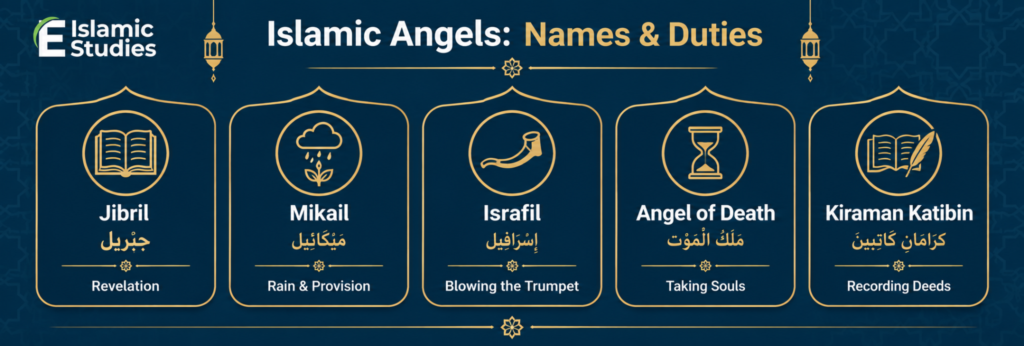
The Quran and Sunnah name several Islamic angels and describe their duties. This part of belief in angels in Islam shows that Allah’s command reaches every corner of creation, from rainfall to the final hour.
Jibril (Gabriel): The Angel of Revelation
Jibril is the greatest of the angels and is entrusted with bringing revelation to the prophets. Allah calls him “the Trustworthy Spirit” (Ash-Shu’ara 26:193), because revelation gives life to hearts.
Jibril brought the first revelation to the Prophet ﷺ in the Cave of Hira with the command “Iqra” (Read). After that, he met the Prophet ﷺ every Ramadan to review the Quran with him, and in the year the Prophet ﷺ passed away, they reviewed it twice (Sahih al-Bukhari 4998).
Allah describes Jibril as “one of mighty power” (An-Najm 53:5). The Prophet ﷺ saw him in his true form only twice, and his size filled the space between the sky and the earth (Sahih Muslim 177).
Mikail (Michael): The Angel of Rain and Provision
Mikail is responsible for rain and vegetation, through which Allah gives life to the earth and provision to His creatures. Allah mentions him by name alongside Jibril in Al-Baqarah 2:98.
Scholars point out a link between the three great angels. Jibril brings revelation, which gives life to hearts. Mikail brings rain, which gives life to the earth. Israfil will blow the Trumpet, which brings life after death.
Mikail’s task also reminds us that provision comes from Allah alone. When rain fell, the Prophet ﷺ would say “Allahumma sayyiban nafi’a” (O Allah, make it beneficial rain) (Sahih al-Bukhari 1032), turning a daily event into an act of remembrance.
Israfil: The Angel of the Trumpet
Israfil will blow the Trumpet (As-Sur) to end life and then to resurrect all creation. The Prophet ﷺ mentioned Jibril, Mikail, and Israfil together in his night prayer supplication (Sahih Muslim 770).
The Quran describes two blows of the Trumpet. At the first, everyone in the heavens and the earth falls dead, except whom Allah wills. At the second, all creation stands up at once, looking on (Az-Zumar 39:68).
The Prophet ﷺ said the angel of the Horn has already put it to his mouth and is waiting for the command to blow. He taught his companions to say “Hasbunallahu wa ni’mal wakil” (Allah is sufficient for us, and He is the best disposer of affairs) (Jami’ at-Tirmidhi 2431).
The Angel of Death
The Angel of Death takes souls at their appointed time. Allah says:
قُلْ يَتَوَفَّىٰكُم مَّلَكُ ٱلْمَوْتِ ٱلَّذِى وُكِّلَ بِكُمْ ثُمَّ إِلَىٰ رَبِّكُمْ تُرْجَعُونَ
“Say, the angel of death who has been entrusted with you will take you” (As-Sajdah 32:11).
Kiraman Katibin: The Noble Scribes
Two noble angels record every deed. One sits on the right and writes good deeds, and the other sits on the left and writes bad ones. Allah describes them as “seated on the right and on the left” (Qaf 50:17). Allah says:
مَّا يَلْفِظُ مِن قَوْلٍ إِلَّا لَدَيْهِ رَقِيبٌ عَتِيدٌ
“Not a word does he utter except that there is a watcher ready with him” (Qaf 50:18).
Also, Allah mentions them in (Al-Infitar 82:11-12).
وَإِنَّ عَلَيْكُمْ لَحَـٰفِظِينَ كِرَامًا كَـٰتِبِينَ
They are “noble and recording; they know whatever you do”
Allah’s mercy shows clearly in how this record works. If a person intends a good deed but does not do it, it is still written as one good deed. If they do it, it is written as ten or more. A bad intention is not written at all unless the person acts on it (Sahih Muslim 130).
Other Angels with Specific Duties
Munkar and Nakir question the dead in the grave, and Malik guards Hellfire. Other angels carry the Throne and seek forgiveness for believers (Ghafir 40:7), and some even come down to listen to the Quran.
When Usayd ibn Hudayr recited at night, the Prophet ﷺ told him: “Those were the angels listening to you” (Sahih Muslim 796). Angels also surround gatherings of knowledge, so joining our live Islamic classes puts you in a gathering they love.
What Are Angels in Islam Meant to Teach Us?
So, what are angels in Islam meant to teach us? Belief in angels in Islam is not only theory. It changes how a Muslim thinks, behaves, and feels every day. Here are the main benefits scholars mention.
1. Greater Awe of Allah
If angels are this vast and this many, how great is the One who created them? Reflecting on Jibril’s six hundred wings fills the heart with reverence for Allah’s power.
The angels who carry the Throne show this greatness clearly. The Prophet ﷺ said that the distance between the earlobe and the shoulder of just one of them is a journey of seven hundred years (Sunan Abi Dawud 4727).
Yet these mighty creatures humble themselves before Allah. When He decrees a matter in the heavens, the angels beat their wings in submission to His words (Sahih al-Bukhari 4701). We should be even more humble before Him.
2. Watching Your Words and Deeds
Knowing that the Noble Scribes record everything makes a believer more careful. You think twice before speaking harshly, and you keep doing good even when no one else sees you.
This awareness reaches even the smallest words. The Prophet ﷺ said a person may say a word that pleases Allah without giving it much thought, and Allah raises him many degrees because of it (Sahih al-Bukhari 6478).
It also builds ihsan: worshipping Allah as if you see Him. Children who learn early that their deeds are recorded grow up with a strong inner compass that guides them even when no parent or teacher is watching.
3. Consistency in Worship
Angels worship without tiring and stand in perfect rows. The Prophet ﷺ urged us to line up for prayer “as the angels line up before their Lord” (Sahih Muslim 430).
Angels never neglect their duties or grow tired of them. Allah says those near Him “are not too proud to worship Him, and they exalt Him, and to Him they prostrate” (Al-A’raf 7:206). This is a model for keeping up small daily acts of worship.
The Prophet ﷺ said the deeds most beloved to Allah are those done regularly, even if they are small (Sahih al-Bukhari 6464). Following the angels’ example means choosing steady worship over short bursts of effort that soon fade.
4. Peace and Reassurance
Believers are never truly alone. Whoever’s “Ameen” in prayer matches the angels’ “Ameen” has their previous sins forgiven (Sahih al-Bukhari 780).
Angels also pray for the believer who stays in his place of prayer after salah, saying “O Allah, forgive him; O Allah, have mercy on him” (Sahih al-Bukhari 445). This keeps going for as long as he does not break his wudu.
At the moment of death, angels comfort the righteous and say: “Do not fear and do not grieve, but receive good tidings of Paradise” (Fussilat 41:30). This promise gives the believer calm in hard times and hope at the end of life.
To turn this awareness into a purer heart, our Tazkiyya course teaches practical steps for purifying the soul.
Deepen Your Faith with Our Online Islamic Courses
Belief in angels in Islam becomes clearer when you study it with qualified teachers. Our Essential Islamic Courses cover the core teachings of Islam, from faith to daily practice, for both kids and adults.
Want to see how faith shaped real lives? Whether you’re looking for Islamic education for yourself or your children, our Islamic History course covers the key events and figures of Islamic history in a clear, engaging way.
Our Islamic Programs
- Islamic Distance Learning Programs
- Islamic Courses Workshops
- Intensive Islamic Course
- Islam Crash Course
- Learning Islam Level 1 Online
- Darse Nizami / Traditional Alim Courses
For serious learners, our Traditional Alim course offers a structured path through the classical Islamic sciences. Explore all our courses and book your free trial class today.
Deepen Your Islamic Knowledge
Join our comprehensive online courses and learn from qualified scholars today.
Book Your Free TrialConclusion
Belief in angels in Islam is the second pillar of faith. It means accepting with certainty that angels exist and believing in their names, their attributes, and the duties Allah has given them.
Angels are honored servants created from light. Jibril brings revelation, Mikail oversees rain, Israfil will blow the Trumpet, the Angel of Death takes souls, and the Noble Scribes record every deed.
The key takeaway is simple: this belief should change how you live. Let it increase your awe of Allah, guard your tongue, and draw you closer to the Quran, the revelation Jibril carried down.
Remember that the angels around you are a mercy from Allah. Every good word and every prayer is recorded with honor, so make your record one you will be glad to read on the Day of Judgment.
FAQs
Here are clear answers to the most common questions people ask about angels in Islam.
What are the 4 main angels in Islam?
The four best-known angels are Jibril (revelation), Mikail (rain and provision), Israfil (the Trumpet), and the Angel of Death (taking souls). Muslims believe in them by name and in all other angels in general.
Is belief in angels one of the six articles of faith?
Yes. Belief in angels in Islam is the second of the six articles of faith. It comes after belief in Allah and before His books, His messengers, the Last Day, and divine decree, as stated in the Hadith of Jibril.
Can angels disobey Allah?
No. Angels have no free will to sin. Allah describes them as servants who “do not disobey Allah in what He commands them but do what they are commanded” (At-Tahrim 66:6).
Is the Angel of Death called Azrael in Islam?
The Quran and authentic hadith call him only “Malak al-Mawt,” the Angel of Death. The name “Azrael” comes from narrations that scholars do not consider authentic, so the Quranic title is preferred.
Do angels enter every house?
No. The Prophet ﷺ said angels do not enter a house that contains a dog or images (Sahih al-Bukhari 3225). Scholars explain that this refers to the angels of mercy, not the recording angels, who never leave a person.
How can children learn about angels in Islam?
Start with simple Quran stories, like Jibril’s visit to Maryam, and short verses about the Noble Scribes. Learning these verses with a qualified teacher helps children link their belief to daily behavior.
Can Angels Take Human Form?
Yes, by Allah’s permission. Jibril came to Maryam “in the form of a well-proportioned man” (Maryam 19:17). He also visited the Prophet ﷺ as a stranger in white clothes, and at other times in the form of the companion Dihyah al-Kalbi.






Leave a Reply