 Learning Islam
Have you ever been asked what Muslims believe and found yourself listing the five daily prayers? Many learners mix up the pillars of Islam with what are the 6 pillars of faith in Islam, yet they answer different questions.
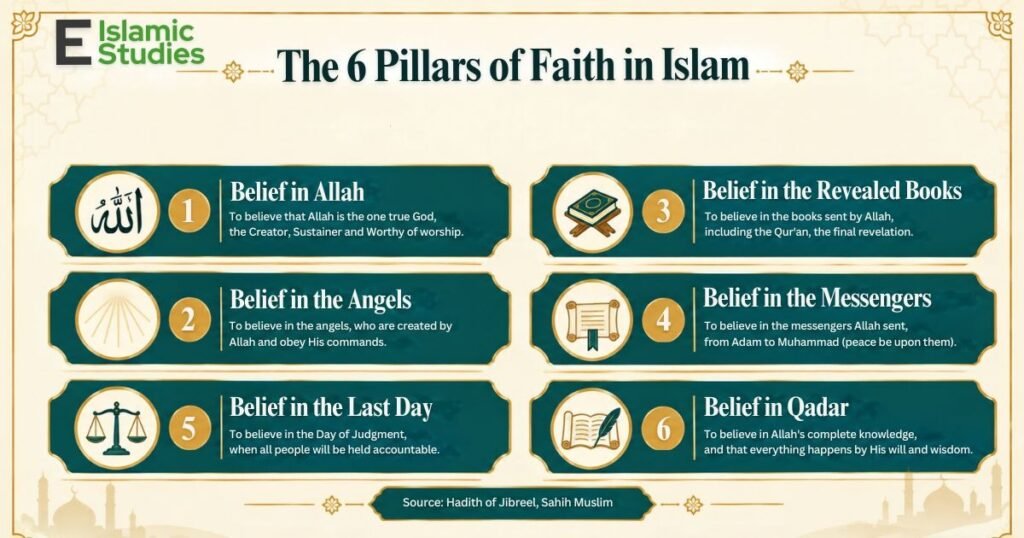
So, what are the 6 pillars of faith in Islam? Known in Arabic as Arkan al-Iman, they are six core beliefs every Muslim holds in the heart: belief in Allah, His angels, His books, His messengers, the Last Day, and divine decree, its good and its bad.
This guide explains each pillar from the Quran and authentic Sunnah, answers how many there are, and shows how these beliefs shape daily life.
Key Takeaways: What You Will Learn
- A clear answer to what are the 6 pillars of faith in Islam and the hadith that lists them.
- The Quranic evidence for each article of belief.
- Why there are six pillars, not five or seven, and where Ihsan fits.
- The difference between Iman (inner belief) and Islam (outward practice).
- Practical ways these beliefs strengthen your worship and character.
What Are the 6 Pillars of Faith?
The pillars of faith are the six foundations of Islamic creed (aqeedah) that a Muslim must affirm with certainty. Without them, faith is not valid.
Linguistically, iman means affirmation with inner tranquility. Ahl al-Sunnah define it as belief in the heart, words of the tongue, and actions of the limbs.
The Hadith of Jibreel: The Primary Evidence
The clearest text on the pillars of faith is the Hadith of Jibreel, narrated by Umar ibn al-Khattab and recorded by Imam Muslim. A stranger in white clothes asked the Prophet ﷺ about Islam, Iman, and Ihsan. About Iman, the Prophet ﷺ replied:
قَالَ فَأَخْبِرْنِي عَنِ الإِيمَانِ . قَالَ ” أَنْ تُؤْمِنَ بِاللَّهِ وَمَلاَئِكَتِهِ وَكُتُبِهِ وَرُسُلِهِ وَالْيَوْمِ الآخِرِ وَتُؤْمِنَ بِالْقَدَرِ خَيْرِهِ وَشَرِّهِ ” . قَالَ صَدَقْتَ .
“That you believe in Allah, His angels, His books, His messengers, and the Last Day, and that you believe in divine decree, its good and its evil.” He later told Umar: “That was Jibreel, who came to teach you your religion.” Sahih Muslim 8a
Scholars call this hadith “the mother of the Sunnah” because it covers the whole religion in one conversation: Islam for outward deeds, Iman for inner beliefs, and Ihsan for the highest level of worship. Through it, Jibreel taught every Muslim the foundations of faith.
Quranic Verses That Mention the Articles of Faith
The Quran confirms what the Hadith of Jibreel teaches. Several verses mention the articles of faith together, which shows that they form one complete creed that a believer cannot divide. Allah says:
ءَامَنَ ٱلرَّسُولُ بِمَآ أُنزِلَ إِلَيْهِ مِن رَّبِّهِۦ وَٱلْمُؤْمِنُونَ ۚ كُلٌّ ءَامَنَ بِٱللَّهِ وَمَلَـٰٓئِكَتِهِۦ وَكُتُبِهِۦ وَرُسُلِهِۦ
“The Messenger has believed in what was revealed to him from his Lord, and so have the believers. All of them have believed in Allah, His angels, His books, and His messengers” (Al-Baqarah 2:285).
An-Nisa 4:136 warns that whoever disbelieves in these pillars has gone far astray. Allah says:
يَـٰٓأَيُّهَا ٱلَّذِينَ ءَامَنُوٓا۟ ءَامِنُوا۟ بِٱللَّهِ وَرَسُولِهِۦ وَٱلْكِتَـٰبِ ٱلَّذِى نَزَّلَ عَلَىٰ رَسُولِهِۦ وَٱلْكِتَـٰبِ ٱلَّذِىٓ أَنزَلَ مِن قَبْلُ ۚ وَمَن يَكْفُرْ بِٱللَّهِ وَمَلَـٰٓئِكَتِهِۦ وَكُتُبِهِۦ وَرُسُلِهِۦ وَٱلْيَوْمِ ٱلْـَٔاخِرِ فَقَدْ ضَلَّ ضَلَـٰلًۢا بَعِيدًا
O believers! Have faith in Allah, His Messenger, the Book He has revealed to His Messenger, and the Scriptures He revealed before. Indeed, whoever denies Allah, His angels, His Books, His messengers, and the Last Day has clearly gone far astray.
This verse calls on believers not only to have faith but to hold firmly to it and keep renewing it. It also makes clear that rejecting any one of these pillars is serious misguidance, because they stand or fall together.
Live Class in Action
Watch how our instructors interact with students in real time, focusing on interactive methods.
Deepen Your Islamic Knowledge
Join our comprehensive online courses and learn from qualified scholars today.
Book Your Free TrialWhat Are the 6 Pillars of Faith of Islam?
The 6 pillars of faith of Islam are belief in Allah, the angels, the revealed books, the messengers, the Last Day, and Qadar (divine decree). Here is each one with its core evidence.
1. Belief in Allah
This is the root of all the pillars of faith. It means affirming that Allah exists, that He alone creates, owns, and governs everything, and that He alone deserves worship. It includes believing in His Names and Attributes without distortion or likening Him to creation:
لَيْسَ كَمِثْلِهِۦ شَىْءٌ ۖ وَهُوَ ٱلسَّمِيعُ ٱلْبَصِيرُ
“There is nothing like unto Him, and He is the All-Hearing, the All-Seeing” (Ash-Shura 42:11).
2. Belief in the Angels
Angels are real beings from the unseen world, created from light, as the Prophet ﷺ said in Sahih Muslim. Allah says:
يَـٰٓأَيُّهَا ٱلَّذِينَ ءَامَنُوا۟ قُوٓا۟ أَنفُسَكُمْ وَأَهْلِيكُمْ نَارًا وَقُودُهَا ٱلنَّاسُ وَٱلْحِجَارَةُ عَلَيْهَا مَلَـٰٓئِكَةٌ غِلَاظٌ شِدَادٌ لَّا يَعْصُونَ ٱللَّهَ مَآ أَمَرَهُمْ وَيَفْعَلُونَ مَا يُؤْمَرُونَ
“Do not disobey Allah in what He commands them, but do what they are commanded” (At-Tahrim 66:6).
We believe in those named in revelation, such as Jibreel, who brings revelation, and Mika’il, entrusted with rain. Others record our deeds. Angels are servants of Allah, never to be prayed to or called upon.
3. Belief in the Revealed Books
Allah revealed scriptures to His messengers as guidance: the Torah to Musa, the Zabur (Psalms) to Dawud, the Injeel (Gospel) to Isa, the Scrolls of Ibrahim and Musa, and finally the Quran to Muhammad ﷺ. The Quran is the final and preserved book, as Allah says:
إِنَّا نَحْنُ نَزَّلْنَا ٱلذِّكْرَ وَإِنَّا لَهُۥ لَحَـٰفِظُونَ
“Indeed, it is We who sent down the Reminder, and indeed, We will be its guardian” (Al-Hijr 15:9).
It confirms and stands as judge over earlier scriptures, which were altered over time. Studying this topic in a structured Islamic studies course helps you understand the status of each scripture with clarity and sound evidence.
4. Belief in the Messengers
Allah chose messengers from among humankind to call people to worship Him alone:
وَلَقَدْ بَعَثْنَا فِى كُلِّ أُمَّةٍ رَّسُولًا أَنِ ٱعْبُدُوا۟ ٱللَّهَ وَٱجْتَنِبُوا۟ ٱلطَّـٰغُوتَ ۖ
“And We certainly sent into every nation a messenger, saying: Worship Allah and avoid false deities” (An-Nahl 16:36).
The Quran names 25 prophets and messengers, and we believe in all of them, named and unnamed. They were human servants with no share in divinity. Muhammad ﷺ is the Seal of the Prophets, sent to all humanity.
5. Belief in the Last Day
This means firm belief in everything revealed about life after death: the trial of the grave, resurrection, the reckoning, the Scale, the Sirat, intercession by Allah’s permission, Paradise, and Hellfire. This belief gives life purpose and accountability, as Allah says:
فَمَن يَعْمَلْ مِثْقَالَ ذَرَّةٍ خَيْرًا يَرَهُۥ ٧ وَمَن يَعْمَلْ مِثْقَالَ ذَرَّةٍ شَرًّا يَرَهُۥ ٨
“Whoever does an atom’s weight of good will see it, and whoever does an atom’s weight of evil will see it” (Az-Zalzalah 99:7–8).
6. Belief in Divine Decree (Al-Qadar)
Belief in Qadar means accepting that everything that happens, pleasant or painful, occurs within Allah’s knowledge, writing, will, and creation. Scholars of Ahl al-Sunnah explain it through four levels.
The Four Levels of Qadar
Knowledge: Allah knows all things, past, present, and future. Writing: He recorded all decrees in the Preserved Tablet. Will: Whatever He wills happens. Creation: He is the Creator of all things, including human actions.
People still have real will and choice, which is why they are held accountable. Qadar is never an excuse for sin: a believer repents after mistakes, is patient in hardship, and still takes the lawful means.
How Many Pillars of Faith Are There in Islam?
There are six pillars of faith in Islam, as stated explicitly in the Hadith of Jibreel. Confusion comes from mixing them with the five pillars of Islam or counting Ihsan as extra.
Is Ihsan a Seventh Pillar of Faith?
No. Ihsan is the highest level of the religion, not a pillar of Iman. The Hadith of Jibreel describes three levels: Islam, Iman, and Ihsan, which is
” أَنْ تَعْبُدَ اللَّهَ كَأَنَّكَ تَرَاهُ فَإِنْ لَمْ تَكُنْ تَرَاهُ فَإِنَّهُ يَرَاكَ ”
“to worship Allah as though you see Him, and if you do not see Him, He surely sees you.”
Pillars of Faith vs. Pillars of Islam
The pillars of Islam are outward acts of the limbs, while the pillars of faith are inward beliefs rooted in the heart. Both are needed together.
| Comparison | Pillars of Islam | Pillars of Faith (Iman) |
| Number | 5 | 6 |
| Nature | Outward acts of worship | Inward beliefs of the heart |
| Includes | Shahadah, prayer, zakah, fasting Ramadan, Hajj | Allah, angels, books, messengers, Last Day, Qadar |
Scholars explain a helpful rule here: when Islam and Iman are mentioned together, as in the Hadith of Jibreel, Islam refers to outward deeds and Iman to inner beliefs. When either word appears alone, it includes the meaning of the other.
Experience Our Classrooms
Don’t just take our word for it—take a look inside! Watch the videos below to experience our engaging teaching methods and vibrant online classrooms firsthand.
Deepen Your Islamic Knowledge
Join our comprehensive online courses and learn from qualified scholars today.
Book Your Free TrialLiving the Pillars of Faith of Iman Every Day
Understanding the pillars of faith of Iman is not about memorizing a list. These beliefs are meant to shape how you pray, treat people, and respond to hardship.
Does Iman Increase and Decrease?
Yes. Iman grows through obedience, knowledge, dhikr, and reciting the Quran, and weakens through sin, as Allah says:
إِنَّمَا ٱلْمُؤْمِنُونَ ٱلَّذِينَ إِذَا ذُكِرَ ٱللَّهُ وَجِلَتْ قُلُوبُهُمْ وَإِذَا تُلِيَتْ عَلَيْهِمْ ءَايَـٰتُهُۥ زَادَتْهُمْ إِيمَـٰنًا وَعَلَىٰ رَبِّهِمْ يَتَوَكَّلُونَ
“When His verses are recited to them, it increases them in faith” (Al-Anfal 8:2).
This is why seeking beneficial knowledge is one of the surest ways to strengthen faith. Studying the Islamic creed step by step in an online Islamic studies class keeps you consistent, and your Iman grows as your understanding deepens.
The Practical Fruits of the Six Pillars
Belief in Allah brings sincerity and reliance on Him. Belief in angels reminds you that your deeds are recorded. Belief in the books deepens your love for the Quran, and belief in the messengers inspires you to follow the Sunnah.
Belief in the Last Day keeps this world in perspective, and belief in Qadar brings patience in hardship and gratitude in ease.
Studying these beliefs in an Islamic Creed Course with a qualified teacher turns the pillars of faith into convictions you understand and can explain, not just a list you memorize.
Strengthen Your Iman with Quran, Tajweed, and Arabic Classes
Our understanding of the pillars of faith grows deeper when you learn from reliable sources with a teacher who answers your questions. At E Islamic Studies School, qualified instructors guide you step by step in flexible online lessons.
Our Islamic studies courses cover aqeedah, the Hadith of Jibreel, the levels of the religion, and the evidence behind each article of faith, all explained in clear, simple English.
Our Islamic Courses
- Islam Classes for Adults
- Islam Classes for Sisters
- Alimah Course for Ladies
- Islam Classes for Kids
- Learn Islam for Beginners
- Learning Islam for New Converts
Want to explain your beliefs with confidence to your children, friends, or new Muslims? Book your first class today and build a solid foundation in Islamic knowledge on a schedule that suits you.
Deepen Your Islamic Knowledge
Join our comprehensive online courses and learn from qualified scholars today.
Book Your Free TrialConclusion
So, what are the 6 pillars of faith in Islam? Simply explained, they are belief in Allah, His angels, His books, His messengers, the Last Day, and divine decree, confirmed by the Hadith of Jibreel and by clear verses of the Quran.
Each pillar answers a central question: who our Lord is, who carries His commands, what guidance He sent, who delivered it, where we are heading, and how events unfold by His wisdom.
The pillars of faith also complete the five pillars of Islam: they give outward worship its sincerity, while righteous deeds confirm and strengthen what the heart believes.
The takeaway message: the pillars of faith are not words to memorize but truths to live by. Learn them, reflect on the Quran that teaches them, and let them shape your worship, character, and outlook every day.
FAQs
Here are clear answers to the questions people ask most often about the pillars of faith in Islam.
What are the 6 pillars of faith in Islam?
They are belief in Allah, His angels, His revealed books, His messengers, the Last Day, and divine decree (Qadar), both its good and its bad. They appear together in the Hadith of Jibreel.
What is the difference between the 5 pillars of Islam and the 6 pillars of faith?
The five pillars of Islam are outward acts: Shahadah, prayer, zakah, fasting, and Hajj. The six pillars of faith are inner beliefs of the heart, and a complete Muslim combines both.
Where are the pillars of faith mentioned in the Quran?
Key verses include Al-Baqarah 2:177 and 2:285, and An-Nisa 4:136. Al-Qamar 54:49 points to the sixth pillar, divine decree.
Does believing in Qadar mean humans have no free will?
No. Humans have real will and ability, which is why they are accountable. That will operates within Allah’s knowledge, will, and creation, so Qadar is never an excuse for sin.
Can someone be a believer while rejecting one of the pillars?
No. The six pillars form one creed, and denying an established pillar contradicts faith. However, judging a specific individual has conditions and should be left to qualified scholars.







[…] hadith, the pillars of faith, is called the Hadith of Jibril because the Angel Jibril came in human form and asked the Prophet […]
[…] the Prophet ﷺ listed it among the six pillars of Iman. When Jibreel asked him about faith, he […]