 Learning Islam
Have you ever wondered what really happens after we die, or how to answer a child who asks, “Where did Grandpa go?” For Muslims, the answer is clear, hopeful, and rooted in revelation.
Belief in the afterlife in Islam is the fifth of the six pillars of faith. It means firmly accepting everything Allah and His Messenger ﷺ told us about what comes after death, from the grave to the final home in Paradise or Hell.
In this guide, you will learn what belief in the afterlife in Islam means, the main stages of the Islamic afterlife, how the Quran describes Jannah, and how this faith shapes daily life.
Take Away: What You Will Learn
- Why belief in the afterlife in Islam is a pillar of faith, and why a Muslim’s faith is incomplete without it.
- The key stages after death: Barzakh, Resurrection, the Book of Deeds, the Scale, and the Sirat.
- What Jannah in Islam is and how its levels are described.
- How belief in the afterlife in Islam builds accountability, justice, and patience.
- Simple ways to teach it to kids and adult learners.
Belief in the Afterlife in Islam
Belief in the afterlife in Islam is the firm conviction that this worldly life is not the end. After death, every person will be raised, judged with perfect justice, and rewarded or held accountable for their deeds.
Why Is the Last Day a Pillar of Faith?
Because the Prophet ﷺ listed it among the six pillars of Iman. When Jibreel asked him about faith, he said:
” أَنْ تُؤْمِنَ بِاللَّهِ وَمَلاَئِكَتِهِ وَكُتُبِهِ وَرُسُلِهِ وَالْيَوْمِ الآخِرِ وَتُؤْمِنَ بِالْقَدَرِ خَيْرِهِ وَشَرِّهِ ”
“To believe in Allah, His angels, His books, His messengers, the Last Day, and divine decree” (Muslim8).
The Quran warns that whoever disbelieves in the Last Day “has certainly gone far astray” (An-Nisa 4:136). So belief in the afterlife in Islam is not optional. It sits at the core of Aqeedah.
How Often Does the Quran Link It to Belief in Allah?
Very often. The phrase “believes in Allah and the Last Day” recurs throughout the Quran, as in Al-Baqarah 2:177, which defines true righteousness through faith in Allah and the Last Day.
The Prophet ﷺ used the same pairing:
” وَمَنْ كَانَ يُؤْمِنُ بِاللَّهِ وَالْيَوْمِ الآخِرِ فَلْيَقُلْ خَيْرًا أَوْ لِيَصْمُتْ ”.
“Whoever believes in Allah and the Last Day, let him speak good or remain silent” (Bukhari).
This hadith shows that faith in the Last Day is more than a belief held in the heart. It also guides the tongue. Every word is recorded and will be shown on the Day of Judgment, so the believer thinks before speaking and either says something kind and useful or stays silent.
What Does Belief in the Afterlife Include?
It includes faith in the life of the grave, the Trumpet, Resurrection, the Gathering, the Reckoning, the Scale, the Bridge, and finally Paradise and Hell. Learning these details makes belief in the afterlife in Islam come alive in the heart.
Live Class in Action
Watch how our instructors interact with students in real time, focusing on interactive methods.
Deepen Your Islamic Knowledge
Join our comprehensive online courses and learn from qualified scholars today.
Book Your Free TrialIslamic Afterlife: The Main Stages After Death
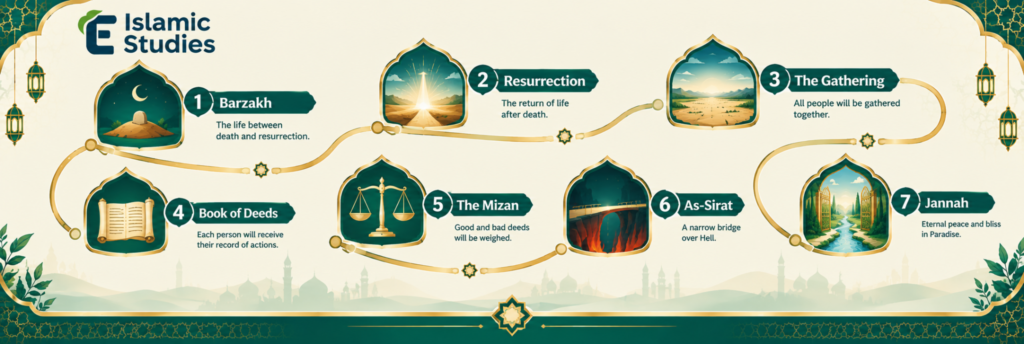
The Islamic afterlife is a journey with clear stations described in the Quran and Hadith. Learning them in order completes the picture of belief in the afterlife in Islam.
a. Death and the Life of Barzakh
Death is the separation of the soul from the body. Allah says:
وَمِن وَرَآئِهِم بَرْزَخٌ إِلَىٰ يَوْمِ يُبْعَثُونَ
“And behind them is a barrier (Barzakh) until the Day they are resurrected” (Al-Mu’minun 23:100).
In the grave, two angels ask: Who is your Lord? What is your religion? Who is this man sent to you? The believer answers with ease; the wrongdoer struggles.
b. The Trumpet and the Resurrection
The Angel Israfil will blow the Trumpet, and all living beings will die. Then it will be blown again, “and at once they will be standing, looking on” (Az-Zumar 39:68).
Allah will return souls to their bodies and raise people from their graves. Belief in the afterlife in Islam includes this bodily Resurrection, which is easy for the One who created us the first time.
c. The Gathering and the Book of Deeds
All of humanity will be gathered on one vast plain. Each person then receives the record of their deeds. Receiving it in the right hand is a sign of success. Allah says:
ٱقْرَأْ كِتَـٰبَكَ كَفَىٰ بِنَفْسِكَ ٱلْيَوْمَ عَلَيْكَ حَسِيبًا
“Read your record. Sufficient is yourself against you this Day as accountant” (Al-Isra 17:14).
This verse shows that the record leaves no room for excuses. Each person will read their own deeds, small and large, and see that nothing was added or forgotten. It reminds us to fill our record today with what we would love to read tomorrow.
d. The Scale (Mizan) and Perfect Justice
Deeds will be weighed on a real Scale. Nothing is too small to count. Belief in the afterlife in Islam reminds us that no good deed, even an atom’s weight, is ever wasted. Allah says:
وَنَضَعُ ٱلْمَوَٰزِينَ ٱلْقِسۡطَ لِيَوۡمِ ٱلۡقِيَٰمَةِ فَلَا تُظۡلَمُ نَفۡسٞ شَيۡـٔٗاۖ وَإِن كَانَ مِثۡقَالَ حَبَّةٖ مِّنۡ خَرۡدَلٍ أَتَيۡنَا بِهَاۗ وَكَفَىٰ بِنَا حَٰسِبِينَ
“And We place the scales of justice for the Day of Resurrection, so no soul will be treated unjustly at all” (Al-Anbiya 21:47).
This verse confirms that Allah’s judgment is perfectly fair. Even a deed the size of a mustard seed will be brought forward and weighed, so no good act is lost and no wrong is overlooked. That is why a believer never looks down on any small good deed.
e. The Bridge (As-Sirat)
The Sirat is a bridge over Hell that everyone must cross. Authentic Hadith describe people crossing at speeds matching their deeds, some like lightning and others crawling.
Believers pass to the final home by Allah’s mercy. Sinful believers may be punished for a time, yet Allah forgives whom He wills among the people of Tawheed.
What Is Jannah in Islam?
Jannah in Islam is the eternal Garden of reward that Allah has prepared for believers who did righteous deeds. It is a home of peace, with no pain, sickness, sadness, or death.
Understanding Jannah is the sweetest part of belief in the afterlife in Islam, because it shows the mercy and generosity waiting for those who obey Allah.
Heaven in Islam as the Quran Describes It
The Quran describes heaven in Islam as gardens beneath which rivers flow, with rivers of pure water, milk, and honey (Muhammad 47:15). Its people feel no fatigue and no ill will. Yet its true beauty is beyond imagination. In (As-Sajdah 32:17), Allah says:
فَلَا تَعْلَمُ نَفْسٌ مَّا أُخْفِيَ لَهُم مِّن قُرَّةِ أَعْيُنٍ جَزَاءً بِمَا كَانُوا يَعْمَلُونَ
“No soul knows what has been hidden for them of comfort for eyes as reward for what they used to do”
Paradise in Islam has a hundred levels, as the Prophet ﷺ said, with the distance between two levels like that between heaven and earth. He taught us to ask Allah for Al-Firdaus, the highest (Bukhari).
The greatest reward of all is seeing Allah. Opposite it lies Jahannam, the home of punishment for those who rejected faith and persisted in wrongdoing.
Experience Our Classrooms
Don’t just take our word for it—take a look inside! Watch the videos below to experience our engaging teaching methods and vibrant online classrooms firsthand.
Deepen Your Islamic Knowledge
Join our comprehensive online courses and learn from qualified scholars today.
Book Your Free TrialHow Belief in the Afterlife in Islam Shapes Your Life
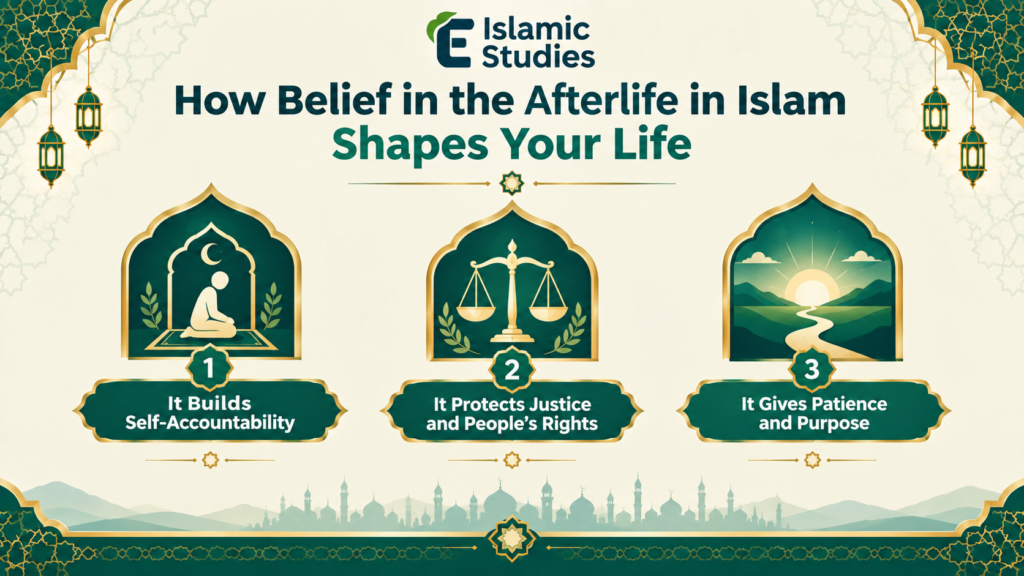
The Last Day is not just information to memorize. Belief in the afterlife in Islam transforms how a Muslim thinks, speaks, and treats others every day.
1. It Builds Self-Accountability
A person who knows every word is recorded watches their tongue and actions, in public and in private. This inner watchfulness is stronger than any human law.
2. It Protects Justice and People’s Rights
Every right will be returned to its owner, so whoever remembers this stops before harming anyone. The Prophet ﷺ said:
” لَتُؤَدُّنَّ الْحُقُوقَ إِلَى أَهْلِهَا يَوْمَ الْقِيَامَةِ حَتَّى يُقَادَ لِلشَّاةِ الْجَلْحَاءِ مِنَ الشَّاةِ الْقَرْنَاءِ ” .
“Rights will surely be restored to their owners on the Day of Resurrection” (Muslim).
This hadith shows how complete justice will be on the Day of Resurrection. Even a hornless sheep will get its due from the horned sheep that struck it. If that is so for animals, human rights will certainly be returned, and no injustice escapes, however small it seems.
3. It Gives Patience and Purpose
Some people feel lost when hardships pile up, and life seems to have no clear direction. The Quran answers this feeling with a powerful question that reminds every person why they were created:
أَفَحَسِبۡتُمۡ أَنَّمَا خَلَقۡنَٰكُمۡ عَبَثٗا وَأَنَّكُمۡ إِلَيۡنَا لَا تُرۡجَعُونَ
“Did you think that We created you uselessly and that to Us you would not be returned?” (Al-Mu’minun 23:115).
This verse reminds us that we were not created without purpose. Every trial, loss, or delay is part of a test, and belief in the afterlife in Islam assures the believer that patience is never wasted, because the full reward is waiting with Allah in the Hereafter.
Teaching Belief in the Afterlife in Islam to Kids and Adults
Children learn best through stories and warm conversations. Talking about Jannah first plants love before fear, so belief in the afterlife in Islam grows as hope, not anxiety.
For structured guidance, our Islamic classes for kids teach Aqeedah through age-appropriate lessons and Quranic stories that make the unseen easy to grasp.
Adults often want deeper study of the verses behind each stage. The Islamic classes for adults and the Tafseer course explain these passages with qualified teachers.
Whether you’re looking for Islamic education for yourself or your children, E Islamic Studies School offers lessons designed to make learning clear, practical, and accessible from anywhere.
New learners can start with the Islamic Essentials Level 1 course, which covers the six pillars of faith step by step, including belief in the afterlife in Islam.
Start Learning Islamic Aqeedah With Expert Teachers Today
Want to understand the Last Day with clarity and confidence? The Islamic Studies program at eIslamicStudies Academy teaches belief in the afterlife in Islam and every pillar of faith from authentic sources in live one-on-one classes.
Lessons suit kids, sisters, beginners, and adults, with flexible schedules that fit busy family life. Every learner gets a personal plan matched to their level and goals.
Our Islamic Essentials Courses
- Essential Islam Courses
- Online Tafseer Course
- Islamic History Course
- Quran Tafseer Classes for Beginners — Introductory Interpretation
- Self-Paced Tafseer Course — Flexible Learning Programs
- Aqidah Course — Islamic Creed and Theology Classes
- Online Seerah Course — Life of Prophet Muhammad Classes
Book your free trial class today and build faith on real knowledge. Your teacher will guide you from the basics of Aqeedah to the deeper meanings of the Quran.
Deepen Your Islamic Knowledge
Join our comprehensive online courses and learn from qualified scholars today.
Book Your Free TrialConclusion
Belief in the afterlife in Islam is the fifth pillar of faith: the firm conviction that this life is a test, followed by the grave, Resurrection, Reckoning, and an eternal home.
The Islamic afterlife unfolds in clear stages, from Barzakh to the Mizan and the Sirat. At its end lies Jannah in Islam, a reward beyond imagination with a hundred levels for the righteous.
This belief also shapes everyday life. It builds self-accountability, protects people’s rights, and gives patience and purpose, because the believer knows that every word and deed will be weighed with perfect justice.
The takeaway message: belief in the afterlife in Islam is meant to live in your heart and shape your actions. Learn it with understanding, teach it with love, and prepare for meeting Allah every day.
FAQs
Here are clear answers to the questions people most often ask about belief in the afterlife in Islam.
What is the afterlife called in Islam?
It is called Al-Akhirah. The Day of Judgment has many Quranic names, including Yawm al-Qiyamah (Day of Resurrection), Yawm ad-Din (Day of Recompense), and Yawm al-Hisab (Day of Reckoning).
Why do Muslims believe in the afterlife?
Belief in the afterlife in Islam is required because Allah and His Messenger ﷺ told us about it, and it is a pillar of Iman. It also reflects Allah’s perfect justice.
What happens right after death in Islam?
The soul is taken by the Angel of Death, and the person enters Barzakh. Two angels question them about their Lord, religion, and Prophet, and they experience comfort or hardship until Resurrection.
Can a Muslim who sinned still enter Paradise?
Yes. A believer who dies upon Tawheed may be forgiven by Allah’s mercy, or punished for a time and then admitted to Paradise.
How do I explain the afterlife to a child?
Start with Allah’s love and the beauty of Jannah, use simple stories, and link good deeds to reward. Answer questions calmly and honestly.







Leave a Reply