 Learning Islam
Every human being eventually asks the same question: what happens after death? In Islam, the answer is built around one core belief: Akhirah.
Understanding what Akhirah in Islam means is essential to understanding the entire Islamic worldview, because belief in the Hereafter shapes how a Muslim views life, death, and the purpose of existence.
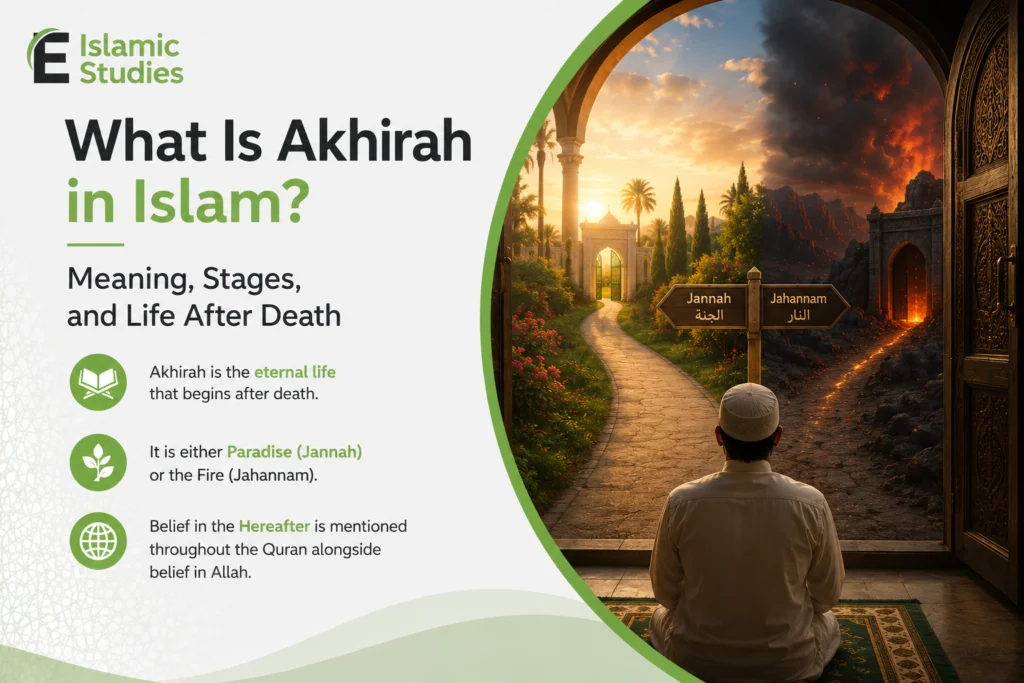
Akhirah meaning in Islam refers to the eternal life that begins after death and continues forever, either in Paradise (Jannah) or in the Fire (Jahannam).
Belief in the Hereafter is mentioned throughout the Quran alongside belief in Allah, which shows how central it is to Islamic theology.
This article explains the akhira meaning in Islam in simple terms, walks through the stages of the Hereafter from death to the Day of Judgment, presents verified Quranic and prophetic evidence, and explores why this belief matters for everyday life.
Take Away: What You Will Learn
● The exact meaning of Akhirah and how it differs from the Dunya (worldly life)
● The stages of the Hereafter: death, the grave, resurrection, judgment, and the final abodes
● Key Quranic verses and hadith that describe the Akhirah
● Why belief in Akhirah is one of the six pillars of Islamic faith
● How belief in the Hereafter shapes a Muslim’s daily choices and character
What Is Akhirah in Islam?
Akhirah (الآخرة) is the Arabic term for “the Hereafter” or “the life to come.” In Islamic belief, Akhirah is the eternal life that begins after death, encompassing the grave, the resurrection, the Day of Judgment, and the everlasting abodes of Paradise (Jannah) and Hellfire (Jahannam).
Unlike the Dunya, which is temporary and limited, the Akhirah is described in the Quran as the true and lasting life. This distinction is not a minor detail; it is one of the foundations of the Islamic understanding of purpose and accountability.
وَمَا هَٰذِهِ الْحَيَاةُ الدُّنْيَا إِلَّا لَهْوٌ وَلَعِبٌ ۚ وَإِنَّ الدَّارَ الْآخِرَةَ لَهِيَ الْحَيَوَانُ ۚ لَوْ كَانُوا يَعْلَمُونَ
“And this worldly life is not but diversion and amusement. And indeed, the home of the Hereafter — that is the [eternal] life, if only they knew.”
The Linguistic and Islamic Meaning of Akhira
The word Akhirah comes from the Arabic root “akhir,” meaning “last” or “later.” It stands in direct contrast to “Dunya,” which comes from a root meaning “near” or “low,” referring to the present, nearer life.
This linguistic contrast reflects the Islamic teaching that the present life is temporary while the Hereafter is permanent.
Several Arabic terms appear throughout Islamic teaching about the Hereafter. Understanding each one helps clarify what happens at every stage of the journey after death.
| Arabic Term | Transliteration | English Meaning |
| الدنيا | Ad-Dunya | The present, worldly life |
| الآخرة | Al-Akhirah | The Hereafter; eternal life after death |
| البرزخ | Al-Barzakh | The intermediate stage in the grave, between death and resurrection |
| القيامة | Al-Qiyamah | The Day of Resurrection / Standing |
| الحساب | Al-Hisab | The reckoning and weighing of deeds |
| الجنة | Al-Jannah | Paradise, the eternal abode of the righteous |
| جهنم | Jahannam | Hellfire, the eternal abode of the disbelievers |
See Our Islamic Studies Classes in Action
Take a look at a sample lesson and see how our interactive online classes help students learn Islamic Studies in a clear, engaging, and supportive environment.
Deepen Your Islamic Knowledge
Join our comprehensive online courses and learn from qualified scholars today.
Book Your Free TrialWhy Belief in Akhirah Is a Pillar of Islamic Faith
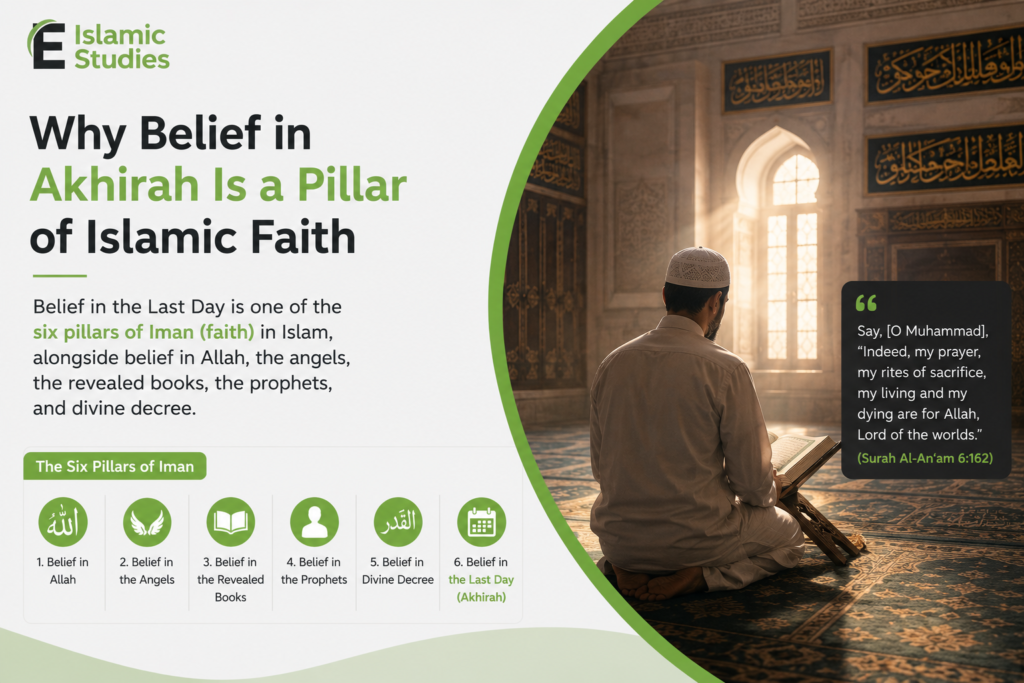
Belief in the Last Day is one of the six pillars of Iman (faith) in Islam, alongside belief in Allah, the angels, the revealed books, the prophets, and divine decree. A Muslim’s faith is considered incomplete without sincere belief in the Akhirah.
لَّيْسَ الْبِرَّ أَن تُوَلُّوا وُجُوهَكُمْ قِبَلَ الْمَشْرِقِ وَالْمَغْرِبِ وَلَٰكِنَّ الْبِرَّ مَنْ آمَنَ بِاللَّهِ وَالْيَوْمِ الْآخِرِ
“Righteousness is not that you turn your face toward the east or the west, but righteousness is [in] one who believes in Allah, the Last Day…”
This verse places belief in the Last Day directly alongside belief in Allah, showing that true righteousness is inseparable from awareness of the Hereafter.
The Stages of the Akhirah: The Journey After Death
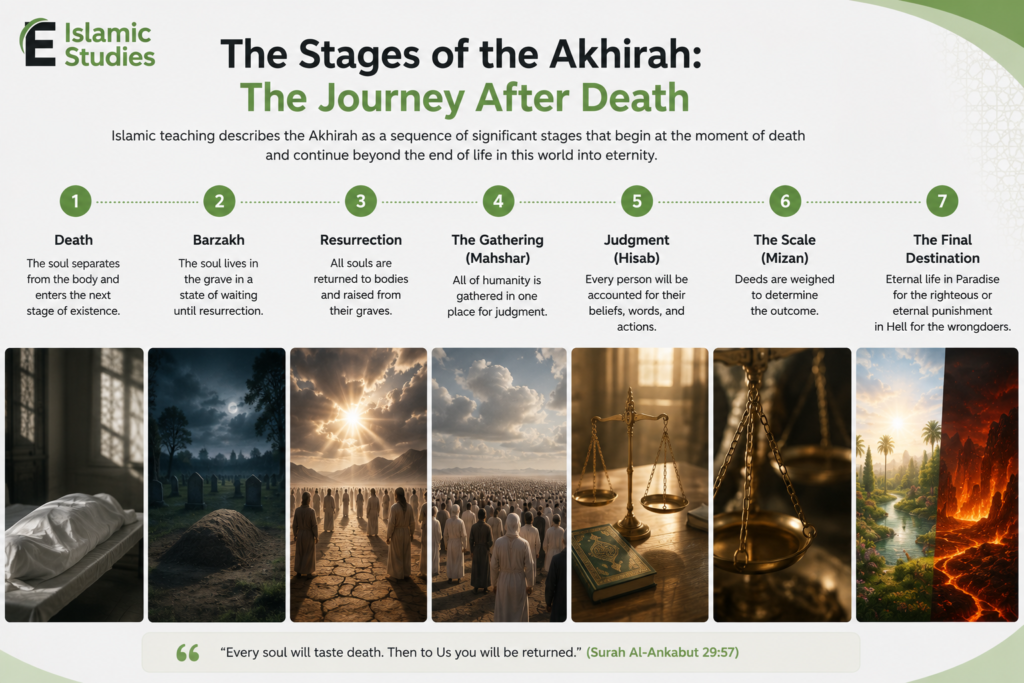
Islamic teaching describes the Akhirah as a sequence of significant stages that begin at the moment of death and continue beyond the end of life in this world into eternity.
Death is not viewed as the end of human existence, but rather as the beginning of a new journey in which every person moves from the temporary life of the dunya toward the everlasting life of the Hereafter.
This journey includes several stages, each with its own purpose and significance in the overall process of accountability and the fulfillment of Allah’s promise of judgment and justice.
From the separation of the soul from the body to the life of Barzakh, the resurrection, the gathering of all people for judgment, and the final destination in Paradise or Hell, every stage reminds believers that this worldly life is temporary and that their actions have lasting consequences.
1. Death and the Departure of the Soul
Death marks the separation of the soul from the body and the transition from the Dunya to the Barzakh. The Quran repeatedly reminds believers that death is certain for every living being and cannot be avoided or delayed.
كُلُّ نَفْسٍ ذَائِقَةُ الْمَوْتِ ۗ وَإِنَّمَا تُوَفَّوْنَ أُجُورَكُمْ يَوْمَ الْقِيَامَةِ
“Every soul will taste death, and you will only be given your [full] compensation on the Day of Resurrection.”
Many parents also choose to introduce these foundational beliefs early, which is why our Islam Classes for Kids are designed to explain concepts like the Akhirah in a simple, age-appropriate way.

2. Al-Barzakh — Life in the Grave
Al-Barzakh is the intermediate stage between death and resurrection. It is often referred to as life in the grave, where the soul experiences either comfort or punishment while awaiting the Day of Judgment.
Islamic teaching describes Al-Barzakh as a barrier that separates the Dunya from the full reality of the Akhirah.
During this stage, a person is questioned about their faith, and the grave becomes either a garden from the gardens of Paradise or a pit from the pits of the Fire, depending on how that person lived.
3. Al-Ba’th — The Resurrection
Al-Ba’th refers to the resurrection, when Allah will raise all of creation from death for the sake of reckoning. The Quran describes this as a sudden and overwhelming event that ends the current order of the universe.
At the resurrection, every soul that has ever lived is brought back and gathered for judgment, with no exceptions. This stage removes any possibility of escaping accountability, since it applies equally to every person regardless of status, wealth, or worldly power.
You may also enjoy our article on istihsan in Islam, which explores how scholars reason through new or unclear matters.
4. Al-Hisab — The Reckoning and Weighing of Deeds
Al-Hisab is the stage in which every person’s deeds are brought forward, weighed, and accounted for. Nothing is considered too small to be recorded, whether good or bad.
Because intentions shape the value of every deed, understanding niyyah in Islam is closely tied to how actions are judged during Al-Hisab, since two similar outward actions can carry very different weight depending on the intention behind them.
فَمَن يَعْمَلْ مِثْقَالَ ذَرَّةٍ خَيْرًا يَرَهُ * وَمَن يَعْمَلْ مِثْقَالَ ذَرَّةٍ شَرًّا يَرَهُ
“So whoever does an atom’s weight of good will see it, and whoever does an atom’s weight of evil will see it.”
5. Jannah and Jahannam — The Final Abodes
After the reckoning, every person is directed to one of two final abodes: Jannah (Paradise) for the righteous believers, or Jahannam (Hellfire) for those who rejected faith and persisted in wrongdoing. Both abodes are described as everlasting.
The Quran uses the term “kafir” to describe those who knowingly reject faith and are warned of Jahannam as a result. To understand this term more precisely, see our article on what is kafir in Islam.
وَالَّذِينَ آمَنُوا وَعَمِلُوا الصَّالِحَاتِ سَنُدْخِلُهُمْ جَنَّاتٍ تَجْرِي مِن تَحْتِهَا الْأَنْهَارُ خَالِدِينَ فِيهَا أَبَدًا
“But those who believe and do righteous deeds — We will admit them to gardens beneath which rivers flow, wherein they abide forever.”
Start your learning journey today and take the next step toward deeper Islamic knowledge.

What Does the Hadith Say About Akhirah?
Alongside the Quran, authentic hadith describe the reality of the Hereafter in vivid detail, removing any doubt about the certainty of death, resurrection, and the permanence of the final abodes. Two hadith in particular are frequently cited when explaining the Akhirah to students.
1. The Hadith of the Slaughtering of Death
This first hadith, recorded in Sahih Muslim, describes a dramatic scene on the Day of Judgment in which death itself is brought forward and ended forever, so that neither the people of Paradise nor the people of the Fire will ever experience death again.
يُؤْتَى بِالْمَوْتِ كَهَيْئَةِ كَبْشٍ أَمْلَحَ، فَيُنَادِي مُنَادٍ: يَا أَهْلَ الْجَنَّةِ! فَيَشْرَئِبُّونَ وَيَنْظُرُونَ، فَيَقُولُ: هَلْ تَعْرِفُونَ هَذَا؟ فَيَقُولُونَ: نَعَمْ هَذَا الْمَوْتُ.
ثُمَّ يُنَادِي: يَا أَهْلَ النَّارِ! فَيَشْرَئِبُّونَ وَيَنْظُرُونَ، فَيَقُولُ: هَلْ تَعْرِفُونَ هَذَا؟ فَيَقُولُونَ: نَعَمْ هَذَا الْمَوْتُ، فَيُذْبَحُ، ثُمَّ يَقُولُ: يَا أَهْلَ الْجَنَّةِ خُلُودٌ فَلَا مَوْتَ، وَيَا أَهْلَ النَّارِ خُلُودٌ فَلَا مَوْتَ
“Death will be brought in the form of a black-and-white ram. A caller will call out: O people of Paradise! They will crane their necks and look. He will say: Do you recognize this? They will say: Yes, this is death. Then he will call: O people of the Fire! They will crane their necks and look. He will say: Do you recognize this? They will say: Yes, this is death. Then it will be slaughtered, and he will say: O people of Paradise, eternity, and no more death! O people of the Fire, eternity, and no more death!” Narrated by: Abu Sa’id al-Khudri (ra)Sahih Muslim 2849
This narration is often called “the slaughtering of death” because it depicts death being personified and then killed, permanently sealing the eternity of both Jannah and Jahannam. It reinforces that the Akhirah, once it begins, has no end.
2. The Hadith on the Believer’s Affair
The second hadith connects belief in the Akhirah to how a believer responds to everyday events, showing that patience and gratitude in this life are themselves preparation for the Hereafter.
عَجَبًا لِأَمْرِ الْمُؤْمِنِ، إِنَّ أَمْرَهُ كُلَّهُ لَهُ خَيْرٌ، وَلَيْسَ ذَلِكَ لِأَحَدٍ إِلَّا لِلْمُؤْمِنِ: إِنْ أَصَابَتْهُ سَرَّاءُ شَكَرَ فَكَانَ خَيْرًا لَهُ، وَإِنْ أَصَابَتْهُ ضَرَّاءُ صَبَرَ فَكَانَ خَيْرًا لَهُ
“How wondrous is the affair of the believer, for all of his affairs are good, and this applies to no one but the believer. If something good happens to him, he is thankful, and that is good for him. If something bad happens to him, he is patient, and that is good for him.” Narrated by: Suhaib ibn Sinan (ra)Sahih Muslim 2999
This hadith shows that belief in the Akhirah is not only about the events after death; it directly shapes patience and gratitude in daily life, since every hardship and blessing is understood as part of a larger accounting that continues into the Hereafter.
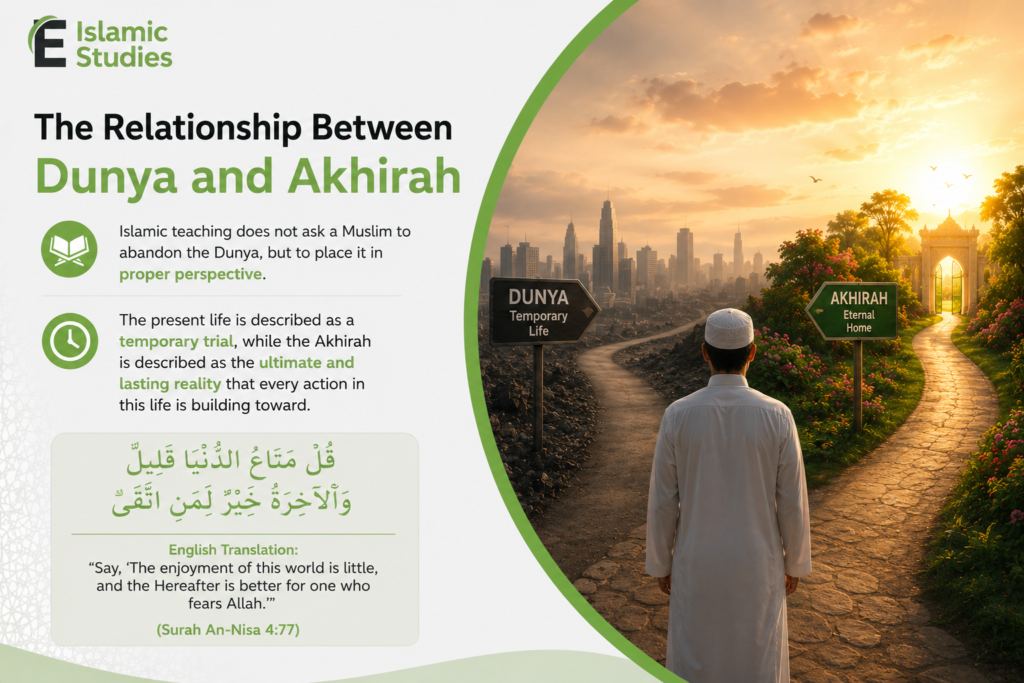
The Relationship Between Dunya and Akhirah
Islamic teaching does not ask a Muslim to abandon the Dunya, but to place it in proper perspective. The present life is described as a temporary trial, while the Akhirah is described as the ultimate and lasting reality that every action in this life is building toward.
قُلْ مَتَاعُ الدُّنْيَا قَلِيلٌ وَالْآخِرَةُ خَيْرٌ لِّمَنِ اتَّقَىٰ
“Say, ‘The enjoyment of this world is little, and the Hereafter is better for one who fears Allah.’ Surah An-Nisa (4:77)
Read Also: What Is Amanah in Islam? Meaning, Types, and Importance of Trust
How Belief in Akhirah Shapes a Muslim’s Daily Life
Because the Akhirah is understood as the true and lasting home, sincere belief in it naturally influences daily choices, patience through hardship, honesty in dealings, and generosity toward others.
A Muslim who is mindful of the Hereafter tends to weigh actions not only by their worldly outcome, but by their lasting value.
This is exactly the kind of foundational understanding that structured Islamic education aims to build.
If you would like guided, teacher-led lessons that walk through core beliefs like the Akhirah in more depth, E Islamic Studies Academy offers online Islamic Studies classes designed for learners at every stage, including interactive Islamic Courses Workshops for group learning.

Read Also: What Is Nafs in Islam? Meaning, Types, and Spiritual Significance
Deepen Your Islamic Knowledge With E Islamic Studies Academy
Learning about concepts such as Akhirah is far more effective with a qualified teacher who can explain context, answer questions, and connect the topic to the wider framework of Islamic belief and practice.
E Islamic Studies Academy provides structured, one-on-one and group online classes covering Aqidah, Fiqh, Quran, and Islamic history for adults, children, sisters, and new Muslims alike. You can learn more directly on the E Islamic Studies Academy website.

Read Also: What Is Rizq in Islam? Meaning, Types, and How Provision Works
Watch a Sample Islamic Studies Class
See how our teachers explain Islamic concepts in an engaging and easy-to-understand way, helping students build knowledge and confidence.
Deepen Your Islamic Knowledge
Join our comprehensive online courses and learn from qualified scholars today.
Book Your Free TrialExplore More Islamic Courses to Continue Your Learning
If this topic raised further questions about Islamic beliefs, worship, or history, the following course categories at E Islamic Studies Academy may help you continue learning.
Our Islamic Courses
● Learning Islam for New Converts
Conclusion
Akhirah in Islam refers to the eternal life that begins after death, moving through the grave, resurrection, and the Day of Judgment, before ending in either Paradise or the Fire.
This belief is one of the six pillars of Islamic faith and is described throughout the Quran and authentic hadith with clarity and detail.
Understanding the akhira meaning in Islam helps a Muslim place the temporary nature of this worldly life in perspective, encouraging patience, gratitude, and accountability in daily actions.
The Hereafter is not a distant abstraction in Islamic belief; it is presented as the true and lasting home every person is journeying toward.
Frequently Asked Questions
What does Akhirah mean in Islam?
Akhirah means “the Hereafter” the eternal life that begins after death and includes the grave, resurrection, judgment, and the final abodes of Paradise or Hellfire. It is one of the core beliefs every Muslim is required to hold.
What are the main stages of the Akhirah?
The main stages are death, Al-Barzakh (life in the grave), Al-Ba’th (resurrection), Al-Hisab (the reckoning of deeds), and finally entry into Jannah or Jahannam. Each stage is described in the Quran and Sunnah.
Why is belief in Akhirah important in Islam?
Belief in Akhirah is one of the six pillars of Iman and is repeatedly paired with belief in Allah in the Quran. It gives meaning and accountability to actions taken in this worldly life.
What happens in the grave before the Day of Judgment?
This stage is called Al-Barzakh, an intermediate period between death and resurrection where the soul experiences comfort or punishment. It ends when the resurrection takes place on the Day of Judgment.
Is Akhirah mentioned directly in the Quran?
Yes. The term Akhirah and its related concepts appear throughout the Quran, often paired with belief in Allah, such as in Surah Al-Baqarah (2:177) and Surah Al-Ankabut (29:64), among many other verses.
Is the worldly life (Dunya) considered unimportant in Islam?
No. Islam does not dismiss the Dunya; it teaches that this life is a trial and an opportunity to prepare for the Akhirah, as reflected in Surah An-Nisa (4:77), which describes worldly enjoyment as limited compared to the Hereafter.
Related Articles
Learning Islam








Leave a Reply