 Learning Islam
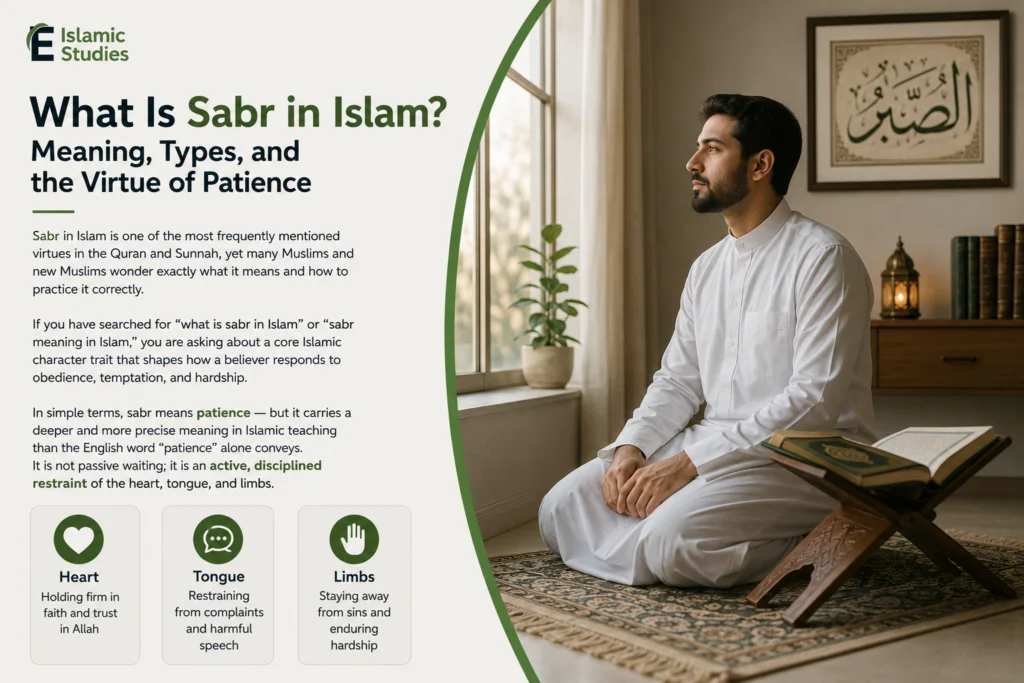
Sabr in Islam is one of the most frequently mentioned virtues in the Quran and Sunnah, yet many Muslims and new Muslims wonder exactly what it means and how to practice it correctly.
If you have searched for “what is sabr in Islam” or “sabr meaning in Islam,” you are asking about a core Islamic character trait that shapes how a believer responds to obedience, temptation, and hardship.
In simple terms, sabr means patience but it carries a deeper and more precise meaning in Islamic teaching than the English word “patience” alone conveys. It is not passive waiting; it is an active, disciplined restraint of the heart, tongue, and limbs.
This article explains the linguistic and Islamic meaning of sabr, its three types, its pillars, and what the Quran and Sunnah say about its virtue so you leave with a clear and accurate understanding of patience in Islam.
Take Away — What You Will Learn
- The precise linguistic and Islamic definition of sabr.
- The three types of sabr are recognized in Islamic teaching.
- The three pillars that must be present for sabr to be complete.
- What the Quran says about the reward of the patient (as-sabirin).
- Examples of sabr from the lives of the Prophets, including Prophet Muhammad ﷺ.
What Is Sabr in Islam? (Definition)
Sabr in Islam is the restraint of the self upon what the Sharia and sound reason require, and preventing it from despair, complaint, and discontent. It is a deliberate, disciplined response not simply enduring difficulty, but doing so in a way that pleases Allah.
This concept sits at the heart of Islamic character because life inevitably brings both ease and hardship, and a believer’s response to each reveals the strength of their faith.
Sabr is not a single feeling but a sustained inner discipline that a Muslim builds gradually, through worship, self-reflection, and reliance on Allah.
Because sabr touches nearly every area of religious and daily life, many students choose to study it properly under qualified teachers rather than relying only on articles.
You can read more about E Islamic Studies Academy and how its programs approach Islamic character-building topics such as this one.

Linguistic Meaning of Sabr
In the Arabic language, sabr (الصَّبْر) comes from the root letters ص-ب-ر, meaning “to hold back” or “to restrain.” Its opposite is jaz’ (الجزع), meaning impatience, panic, or anguished distress.
Classical Arabic usage reflects this sense of confinement. The old expression “qutila fulanun sabran” (so-and-so was killed while restrained) describes someone held in place without the ability to move the same root sense of holding firm that Islamic scholars later applied to describe self-restraint in the face of hardship.
Islamic Terminological Meaning of Sabr
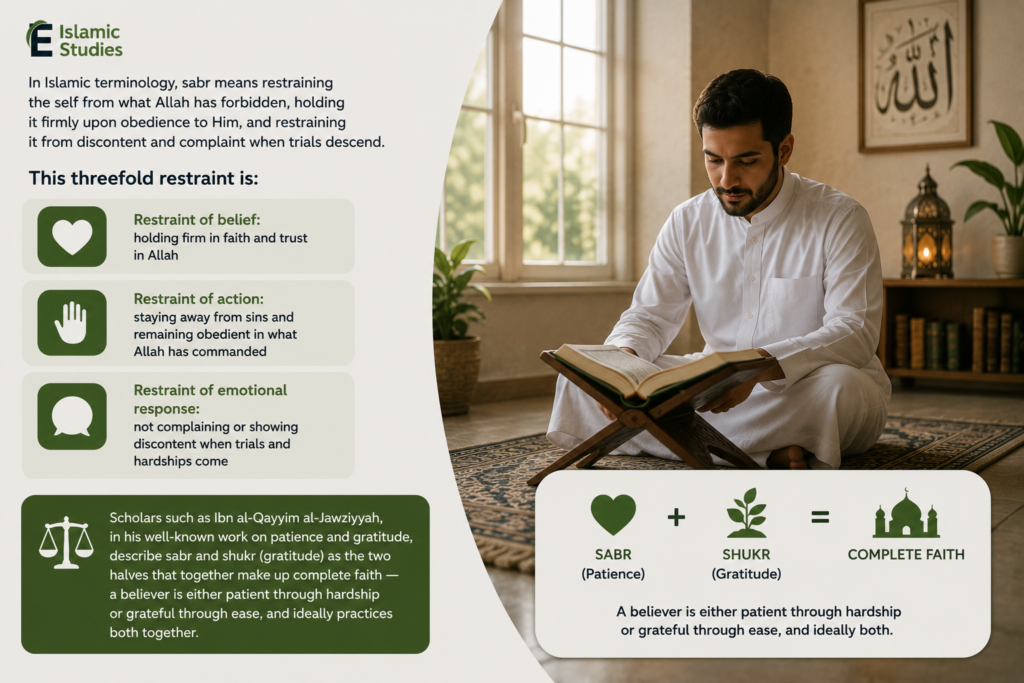
In Islamic terminology, sabr means restraining the self from what Allah has forbidden, holding it firmly upon obedience to Him, and restraining it from discontent and complaint when trials descend.
This threefold restraint of belief, of action, and of emotional response is what distinguishes Islamic sabr from ordinary patience.
Scholars such as Ibn al-Qayyim al-Jawziyyah, in his well-known work on patience and gratitude, describe sabr and shukr (gratitude) as the two halves that together make up complete faith a believer is either patient through hardship or grateful through ease, and ideally practices both together.
Types of Sabr in Islam
Islamic scholarship divides sabr into three main categories, each addressing a different area of a believer’s life: worship, temptation, and hardship.
Recognizing which type of sabr a situation calls for helps a Muslim respond correctly rather than confusing patience with mere endurance.
These three types are not separate virtues but different applications of the same underlying discipline, the restrained, Allah-conscious self. A believer typically practices all three simultaneously throughout an ordinary day, often without realizing it.
1. Sabr on Obedience to Allah
This is patience in consistently performing acts of worship, prayer, fasting, charity, and other obligations even when the self grows tired or unmotivated. It requires ongoing effort because worship is a continuous commitment, not a single act.
The five daily prayers, called for through the Adhan and its meaning, require a Muslim to pause daily tasks and dedicate time to worship a small but repeated test of patience and priority throughout the day.
Fasting is one of the clearest demonstrations of sabr in obedience, since it requires refraining from food, drink, and desires from dawn until sunset for an entire month.
Understanding the benefits of fasting in Islam helps explain why this particular act of worship is so closely tied to the development of sabr.
2. Sabr in Avoiding Sin
This is the patience of restraining the self from forbidden desires and temptations. It involves an internal struggle (mujahadah) against the pull of the lower self toward what Allah has prohibited.
This form of sabr often happens silently, in moments no one else witnesses lowering the gaze, controlling anger, avoiding gossip, or walking away from an unlawful gain. Because it is unseen by people, scholars regard it as one of the most sincere forms of patience.

3. Sabr on Allah’s Decree (Trials and Hardships)
This is patience when facing painful decrees of Allah illness, loss, poverty, or calamity without falling into discontent, complaint against Allah, or despair. Of the three types, this is the one most people associate with the word “patience.”
Scholars note that patience in obedience and in avoiding sin are, in some respects, even more excellent than patience with the decree, because a person has a choice in the first two, whereas the decree itself is unavoidable regardless of how one responds to it.
See Our Islamic Studies Classes in Action
Take a look at a sample lesson and see how our interactive online classes help students learn Islamic Studies in a clear, engaging, and supportive environment.
Deepen Your Islamic Knowledge
Join our comprehensive online courses and learn from qualified scholars today.
Book Your Free TrialThe Pillars of Sabr
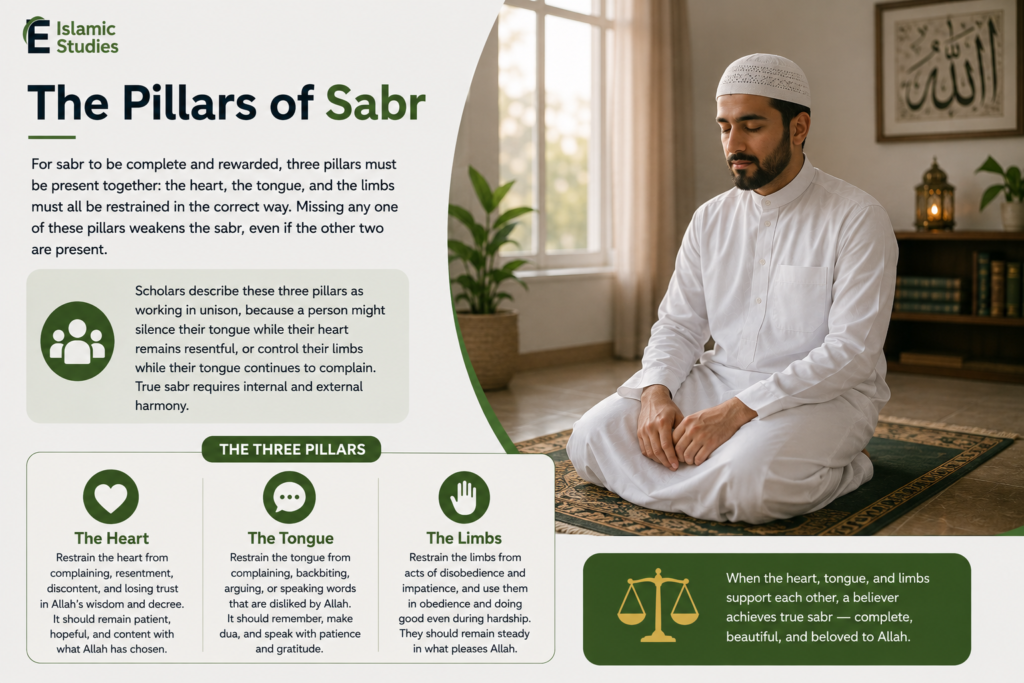
For sabr to be complete and rewarded, three pillars must be present together: the heart, the tongue, and the limbs must all be restrained in the correct way. Missing any one of these pillars weakens the sabr, even if the other two are present.
Scholars describe these three pillars as working in unison, because a person might silence their tongue while their heart remains resentful, or control their limbs while their tongue continues to complain. True sabr requires internal and external harmony.
Restraining the Heart from Discontent
The heart must not become resentful toward Allah’s decree. A believer accepts that whatever Allah has decreed carries a wisdom beyond immediate understanding, even when the outcome appears painful.
This inner acceptance does not mean suppressing natural grief, but rather refusing to let grief turn into anger or rejection of Allah’s wisdom and justice.
Restraining the Tongue from Complaint
The tongue must be held back from excessive complaints to other people. Constantly voicing grievances to created beings, rather than turning to Allah, reflects a lack of contentment with His decree.
Speaking to Allah in supplication, or seeking necessary practical help from others, is not included in this prohibition; the concern is specifically with bitter complaints directed against the decree itself.
Restraining the Limbs from Wrongful Actions
The limbs must be restrained from expressions of grief that Islam prohibits, such as striking the cheeks, tearing clothing, or wailing (an-niyahah) over the deceased.
The Prophet ﷺ made clear that mourning must remain within dignified, lawful bounds, distinguishing sincere grief from the exaggerated displays associated with pre-Islamic customs.
The Virtue of Sabr in the Quran
The Quran repeatedly praises those who practice sabr and promises them great reward, mentioning the patient (as-sabirin) in dozens of verses across nearly every theme of the revelation worship, hardship, warfare, and daily conduct.
The following verses illustrate different dimensions of this virtue, from seeking help through patience in worship, to the promise of reward without limit for those who remain patient through trial.
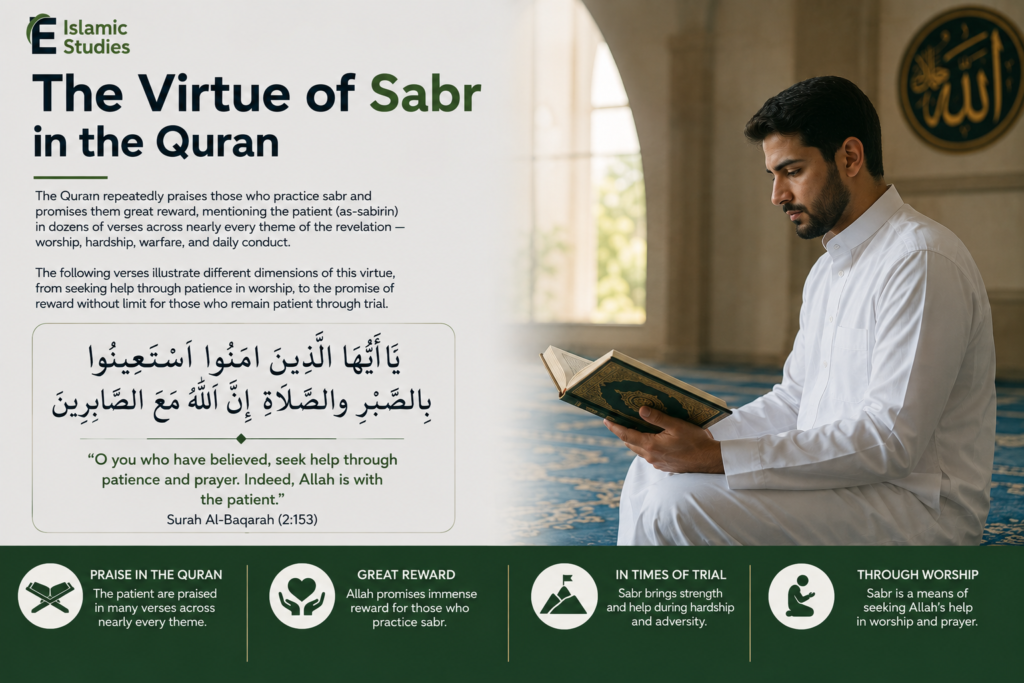
يَا أَيُّهَا الَّذِينَ آمَنُوا اسْتَعِينُوا بِالصَّبْرِ وَالصَّلاةِ ّ إِنَّ اللَّهَ مَعَ الصَّابِرِينَ
“O you who believe! Seek help through patience and prayer. Indeed, Allah is with the patient.”
وَاصْبِرْ وَمَا صَبْرُكَ إِلَّا بِاللَّهِ
“And be patient, and your patience is not except through Allah.”
وَلَنَبْلُوَنَّكُمْ بِشَيْءٍ مِنَ الْخَوْفِ وَالْجُوعِ وَنَقْصٍ مِنَ الْأَمْوَالِ وَالْأَنْفُسِ وَالثَّمَرَاتِ وَبَشِّرِ الصَّابِرِينَ الَّذِينَ إِذَا أَصَابَتْهُم مُّصيبَةٌ قَالُوا إِنَّا لِلَّهِ وَإِنَّا إِلَيْهِ رَاجِعُونَ أُولَـيِكَ عَلَيْهِم صَلَوَاتٌ مِّن رَّبِّهِم وَرَحْمَةٌ وَأُولَـيِكَ هُمُ الْمُهْتَدونَ
“And We will surely test you with something of fear and hunger and a loss of wealth, lives, and fruits, but give good tidings to the patient — who, when disaster strikes them, say, ‘Indeed we belong to Allah, and indeed to Him we will return.’ Those are the ones upon whom are blessings from their Lord and mercy, and it is those who are the guides.”
Sabr in the Life of the Prophets
The Quran presents the Prophets as the highest examples of sabr, describing their trials in detail so believers can learn practical lessons from how each of them responded.
Their patience was not passive resignation but active, faithful perseverance in the face of loss, rejection, and hardship.
Studying their stories helps make the abstract concept of sabr concrete, showing how it looks in real situations illness, bereavement, public rejection, and prolonged struggle for a cause.
Prophet Ayyub (Job), peace be upon him
Prophet Ayyub is the Quranic model of patience through prolonged illness and the loss of family and wealth. Despite the length and severity of his trial, he did not turn away from Allah or complain bitterly, and Allah described him directly:
إِنَّا وَجَدْنَاهُ صَابِرًا ؛ نِّعْمَ الْعَبْدُ ؛ إِنَّهُ أَوَّابٌ
“Indeed, We found him patient, an excellent servant. Indeed, he was one repeatedly turning back to Allah.”
Prophet Ya’qub (Jacob), peace be upon him
Prophet Ya’qub endured the loss of his son Yusuf and later his son Binyamin, grieving so deeply that the Quran describes his eyes turning white from sorrow.
Rather than complaining to people, he said: “So patience is most fitting, and Allah is the One sought for help against what you describe” (Surah Yusuf, 12:18).
This response shows sabr expressed without complaint directed at creation grief acknowledged, but channelled toward Allah rather than toward bitterness against others.
Prophet Nuh (Noah), peace be upon him
Prophet Nuh called his people to the worship of Allah alone for approximately nine hundred and fifty years, facing rejection and mockery throughout, yet he persisted in his mission with sustained patience.
His story illustrates sabr on obedience over an extraordinarily long timescale, showing that patience is not only about a single difficult moment but can also mean decades of unwavering commitment to a divine mission.
Prophet Muhammad ﷺ
The Prophet ﷺ endured the harm and disbelief of the Quraysh, a difficult social boycott, and the loss of his beloved wife Khadijah and his uncle Abu Talib in the same year, while remaining firm in conveying the message of Islam.
Throughout these trials, he continued to treat even his opponents with restraint and mercy, modelling all three pillars of sabr: a controlled heart, a controlled tongue, and controlled actions under some of the most difficult circumstances imaginable.
Read Also: What Is Haya in Islam?
Hadith on the Importance of Sabr
The Sunnah reinforces the Quranic teaching on patience through several authentic narrations, explaining both the reward of sabr and the way it benefits the believer in every circumstance, whether in ease or hardship.
Studying hadith properly including how scholars authenticate and interpret each narration normally requires structured guidance rather than casual reading.
If you are looking for a starting point, this overview of the best schools to learn Islam can help you find a reliable, structured path for deeper study.

عَجَبًا لأمر المؤمن، إن أمره كله له خير، وليس ذلك لأحد إلا للمؤمن، إن أصابته ضراء صبر؛ فكان خيرًا له، وإن أصابته سراء شكر؛ فكان خيرًا له
“How wonderful is the affair of the believer, for his affairs are all good, and this applies to no one but the believer. If something good happens to him, he is thankful for it, and that is good for him. If something bad happens to him, he bears it with patience, and that is good for him.” Narrated by: صُهَيْب بن سنان (رضي الله عنه)
ومن يستعفف يعفه الله، ومن يستغن يغنه الله، ومن يتصبر يصبره الله، وما أعطي أحد من عطاء خيرًا وأوسع من الصبر
“Whoever remains chaste, Allah will keep him chaste. Whoever seeks self-sufficiency, Allah will make him self-sufficient. And whoever is patient, Allah will make him patient, and no one is given a gift better and more comprehensive than patience.” Narrated by: Abu Sa’id al-Khudri (may Allah be pleased with him)
Sahih al-Bukhari and Sahih Muslim
Read Also: What Is Hasad in Islam?
Why Is Patience Important in Islam?
Understanding the ruling on sabr helps clarify its real weight in a believer’s life, since Islamic scholars distinguish clearly between three different responses a person can have toward hardship.
Sabr itself, meaning patience, is obligatory (wajib) upon every believer facing a trial. It requires restraining the heart, tongue, and limbs from discontent and from the forbidden expressions of grief described earlier in this article, such as wailing or striking the face.
Ridha, meaning contentment, goes a step further and is considered a highly recommended (sunnah mu’akkadah) station rather than a strict obligation.
A believer who reaches ridha is not merely enduring the decree but is inwardly at peace with it, trusting fully in Allah’s wisdom.
Jaza’, meaning impatience or anguish, refers to responses such as wailing, striking the face, tearing clothes, or openly voicing discontent with Allah’s decree. This response is forbidden (haram) in Islam, since it reflects a rejection of Allah’s decree rather than acceptance of it.
Taken together, these three levels show that patience is not optional in Islam, while contentment represents an even higher, more excellent station reached by those closest to Allah through consistent practice and sincere trust.
If you would like to study these concepts in greater depth including how classical scholars derived these rulings from the Quran and Sunnah, structured courses can help you build a stronger foundation than reading articles alone.
Read Also: What Is Kibr in Islam?
Watch a Sample Islamic Studies Class
See how our teachers explain Islamic concepts in an engaging and easy-to-understand way, helping students build knowledge and confidence.
Deepen Your Islamic Knowledge
Join our comprehensive online courses and learn from qualified scholars today.
Book Your Free TrialReady to build a stronger foundation in Islamic knowledge?
Choose the learning path that matches your level, study directly with qualified teachers, and get the opportunity to ask about the real-life situations that a general article cannot fully address.
Different students need different learning paths. A new Muslim may need a broad introduction to Islamic beliefs and practice, while another student may want detailed study of fiqh or a traditional curriculum. The academy’s courses are organized to support these different levels and goals.
Our Islamic Essentials Courses
Islamic family rulings make more sense when they are studied alongside the wider Islamic sciences.
Tafseer helps students understand Quranic guidance in context, aqidah develops their understanding of Islamic belief, seerah provides the Prophetic context, and tazkiyah and akhlaq connect legal knowledge with spiritual and ethical development.
- Essential Islam Courses
- Online Tafseer Course
- Islamic History Course
- Tazkiyah Course
- Online Qirat Course
- Quran Tafseer Classes for Beginners
- Online Tafseer Classes in English
- Self-Paced Tafseer Course
- Aqidah Course
- Online Seerah Course
- Akhlaq Course

Conclusion
Sabr in Islam is far more than passive waiting; it is the disciplined restraint of the heart, tongue, and limbs in obedience to Allah, in avoiding sin, and in facing life’s hardships without discontent.
The Quran and Sunnah repeatedly honor those who practice sabr, promising them Allah’s companionship, mercy, guidance, and an unlimited reward. Understanding what sabr truly means, and its three types and pillars, equips a believer to face both ease and difficulty in a way that pleases Allah.
FAQs
What does sabr mean in Islam?
Sabr means restraining the self from discontent, complaint, and forbidden reactions, while remaining firm upon obedience to Allah and avoidance of sin. It is broader than the English word “patience” alone conveys.
What are the three types of sabr?
The three types are patience in obedience to Allah, patience in avoiding sin, and patience with Allah’s painful decrees, such as illness or loss.
Is sabr obligatory in Islam?
Yes, sabr is obligatory upon every believer when facing trials, while responding with wailing or striking the face is forbidden. Reaching full contentment (ridha) with the decree is a highly recommended, higher station.
What is the difference between sabr and ridha?
Sabr is restraining oneself from discontent, while ridha is being inwardly content and at peace with what Allah has decreed. Ridha is considered a higher and more complete station than sabr alone.
Which Prophet is known for extreme patience?
Prophet Ayyub (Job), peace be upon him, is the Quranic example of extreme patience, having endured prolonged illness and loss while remaining devoted to Allah.
Does crying over a loss break one’s sabr?
No, crying itself does not break sabr, as long as it is not accompanied by complaint against Allah, wailing, or striking oneself. The Prophet ﷺ himself wept at the death of his son Ibrahim while affirming patience with Allah’s decree.






Leave a Reply