 Learning Islam
Shirk in Islam refers to associating partners with Allah in His Lordship, His right to be worshipped, or His unique names and attributes. It is considered the most serious violation of Islamic monotheism, known as tawhid.
Many new Muslims and lifelong believers alike ask what is shirk in Islam, why it carries such severe consequences, and how it shows up in everyday life. This guide explains the shirk meaning in Islam clearly, using the Quran and authentic Sunnah as its foundation.
You will also learn the difference between major and minor shirk, along with real examples of shirk in Islam that many people overlook. Understanding these categories helps every Muslim protect and strengthen their personal tawhid.
What You Will Learn
● The exact meaning of shirk in Islamic language and Islamic law.
● Why the Quran describes shirk as a “great injustice”.
● The three main categories of shirk in Islam.
● The difference between major shirk (shirk akbar) and minor shirk (shirk asghar).
● Everyday examples of shirk that Muslims should be aware of.
What Is Shirk in Islam?
Shirk in Islam is the act of associating a partner, rival, or equal with Allah in matters that belong exclusively to Him — His Lordship (rububiyyah), His right to be worshipped (uluhiyyah), or His unique names and attributes (asma wa sifat).
Linguistically, the Arabic term shirk comes from the root sh-r-k, meaning partnership or sharing something between two parties. The early scholar Ibn Qutaybah defined it simply as “making a partner for Allah.”
Later scholars expanded on this definition. Imam Al-Qurtubi explained that the essence of shirk is believing Allah has a partner in divinity, while Ibn Taymiyyah described its foundation as equating a created being with Allah in something that belongs to Him alone.
The direct opposite of shirk is tawhid the Islamic belief that Allah is one and without partner in His Lordship, His worship, and His names and attributes. Every article of Islamic faith is built on protecting this pure tawhid.
Why Is Shirk Considered the Greatest Sin in Islam?
Shirk is regarded as the single greatest sin a person can commit, because it denies Allah His exclusive right to be worshipped despite Him alone being the Creator, Sustainer, and Giver of life. The Quran addresses this sin more than any other.
Shirk Is Described as a “Great Injustice”
The Quran emphasizes the seriousness of shirk by describing it in exceptionally strong terms. In Luqman’s advice to his son, Allah identifies associating partners with Him as a profound form of injustice.
إِنَّ الشِّرْكَ لَظُلْمٌ عَظِيمٌ
“Indeed, association [with Allah] is a great injustice.”
This verse shows that shirk is not merely a mistaken ritual but a profound injustice placing a created being on the same level as the Creator, who alone has the right to be obeyed and worshipped.
Shirk Is the One Sin Allah Does Not Forgive Without Repentance
The Quran also distinguishes shirk from other sins when explaining Allah’s forgiveness. This warning concerns a person who dies persisting in shirk, while repentance from shirk during one’s lifetime can still be accepted.
إِنَّ اللَّهَ لَا يَغْفِرُ أَن يُشْرَكَ بِهِ وَيَغْفِرُ مَا دُونَ ذَٰلِكَ لِمَن يَشَاءُ
“Indeed, Allah does not forgive association with Him, but He forgives what is less than that for whom He wills.”
This verse establishes that while Allah may forgive any other sin, dying upon unrepented shirk forfeits the possibility of forgiveness. This is why correcting one’s tawhid is treated as the highest priority in Islamic belief.
إِنَّهُ مَن يُشْرِكْ بِاللَّهِ فَقَدْ حَرَّمَ اللَّهُ عَلَيْهِ الْجَنَّةَ وَمَأْوَاهُ النَّارُ وَمَا لِلظَّالِمِينَ مِنْ أَنصَارٍ
“Indeed, he who associates others with Allah — Allah has forbidden him Paradise, and his refuge is the Fire. And there are not for the wrongdoers any helpers.”
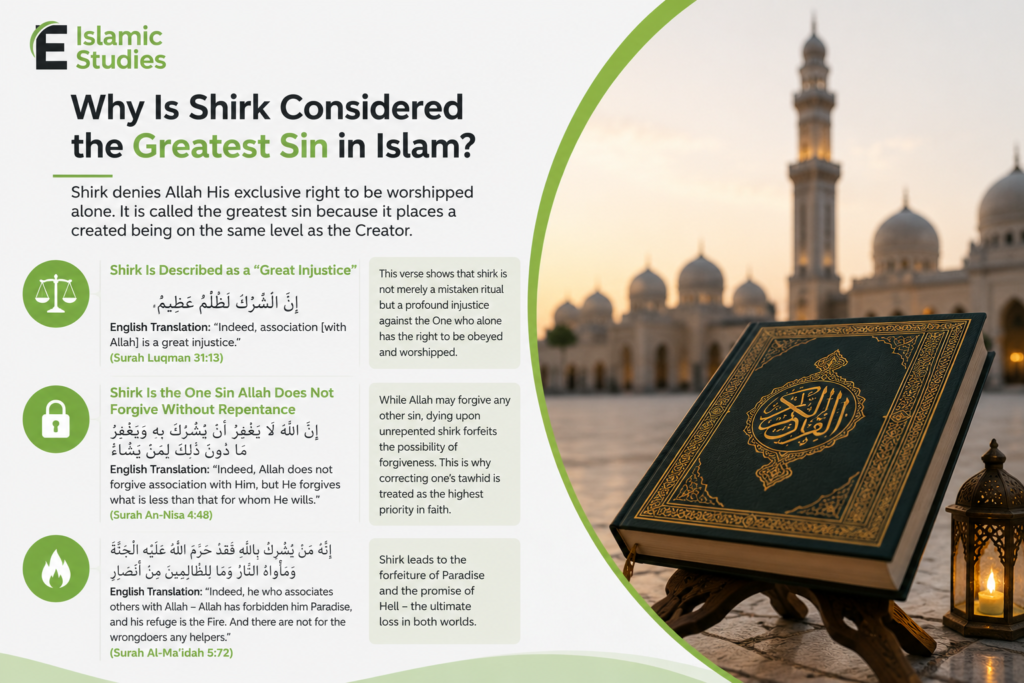
Together, these verses explain why shirk carries the harshest warning in the Quran: it is called an injustice, an unforgivable sin without repentance, and a barrier to Paradise.
If you are searching for a trustworthy place to study, our guide to the best UK schools to learn Islam may also help.
See Our Islamic Studies Classes in Action
Take a look at a sample lesson and see how our interactive online classes help students learn Islamic Studies in a clear, engaging, and supportive environment.
Deepen Your Islamic Knowledge
Join our comprehensive online courses and learn from qualified scholars today.
Book Your Free TrialWhat Are the Types of Shirk in Islam?
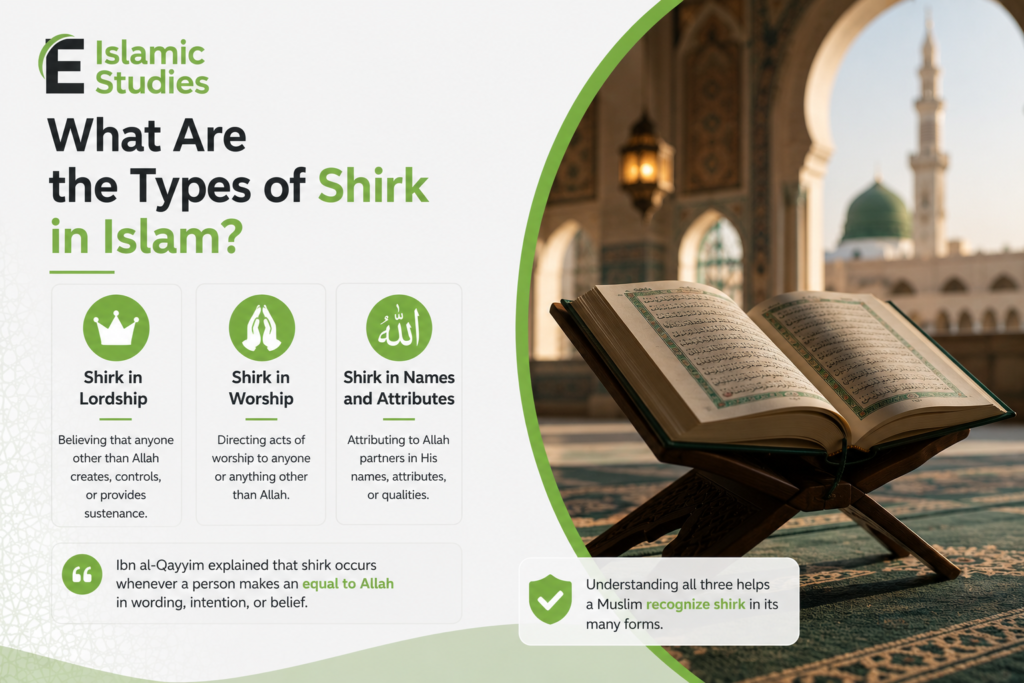
Islamic scholars classify shirk into three broad categories, based on which exclusive right of Allah is being violated: His Lordship, His right to be worshipped, or His unique names and attributes.
This threefold classification is not a modern invention; it reflects how the Quran and Sunnah repeatedly address different dimensions of Allah’s uniqueness.
Ibn al-Qayyim explained that shirk occurs whenever a person makes an equal to Allah in wording, intention, or belief, and each of the three categories below reflects one of those dimensions in practice.
Understanding all three helps a Muslim recognize shirk in its many forms, rather than associating it only with statues and idols.
1. Shirk in Lordship (Shirk fi’l-Rububiyyah)
This type of shirk involves believing that a created being shares in Allah’s control over creation, sustenance, life, or death.
The clearest historical example is Pharaoh, who claimed lordship for himself before Allah destroyed him.
2. Shirk in Worship (Shirk fi’l-Uluhiyyah)
This is the most common form of shirk, involving directing acts of worship such as prayer, sacrifice, or vows to anyone other than Allah. Examples include praying at graves or offering sacrifices to saints, believing this brings one closer to Allah.
Read more in our guide on what is kafir in Islam.
3. Shirk in the Names and Attributes of Allah
This occurs when a person believes a created being shares one of Allah’s unique attributes, such as complete knowledge of the unseen (ghayb) or unlimited power over all things. Such claims contradict Allah’s absolute uniqueness.
You can also read more about our academy and its teaching approach.
Major Shirk (Shirk Akbar) vs Minor Shirk (Shirk Asghar)
Beyond the three categories above, scholars also divide shirk according to its severity into major shirk and minor shirk.
This distinction matters because each carries a completely different ruling in Islamic law, and confusing the two can lead to either unwarranted despair or dangerous carelessness.
Major shirk is a direct violation of tawhid that expels a person from Islam, while minor shirk is a serious sin that damages a person’s faith without removing them from it. Scholars identify both types across a person’s beliefs, statements, and actions.
What Is Major Shirk?
Major shirk (shirk akbar) means directing an act of worship such as prayer, sacrifice, or complete reliance entirely to someone besides Allah. It removes a person from the fold of Islam if they die upon it without repentance.
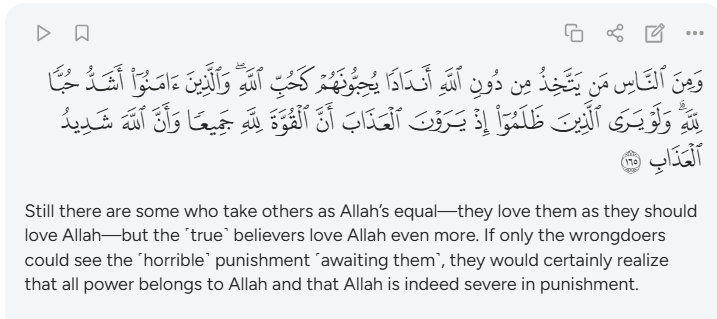
Major shirk in belief includes holding that a created being shares in Allah’s power to give life or death, believing someone deserves obedience above Allah’s own commands, or loving a created being with the complete love and reverence that belongs to Allah alone, as warned against in Surah Al-Baqarah (2:165).
What Is Minor Shirk?
Minor shirk (shirk asghar) does not remove a person from Islam, but it remains a serious sin that can lead toward greater shirk. The Prophet ﷺ warned that riya, or showing off in worship, is the form of minor shirk he feared most for his followers.
عنْ مَحْمُودِ بْنِ لَبِيدٍ رضي الله عنه أَنَّ رَسُولَ اللَّهِ صَلَّى اللَّهُ عَلَيْهِ وَسَلَّمَ قَالَ
«إِنَّ أَخْوَفَ مَا أَخَافُ عَلَيْكُمُ الشِّرْكُ الْأَصْغَرُ» قَالُوا: وَمَا الشِّرْكُ الْأَصْغَرُ يَا رَسُولَ اللهِ؟ قَالَ: «الرِّيَاءُ، يَقُولُ اللهُ عز وجل لَهُمْ يَوْمَ الْقِيَامَةِ إِذَا جُزِيَ النَّاسُ بِأَعْمَالِهِمْ: اذْهَبُوا إِلَى الَّذِينَ كُنْتُمْ تُرَاؤُونَ فِي الدُّنْيَا، فَانْظُرُوا هَلْ تَجِدُونَ عِنْدَهُمْ جَزَاءً؟».
Mahmūd ibn Labīd (may Allah be pleased with him) reported that the Messenger of Allah (may Allah’s peace and blessings be upon him) said:
“The thing that I fear most for you is minor Shirk (polytheism).’ They said: ‘What is minor Shirk, O Messenger of Allah?’ He said: ‘It is Riyā’ (showing off).
Allah Almighty will say on the Day of Judgment when He will requite all people for their deeds: ” Go to those before whom you used to show off with your deeds in the worldly life and see whether you find any reward with them?”
Another example of minor shirk is swearing an oath by something other than Allah, or saying “What Allah wills and you will,” a phrasing the Prophet ﷺ corrected to “What Allah wills, then what you will,” as recorded in Sunan an-Nasa’i.
Common Examples of Shirk in Islam
Understanding real examples of shirk in Islam helps Muslims recognize and avoid it in daily life, since some forms are open while others are subtle.
- Making vows, sacrifices, or prayers to deceased saints or at graves, hoping for their intercession
- Seeking help from jinn, stars, or unseen forces for matters that only Allah controls
- Believing any human being possesses complete knowledge of the unseen exactly as Allah does
- Riya performing acts of worship, such as prayer or charity, to be seen or praised by others
- Wearing amulets or charms while believing they alone ward off harm, apart from Allah’s decree
- Swearing an oath by something other than Allah’s name
Recognizing these examples is only the first step, understanding tawhid in depth requires proper guidance.
Shaykhi Academy offers structured Islamic courses with qualified teachers, helping new and lifelong Muslims alike build a firm, correct understanding of tawhid

How Can a Muslim Avoid Falling Into Shirk?
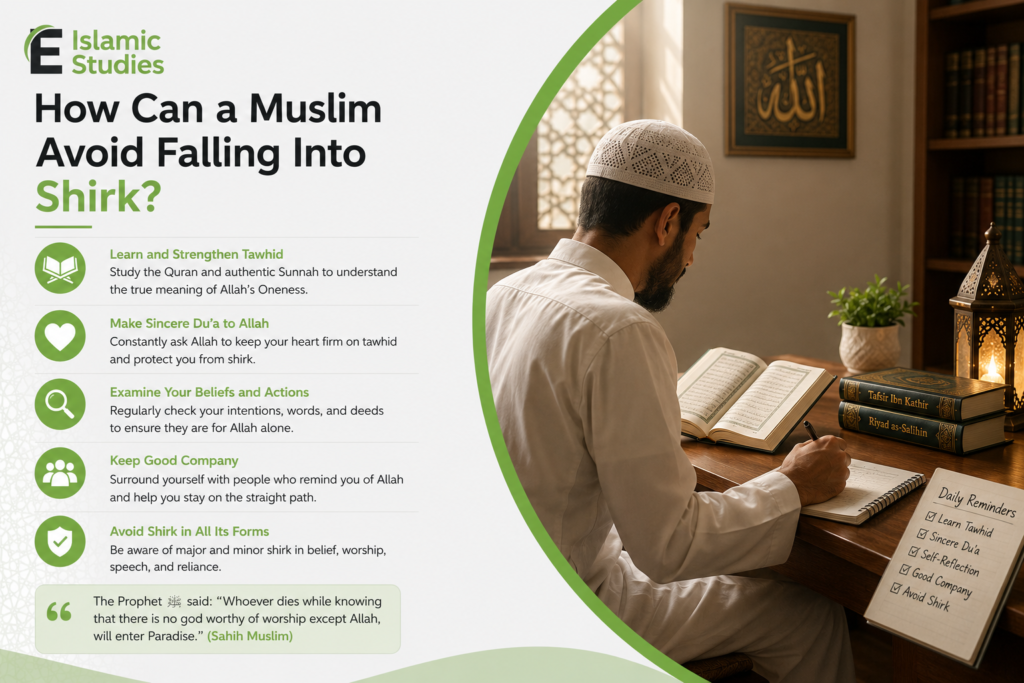
Avoiding shirk is not a one-time decision but an ongoing effort that touches belief, worship, speech, and daily habits. Because minor shirk can be subtle and unintentional, protecting one’s tawhid requires continuous learning, honest self-reflection, and turning back to Allah whenever a doubt or slip is noticed.
The Quran and Sunnah both offer practical guidance for building this protection, rather than leaving Muslims to guess where the boundaries lie.
Learn Tawhid From Reliable Sources
The most effective protection against shirk is learning authentic Islamic knowledge directly from qualified teachers, rather than relying on assumptions, cultural habits, or unverified information online.
A structured curriculum helps a student recognize both the open and the hidden forms of shirk before they take root in daily practice.
Programs such as the Learning Islam Level 1 course at E Islamic Studies Academy are designed to build this foundation step by step, covering tawhid alongside the other core pillars of belief.

Read Also: What Is Mahram in Islam? Meaning, Types, and Rules Explained
Turn to Allah in Sincere Supplication
The Quran records Prophet Ibrahim (peace be upon him) directly asking Allah for protection from shirk, despite being one of Allah’s chosen messengers.
This shows that guarding one’s tawhid is a lifelong concern for every believer, not only for beginners in faith.
وَٱجْنُبْنِى وَبَنِىَّ أَن نَّعْبُدَ ٱلْأَصْنَامَ
“And keep me and my sons away from worshipping idols.” Surah Ibrahim (14:35)
Making similar supplication a regular habit, alongside learning the meaning of tawhid, helps a Muslim stay alert to shirk in its major and minor forms, rather than assuming immunity simply because the obvious idols of the past are absent today.
Read Also: What Is Tawbah in Islam? Meaning, Conditions, and How to Repent
Recognize Subtle and Cultural Practices
Some practices normalized by culture, rather than sound Islamic teaching, can slide toward shirk without people realizing it such as relying on charms for protection or attending rituals passed down through family tradition without questioning their basis.
Learning to distinguish authentic Islamic practice from later religious innovation is closely tied to understanding what is bid’ah in Islam, since many innovative practices open the door to minor shirk over time.
Read Also: Dua After Adhan – A Complete Guide to Prayer After Azan
Watch a Sample Islamic Studies Class
See how our teachers explain Islamic concepts in an engaging and easy-to-understand way, helping students build knowledge and confidence.
Deepen Your Islamic Knowledge
Join our comprehensive online courses and learn from qualified scholars today.
Book Your Free TrialStart Your Islamic Learning Journey with E Islamic Studies School
Build a stronger understanding of Islam through structured, engaging online Islamic Studies classes with qualified teachers.
Whether you’re looking for Islamic education for yourself or your children, E Islamic Studies School offers lessons designed to make learning clear, practical, and accessible from anywhere.
Start your learning journey today and take the next step toward deeper Islamic knowledge.
Our Islamic Courses
● Learning Islam for New Converts
Our Islamic Programs
● Islamic Distance Learning Programs
● Learning Islam Level 1 Online
● Darse Nizami / Traditional Alim Courses
Our Islamic Essentials Courses
● Quran Tafseer Classes for Beginners — Introductory Interpretation
● Online Tafseer Classes in English
● Self-Paced Tafseer Course — Flexible Learning Programs
● Aqidah Course — Islamic Creed and Theology Classes
● Online Seerah Course — Life of Prophet Muhammad Classes
● Akhlaq Course — Islamic Ethics and Character Development

Conclusion
Shirk in Islam means associating a partner with Allah in His Lordship, His worship, or His unique attributes, and it stands as the direct opposite of tawhid.
The Quran describes it as a great injustice and the one sin that is not forgiven without sincere repentance before death, unlike other sins.
Scholars divide shirk into major shirk, which removes a person from Islam, and minor shirk, such as riya, which remains a serious sin without expelling someone from the faith.
Recognizing everyday examples of shirk, and returning continually to sound Islamic knowledge, helps every Muslim protect and strengthen their tawhid throughout life.
Frequently Asked Questions About Shirk in Islam
What is the difference between shirk and kufr in Islam?
Kufr is a broader term covering any rejection of Islamic belief, while shirk specifically means associating partners with Allah. Every shirk is a form of kufr, but not every kufr involves shirk.
Is all shirk major enough to remove someone from Islam?
No. Only major shirk (shirk akbar) removes a person from Islam. Minor shirk (shirk asghar), such as riya, is a serious sin but does not expel a Muslim from the faith.
Can shirk ever be forgiven?
Yes, if a person sincerely repents before death, Allah forgives shirk just as He forgives other sins. However, dying upon unrepented shirk is the one case the Quran says Allah does not forgive.
What is riya, and why is it called minor shirk?
Riya means performing acts of worship to be seen or praised by people rather than sincerely for Allah. The Prophet ﷺ called it minor shirk because it mixes worship, which belongs to Allah alone, with a desire for people’s approval.
What are some everyday examples of shirk in Islam?
Common examples include praying or making vows at graves, wearing charms believed to ward off harm on their own, and swearing oaths by something other than Allah. Riya during prayer or charity is another frequent example.
How can I learn more about tawhid and avoiding shirk?
Structured Islamic education with qualified teachers is the most reliable way to build correct beliefs. Courses offered by E Islamic Studies Academy are designed to guide beginners through these foundations step by step.






Leave a Reply