 Learning Islam
When the call to prayer rings out, many Muslims wonder exactly what to say. The dua after adhan is a set of specific words and phrases that the Prophet Muhammad ﷺ taught his companions to recite once the mu’adhin finishes calling the adhan.
This guide explains the correct prayer after azan step by step, based on the dua after azan hadith recorded in reliable collections such as Sahih al-Bukhari and Sahih Muslim. It is written especially for new Muslims and beginners who want clear, accurate guidance.
You will learn the exact wording recommended after the adhan, the meaning of key Arabic terms such as “al-wasilah,” and how to use the short window between the adhan and the iqamah for personal supplication.
What You Will Learn
● The exact wording of the dua after adhan, based on authentic hadith.
● How to correctly respond to each phrase of the adhan itself, including the exception during the call to prayer.
● Why asking Allah for “al-wasilah” on behalf of the Prophet ﷺ carries special reward.
● What to say after the two testimonies of faith (shahadatayn), and its recorded reward.
● Why the time between the adhan and the iqamah is a recommended time for personal dua.
● Common wording mistakes to avoid so the dua stays true to what was authentically taught.
Dua After Adhan: What It Means and Why It Matters
The adhan announces the beginning of prayer time and was established in Madinah, with Bilal ibn Rabah serving as its first mu’adhin. The Prophet ﷺ taught Muslims specific responses to make this daily call to prayer a moment of dhikr and dua.
Responding to the adhan is recommended (mustahabb), not obligatory. The four major schools of Islamic jurisprudence recognize its virtue based on authentic hadith, so forgetting it does not affect the validity of a person’s prayer.
The response includes four main elements: repeating the mu’adhin’s words, sending blessings on the Prophet ﷺ, asking Allah for al-wasilah, and declaring contentment with Allah, Islam, and the Prophet ﷺ at the shahadatayn. The sections below explain each one in order.
Because the adhan is heard several times every day, learning these responses is especially useful for new Muslims. Structured lessons through E Islamic Studies Academy can also help beginners learn them with correct pronunciation and understanding.

For readers who also want to understand the wider history behind the adhan including the story of Bilal ibn Rabah and the early Muslim community in Madinah the Islamic History course covers this period in more depth.

Repeating The Words Of The Muezzin
Before the closing dua, the Sunnah is to repeat each phrase of the adhan after the mu’adhin, word for word, with one exception: during “Hayya ‘ala-s-Salah” (come to prayer) and “Hayya ‘ala-l-Falah” (come to success), the listener says “La hawla wa la quwwata illa billah” (there is no power or strength except with Allah) instead of repeating the same words.
This means that for every other phrase the opening “Allahu Akbar,” both parts of the shahadatayn, and the closing “Allahu Akbar” and “La ilaha illallah” the listener simply says exactly what the mu’adhin says, at the same pace, quietly to themselves.
In the Fajr (dawn) adhan, the mu’adhin adds the phrase “As-salatu khayrun min an-nawm” (prayer is better than sleep) (الصلاة خير من النوم).
The listener responds by repeating the same phrase, following the same principle of saying what the mu’adhin says rather than substituting different words.
This instruction comes from the hadith of ‘Abdullah ibn ‘Amr ibn al-‘As, in which the Prophet ﷺ said: “When you hear the mu’adhin, say what he says.”
“إِذَا سَمِعْتُمُ الْمُؤَذِّنَ فَقُولُوا مِثْلَ مَا يَقُولُ”
The full hadith, including the command to repeat the adhan and then ask Allah for al-wasilah.
Only once the mu’adhin has finished the entire adhan does the listener move on to the next steps: sending blessings on the Prophet ﷺ, then asking Allah for al-wasilah, which are covered in the following sections.
See Our Islamic Studies Classes in Action
Take a look at a sample lesson and see how our interactive online classes help students learn Islamic Studies in a clear, engaging, and supportive environment.
Deepen Your Islamic Knowledge
Join our comprehensive online courses and learn from qualified scholars today.
Book Your Free TrialPrayer After Azan: Sending Blessings on the Prophet ﷺ
After repeating the mu’adhin’s words, the next step in the prayer after azan is to send blessings (salawat) on the Prophet Muhammad ﷺ.
This can be done using any authentic wording of the salawat, such as the salat al-Ibrahimiyyah recited in the tashahhud of the daily prayers.
| إذا سمعتم المؤذّن فقولوا مثل ما يقول، ثم صلّوا عليّ“Idha sami’tum al-mu’adhdhina fa quluu mithla ma yaquul, thumma sallu ‘alayya…””When you hear the mu’adhin, repeat what he says, then send blessings upon me.” |
Narrated by: ‘Abdullah ibn ‘Amr ibn al-‘As
The same hadith explains the reward for this act: “whoever sends one blessing upon me, Allah will send ten blessings upon him.” This makes the moment right after the adhan an easy and rewarding habit to build into daily life.
Why Sending Blessings on the Prophet ﷺ Is Encouraged
Sending salawat on the Prophet ﷺ is not limited to the moment after the adhan; it is encouraged throughout a Muslim’s life, and Allah Himself instructs believers to do so in the Quran.
| إِنَّ اللَّهَ وَمَلائِكَتَهُ يُصَلُّونَ عَلَى النَّبِيِّ ۖ يَا أَيُّهَا الَّذِينَ آمَنوا صَلُّوا عَلَيْهِ وَسَلِّمُوا تَسْلِيمًا“Indeed, Allah confers blessing upon the Prophet, and His angels [ask Him to do so]. O you who have believed, ask [Allah to confer] blessing upon him and ask [Allah to grant him] peace.”Surah Al-Ahzab (33:56) |
This verse is one reason scholars encourage Muslims to send salawat often, not only after the adhan but throughout the day, including in daily prayers, after dua, and whenever the Prophet’s ﷺ name is mentioned.
In the specific context of the adhan, this step comes right after repeating the mu’adhin’s words and right before asking Allah for al-wasilah, forming the middle link between the two.
The Dua of Al-Wasilah After Adhan
Al-wasilah is described in hadith as a unique, elevated station in Paradise granted to only one servant of Allah, and the Prophet ﷺ expressed his hope that he would be that servant. Asking Allah to grant him this station is the central dua after adhan.
The word wasilah means a means of nearness or reaching something desired. Here, it refers specifically to this special rank in Paradise, while al-fadeelah refers to an additional honour.
The dua also asks Allah to raise the Prophet ﷺ to al-maqam al-mahmud, the praiseworthy station. Scholars explain this as the greater intercession (ash-shafa’ah al-‘uzma) on the Day of Judgement.
| اللّهُمَّ رَبَّ هَذِهِ الدَّعوةِ التَّامَّةِ، والصَّلاةِ القَائِمَةِ، آتِ مُحَمَّدًا الوَسِيلَةَ والفَضِيلَةَ، وابْعَثْهُ مَقامًا مَحْمُودًا الَّذِي وَعَدتَهُ“Allahumma Rabba hadhihi-d-da‘wati-t-tammah, was-salati-l-qa’imah, aati Muhammadan-il-wasilata wal-fadeelah, wab‘athhu maqaman mahmudan-illadhi wa’adtah”“O Allah, Lord of this perfect call and this established prayer, grant Muhammad the wasilah and the favour, and raise him to the praiseworthy station You promised him.” |
Narrated by Jabir ibn ‘Abdullah | Sahih al-Bukhari
The Prophet ﷺ said that whoever recites this dua after the adhan will receive his intercession (shafa’ah) on the Day of Judgement.
The dua is recited individually after the salawat, and it does not need to be said aloud or collectively. Scholars also advise keeping to the authentically reported wording rather than adding phrases that were not narrated.

Declaring Contentment With Allah After the Shahadatayn
When the mu’adhin reaches the two testimonies of faith (the shahadatayn), it is recommended to add a short declaration of contentment with Allah, Islam, and the Prophet Muhammad ﷺ, immediately after repeating the shahadatayn.
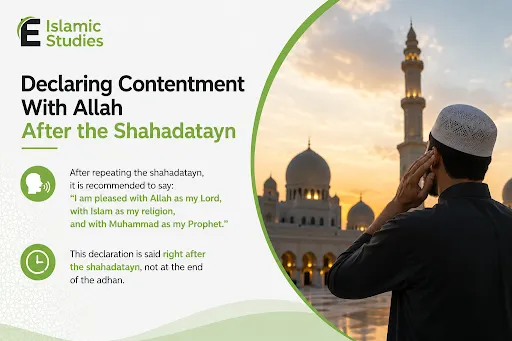
This declaration is separate from the wasilah dua covered above. It is said at a specific point mid-adhan right after repeating “I bear witness that Muhammad is the messenger of Allah” rather than at the very end of the adhan.
| أَشْهَدُ أَنْ لا إِلَهَ إِلَّا اللّهُ وَحْدَهُ لا شَريك لَهُ، وَأَنَّ مُحَمَّدًا عَبْدُهُ وَرَسُولُهُ، رَضِيتُ باللّهِ رَبًّا، وَبِمُحَمَّدٍ رَسُولًا، وَبِالإِسْلامِ دِينًا“Ashhadu an la ilaha illallah, wahdahu la sharika lah, wa anna Muhammadan ‘abduhu wa rasuluh, radeetu billahi Rabban, wa bi-Muhammadin rasoolan, wa bil-Islami deenan””I bear witness that there is no god but Allah, alone without partner, and that Muhammad is His servant and messenger. I am pleased with Allah as my Lord, with Muhammad as my messenger, and with Islam as my religion.” |
Narrated by: Sa’d ibn Abi Waqqas| Sahih Muslim
According to this hadith, whoever says these words upon hearing the shahadatayn in the adhan will have his sins forgiven. This is one of the shortest yet most rewarding phrases a Muslim can memorize early in their learning journey.
After saying this declaration, the listener continues repeating the rest of the adhan as normal the phrase does not replace anything else, it is simply added in at this one point, right after the shahadatayn, before the mu’adhin moves on to “Hayya ‘ala-s-Salah.”
Making Dua Between the Adhan and the Iqamah
The time between the adhan and iqamah is considered a special opportunity for dua. After completing the recommended responses to the adhan, a Muslim can use these minutes to ask Allah for any permissible worldly or religious need.
عن أنس بن مالك قال: قال رسول الله ﷺ: «إن الدعاء لا يُرد بين الأذان والإقامة فادعوا».
Anas ibn Malik reported that the Prophet ﷺ said: “Dua between the adhan and the iqamah is not rejected, so make dua.”
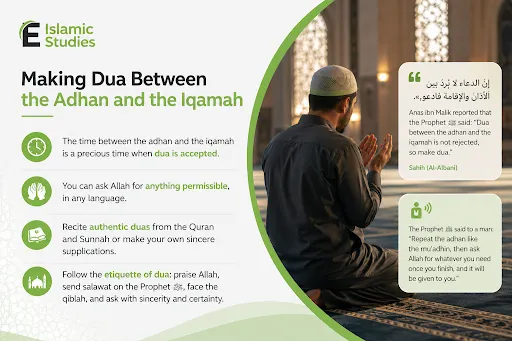
There is no single fixed dua required during this period. Muslims may use authentic supplications from the Quran and Sunnah or make personal dua in their own words and language.
General dua etiquette also applies, such as praising Allah, sending salawat upon the Prophet ﷺ, and asking with sincerity and trust in Allah. Since the interval before the iqamah may be short, keeping a few important requests in mind can make it easier to use this time consistently.
New Muslims who want to develop this habit while learning the meaning and pronunciation of Islamic supplications can also benefit from guidedb Islam classes for beginners at E Islamic Studies Academy.

Quick Reference Table: Dua After Adhan
The table below summarises the key moments covered in this guide, from the exception during “Hayya ‘ala-s-Salah” to the closing wasilah dua, so you can see the full sequence at a glance.
| Occasion | Arabic Phrase (Summary) | English Meaning |
| Hearing “Hayya ‘ala-s-Salah / al-Falah” | لا حول ولا قوة إلا بالله | There is no power or strength except with Allah |
| After the shahadatayn | رضيت بالله ربّا، وبمحمد رسولا، وبالإسلام دينا | I am pleased with Allah as Lord, Muhammad as messenger, and Islam as religion |
| After the adhan ends | اللهم رب هذه الدعوة التامة… | O Allah, Lord of this perfect call… grant Muhammad al-wasilah |
| Between adhan and iqamah | دعاء حر (بأي لغة) | Personal dua for any permissible need |
Read Also: What Is Mahram in Islam? Meaning, Types, and Rules Explained
A Point of Accuracy: Wording to Avoid
Because the wording of dua after adhan is a matter of worship (tawqifi), scholars caution against adding or altering the exact phrases taught by the Prophet ﷺ.
This principle applies to every act of worship, not only the adhan: a Muslim follows what was reported, without adding to it or removing from it.
This matters because a well-intentioned addition can still take a person away from the authentic Sunnah, even if it sounds pious.
Two additions in particular are commonly heard in some communities but are not established in authentic hadith.
● Adding “in Paradise” after “praiseworthy station” in the wasilah dua this phrase has no authentic basis, even though it is sometimes printed in popular dua booklets.
● Saying “Aqamahallahu wa adamaha” (May Allah keep and establish it) after the iqamah this is reported only through a weak chain; the Sunnah is simply to repeat “Qad qamati-s-salah” like the mu’adhin, the same principle used for the adhan itself.
In both cases, the safer and more rewarding practice is to stay with the exact wording documented in the authentic hadith cited throughout this guide, rather than relying on wording passed down informally through family or community habit.
Learning these details with a qualified teacher, rather than only from general online sources, helps avoid unintentionally adding words to an act of worship.
E Islamic Studies Academy structures its lessons around exactly this kind of verified, source-based teaching.
Read Also: What Is Tawbah in Islam? Meaning, Conditions, and How to Repent

See Our Islamic Studies Classes in Action
Take a look at a sample lesson and see how interactive online classes help students learn Islamic Studies in a clear, engaging, and supportive environment.
Watch a Sample Islamic Studies Class
See how experienced teachers explain Islamic concepts, such as the dua after adhan covered in this article, in an engaging and easy-to-understand way that helps students build both knowledge and confidence.
Read Also: What Is Shirk in Islam? Meaning, Types, and Examples Explained
Watch a Sample Islamic Studies Class
See how our teachers explain Islamic concepts in an engaging and easy-to-understand way, helping students build knowledge and confidence.
Deepen Your Islamic Knowledge
Join our comprehensive online courses and learn from qualified scholars today.
Book Your Free Trial
Start Your Islamic Learning Journey With E Islamic Studies Academy
Knowing what to say after the adhan is just one small part of a much bigger picture. E Islamic Studies Academy offers structured, engaging online Islamic Studies classes with qualified teachers, built for beginners, new Muslims, and families who want clear and practical Islamic education from anywhere.
Explore options such as the Islam classes for beginners, browse the full range of Islamic courses, or deepen your understanding of the Prophet’s era through the Islamic History course.
Start your learning journey today and take the next step toward deeper Islamic knowledge.
● Quran Tafseer Classes for Beginners — Introductory Interpretation
● Online Tafseer Classes in English
● Self-Paced Tafseer Course — Flexible Learning Programs
● Aqidah Course — Islamic Creed and Theology Classes
● Online Seerah Course — Life of Prophet Muhammad Classes
● Akhlaq Course — Islamic Ethics and Character Development
Deepen Your Islamic Knowledge
Join our comprehensive online courses and learn from qualified scholars today.
Book Your Free TrialConclusion
The dua after adhan is a short but meaningful practice: repeating the mu’adhin’s words, sending blessings on the Prophet ﷺ, asking Allah for al-wasilah, and declaring contentment with Allah after the shahadatayn.
Together with the personal dua encouraged between the adhan and the iqamah, this is a small daily habit that carries recorded rewards from ten blessings for one salawat, to forgiveness of sins, to the hope of the Prophet’s intercession.
Memorizing the correct prayer after azan, word for word, is one of the most practical steps any new Muslim can take toward a stronger daily connection with their faith.
Frequently Asked Questions
What is the main dua to say after the adhan?
The main dua is: “Allahumma Rabba hadhihi-d-da‘wati-t-tammah, was-salati-l-qa’imah, aati Muhammadan-il-wasilata wal-fadeelah, wab‘athhu maqaman mahmudan-illadhi wa’adtah.” It is said after repeating the mu’adhin and sending blessings on the Prophet ﷺ, based on the hadith of Jabir ibn ‘Abdullah in Sahih al-Bukhari.
Is it obligatory to make dua after the adhan?
No, it is recommended (mustahabb), not obligatory. The four schools of Islamic jurisprudence agree it carries great reward, but leaving it does not make the prayer or adhan invalid.
Can I make dua in my own language after the adhan?
The specific hadith-based phrases, such as the wasilah dua and the shahadatayn declaration, are recommended in their original Arabic wording. Personal dua in the interval between adhan and iqamah, however, may be made in any language.
What should I say instead of repeating “Hayya ‘ala-s-Salah”?
Instead of repeating “Hayya ‘ala-s-Salah” and “Hayya ‘ala-l-Falah,” the listener says “La hawla wa la quwwata illa billah” (there is no power or strength except with Allah), based on established Sunnah.
Is the time between adhan and iqamah really a special time for dua?
Yes. Anas ibn Malik reported that the Prophet ﷺ said dua between the adhan and the iqamah is not rejected, encouraging Muslims to use this short window for sincere supplication.
Is adding “in Paradise” to the wasilah dua correct?
No. Scholars note this addition has no authentic basis in the hadith and should not be included. The correct wording ends with “raise him to the praiseworthy station You promised him.”








Leave a Reply