 Learning Islam
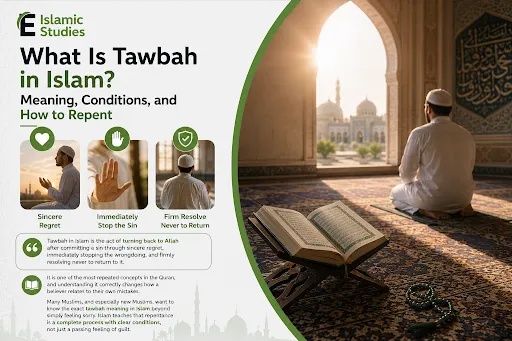
Tawbah in Islam is the act of turning back to Allah after committing a sin through sincere regret, immediately stopping the wrongdoing, and firmly resolving never to return to it.
It is one of the most repeated concepts in the Quran, and understanding it correctly changes how a believer relates to their own mistakes.
Many Muslims, and especially new Muslims, want to know the exact tawbah meaning in Islam beyond simply feeling sorry. Islam teaches that repentance is a complete process with clear conditions, not just a passing feeling of guilt.
This article explains what tawbah in Islam means linguistically and legally, why repentance in Islam matters so deeply to a believer’s faith, and how to repent in Islam in a way that is sincere and, by Allah’s mercy, accepted.
Along the way, it also touches on related concepts such as niyyah (intention) and self-purification, which sit close to the heart of tawbah.
What You Will Learn
● The linguistic and Islamic (Shariah) meaning of tawbah
● The difference between tawbah, istighfar, and inabah
● What the Quran and authentic Sunnah say about repentance
● The conditions scholars outline for how to repent in Islam correctly
● What tawbah nasuha (sincere repentance) really requires
Tawbah in Islam: Meaning and Definition
Tawbah is an Arabic word derived from the root ت-و-ب (t-w-b), which means “to return” or “to come back.” In everyday Arabic, a person who returns from a journey is described using the same root.
In Islamic terminology, tawbah is defined as leaving a sin out of reverence for Allah, feeling genuine regret over having committed it, and sincerely turning back to Him. Imam al-Nawawi described it simply as “abandoning sins in pursuit of Allah’s pleasure.”
This definition matters because it shows that tawbah is not only an emotional reaction. It is a deliberate return in belief, intention, and action from disobedience to obedience.
Tawbah, Istighfar, and Inabah: What Is the Difference?
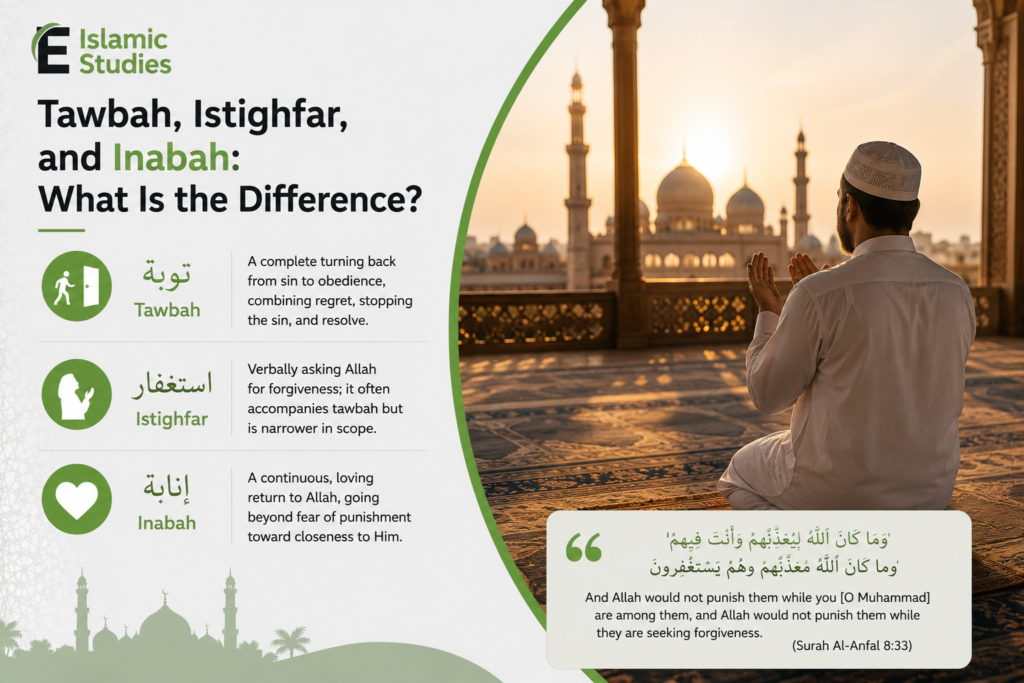
These three Arabic terms are often used together, but they are not identical. The table below outlines how classical scholars distinguished between them.
Tawbah (توبة)
A complete turning back from sin to obedience, combining regret, stopping the sin, and resolve.
Istighfar (استغفار)
Verbally asking Allah for forgiveness; it often accompanies tawbah but is narrower in scope.
Inabah (إنابة)
A continuous, loving return to Allah, going beyond fear of punishment toward closeness to Him.
A person can say istighfar without having truly repented, which is why scholars emphasize that tawbah requires more than words it requires a change in behavior.
This is closely tied to niyyah (intention) in Islam, since the value of any act of worship including repentance depends on the sincerity behind it, not the words alone.
See Our Islamic Studies Classes in Action
Take a look at a sample lesson and see how our interactive online classes help students learn Islamic Studies in a clear, engaging, and supportive environment.
Deepen Your Islamic Knowledge
Join our comprehensive online courses and learn from qualified scholars today.
Book Your Free TrialWhy Is Repentance in Islam Important?
Repentance in Islam is central because every human being sins; this is described as a natural part of being human, not something reserved for a small group of “bad” people.
What distinguishes a believer is not the absence of sin, but the response to it: turning back to Allah rather than persisting in wrongdoing or falling into despair. Islam does not present sin as something that permanently separates a person from Allah’s mercy.
The Quran states that Allah loves those who constantly repent (Surah Al-Baqarah, 2:222), showing that tawbah is not merely tolerated; it is an act Allah is described as pleased with, and one that draws the servant closer to Him rather than further away.
Scholars also explain that repentance is not optional or something to delay until a “better time.” Turning away from a sin the moment a person becomes aware of it is treated as an immediate obligation, because delaying it adds a second wrong the sin of postponing one’s own return to Allah on top of the first.
The door of tawbah is described as open for every person until two points: the moment death approaches, and the Day the sun rises from the west, after which repentance no longer benefits anyone.
Until then, no sin is considered too great to be forgiven through sincere repentance, no matter how many times a person has fallen short before. This is also why repentance carries benefit beyond the individual.
Classical scholars note that when a person sincerely repents, they become more forgiving toward others who struggle with sin, having recognized their own weakness and society as a whole becomes safer and more trustworthy as people take responsibility for the harm their wrongdoing may have caused.
Building a solid understanding of concepts like tawbah together with related topics like tazkiyah (self-purification), Quran, and Fiqh is exactly the kind of structured learning offered through E Islamic Studies Academy, where qualified teachers guide students step by step through core Islamic knowledge.

Tawbah in the Quran
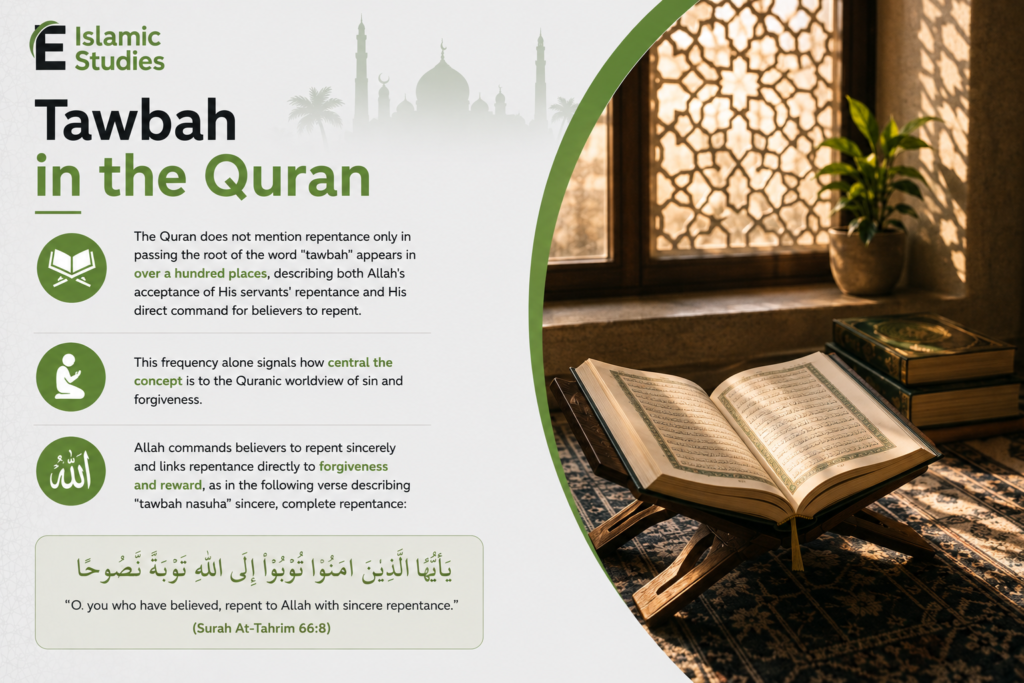
The Quran does not mention repentance only in passing the root of the word “tawbah” appears in over a hundred places, describing both Allah’s acceptance of His servants’ repentance and His direct command for believers to repent.
This frequency alone signals how central the concept is to the Quranic worldview of sin and forgiveness.
Allah commands believers to repent sincerely and links repentance directly to forgiveness and reward, as in the following verse describing “tawbah nasuha” sincere, complete repentance:
يَٰأَيُّهَا الَّذِينَ آمَنُوا تُوبُوٰا إِلَى اللَّهِ تَوْبَة نَّصوحًا
“O you who have believed, repent to Allah with sincere repentance. Perhaps your Lord will remove from you your misdeeds and admit you into gardens beneath which rivers flow.”
This verse links repentance to two outcomes: the removal of past misdeeds and admission into Paradise, showing that sincere tawbah is not merely a private emotional reset; it carries real spiritual consequence.
Elsewhere, the Quran addresses those who fear their sins are too numerous or too severe to be forgiven, responding with one of the most hope-filled verses on the subject:
قُل يَٰعِبَادِيَ الَّذِينَ أَسْرَفُوا عَلَىٰ أَنفُسِهِمْ لَا تَقْنَطُوا مِن رَّحْمَةِ اللَّهِ إِنَّ اللَّهَ يَغْفِرُ الذُّنوبَ جَمِيعًا
“Say, O My servants who have transgressed against themselves, do not despair of the mercy of Allah. Indeed, Allah forgives all sins. Indeed, it is He who is the Forgiving, the Merciful.”
Classical commentators, including Ibn Kathir, explain that this verse was revealed as a general call to every sinner including those who had committed major sins to turn to Allah rather than assume forgiveness was out of reach.
The Quran also sets a condition of timing. Repentance is described as accepted when it comes soon after the sin, before a person allows wrongdoing to become habitual:
إِنَّمَا التَّوْبَةُ عَلَى اللَّهِ لِلَّذِينَ يَعْمَلُونَ السُّوءَ بِجَهَالَةٍ ثُمَّ يَتُوبُونَ مِن قَرِيبٍ فَأُولَٰئِكَ يَتُوبُ اللَّهُ عَلَيْهِمْ وَكَانَ اللَّهُ عَلِيمًا حَكِيمًا
“The repentance accepted by Allah is only for those who do wrong in ignorance and then repent soon after. It is those to whom Allah will turn in forgiveness, and Allah is ever Knowing and Wise.”
Even the Prophet Adam, peace be upon him, is described in the Quran as returning to Allah after his mistake and having his repentance accepted showing that tawbah is a path Allah opened for every believer, from the first prophet onward, not a concession invented later for a struggling few.
فَتَلَقَّىٰ ءَادَمُ مِن رَّبِّهِ كَلِمَٰتٍ فَتَابَ عَلَيْهِ إِنَّهُ هُوَ التَّوَّابُ الرَّحِيمُ
“Then Adam received from his Lord [some] words, and He accepted his repentance. Indeed, it is He who is the Accepting of Repentance, the Merciful.”
Together, these verses form a consistent Quranic message: repentance is commanded, its acceptance is described as near-certain when done sincerely and promptly, and no sin however serious is presented as beyond Allah’s forgiveness for one who truly turns back to Him.
Tawbah in the Sunn
The Prophet Muhammad ﷺ, despite being sinless, modeled constant repentance for his community, showing that tawbah is a daily practice rather than something reserved for major mistakes.
His own habit of frequent repentance set the standard for how often a believer should turn back to Allah, even without a specific major sin in mind.
حَدَّثَنَا أَبُو الْيَمَانِ، أَخْبَرَنَا شُعَيْبٌ، عَنِ الزُّهْرِيِّ، قَالَ أَخْبَرَنِي أَبُو سَلَمَةَ بْنُ عَبْدِ الرَّحْمَنِ، قَالَ قَالَ أَبُو هُرَيْرَةَ سَمِعْتُ رَسُولَ اللَّهِ صلى الله عليه وسلم يَقُولُ ” وَاللَّهِ إِنِّي لأَسْتَغْفِرُ اللَّهَ وَأَتُوبُ إِلَيْهِ فِي الْيَوْمِ أَكْثَرَ مِنْ سَبْعِينَ مَرَّةً ”.
Narrated Abu Huraira: I heard Allah’s Messenger (ﷺ) saying, “By Allah! I ask for forgiveness from Allah and turn to Him in repentance more than seventy times a day.” Narrated by: Abu Hurairah | Sahih al-Bukhari
This hadith is often cited by scholars as proof that repentance is not only for the sinful it is a spiritual habit the most beloved of Allah’s creation practiced daily, out of humility rather than guilt.
In a separate narration, the Prophet ﷺ instructed the entire community to follow this same habit, describing his own repentance as even more frequent:
قَالَ صلى الله عليه وسلم: (يَا أَيُّهَا النَّاسُ تُوبُوا إِلَى اللَّهِ فَإِنِّي أَتُوبُ فِي الْيَوْمِ إِلَيْهِ مِائَةَ مَرَّةٍ)
“O people, repent to Allah and seek His forgiveness, for indeed I repent to Him a hundred times a day.” Narrated by: Al-Agharr ibn Yasar al-Muzani | Sahih Muslim
Scholars note the difference in these two numbers seventy and a hundred is generally understood as figurative, both expressing an emphasis on frequency and constancy rather than a literal daily count.
The Sunnah also describes how Allah receives a servant’s repentance, using a parable meant to convey overwhelming relief and joy:
– لَلَّهُ أشَدُّ فرَحًا بتَوبةِ عَبدِه حينَ يَتوبُ إليه، مِن أحَدِكُم كان على راحِلَتِه بأرضِ فَلاةٍ، فانفَلَتَت منه وعليها طَعامُه وشَرابُه، فأيِسَ منها، فأتى شَجَرةً، فاضطَجَعَ في ظِلِّها، قد أيِسَ مِن راحِلَتِه، فبينا هو كَذلك إذا هو بها قائِمةً عِندَه، فأخَذَ بخِطامِها، ثُمَّ قال مِن شِدَّةِ الفَرَحِ: اللَّهمَّ أنتَ عَبدي وأنا رَبُّكَ، أخطَأ مِن شِدَّةِ الفَرَحِ.
“Allah is more delighted with the repentance of His servant than one of you who was riding his camel in a desert land, and it slipped away from him with his food and drink on it, so he lost hope of finding it. He came to a tree and lay down in its shade, having given up on his camel and while he was like that, there it was, standing before him. He took hold of its halter and said, out of overwhelming joy, ‘O Allah, You are my servant and I am Your Lord,’ mistaking his words out of the intensity of his joy.” Narrated by: Anas ibn Malik — reported in Sahih al-Bukhari and Sahih Muslim.
Finally, the Sunnah sets the outer limit of when repentance is still accepted, which is directly relevant to how urgently a believer should act on it:
إنَّ اللَّهَ عَزَّ وَجَلَّ يَقْبَلُ تَوْبَةَ الْعَبْدِ مَا لَمْ يُغَرْغِرْ
“Indeed, Allah accepts the repentance of a servant so long as [death] has not reached the throat.” Narrated by: Ibn Umar | Sunan al-Tirmidhi
Together, these narrations show that in the Sunnah, tawbah is presented not as a rare emergency measure but as a constant, welcomed practice one Allah is described as actively pleased by, right up until a person’s final moments.
Start your learning journey today and take the next step toward deeper Islamic knowledge.

How to Repent in Islam: The Conditions of Valid Tawbah
Repentance in Islam is not left to personal interpretation of what “feeling sorry” means. Scholars such as Imam al-Nawawi outline clear, specific conditions that must be met for a repentance to be considered valid, a framework drawn directly from the Quran and the practice of the earliest generations of Muslims.
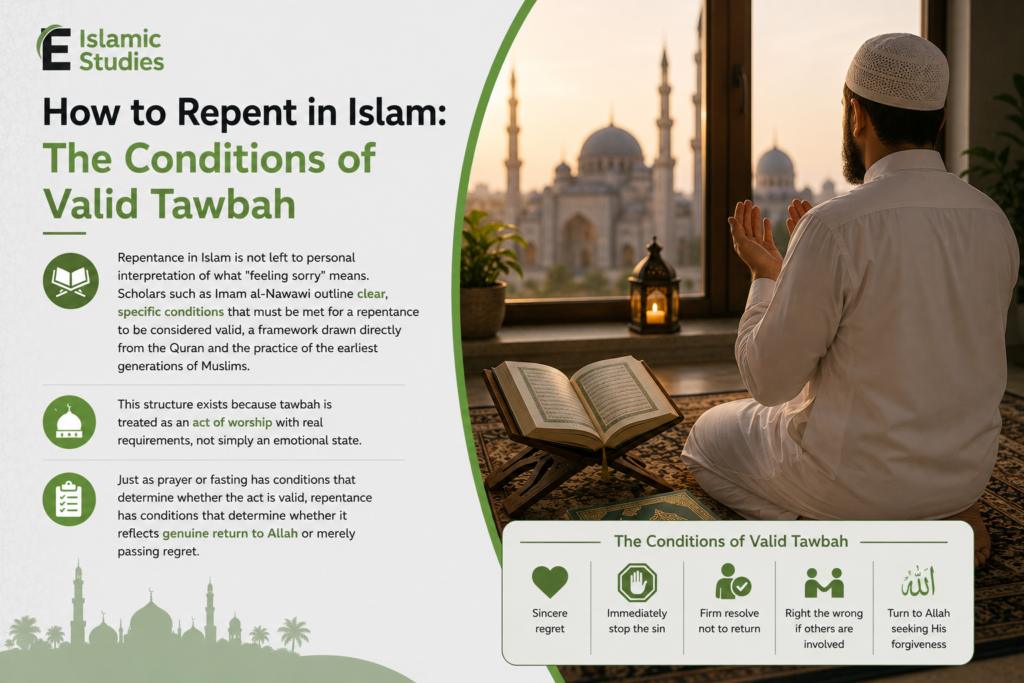
This structure exists because tawbah is treated as an act of worship with real requirements, not simply an emotional state.
Just as prayer or fasting has conditions that determine whether the act is valid, repentance has conditions that determine whether it reflects genuine return to Allah or merely passing regret.
When the sin is only between the person and Allah meaning no other human being was harmed by it scholars agree that three conditions apply.
These three conditions are consistently mentioned across classical texts, including in Imam al-Nawawi’s Riyad al-Salihin and Ibn al-Qayyim’s Madarij al-Salikin, showing broad scholarly consensus on this basic structure.
A fourth condition is added specifically when another person’s rights were violated whether through their wealth, their reputation, their safety, or any other harm caused to them.
This distinction matters because Islam treats sins against Allah and sins against people differently: Allah’s forgiveness can be sought directly through sincere repentance, but a wronged person’s rights are not automatically waived simply because the wrongdoer feels remorse.
وَالَّذِينَ إِذَا فَعَلُوا فَاحِشَةً أَوْ ظَلَمُوا أَنفُسَهُمْ ذَكَرُوا اللَّهَ فَاسْتَغْفَرُوا لِذُنُوبِهِمْ وَمَن يَغْفِرُ الذُّنُوبَ إِلَّا اللَّهُ وَلَمْ يُصِرُّوا عَلَىٰ مَا فَعَلُوا وَهُمْ يَعْلَمُونَ
“And those who, when they commit an immorality or wrong themselves, remember Allah and seek forgiveness for their sins and who can forgive sins except Allah? and do not persist in what they have done while they know.” Surah Aal-e-Imran (3:135)
1. Immediately Stopping the sinful action right away
The first condition is to stop the sinful action right away, without delay or bargaining for “just a little longer.” Its sign, as scholars describe it, is an immediate break from the sin the moment a person decides to repent, not a gradual winding-down while the wrongdoing continues.
Continuing a sin while claiming to repent from it contradicts the meaning of tawbah itself, since the word literally means “to return,” and a person cannot be said to have returned to Allah while still walking in the opposite direction.
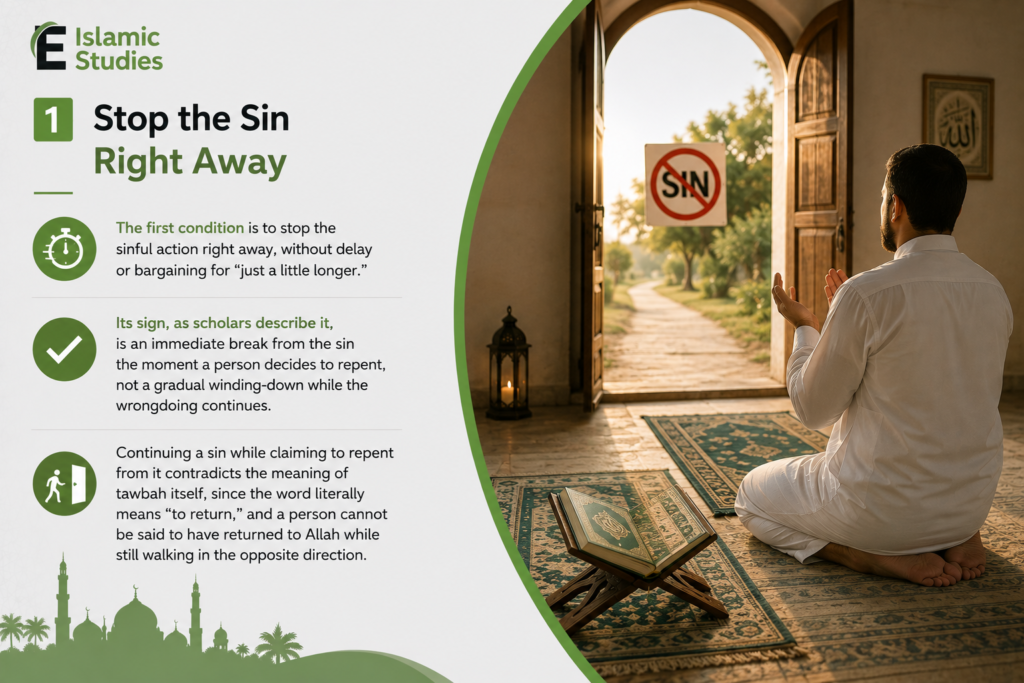
This is why scholars distinguish between someone who says “I repent” while still committing the sin, and someone whose repentance is reflected in an actual change of action.
This condition applies specifically to sins the person is currently able to stop. If the wrongdoing was a one-time past action such as a lie already told or an incident already over this condition is naturally fulfilled, since there is nothing ongoing left to stop.
2. Sincere Regret Over the Sin
The second condition is heartfelt regret, not performative sadness meant to be seen by others or said only to relieve guilt.
Its sign is described by scholars as lasting sorrow over what was done — a grief that returns whenever the sin is remembered, not a fleeting feeling that fades once the words “I’m sorry” have been said.
Have questions about which course fits you best? Get in touch with our team and we’ll help you find the right starting point.

3. A Firm Resolve Never to Return to the Sin
The third condition is a sincere intention not to repeat the sin, formed at the moment of repentance with real conviction rather than half-hearted hope.
Its sign, according to scholars such as Ibn al-Qayyim, is a determination so complete that no hesitation, delay, or “maybe later” remains attached to it.
This does not mean a person can never slip again; human beings are not expected to achieve perfect, permanent sinlessness after a single act of tawbah.
What matters is that the resolve at the moment of repentance must be genuine: the person must truly intend never to return, even if human weakness later causes them to fall short.
Scholars are careful to distinguish this from a repentance made with a hidden intention to return once circumstances allow, sometimes called “the repentance of liars” where the tongue asks forgiveness while the heart has not actually let go of the sin.
A resolve made honestly, even if later broken by weakness, still fulfills this condition; a resolve made dishonestly from the start does not.
Read Also: What Is Mahram in Islam? Meaning, Types, and Rules Explained
4. Restoring the Rights of Others
If the sin involves wronging another person through their wealth, honor, or safety a fourth condition applies: returning what was taken, seeking their forgiveness, or making amends in a way that does not cause greater harm.
Because every situation is different, scholars often rely on tools such as qiyas (analogical reasoning) to apply these general principles to specific, modern cases of restoring someone’s rights.
Read Also: What Is Shirk in Islam? Meaning, Types, and Examples Explained
What Is Tawbah Nasuha (Sincere Repentance)?
Tawbah nasuha, mentioned in Surah At-Tahrim above, refers to the highest and most complete form of repentance.
Ibn al-Qayyim explained that sincere repentance involves three things: covering every sin rather than repenting from only one, gathering complete resolve without hesitation, and purifying the intention so that it is for Allah alone not to protect one’s reputation or avoid people’s blame.
This standard is high, which is why scholars encourage believers not to delay repentance. Delaying it, they explain, is itself something a person will eventually need to repent from.
Some scholars also tie sincere repentance to following established Sunnah practice rather than bid’ah (religious innovation), though this is a matter of scholarly discussion rather than a single universally stated ruling.
Read Also: Dua After Adhan – A Complete Guide to Prayer After Azan
Watch a Sample Islamic Studies Class
See how our teachers explain Islamic concepts in an engaging and easy-to-understand way, helping students build knowledge and confidence.
Deepen Your Islamic Knowledge
Join our comprehensive online courses and learn from qualified scholars today.
Book Your Free TrialStart Your Islamic Learning Journey with E Islamic Studies Academy
Build a stronger understanding of Islam through structured, engaging online Islamic Studies classes with qualified teachers.
Whether you are looking for Islamic education for yourself or your children, E Islamic Studies Academy offers lessons designed to make learning clear, practical, and accessible from anywhere.

Start your learning journey today and take the next step toward deeper Islamic knowledge.
Our Islamic Essentials Courses
● Quran Tafseer Classes for Beginners — Introductory Interpretation
● Online Tafseer Classes in English
● Self-Paced Tafseer Course — Flexible Learning Programs
● Aqidah Course — Islamic Creed and Theology Classes
● Online Seerah Course — Life of Prophet Muhammad Classes
● Akhlaq Course — Islamic Ethics and Character Development

Conclusion
Tawbah in Islam is the sincere return to Allah after sin, combining immediate abandonment of the wrongdoing, genuine regret, firm resolve, and — where relevant — restoring the rights of others.
The Quran and Sunnah repeatedly affirm that Allah welcomes this return, no matter how many times a person has sinned before.
Understanding how to repent in Islam correctly gives a believer both hope and responsibility: hope because Allah’s mercy is described as vast, and responsibility because true repentance requires real, sustained change.
Frequently Asked Questions About Tawbah
What does tawbah mean in Islam?
Tawbah means sincerely turning back to Allah after committing a sin. It combines stopping the sin, feeling genuine regret, and resolving never to return to it, based on the Quran and Sunnah.
How do I repent in Islam if I cannot remember all my sins?
Scholars explain that a person can make a general repentance covering both the sins they remember and those they do not, while continuing to seek Allah’s forgiveness regularly through istighfar.
Is repentance in Islam accepted for major sins?
Yes. The Quran states that Allah forgives all sins for those who repent sincerely (Surah Az-Zumar, 39:53), which scholars explain includes major sins when the conditions of tawbah are met.
When is tawbah no longer accepted?
Repentance is described as accepted throughout a person’s life until the moment of death approaches, based on an authentic hadith narrated by Ibn Umar in Sunan al-Tirmidhi. After that point, repentance no longer benefits a person.
Do I need to repent for sins no one else knew about?
Yes. Tawbah is primarily between a person and Allah. Private sins still require regret, stopping the sin, and resolve, even though no other person needs to be informed.







Leave a Reply