 Learning Islam
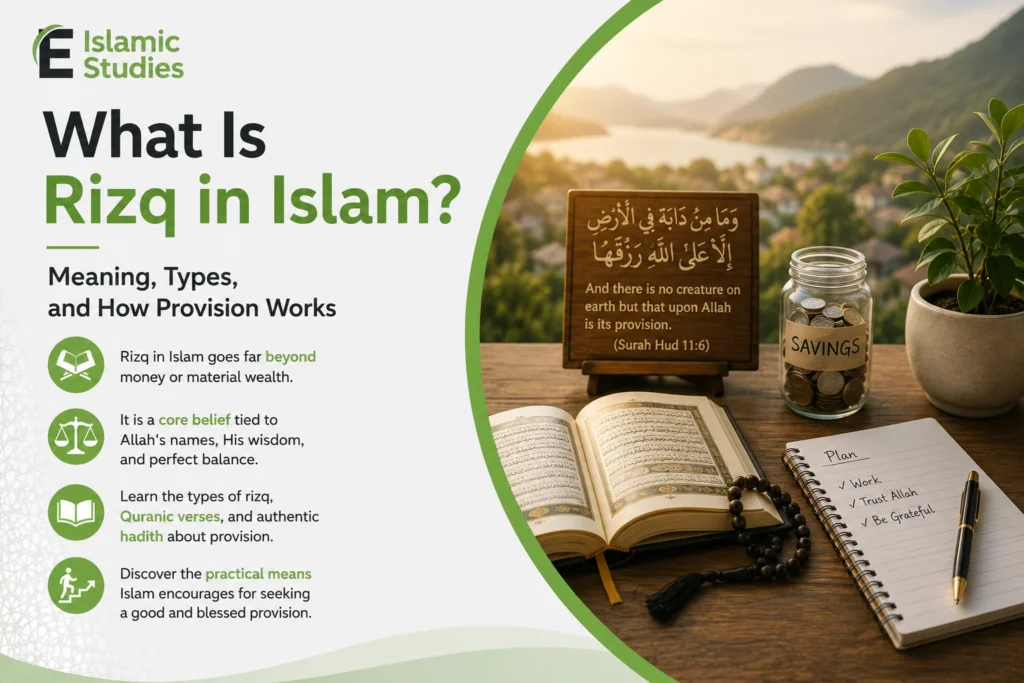
Many Muslims ask, what is rizq in Islam, especially when thinking about money, work, or difficult times. Understanding rizq in Islam brings peace of mind, because it connects daily struggles to a much bigger picture of faith.
Rizq meaning in Islam goes far beyond a paycheck or bank balance. It is a core belief tied to Allah’s names, His wisdom, and the balance between working hard and trusting Him completely.
This article explains the rizq meaning Islam teaches, its two main types, the Quranic verses and hadith that describe it, and the practical means Islam encourages for seeking a good and blessed provision.
Key Takeaways
● Rizq meaning in Islam refers to everything Allah provides for a created being, not only money or food.
● Rizq has two categories: apparent provision for the body and inward provision for the heart, such as knowledge and faith.
● Islamic belief holds that every person’s rizq is already decreed, yet effort and lawful means remain required.
● The Quran and Sunnah mention specific actions such as taqwa, prayer, charity, and maintaining family ties linked to increased barakah in rizq.
● Trusting Allah (tawakkul) and taking practical steps are not opposites; Islam teaches that both work together.
What Is Rizq in Islam? The Core Meaning
Rizq in Islam is everything a created being benefits from as a gift from Allah, whether that benefit is physical, financial, emotional, or spiritual. It is not limited to wealth.
The scholar Ibn Manzur explains in Lisan al-‘Arab that rizq is whatever sustains the life of any living being, whether that sustenance is material or non-material in nature.
This means rizq meaning in Islam includes food, income, and shelter, but also health, knowledge, guidance, good company, and even the ability to worship Allah sincerely.
The Two Types of Rizq in Islam
Islamic scholarship divides rizq into two broad categories, based on what each type sustains: the body or the heart and soul. This distinction is not a minor detail; it shapes how a Muslim understands success, wealth, and hardship in daily life.
A person may be given abundant wealth yet remain spiritually empty, or may live with modest means while enjoying a heart full of faith, knowledge, and contentment.
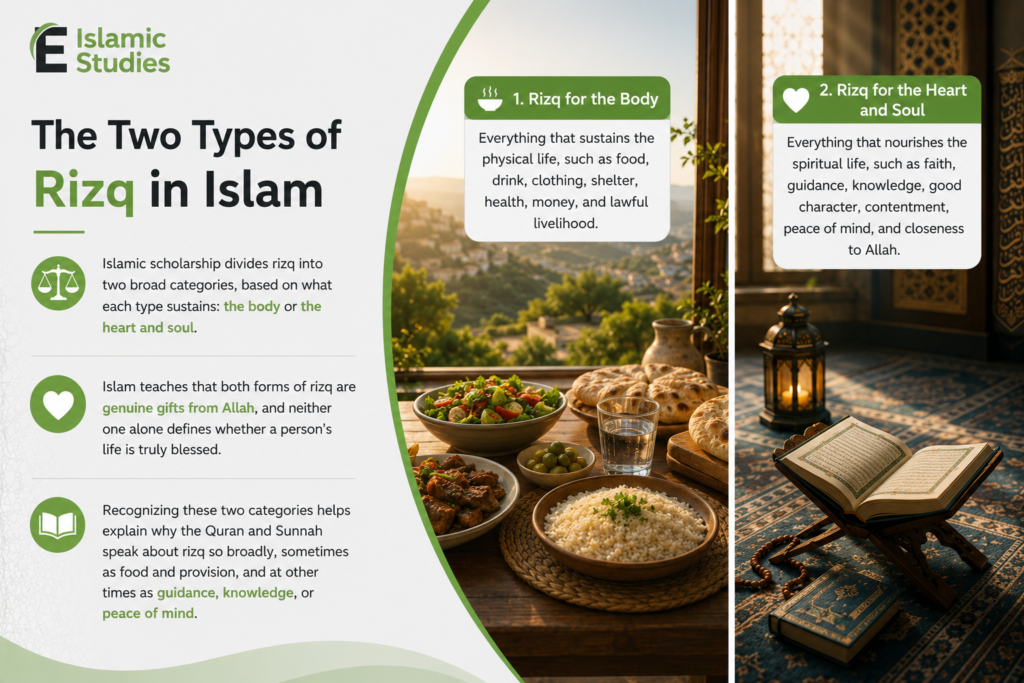
Islam teaches that both forms of rizq are genuine gifts from Allah, and neither one alone defines whether a person’s life is truly blessed.
Recognizing these two categories also helps explain why the Quran and Sunnah speak about rizq so broadly, sometimes describing food and provision, and at other times describing guidance, knowledge, or peace of mind as rizq in its own right.
1. Rizq Zahir — Apparent Provision for the Body
Rizq zahir (ظاهر) is the visible, physical provision that keeps the body alive and functioning. It includes food, drink, clothing, housing, income, and means of transport.
2. Rizq Batin — Inward Provision for the Heart
Rizq batin (باطن) is the unseen provision that nourishes the heart and soul. It includes knowledge, faith, certainty (yaqin), sincerity, and closeness to Allah.
Sheikh Muhammad ibn Salih al-‘Uthaymin described this same division: rizq that sustains the body, such as food and shelter, and rizq that sustains one’s religion, such as knowledge and faith.
If terms like rizq zahir and rizq batin feel unfamiliar, our free Islamic course for beginners walks through this kind of core vocabulary step by step.
Allah Is Ar-Razzaq — The One Who Provides
One of the ninety-nine names of Allah is Ar-Razzaq (الرزّاق), meaning the Great Provider. This name reflects that Allah provides abundantly and continuously for every creature, without exception.
The name Ar-Razzaq uses an intensive Arabic form, signaling not just occasional giving but constant, overflowing provision. It is closely tied to Allah’s role as Creator: whatever He brings into existence, He also sustains, from the smallest insect to the largest human community.
إِنَّ اللَّهَ هُوَ الرَّزَّاقُ ذُو الْقُوَّةِ الْمَتِينُ
“Indeed, it is Allah who is the [continual] Provider, the firm possessor of strength.”
وَكَأَيِّنْ مِنْ دَابَّةٍ لَا تَحْمِلُ رِزْقَهَا اللَّهُ يَرْزُقُهَا وَإِيَّاكُمْ
“And how many creatures carry not its own provision. Allah provides for it and for you.”
These verses show that rizq in Islam is not something a person manufactures alone; it is ultimately a gift from Allah, even when a person works hard to earn it.
This understanding frees a believer from constant anxiety over provision, since the outcome always rests with Allah’s power and generosity, not with human effort alone.
Reflecting on this name also strengthens gratitude. Recognizing Allah as Ar-Razzaq means acknowledging that every meal, every source of income, and every form of support in life traces back to His continuous giving, whether a person notices it or not.
See Our Islamic Studies Classes in Action
Take a look at a sample lesson and see how our interactive online classes help students learn Islamic Studies in a clear, engaging, and supportive environment.
Deepen Your Islamic Knowledge
Join our comprehensive online courses and learn from qualified scholars today.
Book Your Free TrialIs Rizq Already Written and Decreed?
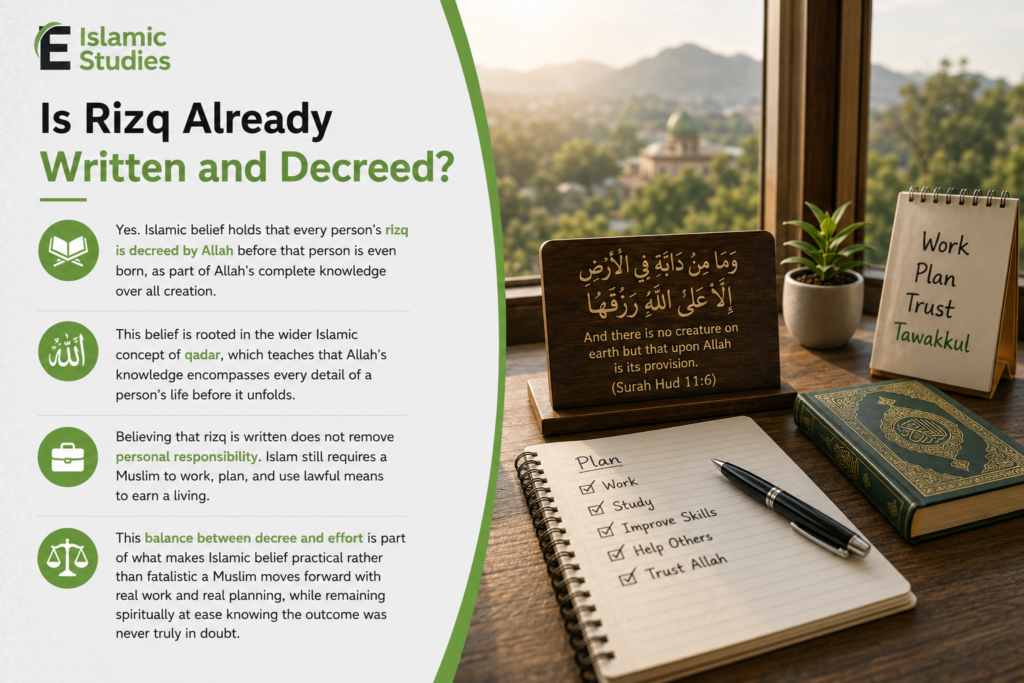
Yes. Islamic belief holds that every person’s rizq is decreed by Allah before that person is even born, as part of Allah’s complete knowledge over all creation.
This belief is rooted in the wider Islamic concept of qadar, which teaches that Allah’s knowledge encompasses every detail of a person’s life before it unfolds.
عَنْ عَبْدِ اللهِ بْنِ عَمْرِو بْنِ الْعَاصِ رضي الله عنهما قَالَ: سَمِعْتُ رَسُولَ اللهِ صَلَّى اللهُ عَلَيْهِ وَسَلَّمَ يَقُولُ:
«كَتَبَ اللهُ مَقَادِيرَ الْخَلَائِقِ قَبْلَ أَنْ يَخْلُقَ السَّمَاوَاتِ وَالْأَرْضَ بِخَمْسِينَ أَلْفَ سَنَةٍ، قَالَ: وَعَرْشُهُ عَلَى الْمَاءِ».
“Allah wrote the decrees of creation fifty thousand years before He created the heavens and the earth, and His Throne was upon the water.”
Narrated by Abdullah ibn Amr ibn al-‘As — Sahih Muslim
وَمَا مِنْ دَابَّةٍ فِي الْأَرْضِ إِلَّا عَلَى اللَّهِ رِزْقُهَا وَيَعْلَمُ مُسْتَقَرَّهَا وَمُسْتَوْدَعَهَا كُلٌّ فِي كِتَابٍ مُبِينٍ
“And there is no creature on earth but that upon Allah is its provision, and He knows its place of dwelling and its place of storage; all is in a clear register.”
Together, these texts describe a provision that is already known to Allah in full detail its amount, its timing, and even the path through which it will reach a person long before that person takes a single step to seek it.
Believing that rizq is written does not remove personal responsibility. Islam still requires a Muslim to work, plan, and use lawful means to earn a living.
The written decree explains the outcome from Allah’s perspective, not an excuse for a person to abandon effort in their own life.
This balance between decree and effort is part of what makes Islamic belief practical rather than fatalistic a Muslim moves forward with real work and real planning, while remaining spiritually at ease knowing the outcome was never truly in doubt.
Does Rizq Require Effort, or Only Trust in Allah?
Islam teaches that seeking rizq requires both sincere effort (asbab) and complete trust in Allah (tawakkul). Neither one replaces the other; they work together.
هُوَ الَّذِي جَعَلَ لَكُمُ الْأَرْضَ ذَلُولًا فَامْشُوا فِي مَنَاكِبِهَا وَكُلُوا مِنْ رِزْقِهِ وَإِلَيْهِ النُّشُورُ
“It is He who made the earth tame for you, so walk among its slopes and eat of His provision, and to Him is the resurrection.”
Scholars such as Ibn Taymiyyah explained that the lawful means a person uses to earn rizq are themselves part of what Allah has decreed. If Allah decreed that a servant’s rizq comes through effort, He also inspires that person to make the effort.
Ibn Taymiyyah also warned against two extremes: relying on tawakkul while abandoning commanded means is misguidance, and relying only on effort while ignoring tawakkul is a form of shirk in one’s reliance.
Deepen Your Islamic Knowledge
Join our comprehensive online courses and learn from qualified scholars today.
Book Your Free TrialWhy Do Some People Receive More Rizq Than Others?
The Quran explains that Allah distributes rizq according to His complete knowledge and wisdom, giving some people abundance and others a more limited provision as a test.
This distribution is never random or unjust; it flows from an understanding of each person’s circumstances that no human being can fully grasp.
إِنَّ رَبَّكَ يَبْسُطُ الرِّزْقَ لِمَنْ يَشَاءُ وَيَقْدِرُ إِنَّهُ كَانَ بِعِبَادِهِ خَبِيرًا بَصِيرًا
“Indeed, your Lord extends provision for whom He wills and restricts it. Indeed He is, concerning His servants, Acquainted and Seeing.”
This verse pairs the act of distributing rizq with two of Allah’s attributes: being Acquainted (Khabir) and Seeing (Basir).
The pairing is deliberate. It tells the reader that any apparent inequality in provision is not oversight or indifference, but the direct result of Allah’s precise awareness of every person’s inner state, character, and circumstances.
وَلَوْ بَسَطَ اللَّهُ الرِّزْقَ لِعِبَادِهِ لَبَغَوْا فِي الْأَرْضِ وَلَكِنْ يُنَزِّلُ بِقَدَرٍ مَا يَشَاءُ إِنَّهُ بِعِبَادِهِ خَبِيرٌ بَصِيرٌ
“And if Allah had extended provision for His servants, they would have transgressed on earth; but He sends down in an amount which He wills. Indeed He is, concerning His servants, Acquainted and Seeing.”
This second verse goes a step further, describing what would happen if every person were given unlimited wealth: widespread transgression on earth. In other words, restricted provision is presented here not as punishment, but as a form of protection both for the individual and for society as a whole.
The exegete Ibn Kathir explained this verse as meaning that Allah knows precisely who can handle wealth without being corrupted by it, and who is better protected through a more modest provision.
Some people, if given abundant wealth, would be led into arrogance, heedlessness, or oppression of others; for them, a more limited provision is mercy in disguise.
This principle reframes how a Muslim is encouraged to view wealth and poverty. Neither is automatically a sign of Allah’s favor or displeasure.
A wealthy person is not necessarily more beloved to Allah, and a person with little is not necessarily neglected. Each situation is calibrated to what that specific individual can carry without being spiritually harmed.
Abundant wealth calls for gratitude and restraint from arrogance; limited provision calls for patience and trust. Both are tests, and both carry their own path toward closeness to Allah.
What Are the Islamic Means That Increase Rizq?
Alongside lawful work, Islam highlights specific acts of worship and character that the Quran and Sunnah link to an increase in a person’s rizq and its barakah.
These means are not shortcuts that replace effort; rather, they work alongside it, opening doors that effort alone cannot open.
Scholars often describe these acts as spiritual asbab, distinct from the physical means of earning a living but no less real in their effect.
A Muslim who combines both sincere worship and diligent work is following the complete guidance the Quran and Sunnah provide on seeking rizq.
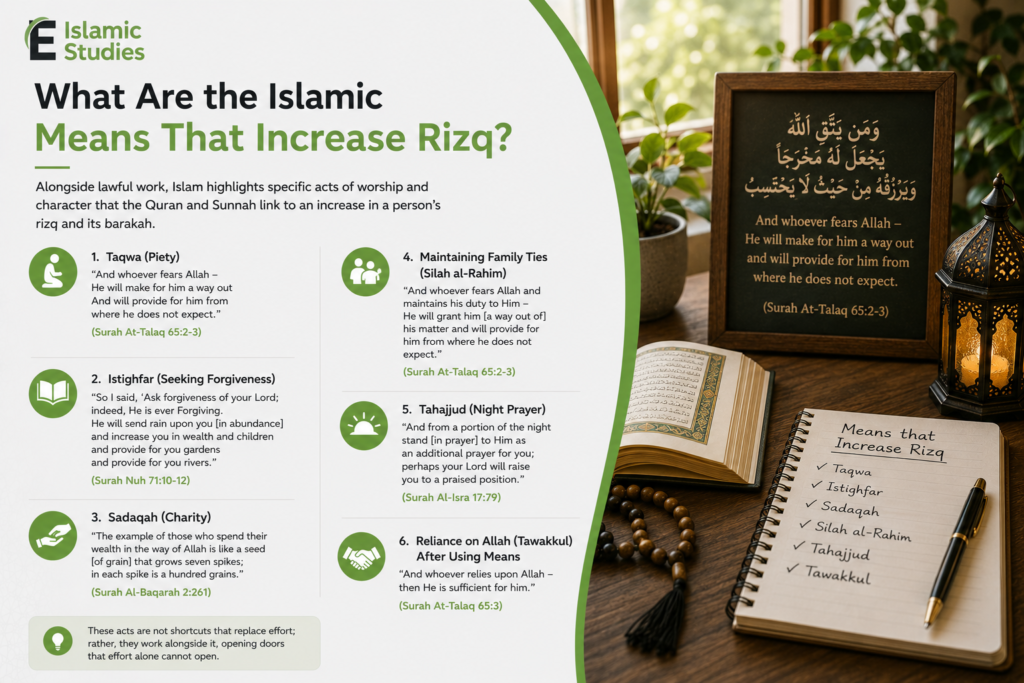
The sections below outline some of the clearest examples mentioned in Islamic texts, each tied to a specific verse or hadith rather than general assumption.
Taqwa and Tawakkul
Taqwa means being conscious of Allah in both private and public matters, avoiding what He has forbidden while carrying out what He has commanded.
وَمَنْ يَتَّقِ اللَّهَ يَجْعَلْ لَهُ مَخْرَجًا وَيَرْزُقْهُ مِنْ حَيْثُ لَا يَحْتَسِبُ
“And whoever fears Allah, He will make for him a way out, and will provide for him from where he does not expect.”
This verse ties that consciousness directly to rizq, promising a way out of hardship through paths a person may never have anticipated.
Fasting is one of the clearest expressions of taqwa in daily practice, since it trains a person to hold back from what is normally permissible purely out of obedience to Allah. For the specific obligations involved, see our guide on the rules of fasting in Islam.
Establishing the Prayer
Financial responsibilities and the pressure of earning a living can sometimes make people feel that they have little time left for worship. This verse offers a powerful reminder that devotion to Allah and seeking provision are not competing priorities.
Allah commands the Prophet ﷺ to establish prayer within his household and then immediately reassures him that provision is ultimately in Allah’s hands. The message is clear: maintaining prayer does not come at the expense of one’s livelihood, because Allah is the One who provides.
وَأْمُرْ أَهْلَكَ بِالصَّلَاةِ وَاصْطَبِرْ عَلَيْهَا لَا نَسْأَلُكَ رِزْقًا نَحْنُ نَرْزُقُكَ وَالْعَاقِبَةُ لِلتَّقْوَى
“And enjoin prayer upon your family and be steadfast therein. We ask you not for provision; We provide for you, and the [best] outcome is for righteousness.”
Spending in Charity
Many people hesitate to give in charity because they fear that spending money will reduce their wealth or leave them with less for their own needs.
However, Islam teaches us to see charity from a different perspective. What we give sincerely for the sake of Allah is never truly lost.
قُلْ إِنَّ رَبِّي يَبْسُطُ الرِّزْقَ لِمَنْ يَشَاءُ مِنْ عِبَادِهِ وَيَقْدِرُ لَهُ وَمَا أَنْفَقْتُمْ مِنْ شَيْءٍ فَهُوَ يُخْلِفُهُ وَهُوَ خَيْرُ الرَّازِقِينَ
“Say, indeed my Lord extends provision for whom He wills of His servants and restricts it for him. But whatever thing you spend, He will compensate it, and He is the best of providers.”
This verse directly counters the fear that giving in charity leads to loss. Instead, it frames spending as something Allah personally compensates, positioning generosity as an investment in one’s own provision rather than a reduction of it.
Maintaining Family Ties (Silat ar-Rahim)
Silat ar-rahim means staying connected to relatives through visits, support, and kindness, even when the relationship is difficult. This hadith links that specific act of character directly to two outcomes people commonly worry about: the size of their provision and the length of their life.
مَنْ سَرَّهُ أَنْ يُبْسَطَ لَهُ فِي رِزْقِهِ، أَوْ يُنْسَأَ لَهُ فِي أَثَرِهِ، فَلْيَصِلْ رَحِمَهُ
“Whoever is pleased that his provision be increased and his lifespan be extended, let him maintain the ties of kinship.”
Narrated by Sahih al-Bukhari
Does Rizq Include Both Halal and Haram Earnings?
Among Ahl as-Sunnah, scholars explain that rizq covers whatever a person actually consumes or benefits from, whether it was earned lawfully or unlawfully, since Allah alone creates and sustains all provision.
Al-Baqillani cited the verse
اللَّهُ الَّذِي خَلَقَكُمْ ثُمَّ رَزَقَكُمْ ثُمَّ يُمِيتُكُمْ ثُمَّ يُحْيِيكُمْ ۖ هَلْ مِن شُرَكَائِكُم مَّن يَفْعَلُ مِن ذَٰلِكُم مِّن شَيْءٍ ۚ سُبْحَانَهُ وَتَعَالَىٰ عَمَّا يُشْرِكُونَ
“Allah is the one who created you, then provided for you, then causes you to die, then will bring you to life” (Ar-Rum, 30:40)
To support this view, noting that being sole Creator of life implies being sole source of provision, halal or haram.
Read Also: What Is Amanah in Islam? Meaning, Types, and Importance of Trust
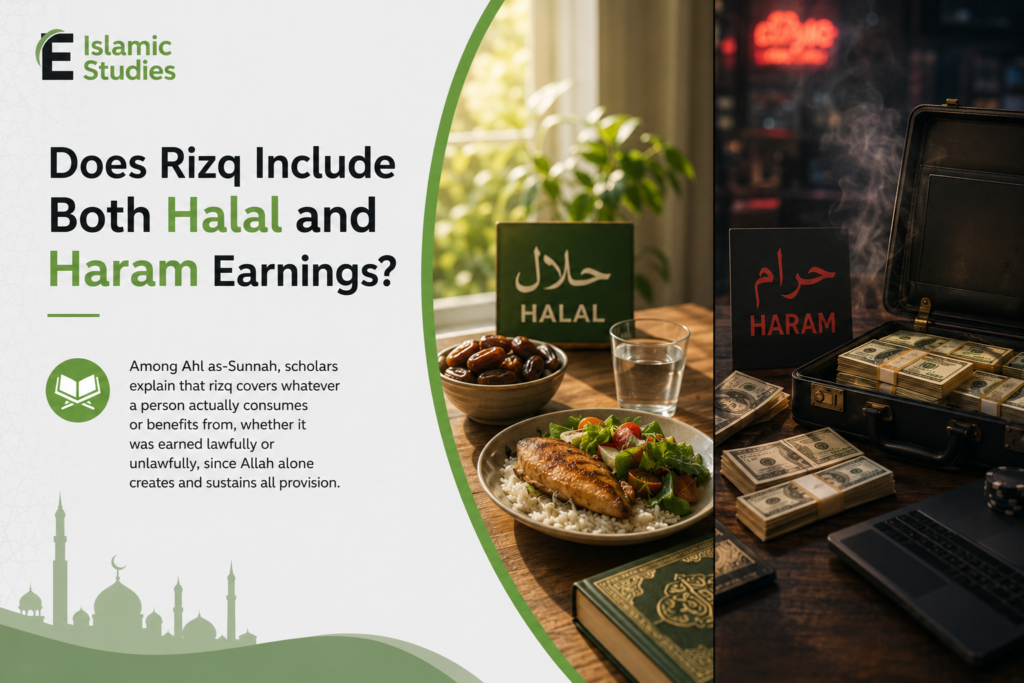
Some Mu’tazilite theologians defined rizq differently, limiting it to lawfully owned wealth. Ahl as-Sunnah responded that this definition contradicts verses describing Allah as provider for every living creature, including animals that own nothing.
This is a point of classical theological discussion rather than a practical ruling. In daily life, a Muslim is still commanded to seek only halal rizq and avoid unlawful earnings.
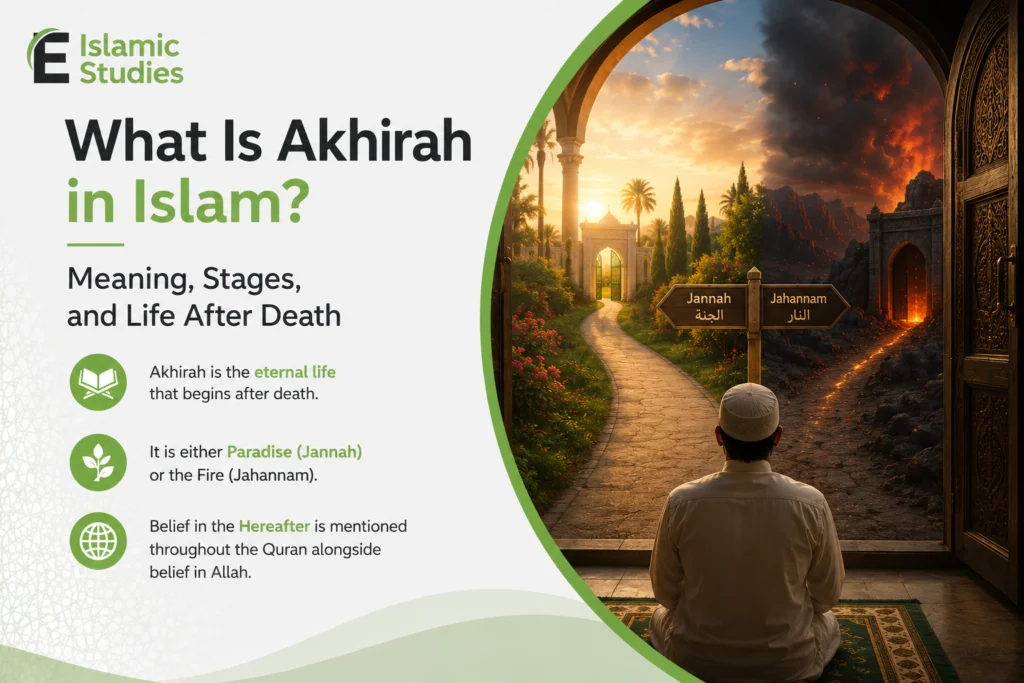
Read Also: What Is Akhirah in Islam? Meaning, Stages, and Life After Death
How Should a Muslim View Their Own Rizq?
Islam encourages contentment (rida) with one’s decreed portion, alongside continued lawful effort, rather than anxiety or envy over what others have been given.
«اتَّقِ المحارِمَ تكُنْ أعْبَدَ النَّاسِ، وارْضَ بما قَسَمَ اللَّهُ لكَ تكُنْ أغْنَى النَّاسِ»
“Be mindful of what is unlawful and you will be among the most worshipful of people, and be content with what Allah has allotted for you and you will be among the richest of people.”
Building this kind of contentment takes structured learning about Islamic beliefs, and this is exactly the kind of grounding offered through the E Islamic Studies Academy, where students study core Islamic beliefs, including qadar and rizq, with qualified teachers.
If you are unsure where to begin, our guide on how to learn more about Islam is a good starting point.
Understand Rizq and Qadar With Qualified Teachers
Learn the beliefs behind rizq, qadar, and tawakkul in structured online classes designed for beginners, new Muslims, and lifelong learners.
Read Also: What Is Nafs in Islam? Meaning, Types, and Spiritual Significance
Watch a Sample Islamic Studies Class
See how our teachers explain Islamic concepts in an engaging and easy-to-understand way, helping students build knowledge and confidence.
Deepen Your Islamic Knowledge
Join our comprehensive online courses and learn from qualified scholars today.
Book Your Free TrialContinue Your Islamic Learning Journey At E Islamic studies School
Understanding rizq is part of a much wider foundation of Islamic belief. The following programs at E Islamic Studies Academy build on these concepts in a structured way.
Our Islamic Essentials Courses
● Quran Tafseer Classes for Beginners — Introductory Interpretation
● Online Tafseer Classes in English
● Self-Paced Tafseer Course — Flexible Learning Programs
● Aqidah Course — Islamic Creed and Theology Classes
● Online Seerah Course — Life of Prophet Muhammad Classes
● Akhlaq Course — Islamic Ethics and Character Development
Explore all programs on the E Islamic Studies Academy website.
Conclusion
Rizq in Islam means every form of provision Allah gives a created being, covering the body through food and income, and the heart through faith and knowledge.
Rizq is decreed before birth, yet Islam still requires sincere effort through lawful means, combined with trust in Allah’s wisdom and timing.
Actions such as taqwa, prayer, charity, and maintaining family ties are linked in the Quran and Sunnah to increased barakah in one’s rizq.
Ultimately, understanding rizq meaning in Islam helps a Muslim work diligently while remaining content, trusting that Allah, Ar-Razzaq, has already written what is best.
Frequently Asked Questions About Rizq in Islam
What does the word rizq mean in Arabic?
Rizq means provision or sustenance in Arabic. In Islamic usage, it refers to everything a created being benefits from as a gift from Allah, not only money or food.
Is rizq only about money and food?
No. Rizq includes physical provision like food and income, but also non-material provision such as knowledge, health, faith, good character, and peace of mind.
Can a person’s rizq include something earned unlawfully?
Scholars of Ahl as-Sunnah say rizq covers whatever a person actually consumes, lawful or unlawful, since Allah alone sustains all creatures. A Muslim is still commanded to seek only halal earnings.
If rizq is already decreed, why should a Muslim work?
Islam teaches that the effort itself is part of what Allah decreed. A person does not know their portion in advance, so working through lawful means remains a religious obligation.
What increases rizq according to the Quran and Sunnah?
The Quran and Sunnah mention taqwa, tawakkul, establishing prayer, giving charity, and maintaining family ties as means linked to increased and blessed rizq.
Does having less wealth mean Allah loves a person less?
No. A more limited provision can be a test or protection rather than a sign of Allah’s displeasure, just as abundant wealth can be a test of gratitude.
Sources
● The Quran — verses cited above are linked directly to Quran.com by Surah and verse number.
● Sahih Muslim — hadith of Ibn Mas’ud on the four decrees; hadith of Abdullah ibn Amr on the fifty-thousand-year decree.
● Sahih al-Bukhari and Sahih Muslim — hadith of Anas ibn Malik on maintaining family ties.
● Sahih al-Jami by Muhammad Nasir al-Din al-Albani — grading reference for the hadith on contentment, narrated by Abu Hurairah.
● Ibn Manzur, Lisan al-‘Arab — classical Arabic lexicon, entry on rizq.
● Ibn Taymiyyah — statements on tawakkul, asbab, and the decree of rizq.
● Ibn Kathir — Tafsir al-Qur’an al-‘Azim, commentary on Surah Al-Isra 17:30 and Ash-Shura 42:27.
● Al-Baqillani, Al-Tamhid — theological discussion of rizq covering halal and haram.
● Al-Juwayni, Al-Irshad — classical definition of rizq in Islamic theology.






Leave a Reply