 Learning Islam
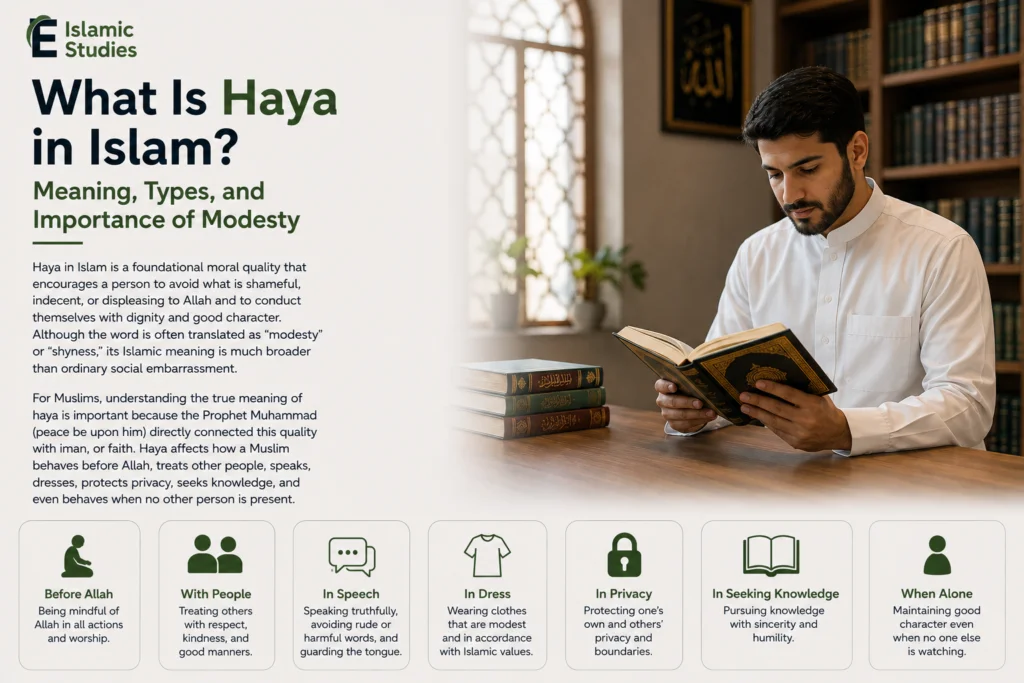
Haya in Islam is a foundational moral quality that encourages a person to avoid what is shameful, indecent, or displeasing to Allah and to conduct themselves with dignity and good character.
Although the word is often translated as “modesty” or “shyness,” its Islamic meaning is much broader than ordinary social embarrassment.
For Muslims, understanding the true meaning of haya is important because the Prophet Muhammad (peace be upon him) directly connected this quality with iman, or faith. Haya affects how a Muslim behaves before Allah, treats other people, speaks, dresses, protects privacy, seeks knowledge, and even behaves when no other person is present.
This article explains the meaning of haya in Arabic and Islamic terminology, its relationship with faith, the different types of haya discussed by Muslim scholars, its virtues according to the Quran and Sunnah, and the important difference between genuine Islamic modesty and unhealthy shyness.
By the end, you will have a clearer understanding of why haya occupies such an important place in Islamic character and how Muslims can develop it without allowing embarrassment or fear of people to prevent them from seeking knowledge or standing for the truth.
You will learn:
- The precise meaning of haya in Arabic and Islamic terminology.
- Why the Prophet (peace be upon him) described haya as a branch of faith.
- The different dimensions of haya, including haya from Allah, the angels, other people, and oneself.
- What genuine haya does — and does not — prevent a Muslim from doing.
- How haya influences speech, dress, worship, relationships, privacy, and personal conduct.
- Practical ways to strengthen haya as part of developing Islamic character.
Haya in Islam: Meaning and Definition
Haya is an Arabic term commonly translated as modesty, shyness, shame, or moral restraint, but none of these English words captures its full Islamic meaning on its own.
In Islam, haya describes an inward sensitivity that makes a person dislike indecency and restrains them from words or actions they know are inappropriate. It is therefore both an internal condition of the heart and a quality that becomes visible through behavior.
A person with genuine haya is not simply concerned about looking respectable in front of others. Rather, this person develops an awareness of Allah, a respect for moral boundaries, and an inner reluctance to commit actions that conflict with faith and good character.
This is why Islamic scholars discuss haya alongside iman, taqwa, manners, worship, and purification of the heart.
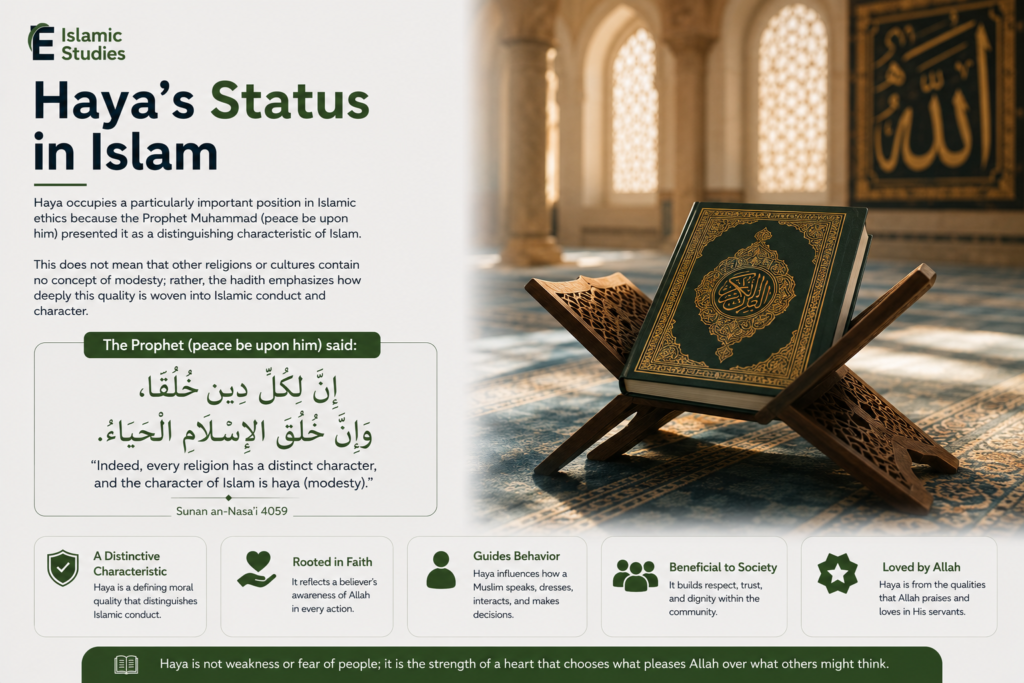
Haya occupies a particularly important position in Islamic ethics because the Prophet Muhammad (peace be upon him) presented it as a distinguishing characteristic of Islam.
This does not mean that other religions or cultures contain no concept of modesty; rather, the hadith emphasizes how deeply this quality is woven into Islamic conduct and character.
In Islamic terminology, scholars commonly explain haya as a noble quality that encourages a person to abandon what is ugly or blameworthy and prevents them from neglecting the rights owed to Allah or His creation.
Therefore, Islamic haya is much closer to moral consciousness and dignified restraint than simple social awkwardness.
The Prophet (peace be upon him) said:
إِنَّ لِكُلِّ دِينٍ خُلُقًا، وَإِنَّ خُلُقَ الإِسْلَامِ الْحَيَاءُ.
“Every religion has a distinct characteristic, and the characteristic of Islam is haya.” Sunan Ibn Majah — graded Hasan.
Calling haya a characteristic of Islam shows that modesty is not an isolated rule applied only to dress or interactions between men and women.
It should influence a Muslim’s speech, relationships, worship, private behavior, attitude toward sin, and treatment of other people.
Haya and Its Relationship to Faith (Iman)
One of the most important things to understand about haya in Islam is that the Sunnah connects it directly with iman. This elevates haya beyond the level of cultural etiquette.
When haya is rooted in faith, it develops because a believer recognizes Allah’s commands, becomes sensitive to wrongdoing, and wants their outward and inward behavior to reflect that belief.
Our guide on learning Arabic in Islam explores the role Arabic plays in understanding the Quran, prayer, and Islamic scholarship.
The Prophet (peace be upon him) once passed by a man from the Ansar who was advising his brother concerning his excessive shyness. Rather than encouraging him to abandon haya, the Prophet (peace be upon him) said:
دَعْهُ، فَإِنَّ الْحَيَاءَ مِنَ الإِيمَانِ.
“Leave him, for haya is part of faith.”
Sahih al-Bukhari (24); also narrated by Muslim.
The relationship becomes even clearer in another famous hadith describing the branches of iman:
الإِيمَانُ بِضْعٌ وَسَبْعُونَ شُعْبَةً، فَأَفْضَلُهَا قَوْلُ لَا إِلَهَ إِلَّا اللهُ، وَأَدْنَاهَا إِمَاطَةُ الأَذَى عَنِ الطَّرِيقِ، وَالْحَيَاءُ شُعْبَةٌ مِنَ الإِيمَانِ.
“Faith has over seventy branches. The highest of them is saying, ‘There is no god but Allah,’ and the lowest is removing something harmful from the road, and haya is a branch of faith.”
Narrated in Sahih Muslim and other hadith collections.
The hadith places haya among the practical manifestations of belief. Faith is not merely something held internally; it influences what a believer says, does, avoids, and feels uncomfortable doing.
For students who want to understand how Islamic scholars connect individual teachings to wider religious principles, studying concepts such as qiyas and analogical reasoning in Islamic scholarship can provide useful insight into the methods used throughout the Islamic intellectual tradition.
Want to build your understanding of Islam beyond individual articles? Study Quran, Islamic character, worship, and foundational knowledge through structured lessons with qualified teachers. Book your free trial and start learning Islam step by step.

The Types of Haya in Islam
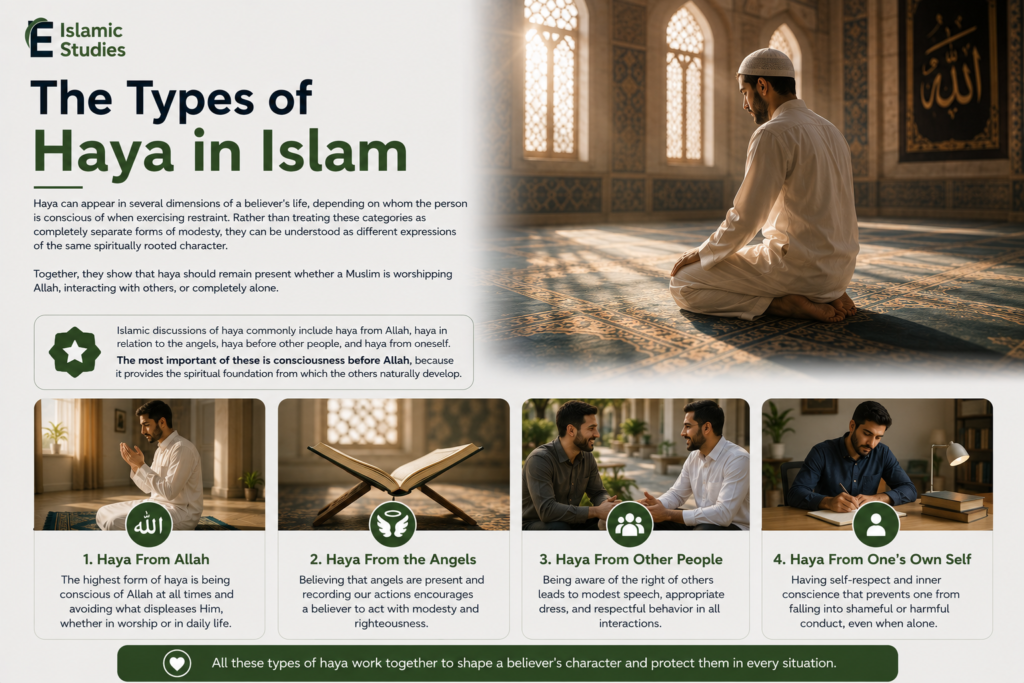
Haya can appear in several dimensions of a believer’s life, depending on whom the person is conscious of when exercising restraint. Rather than treating these categories as completely separate forms of modesty, they can be understood as different expressions of the same spiritually rooted character.
Together, they show that haya should remain present whether a Muslim is worshipping Allah, interacting with others, or completely alone.
Islamic discussions of haya commonly include haya from Allah, haya in relation to the angels, haya before other people, and haya from oneself.
The most important of these is consciousness before Allah, because it provides the spiritual foundation from which the others naturally develop.
1. Haya From Allah
Haya from Allah is the highest and deepest expression of this quality because it does not depend upon the presence or judgment of another human being. It develops when a believer becomes conscious that Allah knows what is public and private, visible and hidden.
This consciousness encourages a Muslim to protect their senses, thoughts, desires, speech, and actions from what Allah has prohibited.
The Prophet (peace be upon him) gave a powerful explanation of what proper haya before Allah requires:
اسْتَحْيُوا مِنَ اللَّهِ حَقَّ الْحَيَاءِ.
قُلْنَا: يَا رَسُولَ اللَّهِ، إِنَّا لَنَسْتَحْيِي وَالْحَمْدُ لِلَّهِ.
قَالَ: لَيْسَ ذَاكَ، وَلَكِنَّ الِاسْتِحْيَاءَ مِنَ اللَّهِ حَقَّ الْحَيَاءِ أَنْ تَحْفَظَ الرَّأْسَ وَمَا وَعَى، وَتَحْفَظَ الْبَطْنَ وَمَا حَوَى، وَلْتَذْكُرِ الْمَوْتَ وَالْبِلَى، وَمَنْ أَرَادَ الآخِرَةَ تَرَكَ زِينَةَ الدُّنْيَا، فَمَنْ فَعَلَ ذَلِكَ فَقَدِ اسْتَحْيَا مِنَ اللَّهِ حَقَّ الْحَيَاءِ.
“Have haya from Allah as He deserves.” They said, “O Messenger of Allah, we do feel shy, and all praise is due to Allah.” He said, “That is not what is meant.
Rather, having proper haya from Allah means guarding the head and what it contains, guarding the stomach and what it holds, and remembering death and decay. Whoever desires the Hereafter leaves the adornments of this world. Whoever does that has truly had haya from Allah as He deserves.”
Sunan al-Tirmidhi (2458) — graded Hasan.
The hadith makes the practical meaning of haya especially clear. Feeling modest before Allah is not merely an emotion; it should result in protecting one’s eyes, ears, tongue, thoughts, desires, consumption, and other actions from disobedience.
2. Haya From the Angels
Haya in relation to the angels develops from the believer’s awareness that human beings are not spiritually unattended. The Quran teaches that Allah has appointed noble recording angels who record people’s deeds.
Remembering their presence can reinforce the believer’s sense of accountability and encourage dignified behavior even when no other human being is nearby.
Allah says:
وَإِنَّ عَلَيْكُمْ لَحَافِظِينَ كِرَامًا كَاتِبِينَ يَعْلَمُونَ مَا تَفْعَلُونَ
“And indeed, [appointed] over you are keepers, noble and recording; they know whatever you do.” Surah Al-Infitar (82:10–12)
The purpose of remembering the recording angels is not to develop obsessive fear but to strengthen awareness that one’s conduct matters even outside public view.
Some early Muslims expressed this awareness as a form of haya in the presence of the angels, treating unseen accountability with seriousness and dignity.
Exploring examples from Islamic history can also help learners see how qualities such as modesty, courage, patience, and personal accountability appeared in the lives of earlier Muslims rather than remaining abstract concepts.

3. Haya From Other People
Haya toward other people concerns the dignity and boundaries that govern social behavior. It encourages a Muslim to avoid indecent speech, public wrongdoing, unnecessary exposure of private matters, humiliation of others, and behavior that violates another person’s rights or dignity. It therefore contributes directly to good manners and healthier relationships.
This type of haya should not be confused with living entirely according to people’s opinions. A Muslim does not avoid a permissible or necessary action merely because someone may criticize them.
Instead, haya toward people means maintaining honorable conduct and recognizing that Islam gives others rights over our speech and behavior.
It can appear in simple everyday actions: avoiding vulgar speech, respecting someone’s privacy, refusing to expose another person’s mistakes for entertainment, dressing appropriately, lowering one’s gaze, speaking respectfully to parents and elders, and avoiding public displays of sinful behavior.
4. Haya From One’s Own Self
Haya from oneself is especially revealing because it concerns what a person does when there is no social pressure at all.
A Muslim with this form of haya develops enough self-respect and spiritual consciousness to reject degrading behavior even when nobody else is present to praise, criticize, or discover it.
This does not mean believing oneself morally superior to others. Rather, it means recognizing the dignity Allah has given the human being and refusing to deliberately lower oneself through persistent wrongdoing.
When someone’s public character is completely different from their private conduct, it may indicate that their restraint is primarily based on people’s opinions rather than an internalized sense of faith.
Developing haya from oneself therefore helps move Islamic character from outward performance toward genuine inner discipline.
See Our Islamic Studies Classes in Action
Take a look at a sample lesson and see how our interactive online classes help students learn Islamic Studies in a clear, engaging, and supportive environment.
Deepen Your Islamic Knowledge
Join our comprehensive online courses and learn from qualified scholars today.
Book Your Free TrialWhy Haya Matters: Its Virtues in Islam
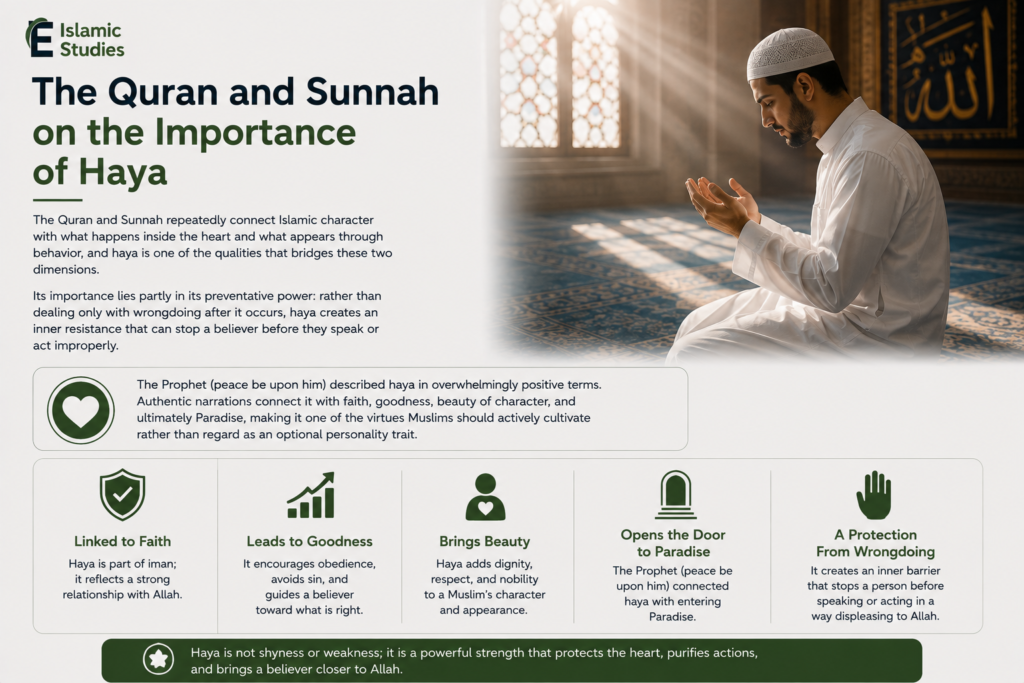
The Quran and Sunnah repeatedly connect Islamic character with what happens inside the heart and what appears through behavior, and haya is one of the qualities that bridges these two dimensions.
Its importance lies partly in its preventative power: rather than dealing only with wrongdoing after it occurs, haya creates an inner resistance that can stop a believer before they speak or act improperly.
The Prophet (peace be upon him) described haya in overwhelmingly positive terms. Authentic narrations connect it with faith, goodness, beauty of character, and ultimately Paradise, making it one of the virtues Muslims should actively cultivate rather than regard as an optional personality trait.
Haya Only Brings Good
True haya does not deprive a believer of anything beneficial. When properly understood, it protects rather than weakens the person because it discourages behavior that damages faith, dignity, relationships, and character.
The Prophet (peace be upon him) said:
الْحَيَاءُ لَا يَأْتِي إِلَّا بِخَيْرٍ.:
“Haya does not bring anything except good.” Sahih al-Bukhari (6117); also narrated in Sahih Muslim.
This hadith also provides an important principle for distinguishing real haya from harmful embarrassment.
If something described as “haya” repeatedly prevents a person from fulfilling obligations, seeking necessary knowledge, protecting their rights, or speaking truth appropriately, then the problem may not actually be the Islamic virtue praised in this hadith.
Haya Leads to Paradise
The relationship between haya and iman carries consequences beyond everyday character. Because genuine haya is an expression of faith, the Prophet (peace be upon him) contrasted it with vulgarity and harshness and connected the two paths with very different destinations.
الْحَيَاءُ مِنَ الإِيمَانِ، وَالإِيمَانُ فِي الْجَنَّةِ، وَالْبَذَاءُ مِنَ الْجَفَاءِ، وَالْجَفَاءُ فِي النَّارِ.
“Haya is part of faith, and faith leads to Paradise; foul speech is part of harshness, and harshness leads to the Fire.” Sunan al-Tirmidhi (2009), graded Hasan Sahih.
The contrast is significant. Islamic modesty is not merely about appearing quiet or reserved; it is associated with a broader pattern of faith, dignity, and good speech, while habitual vulgarity can reveal the opposite direction in a person’s character.
Don’t limit Islamic learning to isolated questions. Build the foundations that connect worship, belief, Quran, and Islamic character together.
Book your free trial and begin learning with qualified teachers in Shaykhi Academy.

Haya Beautifies Whatever It Is Found In
Haya also improves the way other virtues are expressed. Knowledge accompanied by humility is more beautiful than knowledge accompanied by arrogance; confidence accompanied by dignity is better than confidence expressed through vulgarity; and disagreement conducted respectfully is better than disagreement filled with insults.
The Prophet (peace be upon him) said:
مَا كَانَ الْفُحْشُ فِي شَيْءٍ إِلَّا شَانَهُ، وَمَا كَانَ الْحَيَاءُ فِي شَيْءٍ إِلَّا زَانَهُ
“Indecency does not exist in anything except that it disgraces it, and haya does not exist in anything except that it beautifies it.” Sunan al-Tirmidhi (1974), graded Sahih.
This principle applies far beyond individual acts of worship. Haya can beautify family relationships, friendships, online behavior, disagreements, education, work, and the way Muslims present themselves to others.
It Was a Trait of the Prophet (Peace Be Upon Him) Himself
The strongest practical model of haya is the Prophet Muhammad (peace be upon him). His modesty was noticeable to those who lived with him, yet it never prevented him from leading the Muslim community, confronting injustice, teaching sensitive religious matters, correcting mistakes, or conveying Allah’s revelation clearly.
Want to develop Islamic character through more than self-study? Learning directly with qualified teachers can help you understand how qualities such as haya, sabr, taqwa, and good manners work together in everyday Muslim life. Book your free trial and begin structured Islamic study today.

What Haya Is NOT: Common Misconceptions
Because the English words “shyness” and “modesty” only partially translate haya, misunderstandings can easily develop.
Some people assume that having more haya always means speaking less, avoiding difficult conversations, never asking sensitive questions, or remaining passive when something wrong happens. Islamic teachings do not support that understanding.
True haya restrains a Muslim from what is blameworthy; it does not restrain them from what Allah requires. A useful distinction is therefore whether the feeling pushes someone away from sin and indecency or prevents them from fulfilling a legitimate religious or moral responsibility.
Haya Is Not an Excuse to Stay Silent About Truth
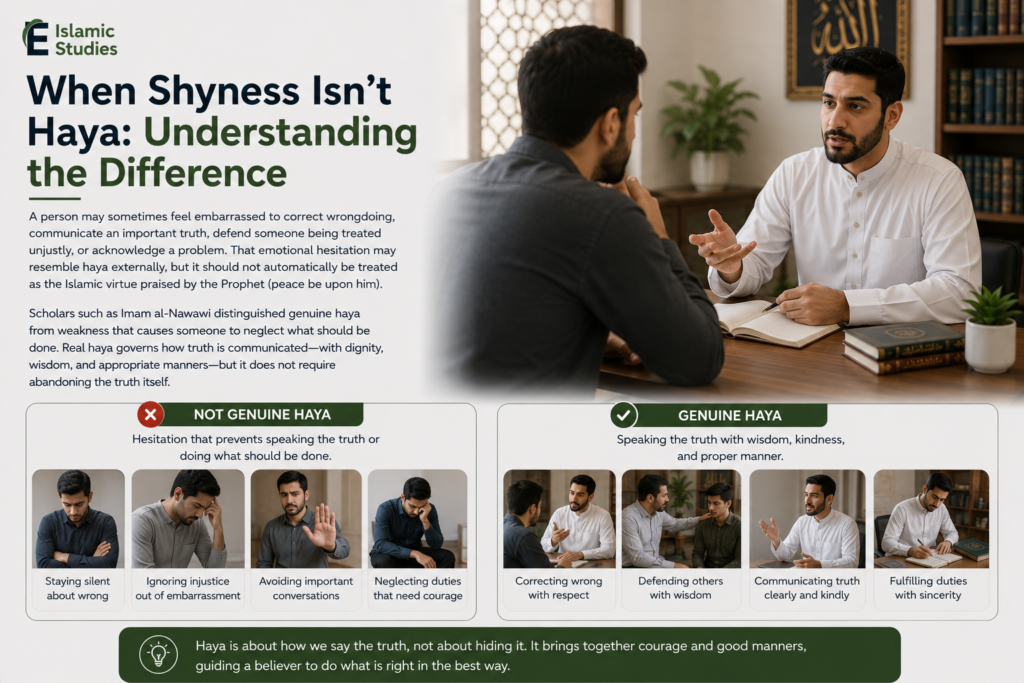
A person may sometimes feel embarrassed to correct wrongdoing, communicate an important truth, defend someone being treated unjustly, or acknowledge a problem.
That emotional hesitation may resemble haya externally, but it should not automatically be treated as the Islamic virtue praised by the Prophet (peace be upon him).
Scholars such as Imam al-Nawawi distinguished genuine haya from weakness that causes someone to neglect what should be done.
Real haya governs how truth is communicated with dignity, wisdom, and appropriate manners but it does not require abandoning the truth itself.
This distinction is particularly important because courage and haya can exist together. A Muslim does not need to become rude in order to become assertive, just as being respectful does not require remaining silent when religious or ethical responsibilities demand speech.
Allah Is Not Shy of the Truth
The Quran itself makes the distinction between inappropriate embarrassment and truth especially clear. Allah uses examples and explains matters according to wisdom and truth, regardless of whether people may consider the subject uncomfortable.
Allah says:
إِنَّ اللَّهَ لَا يَسْتَحْيِي أَنْ يَضْرِبَ مَثَلًا مَا بَعُوضَةً فَمَا فَوْقَهَا
“Indeed, Allah is not timid to present an example — that of a mosquito or what is beyond it.” Surah Al-Baqarah (2:26)
This verse demonstrates an essential principle: truth and genuine haya never contradict one another. Modesty affects the manner in which Muslims behave and communicate, but it should never become an excuse for concealing necessary truth.
Haya Does Not Prevent Seeking Religious Knowledge
Religious learning sometimes requires asking questions about matters people consider private or embarrassing, including purification, menstruation, marriage, intimacy, or bodily functions.
Islam does not teach Muslims to remain ignorant about religious obligations because they feel embarrassed to ask.
Aisha (may Allah be pleased with her) praised the women of the Ansar because their modesty did not prevent them from gaining religious understanding. Their example demonstrates that haya and serious learning can coexist: questions can be asked respectfully and appropriately without abandoning modesty.
For new Muslims especially, this principle is important. Nobody begins their Islamic journey already knowing how to pray, perform purification, understand the Quran, or apply every religious teaching correctly.
If you are building your foundations, our free Islamic course for beginners can help you approach essential Islamic subjects in a structured order rather than trying to learn everything at once.

Read Also: What Is Shukr in Islam?
Haya and Modesty in Practice
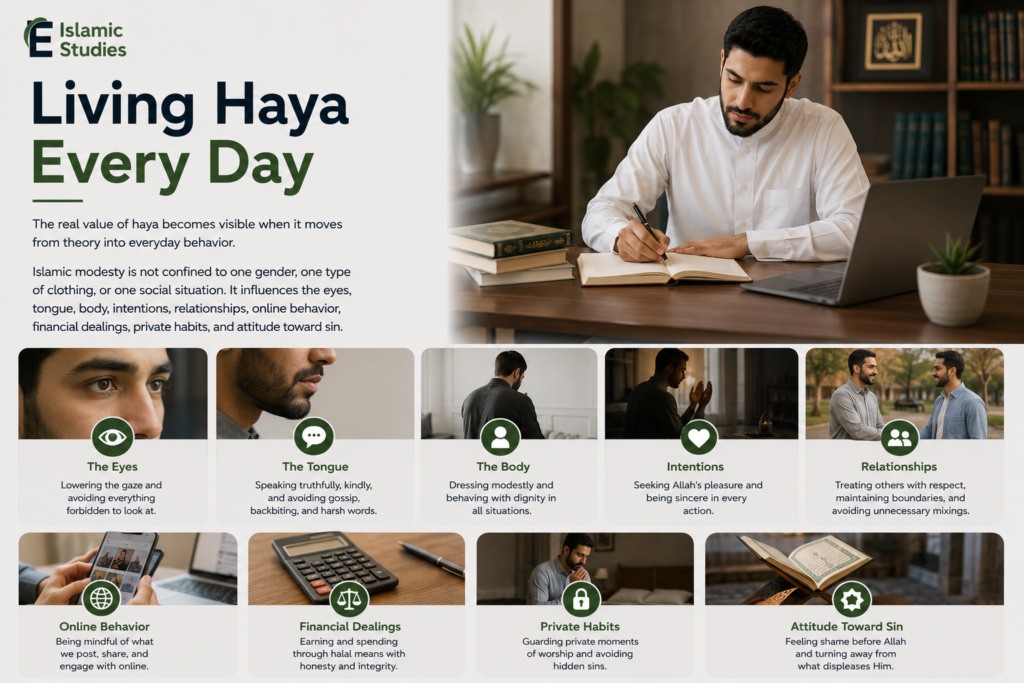
The real value of haya becomes visible when it moves from theory into everyday behavior. Islamic modesty is not confined to one gender, one type of clothing, or one social situation.
It influences the eyes, tongue, body, intentions, relationships, online behavior, financial dealings, private habits, and attitude toward sin.
For example, haya can encourage a Muslim to avoid vulgar jokes even when friends accept them, lower their gaze from what Allah has prohibited, dress with dignity, avoid exposing another person’s private mistakes, speak respectfully during disagreement, refuse dishonest financial behavior, and avoid boasting publicly about sins committed privately.
Haya also has an important digital dimension today. Social media makes it extremely easy to expose private matters, display personal relationships, mock others, share indecent material, reveal another person’s faults, or normalize behavior a Muslim would once have been ashamed to perform publicly.
A believer should therefore carry the same moral awareness online that they would maintain face to face.
At the same time, practicing haya does not mean withdrawing from society. Muslims can study, work, teach, lead, communicate confidently, participate in their communities, and discuss difficult topics while preserving appropriate Islamic boundaries.
Read Also: What Is Sabr in Islam?
For learners who want greater structure and accountability in their studies, a free Islamic course with a certificate can provide a clearer learning path while helping them build knowledge gradually alongside study of the Quran and authentic Sunnah.
Deepen Your Islamic Knowledge
Join our comprehensive online courses and learn from qualified scholars today.
Book Your Free TrialRead Also: What Is Hasad in Islam?
How Can Muslims Strengthen Haya?
Like many qualities of Islamic character, haya can be strengthened through deliberate spiritual practice. Some people naturally have shy personalities, but Islamic haya is not dependent upon personality alone.
A naturally outgoing Muslim can develop profound haya, while a naturally quiet person may still need to work on the spiritual dimensions of modesty.
The goal is therefore not to become socially withdrawn. It is to strengthen the inner awareness that makes obedience more natural and wrongdoing increasingly uncomfortable.
A Muslim can develop haya by increasing awareness of Allah’s constant knowledge, studying the Quran and Sunnah, protecting the eyes and tongue from prohibited things, remembering accountability in the Hereafter, spending time with people of good character, and resisting the gradual normalization of indecency.
Another powerful practice is to examine private behavior. Ask yourself: Would I still avoid this action if nobody on earth could ever discover it? If the answer changes depending on whether people are watching, the heart may need greater consciousness of Allah.
Repentance also strengthens spiritual sensitivity. Repeated sin without repentance can make wrongdoing feel increasingly normal, while sincere tawbah reminds the believer that moral boundaries matter and restores the desire to return to Allah.
Finally, Muslims should learn from the character of the Prophet (peace be upon him). His life demonstrates that haya can exist alongside confidence, courage, leadership, generosity, compassion, and firmness upon truth.
Read Also: What Is Kibr in Islam?
Watch a Sample Islamic Studies Class
See how our teachers explain Islamic concepts in an engaging and easy-to-understand way, helping students build knowledge and confidence.
Deepen Your Islamic Knowledge
Join our comprehensive online courses and learn from qualified scholars today.
Book Your Free TrialReady to build a stronger foundation in Islamic knowledge?
If you want to develop this understanding through guided Islamic study rather than learning through disconnected information, book your free trial and begin studying with qualified teachers.
You can also contact our team if you have questions about choosing the right course.
Our Islamic Essentials Courses
- Essential Islam Courses
- Online Tafseer Course
- Islamic History Course
- Tazkiyah Course
- Online Qirat Course
- Quran Tafseer Classes for Beginners — Introductory Interpretation
- Online Tafseer Classes in English
- Self-Paced Tafseer Course — Flexible Learning Programs
- Aqidah Course — Islamic Creed and Theology Classes
- Online Seerah Course — Life of Prophet Muhammad Classes
Our Fiqh Courses
- Online Fiqh Course — Islamic Jurisprudence Classes
- Fiqh Class for New Muslims — Beginners Fiqh
- Fiqh of Marriage Course — Islamic Marriage Jurisprudence
- Comparative Fiqh Course — Comparing Islamic Schools
- Fiqh of Salah Course — Prayer Jurisprudence
- Hanafi Fiqh Course — Hanafi School Jurisprudence
- Maliki Fiqh Course — Maliki School Jurisprudence
- Shafi Fiqh Course — Shafi School Jurisprudence
- Hanbali Fiqh Course — Hanbali School Jurisprudence

Conclusion
Haya in Islam is far more than ordinary shyness. It is a spiritually rooted form of modesty and moral restraint that encourages a Muslim to avoid what is shameful, fulfill the rights of Allah and other people, and preserve dignity in both public and private life.
The Sunnah’s description of haya as a branch of iman shows how closely Islamic character is connected with faith. Haya before Allah strengthens private obedience; awareness of the angels reinforces accountability; haya toward people encourages respectful conduct; and haya from oneself protects personal dignity when nobody else is present.
At the same time, genuine haya must never be confused with fear, passivity, or inability to speak. It does not prevent Muslims from asking religious questions, seeking their rights, correcting wrongdoing appropriately, or communicating the truth.
The Prophet (peace be upon him) combined extraordinary modesty with courage, leadership, and complete commitment to conveying Allah’s message.
Developing haya therefore does not mean becoming less capable or less confident. It means becoming more conscious of how one’s words, choices, and behavior reflect faith.
FAQ
What Does Haya Mean in Islam?
Haya in Islam refers to a faith-based sense of modesty, moral sensitivity, and restraint that discourages a person from indecent speech and behavior and from neglecting obligations or the rights of others. It is not simply feeling embarrassed around people.
The Prophet Muhammad (peace be upon him) explicitly described haya as part of faith, making it an important element of Islamic character.
Is Haya the Same as Shyness?
No. Shyness is primarily a personality or emotional response, whereas Islamic haya is a moral and spiritual quality. Ordinary shyness can sometimes prevent someone from asking an important question, defending their rights, or communicating when necessary.
Genuine haya should prevent wrongdoing without preventing legitimate and necessary actions, which is why a confident and socially outgoing Muslim can still possess strong haya.
How Many Types of Haya Are There in Islam?
Scholarly discussions describe haya through several dimensions, commonly including haya from Allah, in relation to the angels, toward other people, and from oneself.
These should not necessarily be understood as four entirely separate doctrines; rather, they illustrate how the same quality of modesty and moral restraint operates across different areas of a believer’s relationship with Allah, the unseen, society, and personal conscience.
Does Haya Mean Staying Silent About Wrongdoing?
No. Genuine haya does not require a Muslim to remain silent about wrongdoing when there is a legitimate responsibility to speak. Instead, haya influences the manner in which a person responds: avoiding arrogance, insults, unnecessary humiliation, and vulgarity while still communicating the truth appropriately.
Scholars therefore distinguish praiseworthy haya from weakness or embarrassment that prevents someone from fulfilling a religious obligation.
Can Haya Prevent Someone From Asking Religious Questions?
No. Muslims are expected to learn what they need in order to worship Allah correctly, even when the subject involves personal or sensitive matters.
Islamic scholarship contains many examples of men and women asking the Prophet (peace be upon him) detailed questions about worship, purification, marriage, and other private matters. Questions should be asked respectfully, but modesty should never become a reason to remain ignorant of necessary religious knowledge.







Leave a Reply