 Learning Islam
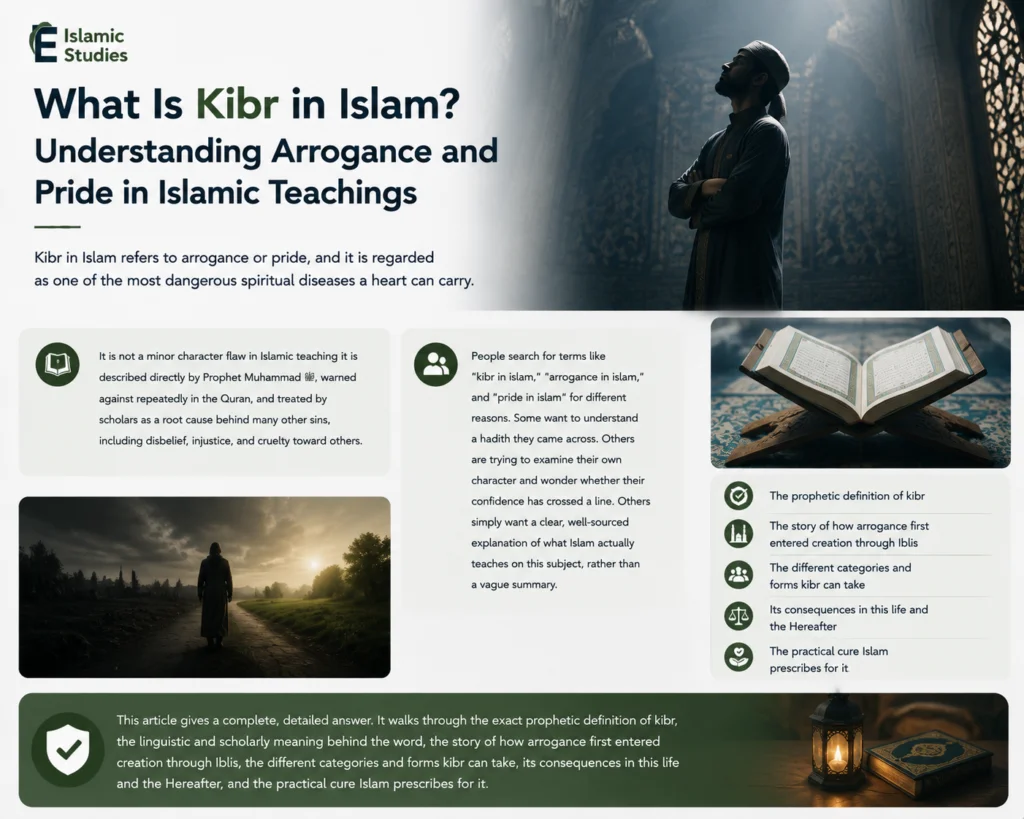
Kibr in Islam refers to arrogance or pride, and it is regarded as one of the most dangerous spiritual diseases a heart can carry.
It is not a minor character flaw in Islamic teaching it is described directly by Prophet Muhammad ﷺ, warned against repeatedly in the Quran, and treated by scholars as a root cause behind many other sins, including disbelief, injustice, and cruelty toward others.
People search for terms like “kibr in islam,” “arrogance in islam,” and “pride in islam” for different reasons. Some want to understand a hadith they came across. Others are trying to examine their own character and wonder whether their confidence has crossed a line.
Others simply want a clear, well-sourced explanation of what Islam actually teaches on this subject, rather than a vague summary.
This article gives a complete, detailed answer. It walks through the exact prophetic definition of kibr, the linguistic and scholarly meaning behind the word, the story of how arrogance first entered creation through Iblis, the different categories and forms kibr can take, its consequences in this life and the Hereafter, and the practical cure Islam prescribes for it.
Takeaway — What You Will Learn
- The precise Islamic definition of kibr, based directly on the words of Prophet Muhammad ﷺ, and its linguistic meaning in Arabic.
- The difference between inward kibr, which lives in the heart, and outward kibr, which shows in behavior and appearance.
- The three categories of kibr identified by Islamic scholars, ranked from the most severe to the most common.
- Quranic evidence explaining why Ib lis became the very first arrogant being, and what this story teaches every believer.
- The real-life consequences of kibr, and the practical steps Islam teaches for replacing arrogance with humility.
What Is Kibr in Islam? (Definition)
Linguistically, the Arabic word “kibr” comes from the root that carries the meaning of greatness (“al-‘azamah”) and self-exaltation (“al-tajabbur”).
It is closely related to the word “kibriya’,” which refers to majesty and grandeur. In its verb forms “takabbara” and “istakbara” the word specifically means to make oneself appear greater than one truly is.
Scholars have offered several technical definitions to capture the religious meaning of kibr more precisely. Al-Zabidi described it as “a state a person develops through self-admiration, in which he sees himself as greater than others.”
Others defined it as “a person exaggerating their own virtues while belittling and diminishing other people, and refusing to lower themselves before those who deserve humility.”
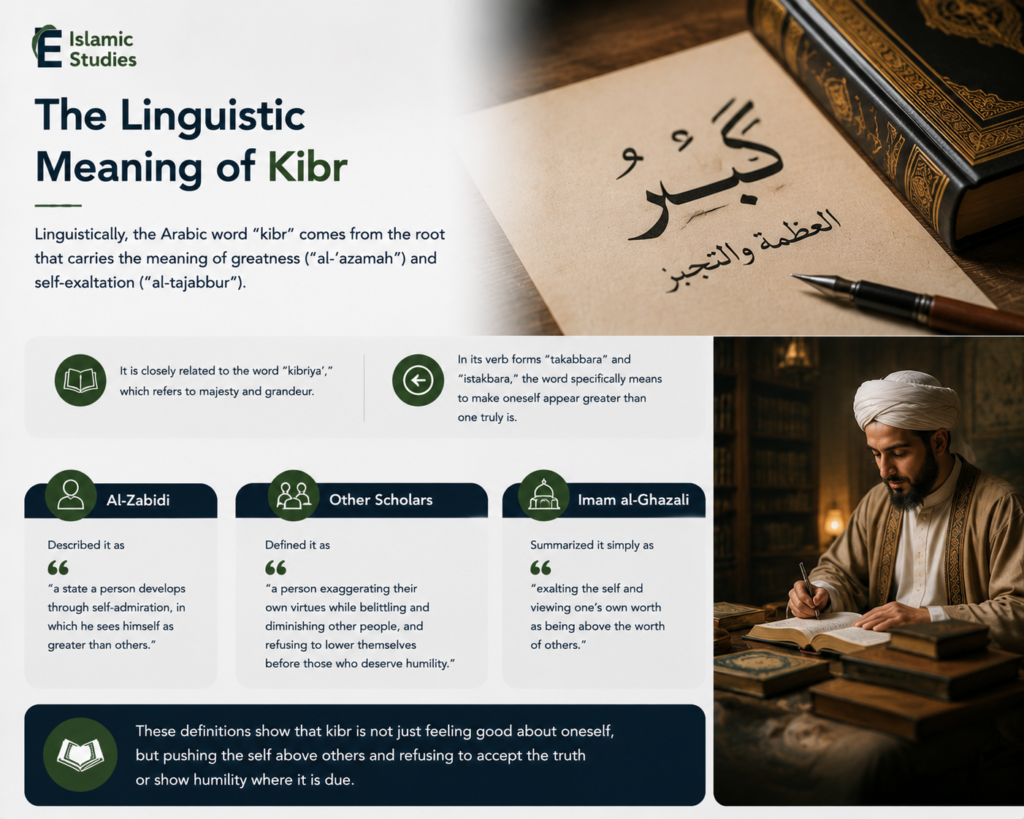
Imam al-Ghazali summarized it simply as “exalting the self and viewing one’s own worth as being above the worth of others.”
The most authoritative definition, however, comes directly from Prophet Muhammad ﷺ, who explained kibr in a hadith recorded in Sahih Muslim.
This hadith is treated by scholars as the foundational text on the subject, since it comes from the Prophet ﷺ himself rather than from later scholarly interpretation.
عَنْ عَبْدِ اللَّهِ بْنِ مَسْعُودٍ، عَنِ النَّبِيِّ صلى الله عليه وسلم قَالَ ” لاَ يَدْخُلُ الْجَنَّةَ مَنْ كَانَ فِي قَلْبِهِ مِثْقَالُ ذَرَّةٍ مِنْ كِبْرٍ ” . قَالَ رَجُلٌ إِنَّ الرَّجُلَ يُحِبُّ أَنْ يَكُونَ ثَوْبُهُ حَسَنًا وَنَعْلُهُ حَسَنَةً . قَالَ ” إِنَّ اللَّهَ جَمِيلٌ يُحِبُّ الْجَمَالَ الْكِبْرُ بَطَرُ الْحَقِّ وَغَمْطُ النَّاسِ ” .
“It Is narrated on the authority of Abdullah b. Mas’ud that the Messenger of Allah (ﷺ), observed:
Abdullah ibn Mas’ud (may Allah be pleased with him) reported that the Messenger of Allah ﷺ said:
“No one who has an atom’s weight of arrogance in his heart will enter Paradise.” A man said, “Indeed, a person loves that his clothes should be beautiful and his shoes should be beautiful.” The Prophet ﷺ said, “Indeed, Allah is Beautiful and He loves beauty. Arrogance is rejecting the truth out of self-conceit and looking down upon people.”
Narrated by: Abdullah ibn Mas’ud (may Allah be pleased with him)-Sahih Muslim 91
This prophetic definition is important because it removes any confusion about what kibr actually means. It is not about wearing expensive clothes, having an assertive personality, or taking pride in one’s achievements.
It consists of exactly two elements: refusing to accept truth once it becomes clear, and viewing other people with contempt or disrespect. A person can be guilty of kibr through either element alone, even without displaying it outwardly.
At E Islamic Studies Academy, the Online Tafseer Course helps students understand the Quranic verses behind Islamic legal reasoning including those cited in establishing istihsan.

Kibr as an Inward and Outward Condition
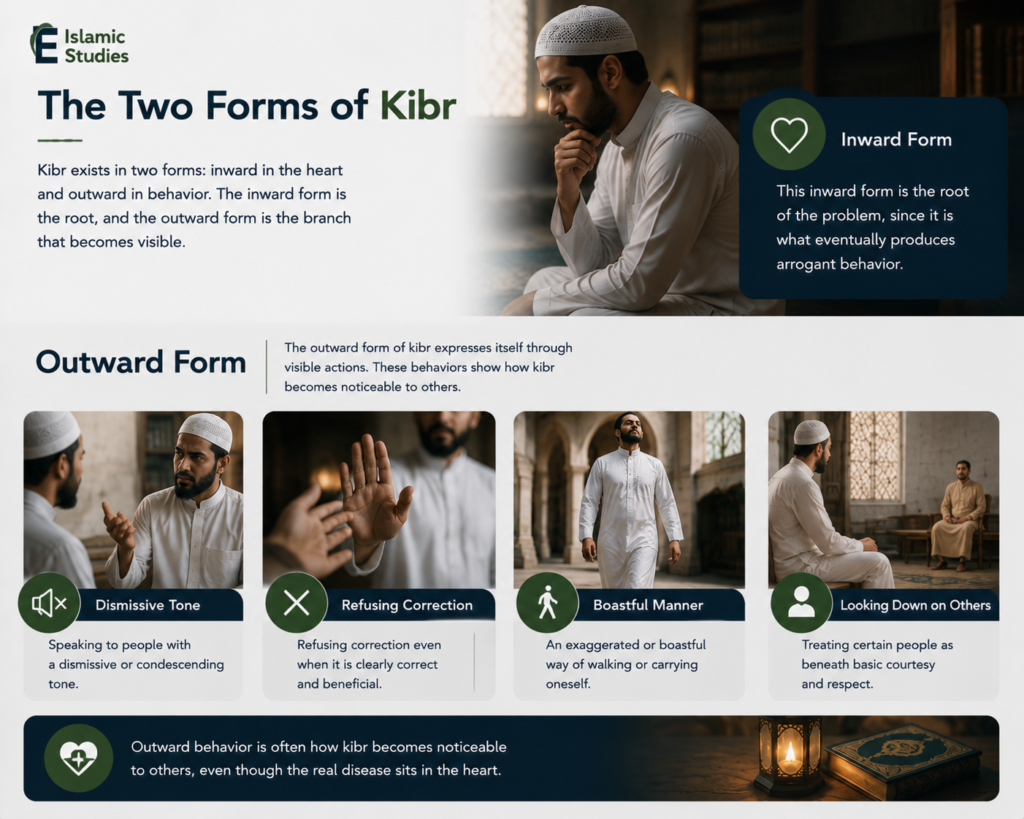
Islamic scholars distinguish between two dimensions of kibr. The inward form is a hidden disease that lives in the heart a person quietly believes they are superior, more capable, more knowledgeable, or more deserving of respect than others, even if they never say this out loud.
This inward form is the root of the problem, since it is what eventually produces arrogant behavior.
The outward form of kibr expresses itself through visible actions: a dismissive tone when speaking to people, refusing correction even when it is clearly correct, an exaggerated or boastful way of walking, or treating certain people as beneath basic courtesy.
Outward behavior is often how kibr becomes noticeable to others, even though the real disease sits in the heart.
It is important to note, however, that not every outward appearance of confidence or a strong walk automatically indicates kibr, since actions are judged according to intention.
The point it illustrates, however, is widely accepted: intention matters, and the same outward action can be sinful pride in one setting and a display of courage and morale on a battlefield in another, depending on what is in the heart.
Read Also: To see how early Muslim generations understood obedience, humility, and Islamic character in daily life, explore Islamic history and its essentials.
See Our Islamic Studies Classes in Action
Take a look at a sample lesson and see how our interactive online classes help students learn Islamic Studies in a clear, engaging, and supportive environment.
Deepen Your Islamic Knowledge
Join our comprehensive online courses and learn from qualified scholars today.
Book Your Free TrialThe Origin of Kibr: The Story of Iblis
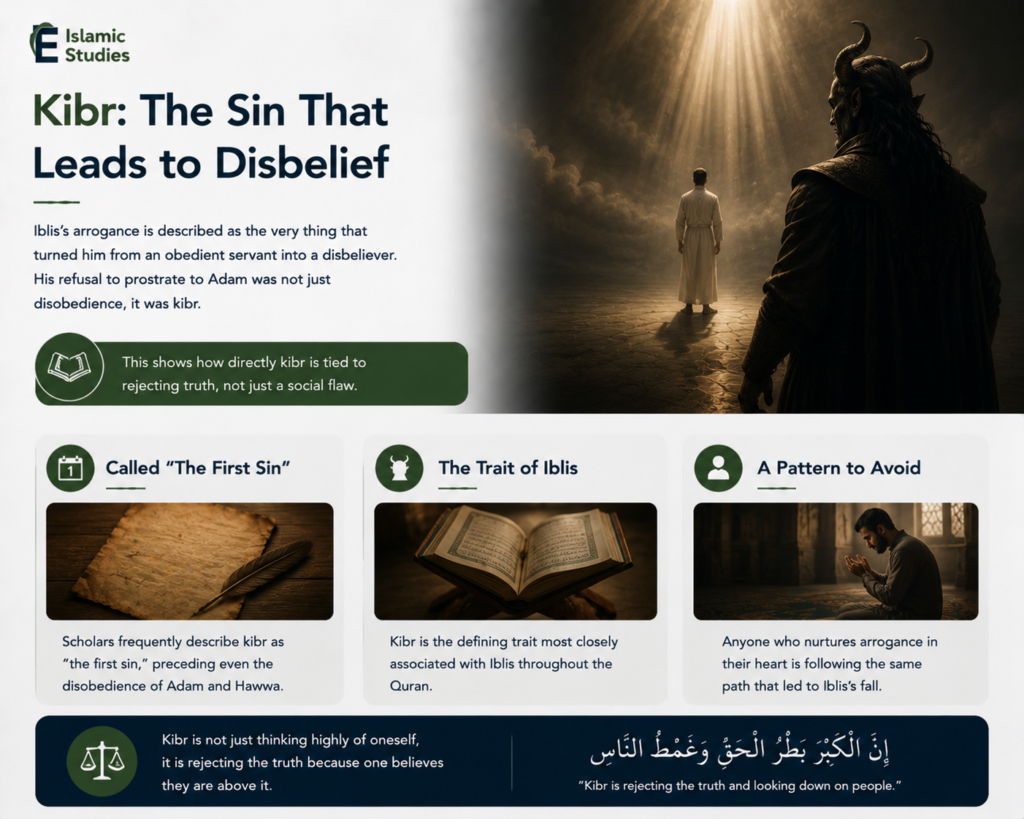
The Quran identifies Iblis as the very first being to display kibr. When Allah commanded the angels to prostrate before the newly created Adam, all of them obeyed immediately except Iblis, who refused out of a sense of superiority, believing himself to be made of a nobler substance than Adam.
وَإِذْ قُلْنَا لِلْمَلَائِكَةِ اسْجُدُوا لِآدَمَ فَسَجَدُوا إِلَّا إِبْلِيسَ أَبَىٰ وَاسْتَكْبَرَ وَكَانَ مِنَ الْكَافِرِينَ
“And when We said to the angels, ‘Prostrate before Adam,’ they prostrated, except for Iblees. He refused and was arrogant and became one of the disbelievers.”
This verse carries a central lesson repeated throughout Islamic teaching on this topic: kibr was not an accidental mistake on the part of Iblis. It was a conscious, deliberate choice to place his own self-regard above a direct command from Allah.
His arrogance is described as the very thing that turned him from an obedient servant into a disbeliever, showing how directly kibr is tied to rejecting truth rather than simply being a social flaw.
Because of this story, scholars frequently describe kibr as “the first sin,” preceding even the disobedience of Adam and Hawwa, and as the character trait most closely associated with Iblis throughout the Quran.
Any person who nurtures arrogance in their own heart is, in this sense, following the same pattern that led to Iblis’s fall.
The Three Types of Kibr in Islam
Scholars, including Ibn Hajar al-Haytami, classify kibr into three categories, based on who the arrogance is directed toward.
Although all three are religiously condemned, they differ significantly in severity, and understanding the difference helps clarify why some forms of arrogance are treated far more seriously than others.
| Type of Kibr | Description | Example |
| Kibr against Allah | The most severe form. It means refusing to worship Allah, or claiming a status equal to Him, purely out of self-exaltation and arrogance. | Pharaoh and Nimrod, who claimed divinity and refused to submit as servants of Allah. |
| Kibr against the Messenger | Refusing to follow the Prophet’s ﷺ guidance out of stubbornness, jealousy, or a feeling that one is above needing guidance. | The disbelief of several tribes of Quraysh and other nations toward their prophets. |
| Kibr against people | The most widespread form. It involves belittling others, refusing to accept truth from them, or refusing to treat them as equals. | Looking down on someone because of their wealth, status, ethnicity, or family background. |
Ibn Hajar al-Haytami explains that greatness and majesty are attributes that suit only a Sovereign who is all-capable and all-powerful, not a weak and dependent servant so for a servant to claim these attributes, even toward other servants, is described as a serious overstepping of one’s place.
Why Does Allah Dislike Arrogance?
The Quran makes it clear that arrogance is a quality that Allah does not love because it corrupts the way a person sees both themselves and others. Instead of recognizing abilities, wealth, knowledge, status, or success as blessings from Allah, an arrogant person may begin to view these things as proof of personal superiority.
This can lead to looking down on others, rejecting sincere advice, seeking admiration, and behaving as though one’s position places them above those around them.
This warning appears within the advice of Luqman to his son, where guidance about worship is closely connected with guidance about character and social behavior.
Luqman warns his son not to turn his face away from people in contempt or walk through the earth with pride. Allah says:
إِنَّ اللَّهَ لَا يُحِبُّ كُلَّ مُخْتَالٍ فَخُورٍ
“Indeed, Allah does not like everyone self-deluded and boastful.”
This verse establishes that kibr is not simply a social inconvenience that irritates other people; it directly affects a person’s standing with Allah.
A believer who genuinely wants to be loved by Allah is instructed to actively examine and remove self-conceit from their character, rather than treating it as a harmless personality trait.
Deepen Your Islamic Knowledge
Join our comprehensive online courses and learn from qualified scholars today.
Book Your Free Trial
Signs and Manifestations of Kibr
Kibr does not always appear as an open declaration that a person believes they are better than everyone else. More often, it reveals itself through ordinary attitudes and behaviors that may gradually become part of a person’s character.
An arrogant tone when correcting others, refusing to admit a mistake despite clear evidence, constantly drawing attention to personal achievements, becoming offended when someone else receives praise, or treating people differently according to their wealth, education, status, or social position can all reflect an unhealthy sense of superiority.
Another important manifestation of kibr is the inability to accept sincere advice. A person may immediately become defensive when corrected, dismiss advice because of who gave it, or insist on winning every disagreement rather than considering whether the other person may be right.

In other cases, arrogance appears through excessive boasting, deliberately displaying possessions or accomplishments, expecting special treatment, or speaking about others in a belittling way.
Even a person’s physical behavior can sometimes express what is happening within the heart. The Quran specifically warns against walking upon the earth with excessive pride and self-importance:
وَلَا تَمْشِ فِي الْأَرْضِ مَرَحًا إِنَّكَ لَنْ تَخْرِقَ الْأَرْضَ وَلَنْ تَبْلُغَ الْجِبَالَ طُولًا
“And do not walk upon the earth exultantly. Indeed, you will never tear the earth apart, nor will you ever reach the mountains in height.”
This verse reminds every believer that no physical strength, wealth, or social standing changes their actual size and limitation in front of the earth and mountains, let alone in front of Allah.
A calm, humble way of walking is described elsewhere in Islamic teaching as a quality of Allah’s righteous servants, serving as a small daily reminder to keep pride in check.
Read Also: Building this kind of character often benefits from structured, guided learning rather than isolated reading. See the available Islamic character and ethics workshops.
Deepen Your Islamic Knowledge
Join our comprehensive online courses and learn from qualified scholars today.
Book Your Free TrialThe Consequences of Kibr in Islam
Kibr carries serious spiritual consequences in Islam because it is not merely an unpleasant personality trait; it can affect a person’s response to truth, treatment of other people, and ultimately their standing before Allah.
Arrogance begins in the heart, but its effects can spread into a person’s beliefs, decisions, relationships, and behavior.
A person who becomes convinced of their own superiority may find it increasingly difficult to admit mistakes, accept correction, recognize the rights of others, or submit sincerely when the truth conflicts with their personal desires or sense of importance.
Prophet Muhammad ﷺ gave one of the strongest warnings about arrogance while also explaining exactly what Islamic teaching means by kibr.
لَا يَدْخُلُ الْجَنَّةَ مَنْ كَانَ فِي قَلْبِهِ مِثْقَالُ ذَرَّةٍ مِنْ كِبْرٍ
“No one will enter Paradise who has an atom’s weight of pride in his heart.”
Narrated by: Abdullah ibn Mas’ud (may Allah be pleased with him)- Sahih Muslim 91
Beyond this warning about the Hereafter, the Quran also describes a consequence that unfolds during a person’s life: persistent arrogance leads to a sealed heart, one that gradually loses the ability to recognize and accept truth, no matter how clearly it is presented.
كَذَٰلِكَ يَطْبَعُ اللَّهُ عَلَىٰ كُلِّ قَلْبِ مُتَكَبِّرٍ جَبَّارٍ
“Thus does Allah seal over every heart belonging to an arrogant tyrant.”
Scholars have also reflected on the psychological root of kibr. Umar ibn al-Khattab (may Allah be pleased with him) is reported to have observed that “no one ever found arrogance in himself except due to a sense of inferiority he felt within.”
This reflection suggests that visible arrogance is very often a cover for insecurity rather than a sign of genuine strength or self-worth.
Historical accounts also describe kibr leading some individuals away from faith entirely. One account tells of Jabalah ibn al-Ayham, a ruler of Ghassan who had embraced Islam, but who later reverted after refusing to accept equal legal treatment with an ordinary man during the time of Umar ibn al-Khattab, considering it beneath his status.
Kibr as a Dispute with Allah’s Attributes
Islam teaches that majesty and pride are attributes that belong exclusively to Allah. A human being who claims these qualities for themselves is, in a real sense, attempting to compete with Allah over something that was never theirs to claim in the first place.
This idea is expressed directly in a hadith qudsi, a sacred narration in which Allah’s own words are conveyed through the Prophet ﷺ.
الْكِبْرِيَاءُ رِدَائِي، وَالْعَظَمَةُ إِزَارِي، فَمَنْ نَازَعَنِي وَاحِدًا مِنْهُمَا أَلْقَيْتُهُ فِي جَهَنَّمَ
“Pride is My cloak and greatness is My garment; whoever competes with Me over either of them, I shall cast into Hell.”
This hadith reframes kibr as more than a moral failing between people — it becomes a spiritual overstep, a servant reaching for a garment that only fits the Creator.
This framing helps explain why the Quran and Sunnah treat kibr with such unusual severity compared to many other character flaws.
Read Also: For those who want ongoing, guided study of topics like this rather than scattered reading, these distance learning Islamic programs.
Start your learning journey today and take the next step toward deeper Islamic knowledge.

Different Forms of Kibr
Kibr does not always take the same shape. A person may become arrogant because of religious knowledge, worship, family lineage, wealth, physical beauty, or positions of power and authority.
Islamic teaching addresses each of these sources directly, since any one of them can quietly convince a person that they deserve more respect than others simply because of what they have or know.
A powerful illustration of this comes from the story of Abu Dharr (may Allah be pleased with him), a respected companion of the Prophet ﷺ, who once insulted another companion, Bilal, by referencing his mother’s ethnicity in a moment of anger.
The Prophet ﷺ corrected him immediately and firmly, without allowing Abu Dharr’s status as a companion to excuse the remark.
أعَيَّرْتَهُ بأُمِّهِ؟ إِنَّكَ امْرُؤٌ فِيكَ جَاهِلِيَّةٌ
“Did you insult him because of his mother? You are a man who still has traces of pre-Islamic ignorance in him.”
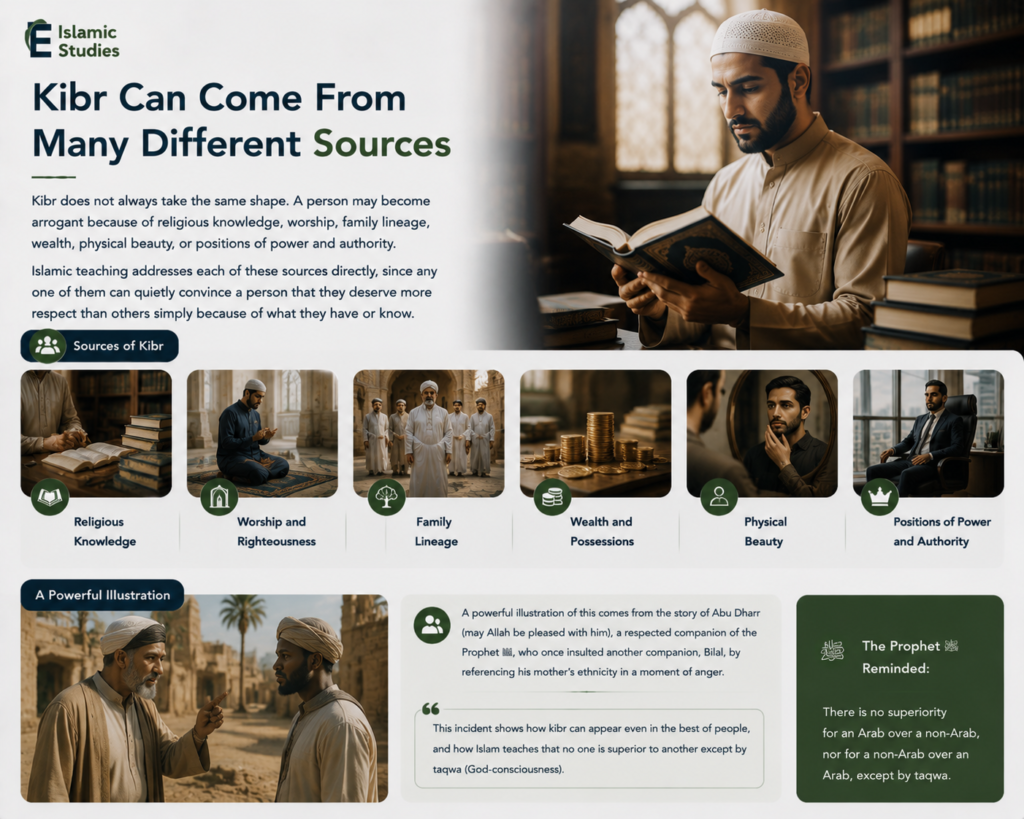
This incident is frequently cited by scholars as decisive evidence that Islam rejects every form of superiority based on lineage, ethnicity, wealth, or social background.
The Prophet ﷺ described this kind of remark not as a minor lapse, but as a lingering trace of “jahiliyyah,” the pre-Islamic culture of tribal pride that Islam came specifically to dismantle.
Read Also: Misconceptions about Islamic character and ethics circulate widely online. This article addresses one such misunderstanding directly: is Islam a violent religion?.
Read Also: What Is Sabr in Islam?
The Cure for Kibr: Humility in Islam
Islam does not simply warn against kibr and describe its consequences; it also provides a clear cure for it: tawadu’ (humility). True humility in Islam is not weakness, lack of confidence, or pretending that a person has no abilities or achievements.
Rather, it is a state of the heart in which a believer recognizes their dependence upon Allah, accepts the truth without allowing pride to interfere, and refuses to consider themselves inherently superior to other people.
This humility must be cultivated sincerely for the sake of Allah rather than performed to gain admiration or develop a reputation for modesty.
A person may speak humbly while secretly enjoying being praised for their humility, just as someone may deliberately minimize their achievements while hoping that others will contradict them and offer compliments.
Islamic humility goes deeper than outward behavior: it concerns how a person understands themselves, their blessings, and their relationship with Allah and His creation.
The Prophet Muhammad ﷺ explained that genuine humility does not lower a person’s true status. On the contrary, humility practiced sincerely for Allah becomes a cause of elevation.
مَا تَوَاضَعَ أَحَدٌ لِلَّهِ إِلَّا رَفَعَهُ اللَّهُ
“No one humbles himself for the sake of Allah except that Allah raises him in status.”
The Quran reinforces this same principle directly, instructing believers to lower themselves gently toward fellow believers rather than approaching them with pride, condescension, or a sense of superiority.
وَاخْفِضْ جَنَاحَكَ لِلْمُؤْمِنِينَ
“And lower your wings to the believers.”
Read Also: To see how a specific act of worship builds humility and self-discipline in practice, explore the rules of fasting in Islam.
Scholars add that the real, lasting cure for kibr requires constant self-examination a Muslim is encouraged to regularly ask whether their sense of achievement, knowledge, or status has begun shaping how they treat other people, and to correct this internally before it becomes visible in their words or actions.
Read Also: What Is Haya in Islam?
Watch a Sample Islamic Studies Class:
See how our teachers explain Islamic concepts in an engaging and easy-to-understand way, helping students build knowledge and confidence.
Kibr vs. Self-Respect: A Common Misunderstanding
Kibr is not the same as healthy self-respect, confidence, or a reasonable sense of personal dignity. Islam does not require a believer to think poorly of themselves or deny their genuine accomplishments a Muslim is permitted to feel proud of lawful achievements and to maintain self-respect in how they are treated by others.
The distinction lies precisely in the two elements found in the Prophet’s ﷺ definition: rejecting truth, and disrespecting people.
A person who remains confident yet still accepts correction when they are wrong, and who still treats others regardless of their status with basic respect, has not crossed into kibr, even if they carry themselves with visible dignity or firmness.
Read Also: What Is Hasad in Islam?
Watch a Sample Islamic Studies Class
See how our teachers explain Islamic concepts in an engaging and easy-to-understand way, helping students build knowledge and confidence.
Deepen Your Islamic Knowledge
Join our comprehensive online courses and learn from qualified scholars today.
Book Your Free TrialLearn the Full Picture with Guided Islamic Study
Understanding a concept like kibr in its full depth including its precise Quranic evidence, its prophetic definitions, its different categories, and its practical application in daily character is far easier with structured guidance than with scattered, isolated reading.
Read Also: For readers looking to build this kind of structured foundation, this resource compares the best schools to learn Islam.

Build a stronger understanding of Islam through structured, engaging online Islamic Studies classes with qualified teachers.
Whether you’re looking for Islamic education for yourself or your children, E Islamic Studies School offers lessons designed to make learning clear, practical, and accessible from anywhere.
Start your learning journey today and take the next step toward deeper Islamic knowledge.
Deepen Your Islamic Knowledge
Join our comprehensive online courses and learn from qualified scholars today.
Book Your Free TrialOur Islamic Essentials Courses
- Essential Islam Courses
- Online Tafseer Course
- Islamic History Course
- Tazkiyah Course
- Online Qirat Course
- Quran Tafseer Classes for Beginners — Introductory Interpretation
- Online Tafseer Classes in English
- Self-Paced Tafseer Course — Flexible Learning Programs
- Aqidah Course — Islamic Creed and Theology Classes
- Online Seerah Course — Life of Prophet Muhammad Classes
- Akhlaq Course — Islamic Ethics and Character Development
Conclusion
Kibr in Islam is defined precisely by Prophet Muhammad ﷺ as rejecting the truth and looking down on other people not simply as pride in appearance, wealth, or achievement.
The Quran traces the origin of this trait to Iblis, who chose arrogance over obedience, and warns repeatedly that persistent kibr can seal a person’s heart against guidance.
Scholars classify kibr into three categories based on severity, and identify several everyday sources of knowledge, worship, lineage, wealth, beauty, and power through which it commonly appears.
Islam responds to this danger with a clear and practical cure: sincere humility, expressed both in worship and in daily treatment of other people.
Recognizing the signs of kibr honesty in oneself, rather than only noticing it in others, is described throughout Islamic teaching as an essential and ongoing part of building sound religious character.
Frequently Asked Questions About Kibr in Islam
What does kibr mean in Islam?
Kibr means arrogance or pride. It is defined precisely by Prophet Muhammad ﷺ as rejecting the truth and looking down on other people, and it is treated in Islamic teaching as a serious disease of the heart rather than a minor personality trait.
Is kibr considered a major sin in Islam?
Yes, kibr is considered a major sin. Prophet Muhammad ﷺ warned that no one carrying even an atom’s weight of pride in their heart will enter Paradise, a statement recorded in Sahih Muslim, showing the seriousness with which this trait is treated.
What is the difference between kibr and healthy confidence?
Confidence and self-respect are not sinful on their own in Islam. Kibr specifically involves the two elements defined by the Prophet ﷺ rejecting truth and disrespecting others which is what distinguishes it from simply having reasonable dignity or self-esteem.
How can a Muslim cure kibr in their own character?
Islam prescribes sincere humility as the cure for kibr, cultivated through worship such as fasting, through lowering oneself before fellow believers, and through consistently remembering that all ability, knowledge, and status ultimately come from Allah rather than from oneself.
Who was the first being to display kibr, according to the Quran?
According to the Quran, Iblis was the first to display kibr, refusing to prostrate before Adam out of a sense of superiority and choosing arrogance over direct obedience to Allah’s command.
Does kibr refer only to outward, visible behavior?
No. Kibr includes both an inward condition of the heart and outward, visible actions. A person may carry hidden self-conceit even while behaving in an outwardly modest way, which is why scholars emphasize purifying the heart itself, not only correcting outward behavior.







Leave a Reply