 Learning Islam
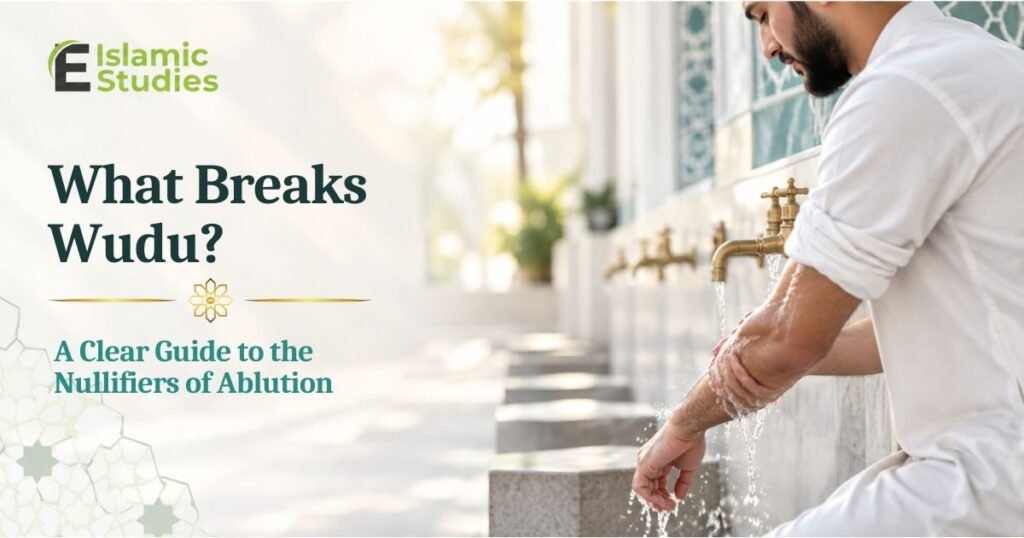
You finish wudu, walk toward your prayer mat, and a small doubt appears. Did that nap on the couch count? What about the cut on your finger, or the burger you just ate? If you have paused like this, you are asking what breaks wudu, and you are not alone.
Knowing what breaks wudu is basic fiqh every Muslim needs. It matters to a parent teaching a child to pray and to an adult revert learning the steps for the first time. The Prophet (peace be upon him) said:
” لاَ يَقْبَلُ اللَّهُ صَلاَةَ أَحَدِكُمْ إِذَا أَحْدَثَ حَتَّى يَتَوَضَّأَ ”.
“Allah does not accept the prayer of anyone of you if he does Hadath (passes wind) till he performs ablution (anew).” (Bukhari 6954).
In this guide, you will learn what breaks wudu by agreement, where the schools of fiqh differ, and the hadith behind each ruling. Will you also get direct answers to two common questions: does eating break wudu, and does bleeding break wudu?
Key Takeaways
- The list of what breaks wudu is limited; anything without proof does not cancel your purification.
- Anything leaving the private passages, deep sleep, and loss of consciousness break wudu by agreement.
- Eating ordinary food does not break wudu, except camel meat.
- Minor bleeding does not break wudu; scholars differ only over heavy, flowing blood.
- Doubt never removes certainty: if you are unsure whether you lost wudu, you are still pure.
What Breaks Wudu
In fiqh, what breaks wudu is called nawaqid al-wudu (the nullifiers of ablution). After one of them happens, you must renew wudu before prayer, touching the Mushaf, or tawaf. Some nullifiers are agreed upon, and others are discussed among the four schools.
1. Anything That Exits From the Two Private Passages
This is the clearest answer to what breaks wudu. Urine, stool, and passing wind all break it, as do madhy (pre-seminal fluid) and wadi. Maniy (semen) goes further and requires a full ghusl.
The amount does not matter. A single drop of urine or a silent release of wind is enough to end your state of purity.
2. Deep Sleep and Loss of Consciousness
Deep sleep is on every scholar’s list of what breaks wudu, because you lose awareness of your surroundings. Fainting, anesthesia, insanity, and intoxication break it as well, since the mind can no longer notice what leaves the body.
Light dozing while sitting firmly, such as nodding off while waiting for the imam, does not break wudu for most scholars. The Companions used to doze while waiting for Isha, then pray without renewing wudu (Muslim 376).
3. Touching the Private Parts Directly
Here opinions on what breaks wudu start to differ. Touching your own private part with the hand, without a barrier, breaks wudu for the Shafi’i, Hanbali, and Maliki schools. The Hanafi school holds that it does not.
Parents should mention this to young children, who often touch themselves while dressing after wudu. Our Learning Islam Level 1 course walks beginners through these purification basics.
4. Eating Camel Meat
This one surprises many learners. Camel meat appears on the Hanbali list of what breaks wudu, a view shared by many hadith scholars and based on an authentic narration in Sahih Muslim. The other three schools treat the command as recommended.
5. Leaving Islam
Apostasy cancels all good deeds, wudu included. A person who returns to Islam makes wudu again before praying.

Other Matters Scholars Discuss
Some points of what breaks wudu are debated. Touching the skin of the opposite gender breaks wudu for Shafi’is, breaks it only with desire for Malikis and Hanbalis, and does not break it for Hanafis. Washing a deceased person is a nullifier for Hanbalis only.
These differences are easier to grasp with a live teacher. Our Islamic Studies courses cover the fiqh of purification step by step, with room for every question you bring.
Live Class in Action
Watch how our instructors interact with students in real time, focusing on interactive methods.
Deepen Your Islamic Knowledge
Join our comprehensive online courses and learn from qualified scholars today.
Book Your Free TrialWhat Breaks Wudu Hadith: The Evidence Behind Each Ruling
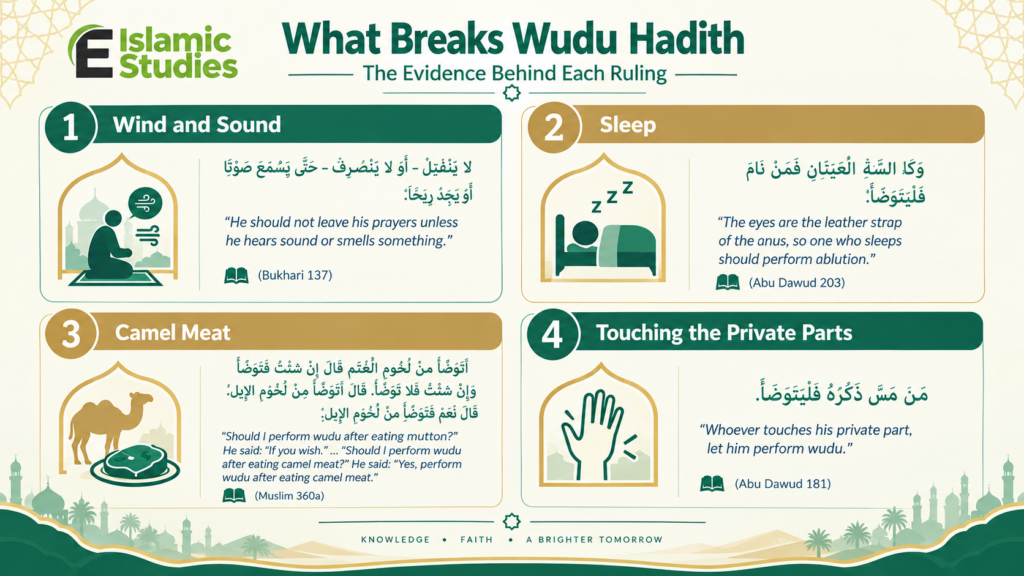
Every ruling above comes from the Quran and Sunnah. Reading the actual what breaks wudu hadith texts lets you act with confidence, not on borrowed habits.
The Hadith About Wind and Sound
A man told the Prophet (peace be upon him) that he felt something during prayer.
The Prophet (peace be upon him) replied:
” لاَ يَنْفَتِلْ ـ أَوْ لاَ يَنْصَرِفْ ـ حَتَّى يَسْمَعَ صَوْتًا أَوْ يَجِدَ رِيحًا ”.
“He should not leave his prayers unless he hears sound or smells something.” (Bukhari 137). This wudu-breaking hadith also teaches that doubt alone never breaks wudu.
The narrator, Abdullah ibn Zayd, described a man who only imagined he had passed wind during prayer. Scholars explain that hearing a sound or smelling an odor stands for certainty and isn’t meant as a literal test. If you are sure, renew your wudu. If you only suspect it, keep praying with a calm heart. This wudu-breaking hadith also teaches that doubt alone never breaks wudu.
The Hadith About Sleep
The Prophet (peace be upon him) said:
” وِكَاءُ السَّهِ الْعَيْنَانِ فَمَنْ نَامَ فَلْيَتَوَضَّأْ ” .
“The eyes are the leather strap of the anus, so one who sleeps should perform ablution. ” (Abu Dawud 203).
The Arabic word wikaa’ means the strap tied around the neck of a water skin to keep it closed. When you’re awake, your senses work like that strap, and you notice anything that leaves the body. Deep sleep loosens that control, so the sleep itself counts as a likely cause of breaking wudu. Scholars combined it with the narration of Anas to separate deep sleep from light dozing.
The Hadith About Camel Meat
Jabir ibn Samurah reported that a man asked:
” أَأَتَوَضَّأُ مِنْ لُحُومِ الْغَنَمِ قَالَ ” إِنْ شِئْتَ فَتَوَضَّأْ وَإِنْ شِئْتَ فَلاَ تَوَضَّأْ ” . قَالَ أَتَوَضَّأُ مِنْ لُحُومِ الإِبِلِ قَالَ ” نَعَمْ فَتَوَضَّأْ مِنْ لُحُومِ الإِبِلِ ” .
“Should I perform wudu after eating mutton?” The Prophet said: “If you wish.” He asked: “Should I perform wudu after eating camel meat?” He said: “Yes, perform wudu after eating camel meat” (Muslim 360a).
Notice the difference in the two answers: a free choice for mutton, but a clear yes for camel meat. Imam Ahmad took this as a binding command. The majority understood it as recommended, or as only washing the hands and mouth. Either way, renewing wudu after eating camel meat stays closest to the Sunnah.
The Hadith About Touching the Private Parts
Busrah bint Safwan narrated that the Prophet (peace be upon him) said:
” مَنْ مَسَّ ذَكَرَهُ فَلْيَتَوَضَّأْ ”
“Whoever touches his private part, let him perform wudu” (Abu Dawud 181).
The Shafi’i and Hanbali schools apply this ruling when the private part is touched directly with the palm or inner fingers, with no barrier in between. The Hanafi school relies on the hadith of Talq ibn Ali, where the Prophet called it “a part of you.” On that basis, they hold that touching it does not break wudu.
This what breaks wudu hadith is the main proof for the majority view. Reading these narrations in Arabic brings you closer to their exact wording. Our Islamic programs combine Arabic with Quran study, so the words of the hadith start to speak to you directly.
Experience Our Classrooms
Don’t just take our word for it—take a look inside! Watch the videos below to experience our engaging teaching methods and vibrant online classrooms firsthand.
Deepen Your Islamic Knowledge
Join our comprehensive online courses and learn from qualified scholars today.
Book Your Free TrialDoes Eating Break Wudu?
No, eating does not break wudu, with the single exception of camel meat. The Prophet (peace be upon him) ate a shoulder of mutton, then prayed without renewing his wudu (Bukhari 207).
The Camel Meat Exception
Camel meat is the only food on the list of what breaks wudu in authentic narrations. Even if you follow the majority view, renewing wudu after eating it is the more cautious choice.
Does Bleeding Break Wudu?
Minor bleeding does not break wudu. A small scratch or a drop of blood that stays on the wound leaves your wudu intact, as Sheikh Ibn Baz confirmed in his fatwa on this question.
Heavy Bleeding and the Four Schools
The difference concerns flowing blood. Hanafis list flowing blood among what breaks wudu, and Hanbalis say a large amount does. The Maliki and Shafi’i schools hold that bleeding never breaks wudu.
A Companion was struck by arrows while praying at night and kept praying as he bled. Many scholars use this to show bleeding does not break wudu, though renewing it after heavy bleeding is a sound precaution.
Vomit and Pus
The same discussion covers vomit, pus, and nosebleeds. The hadith cited for vomit is weak, so the stronger view leaves it off the list of what breaks wudu, though Hanafis count a mouthful.
What Does Not Break Wudu
Knowing what breaks wudu also means knowing what does not. Changing clothes, seeing your own awrah, cutting nails or hair, and normal speech do not affect your purification.
Doubt does not break wudu either. If you are sure you made wudu and unsure whether you lost it, you remain pure, which is a gentle relief for anyone struggling with waswas.
Continuous Conditions
People with urinary incontinence and women with continuous discharge follow a special ruling. They make wudu after the prayer time begins and pray with it, even if the discharge continues. Sisters who want deeper study of these rulings can explore our Alimah course for ladies.
Start Your Islamic Learning Journey With Qualified Teachers
Understanding what breaks wudu is only the first step. Your prayer also needs accurate recitation, and our live one-on-one Tajweed and Quran recitation circles, led by certified teachers, follow your pace.
We teach kids and adults on flexible schedules. Your child learns what breaks wudu, salah, and Quran reading in a warm setting, while you build your own foundation.
Our Islamic Courses
- Islam Classes for Adults
- Islam Classes for Sisters
- Alimah Course for Ladies
- Islam Classes for Kids
- Learn Islam for Beginners
- Learning Islam for New Converts
Whether you’re looking for Islamic education for yourself or your children, E Islamic Studies School offers lessons designed to make learning clear, practical, and accessible from anywhere.
Book a free trial class today and feel the difference in your worship.
Deepen Your Islamic Knowledge
Join our comprehensive online courses and learn from qualified scholars today.
Book Your Free TrialConclusion
What breaks wudu comes down to a short list: anything that exits the private passages, deep sleep or loss of consciousness, and, for many scholars, touching the private parts directly and eating camel meat. Apostasy cancels it as well.
Eating ordinary food does not break wudu, and minor bleeding does not either. Scholars differ on heavy bleeding, touching the opposite gender, and washing the dead, so follow a trusted scholar or the school practiced in your community.
The main lesson is simple: knowing what breaks wudu frees you from doubt and protects your prayer. Learn the rules once from reliable sources, then pray with a calm and certain heart.
FAQs
Here are short answers to the questions about what breaks wudu that learners ask us most often.
Does touching your wife break wudu?
According to the strongest view, held by Sheikh Ibn Baz and many scholars, no. The Prophet (peace be upon him) kissed some of his wives, then prayed without renewing wudu. It is broken only if madhy or another fluid comes out.
Does sleeping break wudu?
Deep sleep is on the list of what breaks wudu because you lose awareness. Light dozing while seated firmly does not, according to the majority of scholars.
Does vaginal discharge break wudu?
Yes, according to many scholars, including Sheikh Ibn Baz, fluid exiting from the front passage breaks wudu. If the discharge is continuous, the woman makes wudu for each prayer after its time begins.
Does laughing break wudu?
Laughing outside prayer does not break wudu. The Hanafis hold that laughing aloud during prayer breaks both the prayer and wudu, while other schools say it breaks only the prayer.
Does changing clothes break wudu?
No. Changing clothes does not break wudu for men or women, as long as nothing from the list of things that break wudu happens.
Does removing socks break wudu after wiping over them?
Most scholars say removing socks or khuffs after wiping over them ends that wudu, so renew it before your next prayer.







Leave a Reply