 Learning Islam
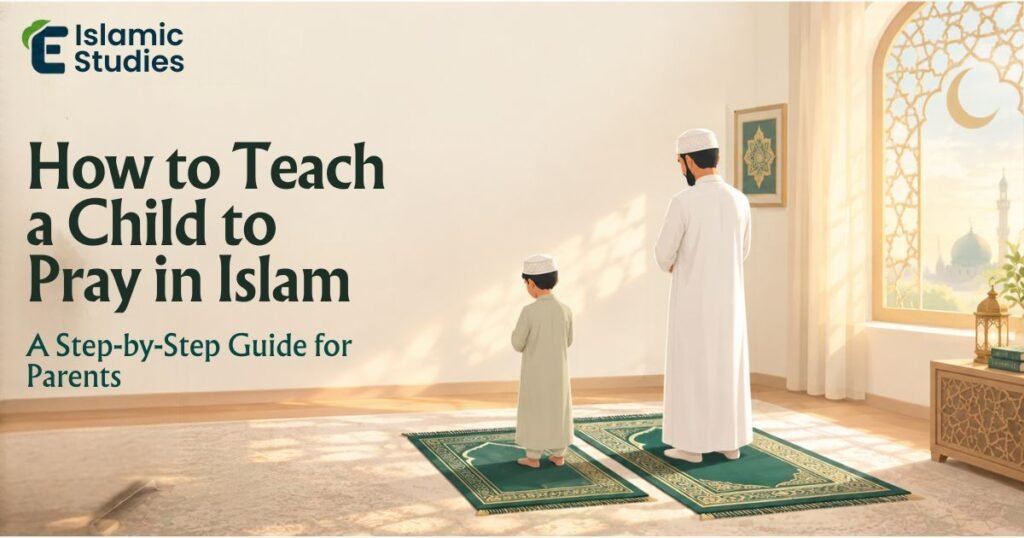
Have you ever seen your toddler copying you on the prayer mat, bowing a beat too late and giggling through sujood? That is their first lesson in salah, and it shows children are ready to learn prayer long before anyone asks them to.
If you are wondering how to teach a child to pray in Islam, the Sunnah gives parents a clear and gentle roadmap. It starts with your example, moves to real teaching at seven, and builds responsibility by ten.
This guide on how to teach a child to pray in Islam covers each age stage and the exact steps of salah in language children understand. It ends with a printable chart you can put on the wall tonight.
Key Takeaways
- The Prophet ﷺ set a clear timeline: teach at seven and become firmer at ten.
- Ages 2 to 6 are about imitation, love, and short surahs, not obligation.
- Wudu comes first. A child who masters it usually masters salah faster.
- Praise, rewards, and consistency work far better than pressure or fear.
- A printable steps-of-salah chart turns abstract rules into a visual daily routine.
How to Teach a Child to Pray in Islam: The Prophetic Method
Learning how to teach a child to pray in Islam starts with one clear hadith that sets the right ages and the right approach for every Muslim parent. The Prophet ﷺ said:
“ مُرُوا أَوْلاَدَكُمْ بِالصَّلاَةِ وَهُمْ أَبْنَاءُ سَبْعِ سِنِينَ وَاضْرِبُوهُمْ عَلَيْهَا وَهُمْ أَبْنَاءُ عَشْرِ سِنِينَ وَفَرِّقُوا بَيْنَهُمْ فِي الْمَضَاجِعِ ” .
“Command your children to pray when they become seven years old, discipline them for it at ten, and separate their beds” (Abu Dawud 495).
As explained in a classical commentary on Abu Dawud, “command” means teaching the conditions and pillars of prayer first, then asking the child to perform it. At ten, follow-up becomes firmer, and separating beds reflects the Sunnah’s care for modesty as children grow. Allah also says:
وَأْمُرْ أَهْلَكَ بِٱلصَّلَوٰةِ وَٱصْطَبِرْ عَلَيْهَا ۖ
“Bid your people to pray, and be diligent in ˹observing˺ it.” (Quran 20:132).
This verse makes parents responsible for their family’s prayer, not only their own. The command to “be diligent” (iṣṭabir) shows that patient, repeated reminders over many years are part of the duty itself. So the method is gradual on purpose. Here is how it works across three stages.
Stage 1: Ages 2 to 6, Love and Imitation
The first rule of how to teach a child to pray in Islam is that young children learn by watching, not by being told. Pray where they can see you, and let them stand beside you, even if they wander off or climb onto your back during sujood.
The Prophet ﷺ himself prayed while carrying his granddaughter Umamah, setting her down for sujood and lifting her again when he stood (Bukhari 516). Never scold a little one for playing near the prayer mat. You want salah to feel warm, not tense.
Give your child a small prayer rug of their own, and a colorful prayer scarf for girls if they like. Link the prayer names to their day, for example: “This is Maghrib, the sun has just set.”
This is also the best time to memorize Al-Fatihah, Al-Ikhlas, Al-Falaq, and An-Nas through short, playful repetition. Many families pair home practice with structured Islamic classes for kids, where a teacher reinforces these surahs with correct pronunciation.
Stage 2: Age 7, Real Teaching Begins
Seven is when the prophetic command begins. Start with wudu step by step, and watch your child do it until it is correct. Use warm water in winter, because cold water is a common hidden reason children avoid prayer.
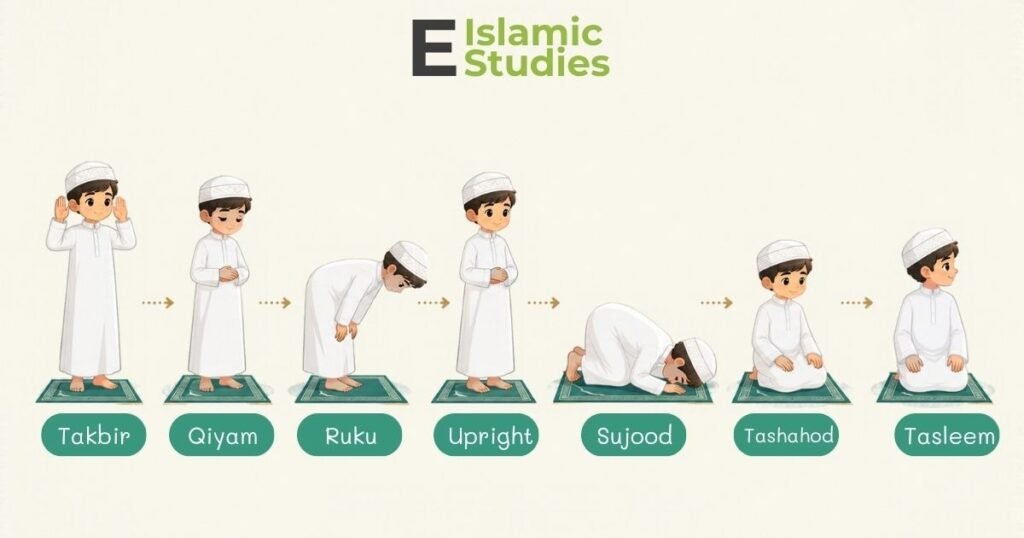
Next, explain the pillars: takbir, reciting Al-Fatihah, ruku, sujood, tashahhud, and tasleem. Pray slowly together, following the Prophet’s ﷺ instruction:
صَلُّوا كَمَا رَأَيْتُمُونِي أُصَلِّي
“Pray as you have seen me praying” (Bukhari 631).
The Prophet ﷺ said this to a group of young men who had stayed with him for twenty days to learn the religion before going home to teach their families. It shows that prayer is learned by watching, so your own salah is your child’s first lesson.
Gradual progress is at the heart of how to teach a child to pray in Islam. Start with Fajr only, then add Dhuhr, and keep going until all five prayers are in place. Once that is steady, work on praying early in the prayer time, then add the sunnah prayers.
Some parents celebrate the seventh birthday as a “salah milestone.” This makes the new responsibility feel like an honor rather than a burden.
Stage 3: Age 10 and Beyond, Consistency and Responsibility
By ten, prayer should be a settled routine. Encourage independence by letting your child set their own prayer alarms or remind the family when the adhan is called.
Instead of asking “Did you pray Asr?”, which can invite a fib, try a gentle reminder like “Asr time, everyone!” Then pray together whenever you can.
On discipline, the hadith allows a light, non-harmful corrective measure at ten. Scholars stress that it must never be on the face, must never leave a mark, and is only permitted if it would actually help. If it would not benefit the child, it is not allowed.
In practice, scholars and educators treat it as a last resort after every gentle method has been tried. Sunnah prayers like witr are encouraged, but a child is never disciplined for missing them. The Prophet ﷺ said:
“ إِنَّ الرِّفْقَ لاَ يَكُونُ فِي شَىْءٍ إِلاَّ زَانَهُ وَلاَ يُنْزَعُ مِنْ شَىْءٍ إِلاَّ شَانَهُ ” .
“Kindness is not to be found in anything but that it adds to its beauty” (Muslim 2594).
Live Class in Action
Watch how our instructors interact with students in real time, focusing on interactive methods.
Deepen Your Islamic Knowledge
Join our comprehensive online courses and learn from qualified scholars today.
Book Your Free TrialHow to Pray: Muslim Kids’ Step-by-Step Salah Guide
Once you know the stages, the next question is practical: what exactly do you teach? This section breaks salah into simple steps, so knowing how to teach a child to pray in Islam becomes a hands-on daily routine.
Step 1: Make Wudu
Teach the order clearly: make the intention and say “Bismillah,” wash the hands, rinse the mouth, rinse the nose, and wash the face. Then wash the arms to the elbows, wipe the head and ears, and wash the feet to the ankles.
Step 2: Face the Qiblah and Make the Intention
Show your child which direction the Qiblah is in your home. Explain that the intention (niyyah) is in the heart, for example: “I am praying Dhuhr for Allah.”
Step 3: Say Takbir and Recite Al-Fatihah
Raise both hands and say “Allahu Akbar.” Place the right hand over the left, recite Al-Fatihah, then recite a short surah.
Step 4: Ruku, Standing and Sujood
Bow with a straight back, saying “Subhana Rabbiyal Adheem” three times. Rise saying “Sami’ Allahu liman hamidah, Rabbana wa lakal hamd.” Then go into sujood saying “Subhana Rabbiyal A’la,” sit briefly, and do a second sujood.
Step 5: Tashahhud and Tasleem
In the final sitting, recite the tashahhud. End the prayer by turning the head to the right and then to the left, saying “Assalamu alaykum wa rahmatullah” each time.
Your child also needs to learn the rak’ah count: Fajr 2, Dhuhr 4, Asr 4, Maghrib 3, and Isha 4. To have these basics taught in a structured order, a course like Learning Islam Level 1 covers purification and prayer step by step.
Experience Our Classrooms
Don’t just take our word for it—take a look inside! Watch the videos below to experience our engaging teaching methods and vibrant online classrooms firsthand.
Deepen Your Islamic Knowledge
Join our comprehensive online courses and learn from qualified scholars today.
Book Your Free TrialVisual Tools and Habits That Help Kids Love Salah
Visual tools make a big difference for young learners. Printable steps of salah for kids turn each movement into a picture your child can follow, even before they read fluently.
1. Use a Printable Salah Chart at Home
The best charts show one illustrated figure for each position, the words said in Arabic with transliteration, and a short English meaning. A separate wudu chart placed by the sink helps a lot too.
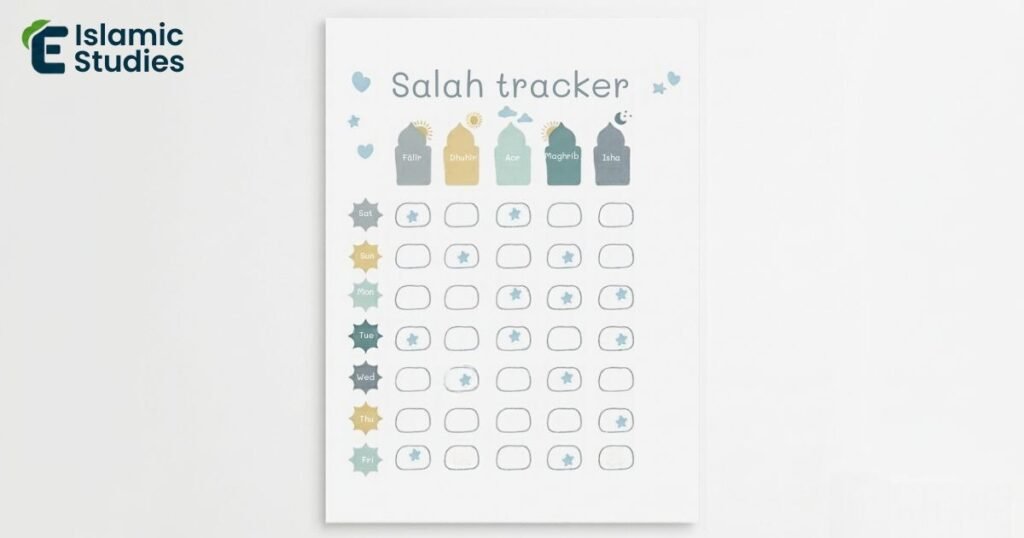
A wall chart is one of the simplest answers to how to teach a child to pray in Islam at home. Laminate it and hang it in a dedicated prayer corner at your child’s eye level, next to a weekly tracker where each completed prayer earns a sticker.
Give a small reward when all five prayers are done in a day, and a bigger one when they are prayed on time. Give rewards right away, because young children quickly forget what they were working toward.
2. Make Your Child the Family’s Prayer Reminder
Give your child the job of announcing each prayer time or gathering the family for Maghrib. Being trusted with this role builds responsibility and makes prayer something they lead, not something they are chased for.
Give them a simple prayer-times app or a small alarm clock and let them check the next prayer each day. When they call out “Dhuhr time, everyone!”, thank them in front of the family so the role feels important and worth keeping.
3. Plan Fun Activities Around Prayer Times
Schedule outings and playtime right after a prayer, for example: “We will go to the park after we pray Asr together.” Keep it a natural order rather than a condition, so your child learns that salah always comes first.
You can also tie weekly highlights to prayer, such as a family breakfast after Fajr on weekends or a short story after Isha before bed. Over time, your child links salah with the happiest moments of the day instead of seeing it as an interruption.
Enroll Your Child in Islamic Classes That Make Salah a Lifelong Habit
At E Islamic Studies Academy, qualified teachers guide children through wudu, salah, and the short surahs in live, one-to-one online sessions. Every lesson is paced to your child’s age and level.
Our tutors use stories, visuals, and gentle encouragement, so your child connects prayer with love for Allah rather than pressure. If you are still working out how to teach a child to pray in Islam, home practice plus expert guidance is the most reliable way to build the habit.
Our Islamic Essentials Courses
- Essential Islam Courses
- Online Tafseer Course
- Islamic History Course
- Tazkiyah Course
- Islam Classes for Sisters
- Islam Classes for Kids
- Learn Islam for Beginners
Our teachers are graduates of reputable Islamic universities and hold traditional ijazat. The kids’ curriculum goes beyond salah to cover Aqeedah, the Fiqh of purification and prayer, Adab, and Seerah, and parents receive regular assessments and progress reports along the way.
Not sure where to start? Book a free trial class today, or browse all our Islamic courses for kids and adults.
Deepen Your Islamic Knowledge
Join our comprehensive online courses and learn from qualified scholars today.
Book Your Free TrialConclusion
Learning how to teach a child to pray in Islam is not about one perfect lesson. It is a steady journey that begins with your own example, grows through patient teaching at seven, and develops into personal responsibility by ten.
The practical tools matter as well: correct wudu, clear steps of salah, rak’ah counts, and a printable chart on the wall. Rewards, praise, and shared prayer times keep motivation going far longer than pressure ever will.
Expect setbacks along the way. Missed prayers, sleepy Fajrs, and rushed rak’ahs are normal, so respond with a calm reminder rather than frustration. Every prayer your child learns from you remains a lasting reward for you, in sha Allah.
The key message is simple: make salah beloved before you make it required. Be gentle, be consistent, and let your child see prayer as the most beautiful part of your family’s day.
FAQs
Here are quick answers to the questions parents ask most often about how to teach a child to pray in Islam.
At what age should a child start praying in Islam?
Formal instruction begins at seven, based on the hadith in Abu Dawud. You can introduce prayer much earlier through imitation, so that by seven your child already knows the movements.
Can a child pray without wudu while learning?
Young children who are only practicing the movements may imitate prayer informally. Still, teach wudu early so your child understands that purification is a condition for a valid prayer.
How do I get my child to pray Fajr?
Set an early bedtime so they get enough sleep, wake them gently, and pray together. Aim for consistency before perfection, and praise every Fajr they attend.
Is it permissible to hit a child for not praying?
The hadith allows only light, non-harmful discipline from age ten. It must never be on the face, and only if it would benefit the child. Scholars emphasize using every gentle method first.
What surahs should a child memorize first for salah?
Start with Al-Fatihah, since no prayer is complete without it. Then add short surahs like Al-Ikhlas, Al-Falaq, and An-Nas.
Related Articles
Learning Islam







Leave a Reply