What Is Kafir in Islam? Definition and Complete Guide
Few Islamic terms carry as much theological weight as kafir. Misapplying it is one of the most serious errors in Islamic creed. This guide covers the complete kafir definition, all seven types, major versus minor kufr, the distinction from shirk, and the scholarly controls on applying this term to individuals.
Kafir in Islam Has a Linguistic Root and a Legal Definition
Linguistically, kafir comes from kafara — to cover and conceal. Arabs called farmers kuffar because they cover seeds with soil. The Quran uses this in Surah Al-Hadid: “like rain whose plant growth pleases the farmers.” Night is also called kafir because it covers things in darkness.
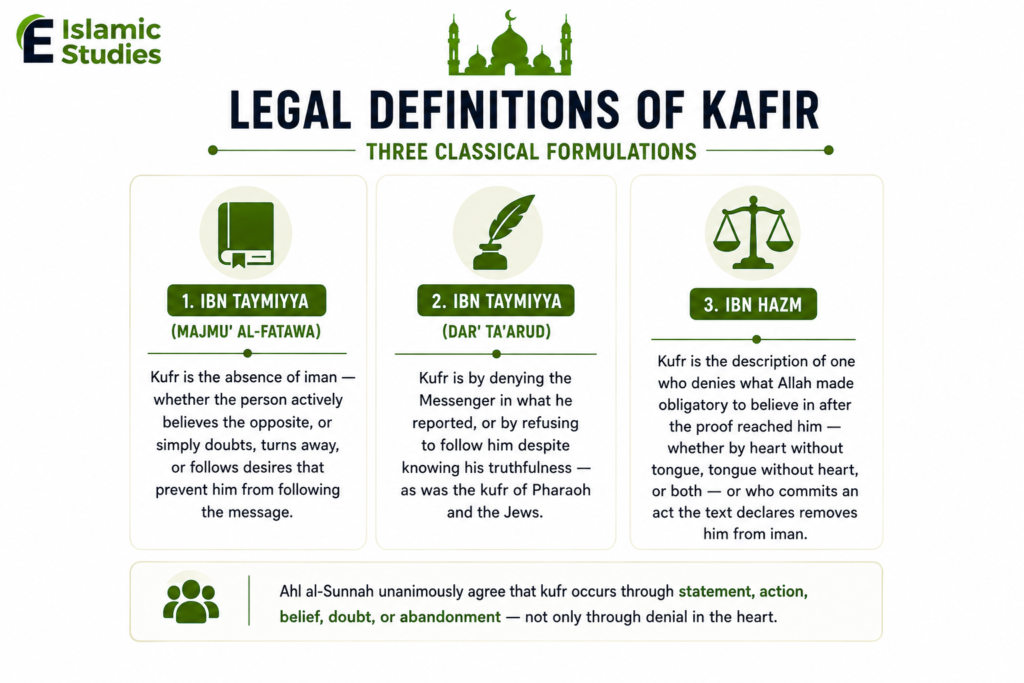
Legally, the kafir definition has three formulations from classical scholars:
Ibn Taymiyya in Majmu’ al-Fatawa: “Kufr is the absence of iman — whether the person actively believes the opposite, or simply doubts, turns away, or follows desires that prevent him from following the message.”
Ibn Taymiyya in Dar’ Ta’arud: “Kufr is by denying the Messenger in what he reported, or by refusing to follow him despite knowing his truthfulness — as was the kufr of Pharaoh and the Jews.”
Ibn Hazm: “Kufr is the description of one who denies what Allah made obligatory to believe in after the proof reached him — whether by heart without tongue, tongue without heart, or both — or who commits an act the text declares removes him from iman.”
Ahl al-Sunnah unanimously agree that kufr occurs through statement, action, belief, doubt, or abandonment — not only through denial in the heart.
At E Islamic Studies Academy, the Essential Islamic Courses teach the foundational knowledge of Aqeedah including iman, kufr, and their relationship.
Kufr Has Seven Foundational Roots That All Disbelief Branches From
Kufr of Shirk
Worshipping other than Allah alongside Him — invoking the dead, sacrificing for other than Allah, or loving something with the love due to Allah alone. Allah says: “Allah does not forgive that partners be associated with Him.”
Kufr of Juhud and ‘Inad
Rejecting Islam while knowing it is true — as Pharaoh did. The Quran says: “They denied them while their souls were certain of them, out of injustice and arrogance.”
Kufr of Takdhib
Rejecting Islam without knowing its truth — as the people of Nuh did. This differs from the previous type because the denial is not accompanied by inner certainty.
Kufr of Iba’ and Istikbar
Refusing Islam out of arrogance — not necessarily denying its truth. Iblis knew the command but refused out of pride: “He refused and was arrogant and became of the disbelievers.”
Kufr of Shakk
Doubting and wavering over the truth of Islam without reaching conviction — as the man of two gardens who said: “I do not think the Hour will occur.”
Kufr of I’rad
Turning away from Islam — refusing to learn it or act upon it. Allah says: “Whoever turns away from My remembrance — he will have a depressed life and We will gather him on the Day of Resurrection blind.”
Kufr of Nifaq
Concealing disbelief internally while outwardly displaying Islam. Allah says: “Indeed, the hypocrites will be in the lowest depths of the Fire.” This is the most dangerous type because it is invisible to human judgment.
At E Islamic Studies Academy, the Online Tafseer Course connects students to the Quranic verses behind these categories with full scholarly context.
Major and Minor Kufr Are Completely Different in Their Effect
The kafir Islamic term does not apply to every sin called kufr in the texts. The distinction is essential:
Aspect
Major Kufr
Minor Kufr
Effect on Islam
Removes from Islam entirely
Does not remove from Islam
Forgiveness
Unforgivable if died upon it
Subject to Allah’s will
Eternal fate
Permanent Fire
No permanent Fire
Established by
The seven foundational roots
External text restricts the meaning
Example
Denying the prophethood of Muhammad
Fighting a fellow Muslim
The clearest proof: the hadith says “fighting a Muslim is kufr” — but the Quran calls the fighting parties believers: “If two groups of believers fight each other, make peace between them.” Ibn Kathir confirmed Allah affirmed their iman despite their fighting. So this kufr is minor — restrained by the Quranic text.
Similarly, shirk divides into two categories:
Aspect
Major Shirk
Minor Shirk
Effect
Removes from Islam
Does not remove from Islam
Examples
Idol worship, invoking the dead
Swearing by other than Allah, riya’, tatayyur
Status
Worst of all sins
Worse than major sins, but not exit from Islam
The Prophet said: “Whoever swears by other than Allah has committed shirk.” He said: “Riya’ is the hidden shirk — the most feared thing I fear for my community.” He said: “Al-tatayyur is shirk.” All of these are named shirk without constituting the major shirk that removes from Islam.
Take a look at a sample lesson and see how our interactive online classes help students learn Islamic Studies in a clear, engaging, and supportive environment.
Deepen Your Islamic Knowledge
Join our comprehensive online courses and learn from qualified scholars today.
Kufr Can Be Expressed Through Words, Actions, and Beliefs
Ibn Taymiyya in Majmu’ al-Fatawa: “Whoever utters a word of kufr intentionally, knowing it is a word of kufr, without need — he has disbelieved outwardly and inwardly. It is not permissible to say he may inwardly be a believer.”
He also said: “Insulting Allah or insulting His Messenger is kufr — outwardly and inwardly — whether the person considers it forbidden or not, whether he is serious or joking. This is the position of the jurists and all Ahl al-Sunnah.”
Ibn al-Qayyim said: “Just as a person disbelieves by uttering a word of kufr willingly, he also disbelieves by committing a branch of kufr — like prostrating to an idol or disrespecting the Quran. This is a foundational principle.”
Ishaaq ibn Rahawayh said: “The scholars agreed on declaring kafir one who kills a prophet or assists in killing him — even if he verbally affirms the prophethood — if he says killing prophets is forbidden. Similarly, one who insults a prophet or rejects his words without coercion.”
Al-Barbahari said: “We do not declare any person of the qibla to have left Islam until he rejects a verse of the Book of Allah, rejects something from the Messenger, sacrifices for other than Allah, or prays to other than Allah.”
Shirk and Kufr Overlap but Are Not Identical
Imam Al-Nawawi in his commentary on Sahih Muslim: “Shirk and kufr are sometimes used interchangeably and sometimes distinguished. When distinguished — shirk is specific to those who worship created things alongside their acknowledgment of Allah, as the pagans of Quraysh did. Kufr is the broader term.”
This means all mushrikeen are kuffar, but not all kuffar are mushrikeen in the technical sense. People of the Book fall under kufr through rejecting the Prophet — even though shirk applies differently to them. Both are described in the Quran as eternally in the Fire:
The Kafir Definition Applies Generally Before It Applies to Individuals
This is one of the most critical scholarly controls in Islamic theology. Ibn Taymiyya stated: “Takfir has conditions and barriers that may be absent in the case of a specific individual. The general ruling on a category does not necessitate ruling on a specific named person — unless the conditions are met and the barriers are removed.”
He added: “Whoever’s Islam is confirmed with certainty, that certainty does not depart through doubt. It only departs after the proof is established and the doubt is removed.”
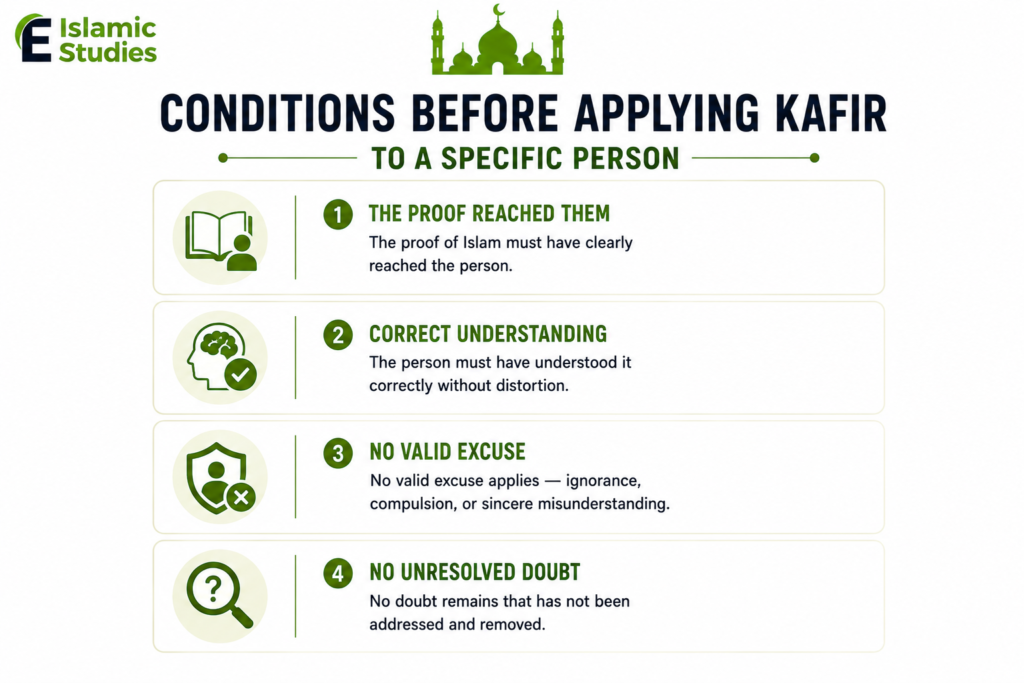
Conditions required before applying kafir to a specific person:
The proof of Islam must have clearly reached the person.
The person must have understood it correctly without distortion.
No valid excuse applies — ignorance, compulsion, or sincere misunderstanding.
No doubt remains that has not been addressed and removed.
Abu Hamid Al-Ghazali in Faysal al-Tafriqa equated those who never received the message of Islam at all with those who received only a distorted and repelling version — both are excused. Whoever reached only a corrupted image of Islam is like one ignorant of its true reality.
Six Barriers Historically Prevented Disbelievers from Following Islam
The Al-Aluka sources identify six reasons — each with a Quranic text:
Blind Following of Forefathers
“They said: Rather, we will follow what we found our fathers doing — even if their fathers understood nothing and were not guided.”
Following Desires
Allah warned Dawud: “Do not follow your desires — it will lead you astray from the path of Allah.”
Arrogance
Iblis was commanded and refused out of pride. This is the barrier that produces Kufr of Iba’ and Istikbar.
Fear of Losing Worldly Interests
The Prophet warned: “Two hungry wolves among sheep are no more destructive than a person’s greed for wealth and status is to his religion.” This was why Heraclius, king of Rome, returned to kufr after having believed.
Envy
Many Jews knew the truth of Islam but rejected it out of envy that the Arabs received the final Prophet. Allah says: “Many of the People of the Scripture wish they could turn you back to disbelief — out of envy from themselves after the truth became clear to them.”
Ignorance
Not knowing the true nature of Islam. Allah commands protection for the polytheist who seeks to hear the speech of Allah: “That is because they are a people who do not know.”
At E Islamic Studies Academy, the Tazkiyya Course addresses the internal diseases — arrogance, envy, following desires — identified as the very roots of kufr and barriers to faith.
E Islamic Studies Academy Brings You Authentic Islamic Knowledge
Thousands of Muslims want to understand Islamic creed — including the kafir definition — at the level of real classical scholarship. E Islamic Studies Academy provides one-on-one live sessions with qualified scholars trained in classical Islamic sciences including Aqeedah, Fiqh, Sarf, Nahw, and Tafseer.
Programs run from complete beginner foundations through traditional Alim-level scholarship. Dedicated courses exist for women, new converts, children, adult learners, and sisters seeking female-led instruction. All global time zones are covered and a free trial class is available before any commitment.
The kafir definition is one of the most precisely governed concepts in Islamic theology. Understanding its linguistic roots, seven foundational types, major and minor division, distinction from shirk, and the scholarly controls on individual application protects Muslims from both ignorance and the dangerous misuse of takfir.
Frequently Asked Questions
What is kafir in Islam?
Kafir in Islam is one who disbelieves in Allah or rejects what the Prophet Muhammad brought — through denial in the heart, statement by the tongue, or action of the body.
What is the kafir definition according to classical scholars?
The kafir definition according to Ibn Taymiyya is the absence of iman in Allah and His Messenger — whether through active denial, arrogance, doubt, turning away, or concealing disbelief while outwardly displaying Islam.
What is the kafir Islamic term and how is it applied to individuals?
The kafir Islamic term applies first to categories of statement, action, and belief. Applying it to a specific individual requires that the proof reached them clearly, they understood it correctly, and no valid excuse applies to their case.
What is the difference between major and minor kufr?
Major kufr removes from Islam and is unforgivable if died upon. Minor kufr is a sin named kufr in a text but does not remove from Islam — restrained by a separate Sharia evidence.
What is the difference between kafir and mushrik?
Kufr is broader. All mushrikeen are kuffar but not all kuffar are mushrikeen technically. Shirk refers specifically to associating partners with Allah. Kufr encompasses shirk and other forms of rejection.
 Learning Islam











Leave a Reply