 Learning Islam
Many Muslims and new Muslims come across the Arabic word “nafs” while reading the Quran and want to know exactly what it means. Nafs in Islam refers to the human self the inner reality that combines the soul, the ego, and the source of a person’s desires, thoughts, and moral choices.
This article explains the meaning of nafs, how it relates to ruh (the spirit), the different states the nafs can take according to the Quran, and why understanding the nafs matters for a Muslim’s spiritual growth.
By the end, you will have a clear, accurate picture of nafs meaning in Islam, supported by verified verses of the Quran, an authentic Hadith, and explanations from recognised scholars.
What You Will Learn
• The literal and Islamic meaning of nafs, and how it relates to ruh (soul/spirit)
• The three states of the nafs described in the Quran: ammarah, lawwamah, and mutma’innah
• Authentic Quranic verses and a Hadith describing the nafs and its purification
• Practical, scholar-recommended ways to discipline and purify the nafs
• Why tazkiyat al-nafs (self-purification) is central to a Muslim’s spiritual life
What Is Nafs in Islam?
Nafs (نَفْس) is an Arabic word that linguistically means “self,” “soul,” or the essential reality of a thing. In Islamic terminology, nafs refers to the inner human self that combines the body and the spirit, and that is held accountable before Allah for its intentions, choices, and deeds.
The word nafs, in its various forms, appears in the Quran close to 298 times, carrying several related meanings depending on the context of each verse. This wide usage is one reason new students of Islamic studies often find the term nafs confusing at first.
Classical Arabic lexicons, such as Ibn Faris’s Maqayis al-Lughah, trace the root n-f-s to the release of breath. From it come related words such as nafas (breath) and tanaffus (breathing), since human life is sustained by breathing which is one reason the self came to be called nafs.
Is Nafs the Same as Ruh (Soul) in Islam?
Scholars have long discussed whether nafs and ruh describe the same reality or two different things. Ibn al-Qayyim explained that when the self is connected to the body it is usually called nafs, and when considered apart from the body it is often called ruh so the two terms largely describe the same reality seen from different angles.
Other scholars, including commentators on al-Tahawiyyah, noted that nafs and ruh sometimes overlap in meaning and sometimes differ depending on context.
What is agreed upon is that the ruh is what gives the body life, while the nafs is the self that is addressed, tested, and held accountable in this life and the next.
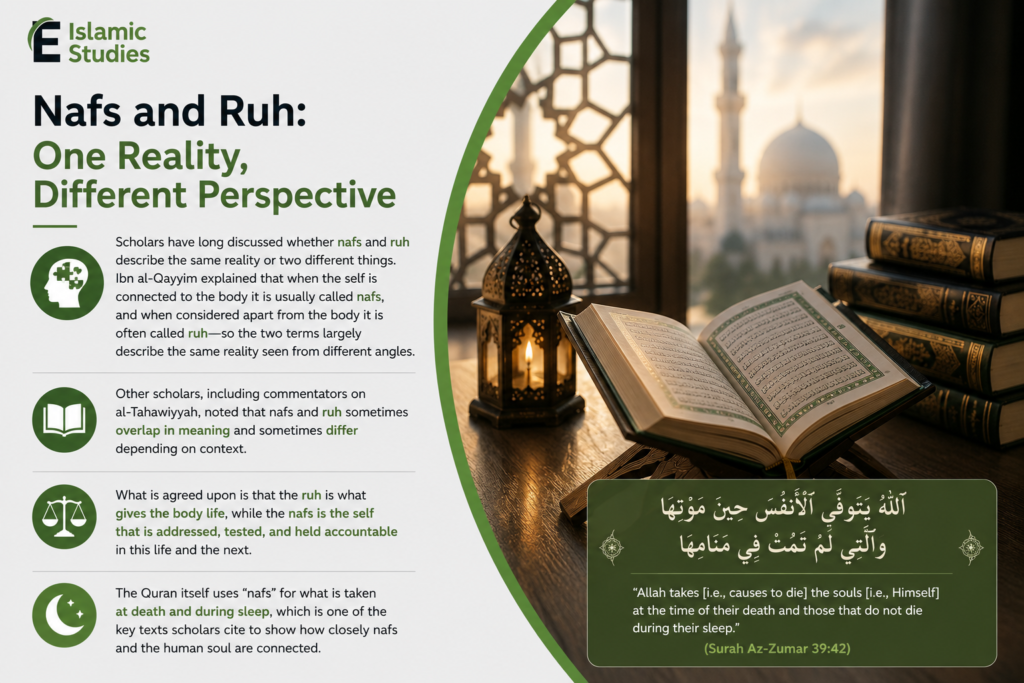
The Quran itself uses “nafs” for what is taken at death and during sleep, which is one of the key texts scholars cite to show how closely nafs and the human soul are connected.
اللَّهُ يَتَوَفَّى الأَنفُسَ حِينَ مَوْتِهَا وَالَّتِي لَمْ تَمُتْ فِي مَنَامِهَا
“It is Allah who takes the souls at the time of their death, and those that do not die [He takes] during their sleep.”
See Our Islamic Studies Classes in Action
Take a look at a sample lesson and see how our interactive online classes help students learn Islamic Studies in a clear, engaging, and supportive environment.
Deepen Your Islamic Knowledge
Join our comprehensive online courses and learn from qualified scholars today.
Book Your Free TrialThe Three States (Maratib) of the Nafs in the Quran
Scholars such as Ibn Uthaymeen explained that the Quran describes three states of the human nafs not three separate souls living inside one body, but three conditions the very same self can move through, depending on how it responds to guidance, temptation, and the pull of worldly desire.
A person is not permanently locked into one state; the same nafs that inclines toward sin in one moment may reproach itself the next, and may later settle into calm obedience after sustained effort and worship.
Understanding these three states is one of the most practical parts of learning about the nafs, because it gives a Muslim a vocabulary for their own inner experience.
Read also: Ijtihad in Islam — how scholars reach these explanations
1. Nafs al-Ammarah bis-Su’ (The Soul That Commands Evil)
Nafs al-ammarah bis-su’ is the state of the self when it inclines strongly toward desires, sin, and heedlessness, pushing a person toward wrongdoing unless it is restrained by faith and self-discipline.
This does not mean a person in this state is beyond hope; rather, it describes the default pull of the untrained self toward whatever feels immediately pleasurable or easy, regardless of whether it pleases Allah.
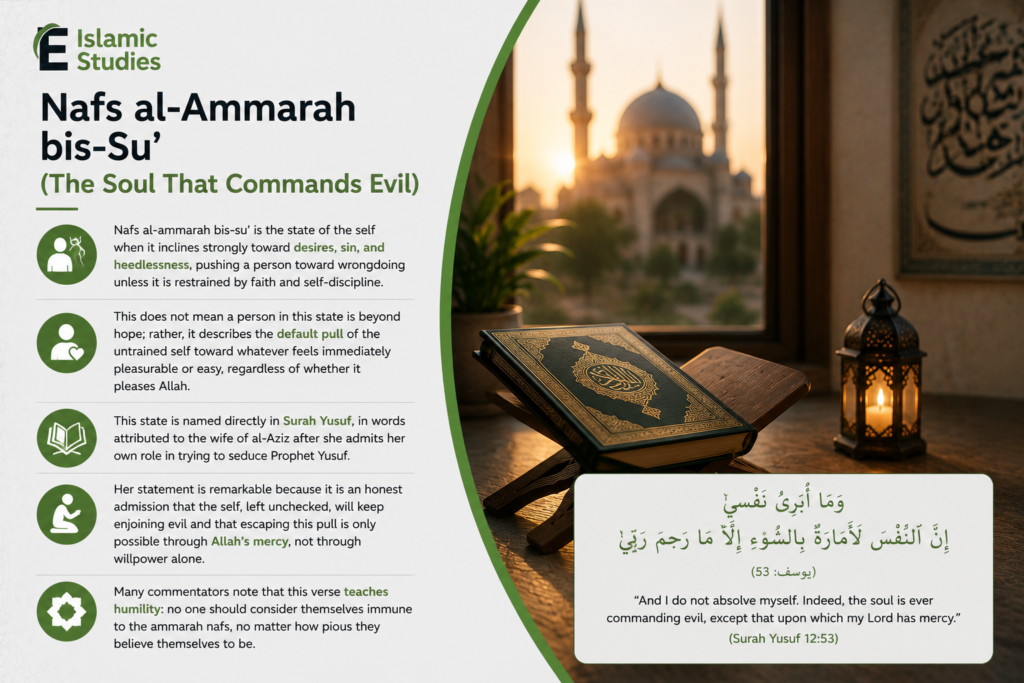
This state is named directly in Surah Yusuf, in words attributed to the wife of al-Aziz after she admits her own role in trying to seduce Prophet Yusuf.
Her statement is remarkable because it is an honest admission that the self, left unchecked, will keep enjoining evil and that escaping this pull is only possible through Allah’s mercy, not through willpower alone.
Many commentators note that this verse teaches humility: no one should consider themselves immune to the ammarah nafs, no matter how pious they believe themselves to be.
وَمَا أُبَرِّئُ نَفْسِي إِنَّ النَّفْسَ لَأَمَّارَةٌ بِالسُّوءِ إِلَّا مَا رَحِمَ رَبِّي إِنَّ رَبِّي غَفُورٌ رَحِيمٌ
“And I do not acquit myself. Indeed, the soul is a persistent enjoiner of evil, except those upon whom my Lord has mercy. Indeed, my Lord is Forgiving and Merciful.”
2. Nafs al-Lawwamah (The Self-Reproaching Soul)
Nafs al-lawwamah is the state in which the self blames and reproaches itself after wrongdoing, or feels regret for falling short in obedience to Allah, constantly questioning and correcting its own behaviour.
Some scholars describe it as a kind of built-in conscience: even when a person slips into sin, this state of the nafs will not let them rest comfortably in it, but keeps nudging them back toward repentance and self-improvement.
There is a scholarly discussion about whether nafs al-lawwamah is a distinct third category, separate from ammarah and mutma’innah, or whether it is really a description of how either of those two states behaves at certain moments the righteous nafs blaming itself for a shortcoming, or the sinful nafs blaming itself for the restrictions it feels obedience places on it.
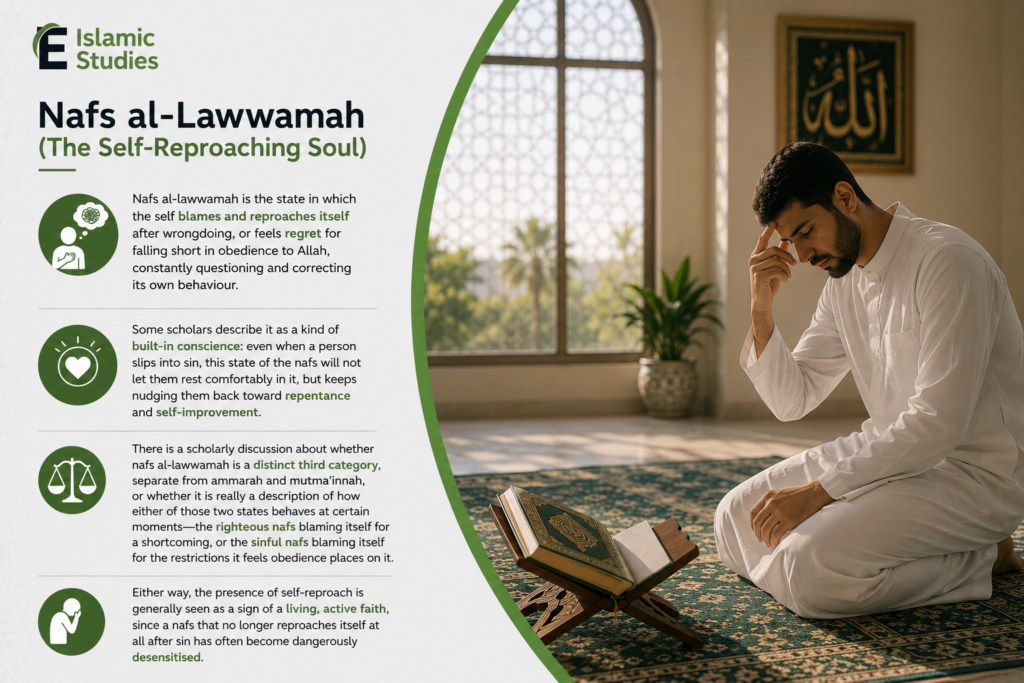
Either way, the presence of self-reproach is generally seen as a sign of a living, active faith, since a nafs that no longer reproaches itself at all after sin has often become dangerously desensitised.
لَا أُقْسِمُ بِيَوْمِ الْقِيَامَةِ وَلَا أُقْسِمُ بِالنَّفْسِ اللَّوَّامَةِ
“I swear by the Day of Resurrection, and I swear by the reproaching soul [that this Book is true].”
3. Nafs al-Mutma’innah (The Soul at Peace)
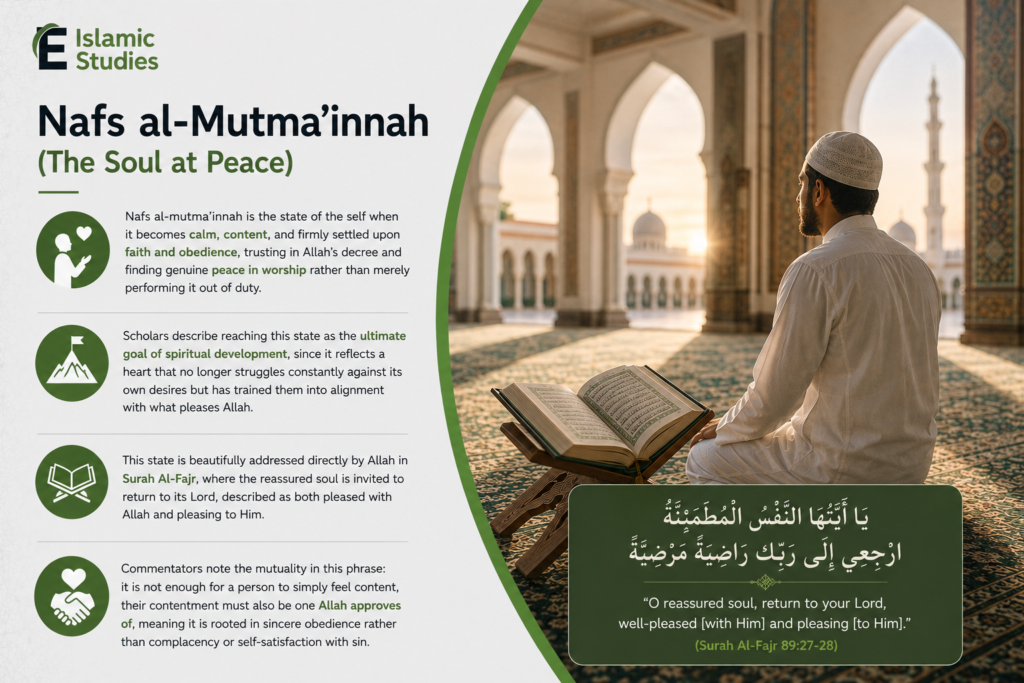
Nafs al-mutma’innah is the state of the self when it becomes calm, content, and firmly settled upon faith and obedience, trusting in Allah’s decree and finding genuine peace in worship rather than merely performing it out of duty.
Scholars describe reaching this state as the ultimate goal of spiritual development, since it reflects a heart that no longer struggles constantly against its own desires but has trained them into alignment with what pleases Allah.
This state is beautifully addressed directly by Allah in Surah Al-Fajr, where the reassured soul is invited to return to its Lord, described as both pleased with Allah and pleasing to Him.
Commentators note the mutuality in this phrase: it is not enough for a person to simply feel content, their contentment must also be one Allah approves of, meaning it is rooted in sincere obedience rather than complacency or self-satisfaction with sin.
يَا أَيَتُّهَا النَّفْسُ الْمُطْمَئِنَّةُ ارْجِعِي إِلَى رَبِّكِ رَاضِيَةُّ مَّرْضِيَّةً فَادْخُلِي فِي عِبَادِي وَادْخُلِي جَنَّتِي
“O reassured soul, return to your Lord, well-pleased and pleasing [to Him]. And enter among My [righteous] servants, and enter My Paradise.”
Ibn al-Qayyim noted that these three descriptions do not refer to three completely separate souls living side by side.
Rather, the very same nafs may act as ammarah at one moment and lawwamah or mutma’innah at another, sometimes within the same day; a person is ultimately judged by whichever state is most dominant and habitual for them over time, not by isolated moments of weakness or strength.
Physical acts of worship also play a real role in shaping which state the nafs settles into over time.
Small, repeated acts such as maintaining wudu before prayer are not just rituals; scholars describe them as quiet training for the nafs, building the habit of returning to a state of purity and attentiveness before standing in worship.
Read Also: What Is Amanah in Islam? Meaning, Types, and Importance of Trust
The Nafs and the Concept of Jihad al-Nafs
Because the ammarah nafs constantly pulls a person toward sin, Islam places great emphasis on striving against one’s own desires known as jihad al-nafs.
Many scholars describe this inner struggle as the foundation for every other form of striving in Islam, since a person who cannot govern their own desires will struggle to be consistent in anything else they are asked to do, whether in worship, work, or their treatment of others.
It is worth being precise about what this term means, because “jihad” is often misunderstood outside of its proper Islamic context.
Jihad al-nafs refers specifically to the internal, lifelong effort of resisting harmful desires and heedlessness it has nothing to do with aggression toward others, and classical scholars in fact place it above outward struggle in terms of difficulty and constancy, since it must be renewed every single day for the rest of a person’s life.
Ibn al-Qayyim explained that the most obligatory struggle is against one’s own nafs, then against desire, then against Satan, then against worldly distraction and that whoever strives against these four for Allah’s sake will be guided to the paths that lead to His pleasure.
He described the relationship between the ammarah and mutma’innah states almost like an ongoing internal war, where whatever is easy for one side is difficult for the other, and where consistent patience is what ultimately tips the balance toward the soul that is at peace.
Read also: Is Islam a violent religion? Clearing up a common misconception

Read Also: What Is Akhirah in Islam? Meaning, Stages, and Life After Death
Why Understanding the Nafs Matters for a Muslim’s Spiritual Life
Recognising which state one’s nafs leans toward is the starting point of what scholars call tazkiyat al-nafs, or purification of the self. Without this awareness, a person can drift through harmful habits of thought and behaviour without ever addressing their root cause.
Learning about the nafs in more depth, alongside related topics such as tazkiyah, aqidah, and akhlaq, is often easier with structured guidance from qualified teachers.
Programs such as those offered by E Islamic Studies Academy are designed to help students study these topics gradually, in proper context from the Quran and Sunnah.

Read Also: What Is Rizq in Islam? Meaning, Types, and How Provision Works
How to Purify the Nafs (Tazkiyat al-Nafs)
Scholars have outlined several practical means that help a Muslim gradually move their nafs from the ammarah state toward the mutma’innah state. These practices strengthen a person’s connection to Allah and build the discipline needed to resist harmful desires.
• Maintaining the five daily prayers consistently, along with voluntary prayers.
• Reciting and reflecting on the Quran regularly.
• Engaging often in dhikr (remembrance of Allah).
• Practicing muhasabah (self-accountability) for one’s actions and shortcomings.
• Keeping the company of righteous, sincere people
• Making frequent dua, asking Allah to protect one from the evil of one’s own nafs.
Structured courses such as an Online Tafseer Course or a dedicated Tazkiyah Course can help a student apply these steps consistently, with a teacher able to answer questions along the way.
See Our Islamic Studies Classes in Action:
Take a look at a sample lesson and see how our interactive online classes help students learn Islamic Studies in a clear, engaging, and supportive environment
Deepen Your Islamic Knowledge
Join our comprehensive online courses and learn from qualified scholars today.
Book Your Free TrialStart Your Islamic Learning Journey with E Islamic Studies Academy
Understanding the nafs is one step on a much longer path of Islamic learning. E Islamic Studies Academy offers structured, engaging online Islamic Studies classes with qualified teachers for adults, sisters, kids, and new Muslims alike, so you can build this knowledge with proper guidance rather than piecing it together alone.
Explore More Islamic Courses at E Islamic Studies Academy
If you would like to continue building your understanding of the nafs and related topics such as tazkiyah, aqidah, and akhlaq, the following programs at E Islamic Studies Academy can help you go further with a qualified teacher.
Our Islamic Essentials Courses
• Quran Tafseer Classes for Beginners — Introductory Interpretation
• Online Tafseer Classes in English
• Self-Paced Tafseer Course — Flexible Learning Programs
• Aqidah Course — Islamic Creed and Theology Classes
• Online Seerah Course — Life of Prophet Muhammad Classes
• Akhlaq Course — Islamic Ethics and Character Development

Conclusion
Nafs in Islam is the human self the inner reality that combines body and spirit and that is held accountable before Allah for its intentions and deeds. The Quran describes this self in three recurring states: ammarah (inclined to evil), lawwamah (self-reproaching), and mutma’innah (at peace).
A Muslim’s spiritual goal is to move the nafs, through consistent worship, remembrance, self-accountability, and good companionship, from the ammarah state toward the mutma’innah state described in Surah Al-Fajr. This ongoing effort is what scholars call tazkiyat al-nafs.
Frequently Asked Questions About Nafs in Islam
What does nafs mean in Islam?
Nafs means the human self the inner reality combining body and spirit that is held accountable for its intentions and actions. It is one of the most frequently used Quranic terms for describing the human being.
Is nafs the same as ruh (soul) in Islam?
They largely overlap. Scholars such as Ibn al-Qayyim explain that nafs usually describes the self while connected to the body, while ruh often describes it when considered apart from the body, though usage varies by context.
What are the three types of nafs mentioned in the Quran?
The Quran describes three states of the same self: nafs al-ammarah (inclined to evil, Surah Yusuf 12:53), nafs al-lawwamah (self-reproaching, Surah Al-Qiyamah 75:2), and nafs al-mutma’innah (at peace, Surah Al-Fajr 89:27).
What is nafs al-mutma’innah?
Nafs al-mutma’innah is the state of the self when it becomes calm and firmly settled upon faith, trusting Allah’s decree. The Quran addresses this soul directly in Surah Al-Fajr, inviting it to return to its Lord well-pleased.
How can a Muslim purify their nafs?
Common means include maintaining the five daily prayers, reciting and reflecting on the Quran, frequent dhikr, honest self-accountability (muhasabah), keeping righteous company, and making dua for protection from one’s own nafs.
Why is jihad al-nafs important in Islam?
Jihad al-nafs, striving against one’s own desires, is described by scholars as the foundation of all other forms of striving in Islam, since overcoming the ammarah nafs is what allows a person to obey Allah consistently.
Related Articles
Learning Islam








Leave a Reply