 Learning Islam
Have you ever read Surah Al-Qari’ah with your child and been asked, “What will happen on that Day?” It is one of the first questions Quran students ask, and it deserves a clear, authentic answer.
The Day of Judgement in Islam is the end of this worldly life and the start of eternal life, with reckoning and reward. Every soul will stand before Allah and receive what it earned.
In this guide, you will learn what the Quran and Sunnah teach about the Day of Judgement in Islam: its names, its signs, and the order of its events, from the Trumpet to Paradise or Hell.
Take Away: What You Will Learn
- The meaning of the Day of Judgement in Islam and its main names in the Quran.
- The minor and major signs that come before the Hour.
- What happens on the Day of Judgement in Islam, step by step.
- Why even righteous believers fear that Day and how to prepare for it.
- How you and your children can study this belief with qualified teachers.
Day of Judgement in Islam
Belief in the Day of Judgement in Islam is a core part of the creed. It shapes how a Muslim prays, treats people, and spends every hour. It is also one of the six core pillars of Iman.
What Is the Day of Judgement in Islam?
The Day of Judgement in Islam is the Day Allah raises all creation from their graves to stand before Him, barefoot and uncovered. Each person is then judged for every deed, small or great. Allah describes its terror:
يَـٰٓأَيُّهَا ٱلنَّاسُ ٱتَّقُوا۟ رَبَّكُمْ ۚ إِنَّ زَلْزَلَةَ ٱلسَّاعَةِ شَىْءٌ عَظِيمٌ
“O mankind, fear your Lord. Indeed, the convulsion of the Hour is a terrible thing” (Al-Hajj 22:1).
Names of the Last Day in the Quran
The Quran gives the Day of Judgement in Islam many names, each highlighting a different side of it:
- Al-Yawm Al-Akhir (The Last Day).
- As-Sa’ah (The Hour).
- Yawm Ad-Deen (The Day of Recompense)
- Yawm Al-Hisab (The Day of Reckoning).
- Al-Qari’ah (The Striking Calamity)
- Al-Haqqah (The Inevitable Reality)
- Yawm Al-Fasl (The Day of Decision).
Why Belief in the Day of Judgement in Islam Matters
It is one of the six pillars of faith, as the Prophet ﷺ taught in the Hadith of Jibreel. A person’s faith is not complete without it. This belief gives life purpose and justice. No wrong is forgotten, and no good deed is lost, even if it weighs an atom.
If you want your family to build this creed on solid ground, our Essential Islamic Courses explain the pillars of faith step by step for kids and adults.
Live Class in Action
Watch how our instructors interact with students in real time, focusing on interactive methods.
Deepen Your Islamic Knowledge
Join our comprehensive online courses and learn from qualified scholars today.
Book Your Free TrialSigns of the Day of Judgement in Islam
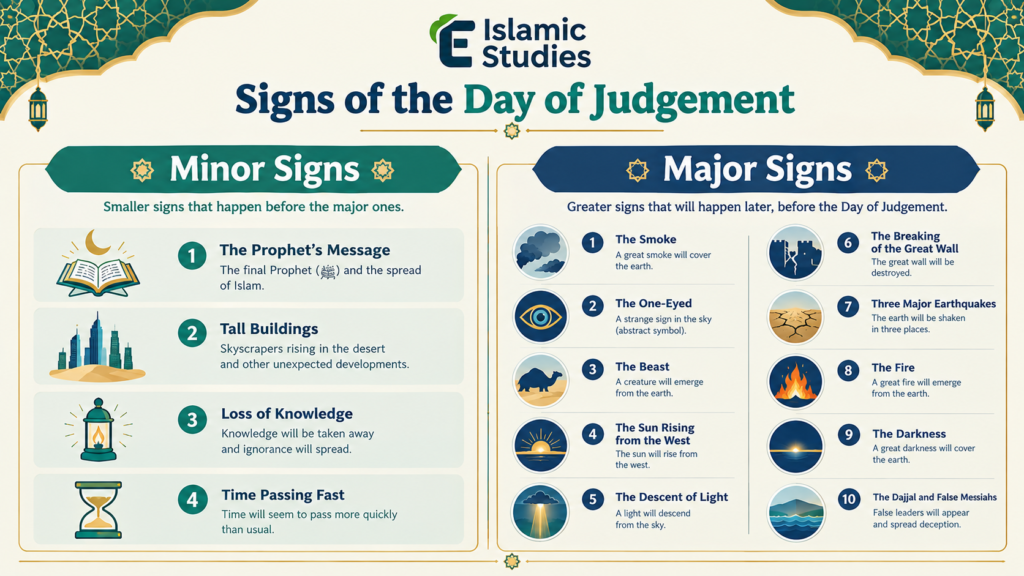
Only Allah knows when the Day of Judgement in Islam will come. Still, the Prophet ﷺ described signs of its approach, and scholars divide the signs of the Day of Judgement in Islam into minor and major.
Minor Signs of the Day of Judgement
The minor signs of the Day of Judgement appear long before the end, and many have already happened. They include:
- The Prophet Muhammad ﷺ himself, the final messenger, was sent.
- Barefoot, poor shepherds competing in constructing tall buildings.
- The spread of ignorance, open sins, and the loss of religious knowledge.
- Time passing quickly and killing becoming widespread.
These signs are a reminder, not a cause for panic. They push the believer to repent before time runs out.
Major Signs of Judgement Day in Islam
The major signs of Judgement Day in Islam are great events that come close to the end and follow one another quickly. In Sahih Muslim, the Prophet ﷺ listed ten:
- The smoke, the Dajjal (False Messiah), and the Beast.
- The sun rising from the west and the descent of Isa (Jesus), peace be upon him.
- Gog and Magog (Ya’juj and Ma’juj) and three great landslides: in the east, the west, and Arabia.
- A fire from Yemen that drives people to their place of gathering.
Day of Resurrection in Islam
The Day of Resurrection in Islam is the opening scene of the Day of Judgement in Islam. It begins when the world as we know it ends.
The Blowing of the Trumpet
The angel Israfil blows the Trumpet (As-Soor). The first blast brings terror and death to all except whom Allah wills. Then Allah says:
وَنُفِخَ فِى ٱلصُّورِ فَصَعِقَ مَن فِى ٱلسَّمَـٰوَٰتِ وَمَن فِى ٱلْأَرْضِ إِلَّا مَن شَآءَ ٱللَّهُ ۖ ثُمَّ نُفِخَ فِيهِ أُخْرَىٰ فَإِذَا هُمْ قِيَامٌ يَنظُرُونَ
“Then it will be blown again, and at once they will be standing, looking on” (Az-Zumar 39:68).
This verse mentions both blasts. The Prophet ﷺ said the gap between them is “forty,” and Abu Hurairah declined to say whether he meant days, months, or years. During that time, Allah sends down rain, and human bodies grow from the tailbone like plants, ready to rise (Sahih al-Bukhari 4935).
Gathering on the Plain of Judgement
People leave their graves and are gathered (Al-Hashr) on a white, flat land with no landmarks. The Prophet ﷺ said they will be gathered barefoot, naked, and uncircumcised. When Aisha asked whether men and women would look at one another, he said the matter would be too severe for that.
Experience Our Classrooms
Don’t just take our word for it—take a look inside! Watch the videos below to experience our engaging teaching methods and vibrant online classrooms firsthand.
Deepen Your Islamic Knowledge
Join our comprehensive online courses and learn from qualified scholars today.
Book Your Free TrialWhat Happens on the Day of Judgement in Islam?
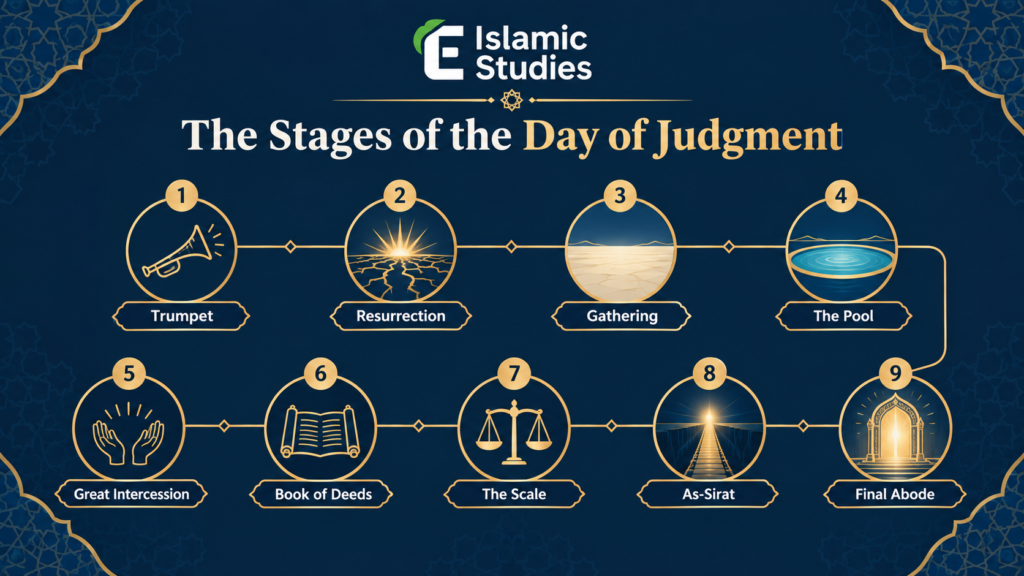
After the resurrection, people pass through stages. Based on the Quran, authentic hadith, and scholars, the order of the Day of Judgement in Islam is generally as follows (scholars differ slightly on the timing of the Pool):
1. The Long Standing and the Prophet’s Pool
People stand for a Day equal to fifty thousand years, in fear and thirst. Many scholars mention that the Prophet’s Pool (Al-Hawd) is raised during this stage, and whoever follows his Sunnah drinks from it and never thirsts again.
2. The Great Intercession
People go to Adam, Nuh, Ibrahim, Musa, and Isa, asking them to intercede, but each says, “Myself, myself.” Then they come to Prophet Muhammad ﷺ, who says, “I am for it,” and Allah accepts his intercession to begin the judgment.
3. The Presentation and the Reckoning
Once the Prophet’s ﷺ intercession is accepted, the most decisive part of the Day of Judgement in Islam begins. All creation stands in rows before its Lord (Al-Kahf 18:48), and each person faces their deeds with no wealth, no helper, and no excuse to hide behind. Every servant is presented before Allah:
يَوْمَئِذٍ تُعْرَضُونَ لَا تَخْفَىٰ مِنكُمْ خَافِيَةٌ
“That Day, you will be presented; not hidden among you is anything concealed” (Al-Haqqah 69:18).
For many believers, this presentation is the “easy reckoning” mentioned in Surah Al-Inshiqaq 84:8. The Prophet ﷺ told Aisha that anyone whose account is examined in detail will be ruined. This is why believers pray for a light reckoning and for Allah to cover their sins (Sahih al-Bukhari 6537).
4. Receiving the Book of Deeds
The record of deeds flies to each person. The fortunate receive it in their right hand, while the losers receive it in their left hand or behind their backs.
5. The Scale (Al-Mizan)
Deeds are weighed with perfect justice. Good character and the remembrance of Allah are among the heaviest things on the Scale.
6. The Light and the Bridge (As-Sirat)
Believers receive light, while hypocrites remain in darkness and are separated by a wall (Al-Hadid 57:13). The Sirat is a bridge laid over Hell, and people cross it according to their deeds: some like lightning, some crawling, and some falling.
7. The Bridge of Retribution and the Final Abode
Believers who cross are stopped at Al-Qantarah to settle wrongs between them. Once purified, they enter Paradise, the final stage, while the disbelievers abide in Hell.
Day of Judgement in Islam: Does Passing One Stage Mean Entering Paradise?
No. Passing one stage does not lead straight to Paradise; every person moves on to the next stage until they reach their final abode. Only some, like the seventy thousand who enter Paradise without reckoning, are spared certain stages, yet they still cross the Sirat.
This is why even believers given good news in the grave still fear the Day of Judgement in Islam. No servant is fully safe until he enters Paradise by Allah’s mercy.
Learning these details with a qualified teacher turns fear into hope and action. Our teachers in the Islamic Programs connect each stage to verses your child already memorizes.
How to Prepare for the Day of Judgement in Islam
Preparing for the Day of Judgement in Islam starts with sincere faith. Then come the five prayers, good character, and returning people’s rights before it is too late.
Many scholars also advise a short daily self-review, following the famous words of Umar ibn Al-Khattab: “Hold yourselves to account before you are held to account.” Ending each day with sincere repentance keeps your record light.
Reading and understanding the Quran is one of the best preparations. Our guide on how to learn Quran Tafseer shows how the meanings of Juz’ Amma describe the Last Day in vivid detail.
Start Your Journey in Islamic Creed With Expert Teachers Today
Give yourself and your children a clear, authentic understanding of the Day of Judgement in Islam. Our certified teachers explain the Quran and Sunnah in simple English, with patience and care.
Lessons are one-to-one and fit your schedule. Kids learn this belief through stories, verses, and short activities, while adults study the evidence in depth.
Our Islamic Essentials Courses
- Essential Islam Courses
- Online Tafseer Course
- Islamic History Course
- Tazkiyah Course
- Online Qirat Course
- Quran Tafseer Classes for Beginners — Introductory Interpretation
- Online Tafseer Classes in English
- Self-Paced Tafseer Course — Flexible Learning Programs
- Aqidah Course — Islamic Creed and Theology Classes
- Online Seerah Course — Life of Prophet Muhammad Classes
- Akhlaq Course — Islamic Ethics and Character Development
Every lesson is built on the Quran, the authentic Sunnah, and trusted scholarship, so you learn not only what to believe but also why. Whether you are a beginner or refreshing your knowledge, you move at your own pace.
Start with Learning Islam Level 1 and build a strong foundation in faith, worship, and character. Book your free trial class today and take the first step.
Deepen Your Islamic Knowledge
Join our comprehensive online courses and learn from qualified scholars today.
Book Your Free TrialConclusion
The Day of Judgement in Islam is a real, promised Day when all creation is raised, gathered, and judged with complete justice. The Quran calls it the Hour, the Day of Recompense, and the Day of Decision.
Many of its minor signs have appeared, and its major signs will come in quick succession. Then the Trumpet, gathering, intercession, reckoning, Scale, Sirat, and final abode follow in order.
Yet the Day is not only about fear. The Prophet’s ﷺ intercession, his Pool, and the light given to believers on the Sirat are all signs of Allah’s mercy toward those who prepared for it.
The takeaway is simple: the Day of Judgement in Islam is not a story to fear blindly, but a reality to prepare for. Every prayer, kind word, and verse learned today adds weight to your Scale tomorrow.
FAQs
Here are quick answers to the questions people ask most often about the Day of Judgement in Islam.
How long is the Day of Judgement in Islam?
The Quran describes a Day “whose measure is fifty thousand years” (Al-Ma’arij 70:4). Scholars mention that Allah makes it feel short for sincere believers.
What are the 10 major signs of the Day of Judgement?
They are the smoke, the Dajjal, the Beast, the sun rising from the west, the descent of Isa, Gog and Magog, three landslides, and a fire from Yemen, as narrated in Sahih Muslim.
Who will be the first to be judged on the Day of Judgement?
The first deed judged among the rights of Allah is prayer, and the first cases between people are those of bloodshed.
Will animals be judged on the Day of Judgement in Islam?
Yes. Animals are resurrected, and even a hornless sheep gets justice from a horned one. Then they become dust (An-Naba’ 78:40).
Can children learn about the Day of Judgement?
Yes. Children can learn about the Day of Judgement in Islam gently through short surahs like Az-Zalzalah and Al-Qari’ah, focusing on Allah’s justice, mercy, and Paradise.







[…] Remember that the angels around you are a mercy from Allah. Every good word and every prayer is recorded with honor, so make your record one you will be glad to read on the Day of Judgment. […]