 Learning Islam
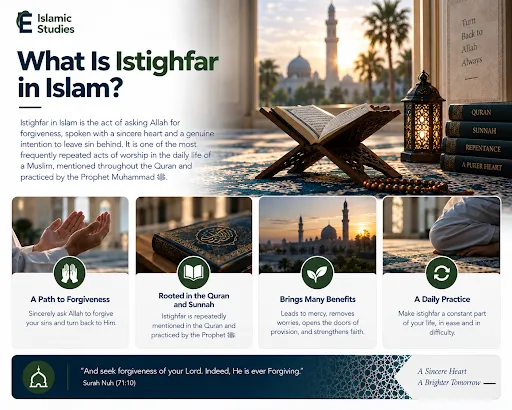
Istighfar in Islam is the act of asking Allah for forgiveness, spoken with a sincere heart and a genuine intention to leave sin behind.
It is one of the most frequently repeated acts of worship in the daily life of a Muslim, mentioned throughout the Quran and practiced constantly by the Prophet Muhammad ﷺ himself.
Whether you are a new Muslim or simply want a clearer understanding of this essential act of worship, this guide brings together reliable sources so you can learn istighfar correctly and apply it with confidence.
You can also explore structured Islamic studies programs that walk you through worship, Quran, and Hadith step by step.
Take Away — What You Will Learn
- The exact linguistic and Islamic meaning of istighfar.
- The full wording of Sayyidul Istighfar, the master supplication for forgiveness.
- What the Quran says about seeking Allah’s forgiveness.
- Authentic Hadith describing how often the Prophet ﷺ practiced istighfar.
- The core benefits of istighfar in a Muslim’s spiritual and daily life.
What Is Istighfar in Islam?
Istighfar is the act of seeking Allah’s forgiveness for sins, mistakes, and shortcomings. It expresses a believer’s recognition that they are in constant need of Allah’s mercy and pardon, regardless of how righteous they may strive to be.
Istighfar is therefore more than simply repeating a phrase with the tongue. At its deepest level, it reflects humility before Allah, acknowledgment of one’s faults, hope in His mercy, and a sincere desire to return to obedience.
Through istighfar, a believer asks Allah to forgive their wrongdoing, conceal their faults, protect them from the consequences of sin, and accept their return to Him.
The Islamic (Shar’i) Meaning of Istighfar
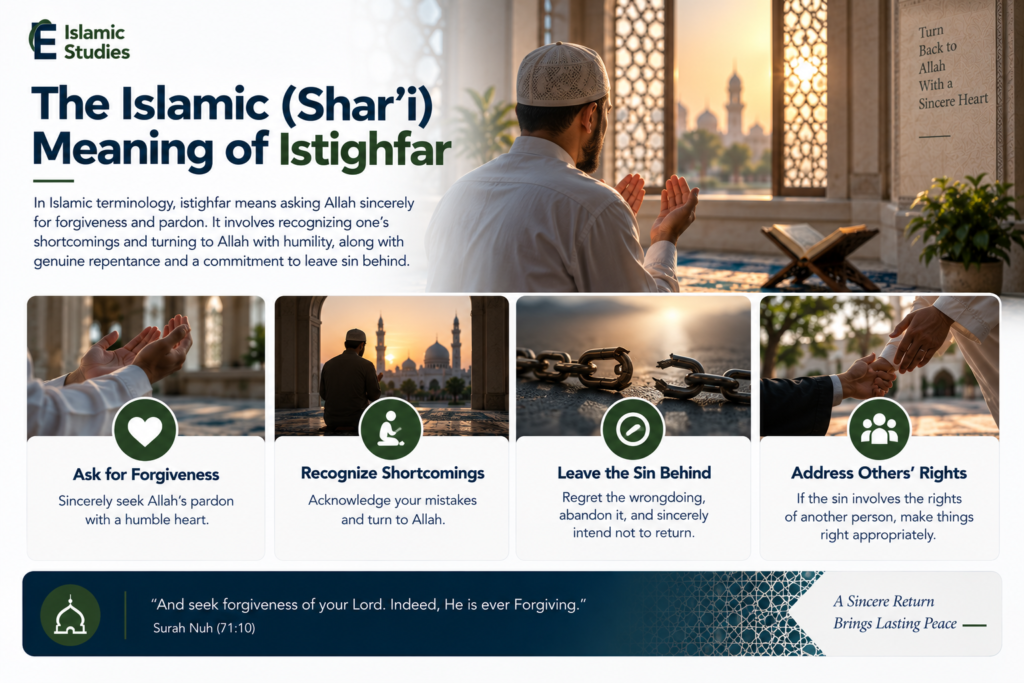
In Islamic terminology, istighfar means asking Allah sincerely for forgiveness and pardon. It involves recognizing one’s shortcomings and turning to Allah with humility rather than becoming comfortable with persistent disobedience.
When istighfar accompanies repentance from a specific sin, it should not remain only a verbal statement. Genuine repentance involves regretting the wrongdoing, abandoning it, and sincerely intending not to return to it.
If the sin involves the rights of another person, those rights must also be addressed appropriately.
Common Phrases Used for Istighfar
There is no requirement to use only one wording whenever a Muslim seeks forgiveness. The Quran and Sunnah contain several forms of istighfar, ranging from very short phrases that can be repeated throughout the day to longer and more comprehensive supplications.
This variety makes istighfar easier to incorporate into everyday life. A Muslim can seek forgiveness after prayer, during morning and evening remembrance, after recognizing a mistake, or simply as part of regular dhikr and self-reflection.
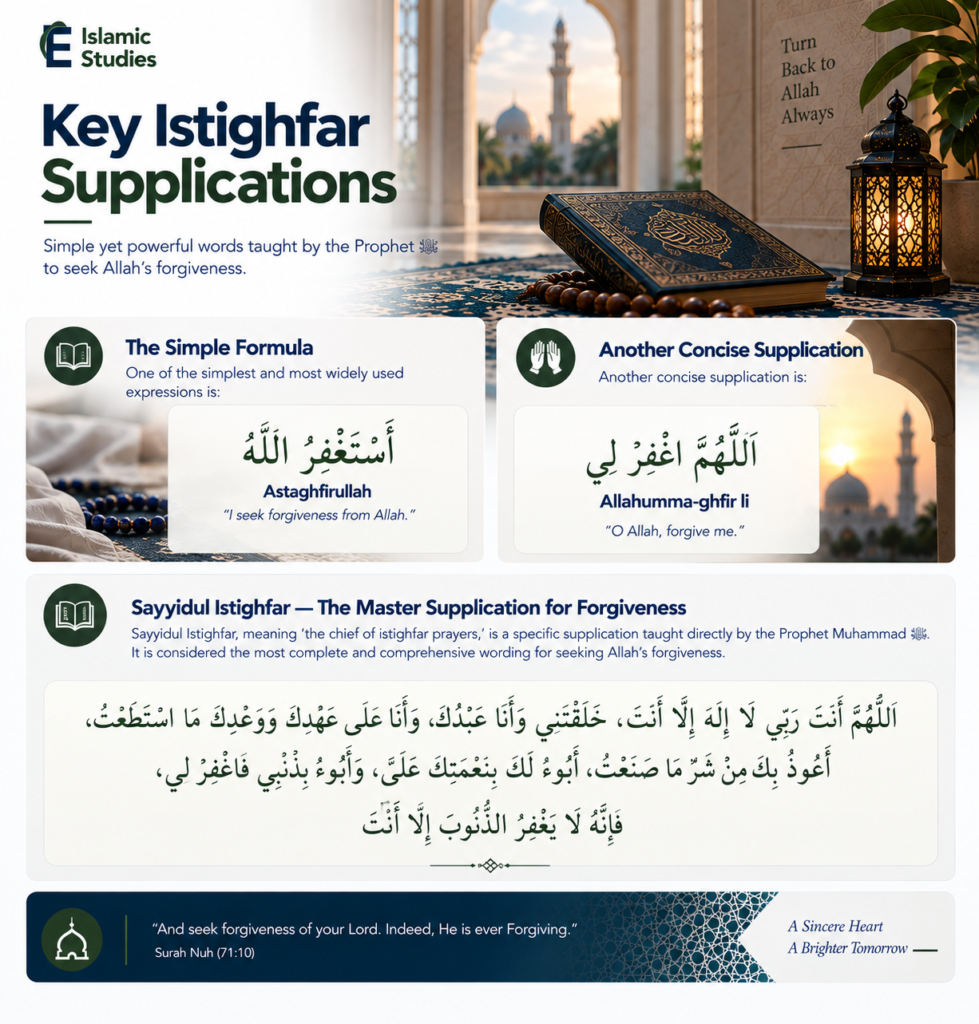
The Simple Formula
One of the simplest and most widely used expressions is:
أَسْتَغْفِرُ اللَّهَ
Astaghfirullah
“I seek forgiveness from Allah.”
Another concise supplication is:
اللَّهُمَّ اغْفِرْ لِي
Allahumma-ghfir li
“O Allah, forgive me.”
Sayyidul Istighfar — The Master Supplication for Forgiveness
Sayyidul Istighfar, meaning ‘the chief of istighfar prayers,’ is a specific supplication taught directly by the Prophet Muhammad ﷺ. It is considered the most complete and comprehensive wording for seeking Allah’s forgiveness.
اللَّهُمَّ أَنْتَ رَبِّي لَا إِلَهَ إِلَّا أَنْتَ، خَلَقْتَنِي وَأَنَا عَبْدُكَ، وَأَنَا عَلَى عَهْدِكَ وَوَعْدِكَ مَا اسْتَطَعْتُ، أَعُوذُ بِكَ مِنْ شَرِّ مَا صَنَعْتُ، أَبُوءُ لَكَ بِنِعْمَتِكَ عَلَيَّ، وَأَبُوءُ بِذَنْبِي فَاغْفِرْ لِي، فَإِنَّهُ لَا يَغْفِرُ الذُّنُوبَ إِلَّا أَنْتَ
“O Allah, You are my Lord, there is no god but You. You created me and I am Your servant, and I am faithful to my covenant and my promise as much as I am able. I seek refuge in You from the evil of what I have done. I acknowledge Your favor upon me, and I acknowledge my sin, so forgive me, for none forgives sins except You.”
Sisters who prefer a dedicated learning space can also join Islamic classes for sisters, which cover topics like istighfar, daily duas, and core Islamic knowledge in a comfortable environment.
| Practice What You Learn in a Supportive ClassJoin workshops built around real worship, duas, and everyday practice, alongside other students learning at your pace.➤ Explore Our Workshops |
See Our Islamic Studies Classes in Action
Take a look at a sample lesson and see how our interactive online classes help students learn Islamic Studies in a clear, engaging, and supportive environment.
Deepen Your Islamic Knowledge
Join our comprehensive online courses and learn from qualified scholars today.
Book Your Free TrialWhat Does the Quran Say About Istighfar?
The Quran presents istighfar as an essential practice in a believer’s relationship with Allah. Seeking forgiveness is repeatedly encouraged not only after committing sins, but as a regular expression of humility and dependence upon Allah’s mercy.
Quranic verses also connect sincere istighfar with forgiveness, mercy, relief, provision, and protection from punishment, showing that its benefits extend to both a person’s spiritual life and their worldly affairs.
وَاسْتَغْفِرُوا اللَّهَ إِنَّ اللَّهَ غَفُورٌ رَحِيمٌ
“And seek forgiveness of Allah. Indeed, Allah is Forgiving and Merciful.”
وَالَّذِينَ إِذَا فَعَلُوا فَاحِشَةً أَوْ ظَلَمُوا أَنْفُسَهُمْ ذَكَرُوا اللَّهَ فَاسْتَغْفَرُوا لِذُنُوبِهِمْ
“And those who, when they commit an immorality or wrong themselves, remember Allah and seek forgiveness for their sins.”
إِنَّ اللَّهَ لَا يَغْفِرُ أَنْ يُشْرَكَ بِهِ وَيَغْفِرُ مَا دُونَ ذَٰلِكَ لِمَنْ يَشَاءُ
“Indeed, Allah does not forgive association with Him, but He forgives what is less than that for whom He wills.”
| Learn the Quran and Its Meanings with Qualified TeachersUnderstand verses like these in their full context through guided, one-on-one Quran study.➤ Book Your Free Trial |

What Does the Sunnah Say About the Prophet’s Own Istighfar?
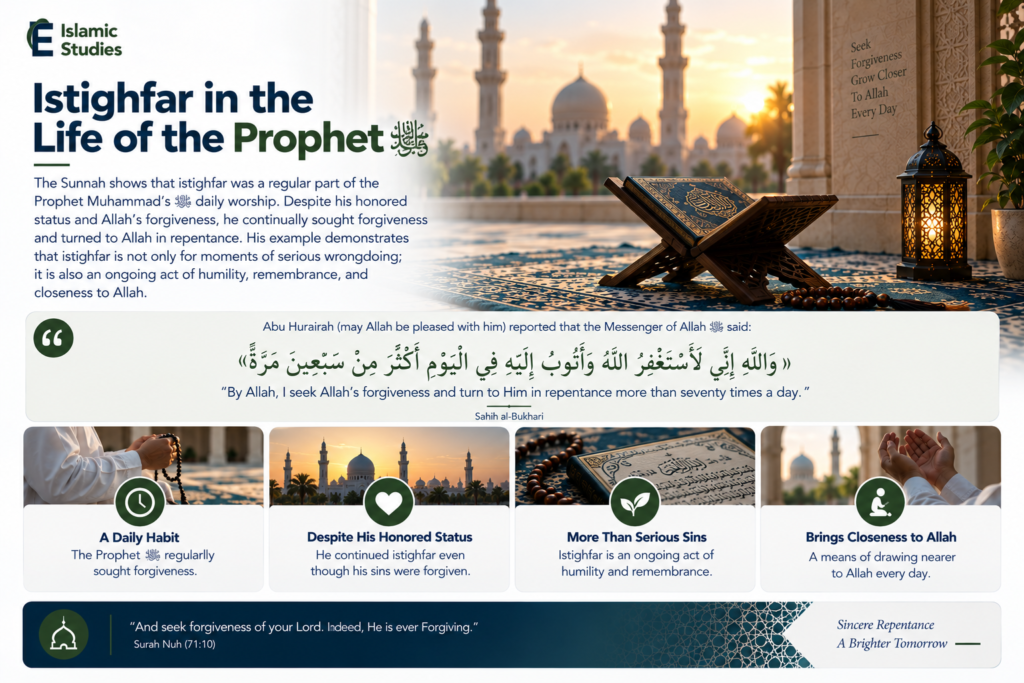
The Sunnah shows that istighfar was a regular part of the Prophet Muhammad’s ﷺ daily worship. Despite his honored status and Allah’s forgiveness, he continually sought forgiveness and turned to Allah in repentance.
His example demonstrates that istighfar is not only for moments of serious wrongdoing; it is also an ongoing act of humility, remembrance, and closeness to Allah.
Abu Hurairah (may Allah be pleased with him) reported that the Messenger of Allah ﷺ said:
عَنْ أَبِي هُرَيْرَةَ رضي الله عنه قَالَ: سَمِعْتُ رَسُولَ اللَّهِ ﷺ يَقُولُ:
«وَاللَّهِ إِنِّي لَأَسْتَغْفِرُ اللَّهَ وَأَتُوبُ إِلَيْهِ فِي الْيَوْمِ أَكْثَرَ مِنْ سَبْعِينَ مَرَّةً».
“By Allah, I seek the forgiveness of Allah and turn to Him in repentance more than seventy times a day.”
Benefits of Istighfar in Islam
The Quran and Sunnah describe several spiritual and worldly benefits associated with sincere istighfar. Seeking Allah’s forgiveness is connected with His mercy, the removal of sins, relief from hardship, and forms of provision and increase.
These benefits show that istighfar is not only a response to past mistakes, but also an important practice through which a believer continually turns back to Allah, strengthens their relationship with Him, and seeks His goodness in both this life and the Hereafter.
1. A Means of Forgiveness and Mercy
Istighfar is the most direct path to Allah’s forgiveness. Allah loves for His servant to return to Him after sin rather than persist in it or despair of His mercy.
فَقُلْتُ اسْتَغْفِرُوا رَبَّكُمْ إِنَّهُ كَانَ غَفَّارًا
“So I said, ‘Seek forgiveness from your Lord. Indeed, He is ever a Perpetual Forgiver.'”
2. A Means of Provision and Blessing
The Quran connects istighfar with rain, wealth, children, and abundance for those who combine it with faith and righteous action.
يُرْسِلِ السَّمَاءَ عَلَيْكُمْ مِدْرَارًا وَيُمْدِدْكُمْ بِأَمْوَالٍ وَبَنِينَ وَيَجْعَلْ لَكُمْ جَنَّاتٍ وَيَجْعَلْ لَكُمْ أَنْهَارًا
“He will send [rain from] the sky upon you in [continuing] showers and give you increase in wealth and children and provide for you gardens and provide for you rivers.”

3. A Means of Protection from Punishment
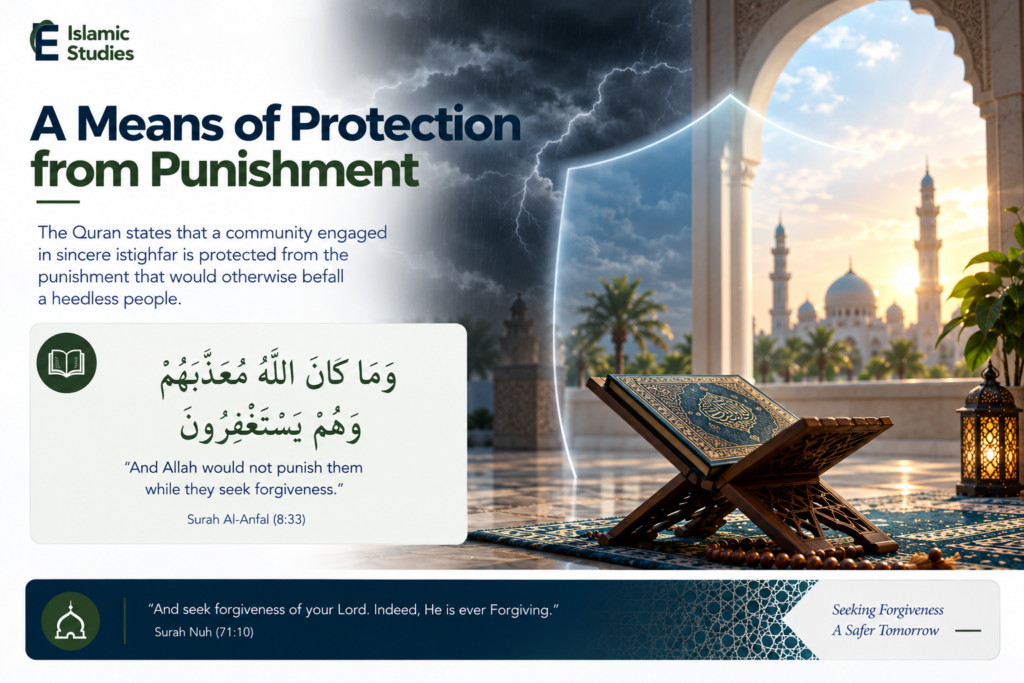
The Quran states that a community engaged in sincere istighfar is protected from the punishment that would otherwise befall a heedless people.
وَمَا كَانَ اللَّهُ مُعَذِّبَهُمْ وَهُمْ يَسْتَغْفِرُونَ
“And Allah would not punish them while they seek forgiveness.”
Read Also: What Is Shukr in Islam?
When and How Often Should a Muslim Say Istighfar?
There is no single fixed number required for istighfar, but authentic Hadith show the Prophet ﷺ repeating it often, including after the five daily prayers and throughout the day and night.
Following his example, many Muslims say ‘Astaghfirullah’ three times after each obligatory prayer, and repeat Sayyidul Istighfar or similar supplications at other times of the day.
New Muslims and those still becoming familiar with daily worship often benefit from guided practice. E-Islamic Studies Academy offers dedicated classes for new converts that cover essential duas, including istighfar, in a clear and supportive setting.

Common Misunderstandings About Istighfar
Istighfar is sometimes confused with tawbah (repentance). Istighfar is the act of asking for forgiveness, while tawbah is the fuller process of repentance, which includes regret, stopping the sin, and a firm resolve not to return to it.
Saying istighfar with the tongue while intentionally continuing a sin does not reflect its true meaning. Scholars explain that sincere istighfar should be accompanied, where possible, by genuine effort to change one’s behavior.
Watch a Sample Islamic Studies Class
See how our teachers explain Islamic concepts in an engaging and easy-to-understand way, helping students build knowledge and confidence.
Deepen Your Islamic Knowledge
Join our comprehensive online courses and learn from qualified scholars today.
Book Your Free TrialDeepen Your Islamic Knowledge with E-Islamic Studies Academy
Understanding istighfar is just one step in building a stronger connection with your faith. E-Islamic Studies Academy offers distance learning programs designed to help Muslims of all backgrounds learn Quran, Hadith, and daily worship with qualified teachers.
Our Islamic Programs
- Islamic Distance Learning Programs
- Islamic Courses Workshops
- Intensive Islamic Course
- Islam Crash Course
- Learning Islam Level 1 Online
- Darse Nizami / Traditional Alim Courses
Conclusion
Istighfar in Islam is the sincere act of seeking Allah’s forgiveness, rooted in the Quran and modeled constantly by the Prophet Muhammad ﷺ through supplications like Sayyidul Istighfar. It brings forgiveness, blessing, and protection to those who practice it with a present heart and true intention.
By learning its correct meaning, authentic wording, and the evidence behind it, a Muslim can make istighfar a consistent and meaningful part of daily worship rather than a routine phrase repeated without reflection.
Frequently Asked Questions About Istighfar
What is the meaning of istighxfar in Islam?
Istighfar means asking Allah for forgiveness and pardon for one’s sins, combined with sincere regret and the intention to leave disobedience behind. It comes from the Arabic root ghafr, meaning to cover or conceal.
What is Sayyidul Istighfar?
Sayyidul Istighfar is the ‘master’ supplication for seeking forgiveness, taught by the Prophet Muhammad ﷺ and recorded in Sahih al-Bukhari 6306. It is considered the most complete wording for istighfar.
How many times a day should a Muslim say istighfar?
There is no single obligatory number. The Prophet ﷺ himself is reported to have sought forgiveness more than seventy times a day (Sahih al-Bukhari 6307) and up to a hundred times in other narrations.
What is the difference between istighfar and tawbah?
Istighfar is the specific act of asking for forgiveness, while tawbah (repentance) is the broader process that includes regret, ceasing the sin, and a firm resolve not to return to it.
Can non-Arabic speakers say istighfar in their own language?
A Muslim can express regret and ask forgiveness from Allah in any language they understand. The specific Arabic wordings, such as Sayyidul Istighfar, carry the exact phrasing taught by the Prophet ﷺ and are recommended when a person is able to learn and recite them.
What are the benefits of istighfar according to the Quran?
The Quran links istighfar to forgiveness and mercy (Surah Nuh 71:10), increased provision and blessing (Surah Nuh 71:11-12), and protection from punishment (Surah Al-Anfal 8:33).








Leave a Reply