 Learning Islam
Why does a Muslim say “peace be upon him” after the names of Moses, Jesus, and Abraham, and not only after Muhammad? The answer lies in a core foundation of faith: belief in prophets in Islam.
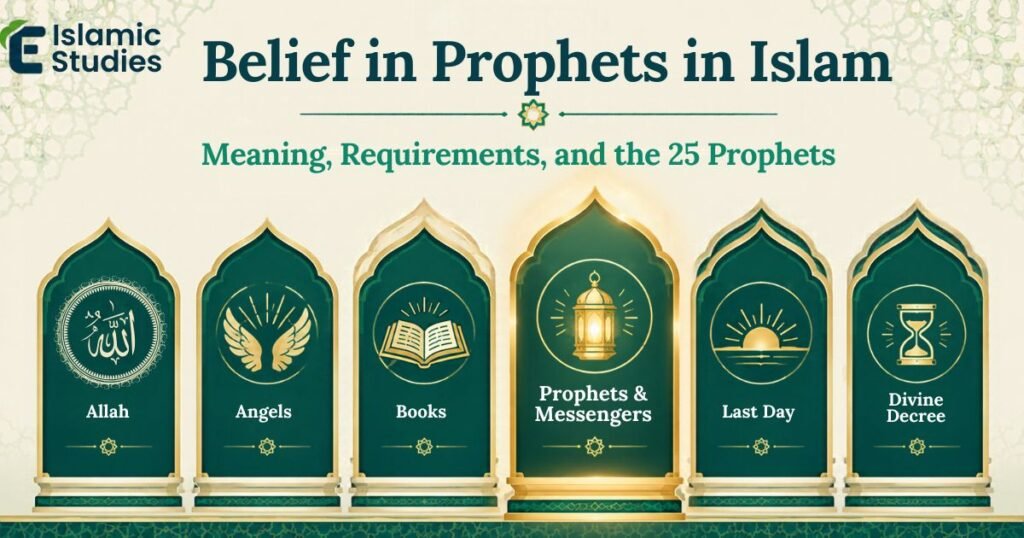
Belief in prophets in Islam is the fourth pillar of faith (iman). No Muslim’s faith is complete without firm belief in every prophet Allah sent, from Adam to Muhammad (peace be upon them all).
This guide explains what the belief means, how a prophet differs from a messenger, the 25 prophets named in the Quran, and how many prophets were sent. It uses evidence from the Quran and Sunnah and is written for adults and young learners.
What You Will Learn
- Why belief in prophets in Islam is the fourth pillar of faith and what it requires.
- The clear difference between a prophet (nabi) and a messenger (rasul).
- The names of all prophets in Islam mentioned in the Quran.
- Who the five “Ulul Azm” prophets are and why Muhammad ﷺ is the final prophet.
- What the hadith says about how many prophets were sent.
Belief in Prophets in Islam
Belief in prophets in Islam is the firm conviction that Allah chose certain men, gave them revelation, and sent them to guide people to worship Him alone. It is tied directly to the other five pillars of faith.
What Does Belief in Prophets in Islam Mean?
It means being certain that Allah sent a messenger to every nation, that all of them were truthful, and that they delivered the message completely. Allah says:
وَلَقَدْ بَعَثْنَا فِى كُلِّ أُمَّةٍ رَّسُولًا أَنِ ٱعْبُدُوا۟ ٱللَّهَ
“And We certainly sent into every nation a messenger, [saying], ‘Worship Allah and avoid false gods'” (An-Nahl16:36).
This verse shows that Allah left no nation without guidance, and every community received a messenger calling to the same truth. Each prophet’s message had two sides: worship Allah alone, and reject taghut, which means anything worshipped besides Him.
Why Is It a Pillar of Faith?
This hadith, the pillars of faith, is called the Hadith of Jibril because the Angel Jibril came in human form and asked the Prophet ﷺ about Islam, iman, and ihsan in front of his companions. Scholars call it the “Mother of the Sunnah” because it sums up the whole religion. In it, the Prophet ﷺ defined faith as believing:
” أَنْ تُؤْمِنَ بِاللَّهِ وَمَلاَئِكَتِهِ وَكُتُبِهِ وَرُسُلِهِ وَالْيَوْمِ الآخِرِ وَتُؤْمِنَ بِالْقَدَرِ خَيْرِهِ وَشَرِّهِ ”
“in Allah, His angels, His books, His messengers, the Last Day, and divine decree” (Sahih Muslim, 8).
Allah also links rejecting the messengers with going far astray ( An-Nisa 4:136). Scholars explain that “messengers” in this hadith includes the prophets too. So belief in prophets in Islam covers both groups, not messengers alone.
Live Class in Action
Watch how our instructors interact with students in real time, focusing on interactive methods.
Deepen Your Islamic Knowledge
Join our comprehensive online courses and learn from qualified scholars today.
Book Your Free TrialWhat Is the Difference Between a Prophet and a Messenger?
A messenger (rasul) received a new law from Allah and was commanded to convey it. A prophet (nabi) received revelation but followed and taught the law of an earlier messenger. Many prophets of the Children of Israel, for example, taught the Torah of Moses.
The scholarly rule is simple: every messenger is a prophet, but not every prophet is a messenger. Qadi Iyad noted that this is the view of the vast majority of scholars.
What Does Belief in Prophets in Islam Require?
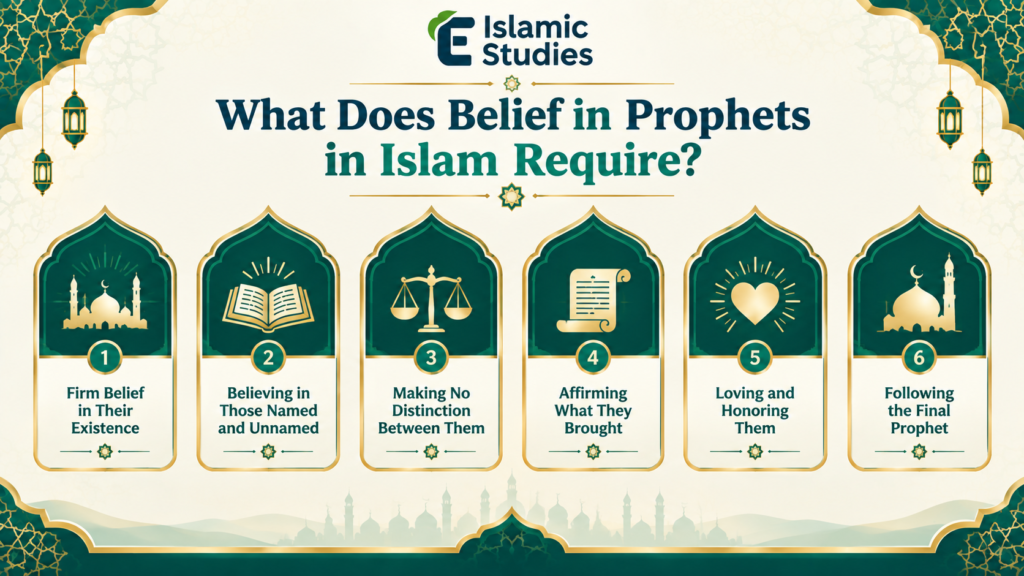
This belief is more than a statement. It carries six clear requirements.
- Firm Belief in Their Existence: A Muslim is certain that Allah truly chose human beings and sent them as guides.
- Believing in Those Named and Unnamed: We believe in detail in the 25 prophets named in the Quran. We believe in general in all the others whose names Allah did not tell us (Quran 40:78).
- Making No Distinction Between Them: Allah says: “We make no distinction between any of them” (Quran 2:136). Ibn Taymiyyah stated that disbelieving in one prophet is disbelief in all of them.
- Affirming What They Brought: We accept the revelation they conveyed and the miracles Allah gave them, such as the staff of Moses.
- Loving and Honoring Them: Muslims love all prophets, defend their honor, and never belittle them. Scholars agree that insulting a prophet takes a person outside Islam.
- Following the Final Prophet: Every nation followed its own prophet’s law. Today, belief in prophets in Islam requires following the Sharia of Prophet Muhammad ﷺ, who was sent to all of humanity.
These six points are the heart of sound creed. If you want to study them step by step with a qualified teacher, our Learning Islam Level 1 course covers the pillars of faith in a clear, structured way.
Prophets in Islam
The prophets in Islam were the best of humanity in character, patience, and devotion. Knowing their role shows why belief in prophets in Islam shapes a Muslim’s daily life.
Why Did Allah Send Prophets?
Allah sent prophets to deliver His message so people would have no excuse on the Day of Judgment:
رُّسُلًا مُّبَشِّرِينَ وَمُنذِرِينَ لِئَلَّا يَكُونَ لِلنَّاسِ عَلَى ٱللَّهِ حُجَّةٌۢ بَعْدَ ٱلرُّسُلِ ۚ
“Messengers as bringers of good tidings and warners so that mankind will have no argument against Allah after the messengers” (An-Nisa 4:165).
This wisdom is the foundation of belief in prophets in Islam. The prophets also showed people how to live the religion in practice.
Were the Prophets Human?
Yes. All prophets in Islam were human beings who ate, slept, and married. They were not angels or divine beings. Allah commands:
قُلْ إِنَّمَآ أَنَا۠ بَشَرٌ مِّثْلُكُمْ يُوحَىٰٓ إِلَىَّ أَنَّمَآ إِلَـٰهُكُمْ إِلَـٰهٌ وَٰحِدٌ ۖ
“Say, ‘I am only a man like you, to whom it has been revealed that your god is one God'” (Al-Kahf 18:110).
Yet they were protected (ma’sum) from error in conveying the message and from major sins. Balanced belief in prophets in Islam avoids both belittling them and exaggerating their status.
What Was the Core Message of All Prophets?
Every prophet was called to tawhid, worshipping Allah alone. Their creed was one, but their detailed laws differed. The Prophet ﷺ said:
وَالأَنْبِيَاءُ إِخْوَةٌ لِعَلاَّتٍ، أُمَّهَاتُهُمْ شَتَّى، وَدِينُهُمْ وَاحِدٌ
“The prophets are brothers from one father; their mothers are different, but their religion is one” (Sahih al-Bukhari, 3443).
The “one father” stands for tawhid, the creed every prophet shared, and the “different mothers” stand for their different laws. Allah says, “To each of you We prescribed a law and a method” (Al-Ma’idah 5:48), so the laws changed over time but the core faith never did.
Why Were Prophets Given Miracles?
Miracles proved that a prophet was truly sent by Allah. They often matched what his people excelled in: Moses faced magicians, and Muhammad ﷺ brought the Quran to a nation of master poets.
Experience Our Classrooms
Don’t just take our word for it—take a look inside! Watch the videos below to experience our engaging teaching methods and vibrant online classrooms firsthand.
Deepen Your Islamic Knowledge
Join our comprehensive online courses and learn from qualified scholars today.
Book Your Free TrialAll Prophets in Islam
When people search for all prophets in Islam, they usually want the names given in the Quran. Allah named 25, and 18 of them appear together in Surah Al-An’am (6:83–86). Detailed belief in prophets in Islam starts with these names.
The 25 Prophets Named in the Quran
The table below lists the 25 prophets named in the Quran in roughly chronological order, with each name in Arabic transliteration and its English equivalent.
| # | Arabic Name | English Name | # | Arabic Name | English Name |
| 1 | Adam | Adam | 14 | Musa | Moses |
| 2 | Idris | Enoch | 15 | Harun | Aaron |
| 3 | Nuh | Noah | 16 | Dhul-Kifl | Ezekiel (by some) |
| 4 | Hud | Hud | 17 | Dawud | David |
| 5 | Salih | Salih | 18 | Sulayman | Solomon |
| 6 | Ibrahim | Abraham | 19 | Ilyas | Elijah |
| 7 | Lut | Lot | 20 | Al-Yasa’ | Elisha |
| 8 | Isma’il | Ishmael | 21 | Yunus | Jonah |
| 9 | Ishaq | Isaac | 22 | Zakariyya | Zechariah |
| 10 | Ya’qub | Jacob | 23 | Yahya | John the Baptist |
| 11 | Yusuf | Joseph | 24 | Isa | Jesus |
| 12 | Ayyub | Job | 25 | Muhammad ﷺ | Muhammad |
| 13 | Shu’ayb | Jethro (by some) |
Do Muslims Believe in Prophets Not Named in the Quran?
Yes. Belief in prophets in Islam includes them in general, without names. Allah says:
وَرُسُلًا قَدْ قَصَصْنَـٰهُمْ عَلَيْكَ مِن قَبْلُ وَرُسُلًا لَّمْ نَقْصُصْهُمْ عَلَيْكَ ۚ
“And messengers about whom We have related to you before and messengers about whom We have not related to you” (An-Nisa 4:164).
Children love these stories, and teaching belief in prophets in Islam early builds lasting faith. Many families begin with our Essential Islamic Courses, designed for kids and adults.
Prophets of Islam: Ranks and Status
All prophets of Islam are honored, yet Allah raised some above others: “Those messengers – some of them We caused to exceed others” (Al-Baqarah 2:253). This ranking never permits disrespect toward any prophet.
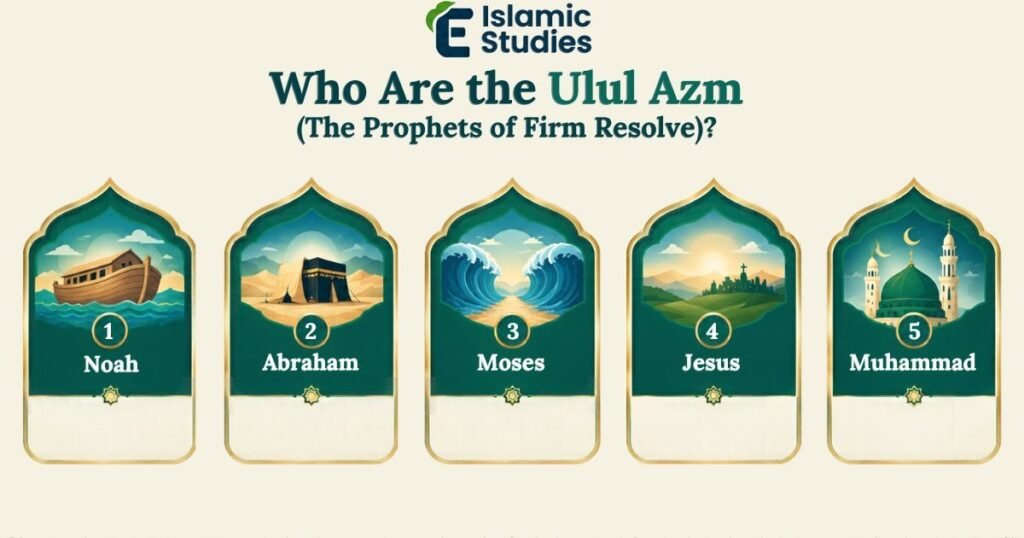
Who Are the Ulul Azm (The Prophets of Firm Resolve)?
They are five: Noah, Abraham, Moses, Jesus, and Muhammad (peace be upon them). Allah names them together in Al-Ahzab 33:7 and Ash-Shuraa 42:13 and praises their patience in Al-Ahqaf 46:35.
Why Is Muhammad ﷺ the Final and Greatest Prophet?
No prophet will come after him. Allah calls him:
وَلَـٰكِن رَّسُولَ ٱللَّهِ وَخَاتَمَ ٱلنَّبِيِّـۧنَ ۗ
“the Messenger of Allah and the seal of the prophets” (Al-Ahzab 33:40).
The Arabic word khatam means a seal that closes and completes something, so prophethood ended with Muhammad ﷺ. The Prophet ﷺ confirmed this himself, saying: “There will be no prophet after me” (Sahih al-Bukhari, 3455).
How Many Prophets in Islam?
The Quran names 25 prophets, but far more were sent. A hadith narrated by Abu Dharr states there were 124,000 prophets, of whom 315 were messengers (Musnad Ahmad, Sahih Ibn Hibban).
Is the 124,000 Number Authentic?
Scholars differ on how reliable this hadith is. Ibn Hibban accepted it, while others considered its chains weak. What is certain is that Allah sent a warner to every nation (Surah Fatir 35:24).
Knowing how many prophets in Islam were sent matters less than believing in all of them. Belief in prophets in Islam means detailed faith in the named prophets and general faith in the rest.
To go deeper with authentic sources, the Traditional Alim Course offers advanced aqeedah, tafsir, and hadith. Sisters can join the Alimah Course for Ladies.
Start Learning Authentic Aqeedah Today
Belief in prophets in Islam is best learned with a qualified teacher who explains the evidence and answers your questions. At E Islamic Studies School, certified tutors teach creed in a simple, engaging way.
Our one-on-one online classes suit kids, teens,s and adults. You choose the schedule, pace, and level, from beginner to advanced.
Our Islamic Essentials Courses
- Essential Islam Courses
- Online Tafseer Course
- Islamic History Course
- Tazkiyah Course
- Self-Paced Tafseer Course — Flexible Learning Programs
- Aqidah Course — Islamic Creed and Theology Classes
- Online Seerah Course — Life of Prophet Muhammad Classes
- Akhlaq Course — Islamic Ethics and Character Development
Build strong faith from home with a structured plan. Book your free trial class today and master belief in the prophets in Islam with confidence.
Deepen Your Islamic Knowledge
Join our comprehensive online courses and learn from qualified scholars today.
Book Your Free TrialConclusion
Belief in prophets in Islam is the fourth pillar of faith. It means believing in every prophet Allah sent, without distinction, and honoring them as the best of humanity.
We covered the difference between a prophet and a messenger, the six requirements of belief in prophets in Islam, the 25 prophets named in the Quran, the five Ulul Azm, and the hadith of 124,000 prophets.
The key takeaway: all prophets carried one message of tawhid, and today we follow it through the final Prophet, Muhammad ﷺ. Keep learning, and let the prophets be your role models.
Learning the stories of the prophets with a qualified teacher turns this belief into something you live by every day. Start with our Islamic Essentials courses and build a strong foundation in faith for yourself and your children.
FAQs
Here are quick answers to the most common questions people ask about belief in prophets in Islam.
What Is the Fourth Pillar of Iman in Islam?
The fourth pillar of iman is belief in prophets in Islam, including all messengers. It appears in the Hadith of Jibril (Sahih Muslim, 8), after belief in Allah, His angels, and His books.
Who Was the First Prophet in Islam?
Adam was the first prophet. Authentic hadith describes Noah as the first messenger sent to the people of the earth.
Is Jesus a Prophet in Islam?
Yes. Jesus (Isa) is one of the five Ulul Azm, and belief in prophets in Islam includes honoring him. Muslims believe in his miraculous birth and his miracles, but not in his divinity (Quran 5:75).
Who Is the Last Prophet in Islam?
Muhammad ﷺ is the last prophet and messenger. The Quran calls him the “seal of the prophets” (33:40), and his message is for all humanity.
Can a Muslim Believe in Some Prophets and Reject Others?
No. Rejecting one prophet means rejecting all of them, and Allah calls such people “the disbelievers, truly” (Quran 4:150–151). True belief in prophets in Islam includes every prophet without exception.
Related Articles
Learning Islam







Leave a Reply