 Learning Islam
Have you ever stood at the sink before Salah, unsure whether you wiped your head once or three times? You are not alone. Reverts, new learners, and parents teaching their children all ask how to perform wudu the way the Prophet ﷺ did.
Wudu is more than a hygiene routine. It is the gateway to prayer, and the Prophet ﷺ said
” لاَ تُقْبَلُ صَلاَةُ مَنْ أَحْدَثَ حَتَّى يَتَوَضَّأَ ”
” The prayer of a person who does Hadath (passes urine, stool, or wind) is not accepted till he performs ablution.”
This guide covers the complete Sunnah method of ablution, the acts that make it valid, common mistakes, and what to say once you finish. All of it is drawn from authentic hadith and trusted scholars.
This method follows the wudu of Uthman ibn Affan (may Allah be pleased with him), who said he saw the Prophet ﷺ perform it this way (al-Bukhari and Muslim). Three washes per limb is best; one is enough.
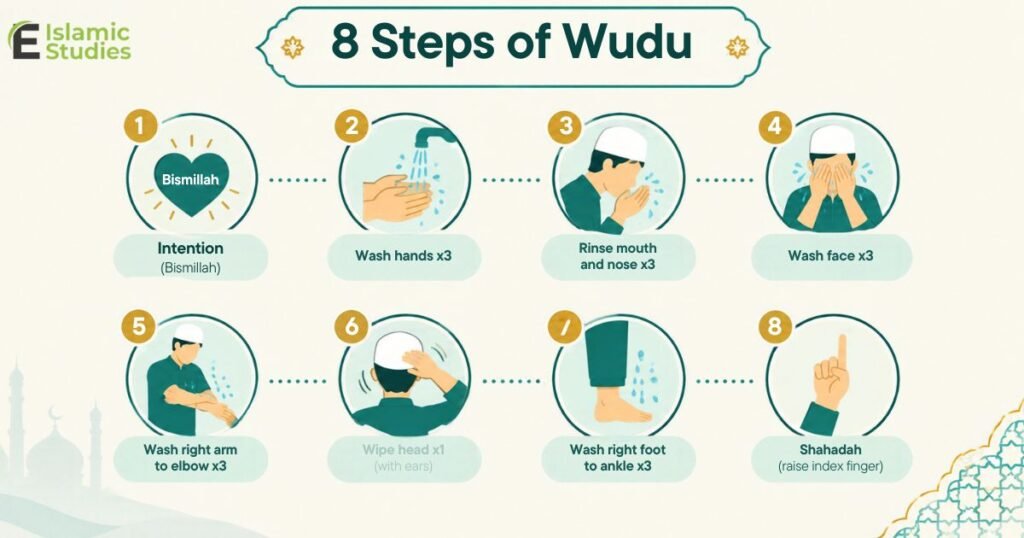
1. Make Your Intention and Say, Bismillah
The first step to perform wudu is to make the intention (niyyah) in your heart that you are purifying yourself for worship. Do not say it aloud, because there is no evidence that the Prophet ﷺ voiced his intention.
The intention matters because it turns washing into worship. The Prophet ﷺ said: “Actions are only by intentions” (al-Bukhari and Muslim). So most scholars hold that washing these limbs without intending wudu, just to cool down, for example, does not count as ablution.
Then say “Bismillah” (In the name of Allah). Imam Ahmad held it to be obligatory for those who remember it, while most scholars consider it a Sunnah. If you forget it, your wudu is still valid.
2. Wash Your Hands Three Times
Wash both hands up to the wrists three times, rubbing between the fingers, since your hands carry water to every other limb.
This washing is a Sunnah, and it is especially emphasised after waking from sleep. The Prophet ﷺ said that no one should put his hand into a water vessel before washing it three times, because “he does not know where his hand spent the night” (al-Bukhari and Muslim).
3. Rinse Your Mouth and Nose Three Times
Take water in your right hand and rinse your mouth (madmadah). Then draw water into your nose (istinshaq) and blow it out using your left hand (istinthar). Repeat three times.
Using one handful for both is fine, as the Prophet ﷺ often did. Rinse thoroughly, but gently if you are fasting.
This is also the right moment to use the miswak, because scholars place it at the rinsing of the mouth. The Prophet ﷺ said that if it were not a hardship for his Ummah, he would have commanded them to use it before every prayer (al-Bukhari and Muslim).
4. Wash Your Face Three Times
Wash your entire face three times, from the hairline to the bottom of the chin and from one earlobe to the other. Men with thick beards should run wet fingers through the beard.
Let the water cover the whole face, including the forehead at the hairline, the sides near the ears, and the area under the chin. A quick splash often misses these edges, which is one of the most common reasons wudu is left incomplete.
If you wear makeup, remove any waterproof layer that stops water from reaching the skin. A light beard is washed down to the skin, while a thick beard is washed on its surface, and the Prophet ﷺ would run his wet fingers through it (al-Tirmidhi).
5. Wash Your Arms up to the Elbows
Wash your right arm from the fingertips to the elbow three times, then do the same with your left arm. Make sure water reaches the elbow itself, not just the forearm.
Abu Hurayrah (may Allah be pleased with him) washed his arms until the water reached his upper arms and said this was how he saw the Prophet ﷺ perform wudu. He also reported that the Ummah will come on the Day of Judgement with limbs shining from the traces of wudu (Muslim).
Before you start, push your sleeves well above the elbows so the water reaches every part of the arm. Move or remove a tight ring or watch, and take off nail polish, since anything that blocks water from the skin makes the washing incomplete.
6. Wipe Your Head and Ears Once
With wet hands, wipe your head once, moving from the front to the nape of your neck and back to the front. Unlike the other limbs, you wipe your head only once.
Then wipe your ears, with your index fingers inside and your thumbs along the back. Women wipe over their hair in the same way and do not need to undo their braids.
Scholars differ on how much of the head must be wiped. The Hanbali and Maliki schools require the whole head, while the Shafi’i and Hanafi schools accept part of it. Wiping the full head as described above follows the Sunnah and satisfies every view.
7. Wash Your Feet up to the Ankles
Wash your right foot up to and including the ankle three times, then the left. Pass your fingers between your toes and pay close attention to the heels, since the Prophet ﷺ warned: a man who did not wash his heel, and he remarked:
وَيْلٌ لِلأَعْقَابِ مِنَ النَّارِ ” ”
Woe to the heels because of hell-fire.
In winter, many people would rather not take off their socks or boots at school or work. Wiping over them is allowed if you put them on after a complete wudu, as explained in the FAQs below.
8. Recite the Dua After Wudu
Finish with the testimony of faith and the supplication taught by the Prophet ﷺ, covered below.
The Prophet ﷺ also said that whoever says this du’a after wudu, all eight gates of Paradise will be opened for him. Narrated by Muslim.
«أشهد أن لا إله إلا الله وحده لا شريك له، وأشهد أن محمداً عبده ورسوله»
“ I testify that there is no god but Allah, the One; there is no associate with Him, and I testify that Muhammad is His servant and His Messenger.”
The first half of this testimony affirms that worship belongs to Allah alone, with no partner. The second describes the Prophet ﷺ as His servant and Messenger: he is honoured and followed, but never worshipped. You can also make du’a to be among the repentant and those who purify themselves and say:
«اللهم اجعلني من التوابين واجعلني من المتطهرين»
“ O Allah! Make me among those who repent, and among those who purify themselves.” (Jami’ At-Tirmizi)
The Arabic word “tawwabin” describes people who turn back to Allah again and again, not just once. Your body has just been washed, so this dua asks Allah to keep your heart clean through constant repentance as well. A few guided sessions with a qualified teacher in simple Arabic can make it sound natural.
Wudu Meaning in Islam
Wudu is much more than washing before prayer. Knowing how to perform wudu is only the start: when you understand its meaning, why Islamic law requires it, and its reward, you can perform it with a present heart instead of out of habit.
Ablution In Islam: What Does Wudu Mean?
Wudu (الوضوء) comes from an Arabic root meaning brightness and cleanliness. In Islamic law, it is the ritual washing of specific body parts, in a set order, with the intention of purifying oneself for worship.
Why Is Wudu Required Before Prayer?
Wudu is a condition for the validity of Salah. Allah commands it in Surah Al-Ma’idah (5:6), and the Prophet ﷺ said: “No prayer is accepted without purification” (Muslim).
It is also a means of forgiveness. The Prophet (ﷺ) said:
” إِذَا تَوَضَّأَ الْعَبْدُ الْمُسْلِمُ – أَوِ الْمُؤْمِنُ – فَغَسَلَ وَجْهَهُ خَرَجَ مِنْ وَجْهِهِ كُلُّ خَطِيئَةٍ نَظَرَ إِلَيْهَا بِعَيْنَيْهِ مَعَ الْمَاءِ – أَوْ مَعَ آخِرِ قَطْرِ الْمَاءِ – فَإِذَا غَسَلَ يَدَيْهِ خَرَجَ مِنْ يَدَيْهِ كُلُّ خَطِيئَةٍ كَانَ بَطَشَتْهَا يَدَاهُ مَعَ الْمَاءِ – أَوْ مَعَ آخِرِ قَطْرِ الْمَاءِ – فَإِذَا غَسَلَ رِجْلَيْهِ خَرَجَتْ كُلُّ خَطِيئَةٍ مَشَتْهَا رِجْلاَهُ مَعَ الْمَاءِ – أَوْ مَعَ آخِرِ قَطْرِ الْمَاءِ – حَتَّى يَخْرُجَ نَقِيًّا مِنَ الذُّنُوبِ ” .
When a bondsman-a Muslim or a believer-washes his face (in course of ablution), every sin he contemplated with his eyes, will be washed away from his face along with water, or with the last drop of water; when he washes his hands, every sin they wrought will be effaced from his hands with the water, or with the last drop of water; and when he washes his feet, every sin towards which his feet have walked will be washed away with the water or with the last drop of water with the result that he comes out pure from all sins. (Sahih Muslim 244).
This hadith shows that each washed limb is cleansed of the sins it took part in: the eyes through the face, then the hands and the feet. Scholars such as Imam an-Nawawi explained that this covers minor sins, while major sins need sincere repentance. Every careful wudu is therefore a fresh chance to stand before Allah purified in both body and heart.
See Our Islamic Studies Classes in Action
Take a look at a sample lesson and see how our interactive online classes help students learn Islamic Studies in a clear, engaging, and supportive environment.
Deepen Your Islamic Knowledge
Join our comprehensive online courses and learn from qualified scholars today.
Book Your Free TrialWudu Steps In Islam: What Are The Obligatory Vs. Sunnah Acts
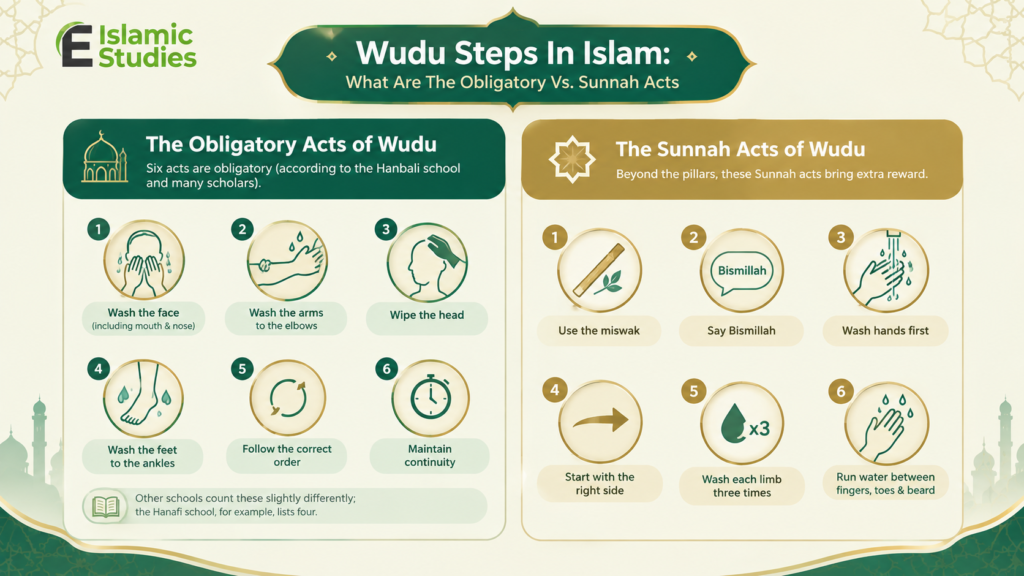
Not every part of wudu carries the same ruling. Some acts are pillars without which ablution is invalid, while others complete it and bring extra reward.
The Obligatory Acts of Wudu
According to the Hanbali school and many scholars, there are six obligatory acts. The first four are washing the face (including the mouth and nose), washing the arms to the elbows, wiping the head, and washing the feet to the ankles.
The remaining two are following the correct order (tartib) and continuity (muwalat), which means washing each limb without a long pause. Other schools count these slightly differently; the Hanafi school, for example, lists four.
The Sunnah Acts of Wudu
Beyond the pillars, several Sunnah acts complete your wudu and bring extra reward. These include using the miswak before you begin, saying Bismillah, and washing your hands first, since they carry water to every other limb.
It is also Sunnah to start with the right side and to wash each limb three times instead of once. You should also run water between your fingers, toes, and beard so that no spot is left dry.
How to Do Wudu Correctly: Common Mistakes to Avoid
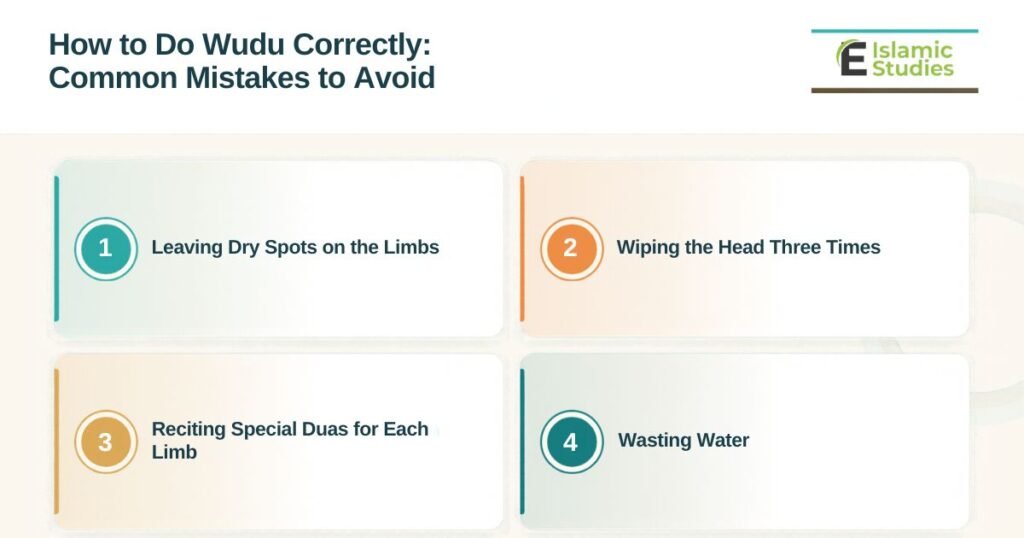
Small errors can leave your ablution incomplete without you noticing. These are the ones scholars warn about most often.
Leaving Dry Spots on the Limbs
Water must reach every part of each limb you wash, so even a small dry patch can leave your wudu incomplete. The areas people most often miss are the heels, the elbows, and the edges of the face near the ears.
The Prophet ﷺ took this seriously. He once saw a man who had left a dry spot the size of a fingernail on his foot, and he told him: “Go back and perform your wudu well” (Muslim). The man returned, completed his ablution, and then prayed.
To avoid this, pass your hand over each limb as you wash it instead of only pouring water. If you notice a dry spot soon after finishing, many scholars say to wash it and the limbs that come after it. If a long time has passed, repeat the whole wudu.
Wiping the Head Three Times
Unlike the face, arms, and feet, the head is wiped only once in the authentic Sunnah. Repeating the wipe three times out of habit adds nothing to your wudu and goes against the Prophet’s ﷺ practice.
Abdullah ibn Zayd described the Prophet’s ﷺ wudu: he washed the other limbs more than once and wiped his head a single time, from front to back and back again (al-Bukhari and Muslim). Most scholars follow this, though the Shafi’i school recommends three wipes, and the wudu is valid either way.
Part of the wisdom is ease. Allah commanded wiping the head rather than washing it, which lightens the act for everyone, especially women with long hair or a hijab. Repeated wipes turn a light act into something close to washing, which the Sunnah never required.
Reciting Special Duas for Each Limb
Shaykh Ibn Baz explained that the supplications people recite while washing the face, hands, or feet are not authentically reported. Begin your wudu with Bismillah, and close it with the shahadah and the dua after wudu.
A common example is saying “O Allah, brighten my face on the Day faces are brightened” while washing the face. Imam an-Nawawi stated in al-Adhkar that nothing has been reported from the Prophet ﷺ about supplications for each limb of wudu.
General remembrance of Allah is not forbidden, but these phrases should not be treated as part of the Sunnah. Focus on washing each limb with care and presence, and save your supplications for the authentic words taught after you finish.
Wasting Water
The Prophet ﷺ performed wudu with about one mudd of water, roughly two cupped handfuls. Following his example is easy: turn the tap down or close it between limbs, and use only what you need.
Imam al-Bukhari noted in his Sahih that scholars disliked wastefulness in wudu and going beyond what the Prophet ﷺ did. This applies even when water is plentiful, because moderation is part of the act of worship itself.
A tap left fully open for the whole wudu can easily use several litres, far more than the less-than-a-litre amount. Washing three times doesn’t mean using three times the water. A gentle stream, or a jug at home, is usually enough.
What Breaks Wudu?
Wudu is broken by urine, stool, wind, deep sleep, and loss of consciousness. Many scholars also include directly touching the private parts and eating camel meat.
After using the toilet, clean yourself first (istinja) and then perform wudu. After passing wind or waking from sleep, wudu alone is enough and istinja is not needed.
Knowing how to perform wudu is only half the picture, because knowing what breaks it tells you when to renew it. If none of these things happen, your wudu stays valid for as many prayers as you like. Renewing it for each prayer is recommended but not required.
Experience Our Classrooms
Don’t just take our word for it—take a look inside! Watch the videos below to experience our engaging teaching methods and vibrant online classrooms firsthand.
Deepen Your Islamic Knowledge
Join our comprehensive online courses and learn from qualified scholars today.
Book Your Free TrialWudu Prayer: What to Do After Ablution
Your wudu ends with remembrance and opens the door to Salah. These Sunnah acts take a minute but carry great reward.
The Dua After Wudu
Once the last limb is washed, the Prophet ﷺ taught a short supplication to seal your ablution. It takes only a few seconds, yet it turns a physical act of cleansing into a renewed declaration of faith.
أَشْهَدُ أَنْ لَا إِلَٰهَ إِلَّا اللَّهُ وَحْدَهُ لَا شَرِيكَ لَهُ، وَأَشْهَدُ أَنَّ مُحَمَّدًا عَبْدُهُ وَرَسُولُهُ، اللَّهُمَّ اجْعَلْنِي مِنَ التَّوَّابِينَ وَاجْعَلْنِي مِنَ الْمُتَطَهِّرِينَ
Ash-hadu an la ilaha illallahu wahdahu la sharika lah, wa ash-hadu anna Muhammadan ‘abduhu wa rasuluh. Allahumma ij’alni minat-tawwabin, waj’alni minal-mutatahhirin.
This dua has two parts. The first is the shahadah, which renews your belief in the oneness of Allah and in the message of the Prophet ﷺ. Your body has just been cleansed with water, and this testimony cleanses the heart.
The second part asks Allah to make you among “those who repent and those who purify themselves”. Repentance purifies you from sins, and wudu purifies you from physical impurity, so you ask for both.
Learn to Recite Your Prayers Correctly with E Islamic Studies
Knowing how to perform wudu is the first step. The next is reciting Al-Fatihah and your prayer adhkar with correct pronunciation, and E Islamic Studies supports kids and adults with exactly that.
Qualified teachers lead our live Tajweed and Quran recitation circles. They correct every letter, and classes fit around school and work schedules.
Our comprehensive Islamic Studies courses cover essential topics including Fiqh, Aqeedah, Seerah, and Islamic history, all taught by expert instructors who understand the needs of Muslim students.
- Our Islamic Courses and Programs
- Islam Classes for Adults
- Islam Classes for Sisters
- Islam Classes for Kids
- Islamic Distance Learning Programs
- Islamic Courses Workshops
- Intensive Islamic Course
- Islam Crash Course
- Learning Islam Level 1 Online
Contact our team today to book your first session
Deepen Your Islamic Knowledge
Join our comprehensive online courses and learn from qualified scholars today.
Book Your Free TrialConclusion
Learning how to perform wudu correctly means following the Prophet’s ﷺ order. Begin with intention and Bismillah, then wash the hands, mouth and nose, face, and arms, wipe the head and ears, and finish with the feet.
Knowing the obligatory acts protects the validity of your ablution, and the Sunnah acts complete it. Avoiding mistakes such as dry heels or invented duas keeps it sound.
Remember that wudu is also an act of worship in its own right. With every limb you wash, minor sins fall away with the water. Slowing down and doing each step with presence turns a daily habit into a lasting source of reward.
The takeaway is simple: a careful wudu prepares a focused prayer. Close it with the shahadah, pray two rak’ahs when you can, and keep building the recitation skills that bring your Salah to life.
FAQs
Here are quick answers to the questions people most often ask about wudu.
Is It Valid to Wash Each Limb Only Once?
Yes. The Prophet ﷺ sometimes washed each limb once, sometimes twice, and most often three times. Once is valid and three times is the more complete Sunnah, but going beyond three is discouraged.
Can I perform wudu with nail polish on?
No. Nail polish forms a layer that stops water from reaching the nails, so remove it first. Henna is fine because it only stains the skin.
Can I wipe over my socks instead of washing my feet?
Yes, if you put the socks on after a complete wudu. Authentic hadith allow a resident to wipe over them for one day and night, and a traveller for three days and nights.
How long does wudu last?
Wudu has no time limit. It stays valid until something breaks it, so one wudu can cover several prayers.
What if I doubt whether my wudu was broken?
If you are sure you had wudu and only doubt whether it was broken, it is still valid. The Prophet ﷺ told someone who felt something during prayer not to leave unless he heard a sound or noticed a smell (al-Bukhari and Muslim).
At what age should children learn wudu?
The Prophet ﷺ instructed parents to teach children to pray from the age of seven, so this is an ideal time to teach wudu too. Practising together and gently correcting mistakes helps the habit stick.








Leave a Reply