 Learning Islam
Millions of Muslims hear the adhan five times every day but have never studied what each phrase actually means. The adhan words meaning goes far deeper than a prayer announcement — every sentence is a precise theological declaration, an invitation, and an act of worship that connects the listener directly to the foundations of Islamic belief.
This guide covers every phrase of the adhan lyrics in English and Arabic, with full transliteration, translation, and meaning, so every Muslim can engage with the Islamic call to prayer as an act of conscious worship rather than background sound.
1- The Origin of the Adhan Explains Why Its Words Matter
Before studying the adhan words meaning phrase by phrase, every Muslim should understand where these specific words came from. The adhan was not established through scholarly discussion or human decision — it was revealed through a blessed dream that the Prophet Muhammad, peace be upon him, confirmed as true guidance from Allah.
The companion Abdullah ibn Zayd, may Allah be pleased with him, saw in a dream a man teaching him the exact words and sequence of the call to prayer. He brought this dream to the Prophet, who confirmed its authenticity and commanded that the adhan be called using these precise words.
Bilal ibn Rabah, may Allah be pleased with him — whose voice was described as uniquely powerful and beautiful — became the first muezzin in Islamic history, calling these same words from the earliest days of the Muslim community in Madinah.
This origin establishes a fundamental principle: the call to prayer words in Arabic are not subject to personal modification, addition, or alteration. Every phrase is fixed in its position, its number of repetitions, and its meaning.
The adhan delivered today in Makkah, Istanbul, Jakarta, and Lagos follows the same sequence heard in seventh-century Madinah — making it one of the most unbroken continuous acts of worship in human history. Allah describes the call to prayer as the finest speech a person can make:
“وَمَنْ أَحْسَنُ قَوْلًا مِّمَّن دَعَا إِلَى اللَّهِ وَعَمِلَ صَالِحًا وَقَالَ إِنَّنِي مِنَ الْمُسْلِمِينَ”
Wa man ahsanu qawlan mimman da’a ila Allahi wa ‘amila salihan wa qala innanee mina al-muslimeen.
“And who is better in speech than one who invites to Allah and does righteousness and says, “Indeed, I am of the Muslims.”
Many Muslims — including new converts and those who grew up hearing the adhan without studying it — want to understand what they are hearing and responding to. At E Islamic Studies Academy, the Learning Islam for New Converts course provides exactly this grounding, connecting new Muslims to the foundational practices of Islamic worship with clarity and structure.
Read also: Voluntary Fasting Days in Islam You Should Know

Begin understanding your faith from its foundations today.
2- Allahu Akbar — Allah Is the Greatest
The adhan opens with the most repeated phrase in the entire call — spoken four times before anything else is said. This opening commands attention and establishes the theological foundation for everything that follows in the Islamic call to prayer lyrics.
“اللَّهُ أَكْبَرُ” Allahu Akbar. “Allah is the Greatest.”
The word Allahu is the proper name of God in Arabic — not a title or description, but a name that carries in itself all attributes of divinity and perfection. The word Akbar is the superlative form of kabeer, meaning great — making Akbar the expression of a greatness that surpasses all comparison.
Allahu Akbar therefore means not merely that Allah is great, but that Allah is greater than everything — greater than any worldly concern, distraction, or rival claim on the believer’s attention.
By repeating this phrase four times before anything else is said, the muezzin is calling every listener to shift their internal hierarchy — to place Allah above work, commerce, fatigue, and every competing obligation. Islamic scholars describe Allahu Akbar as the phrase that recalibrates the Muslim’s priorities five times every single day.
Read also: Top 10 Rules of Fasting in Islam Every Muslim Must Know
3- Ashhadu an La Ilaha Illa Allah — The Testimony of Tawheed
After establishing Allah’s greatness, the adhan moves immediately to the most fundamental statement in all of Islam. This is the first half of the shahada — the testimony of faith — and its placement in the adhan means that every prayer is preceded by a public reaffirmation of Islamic belief. This phrase is repeated twice.
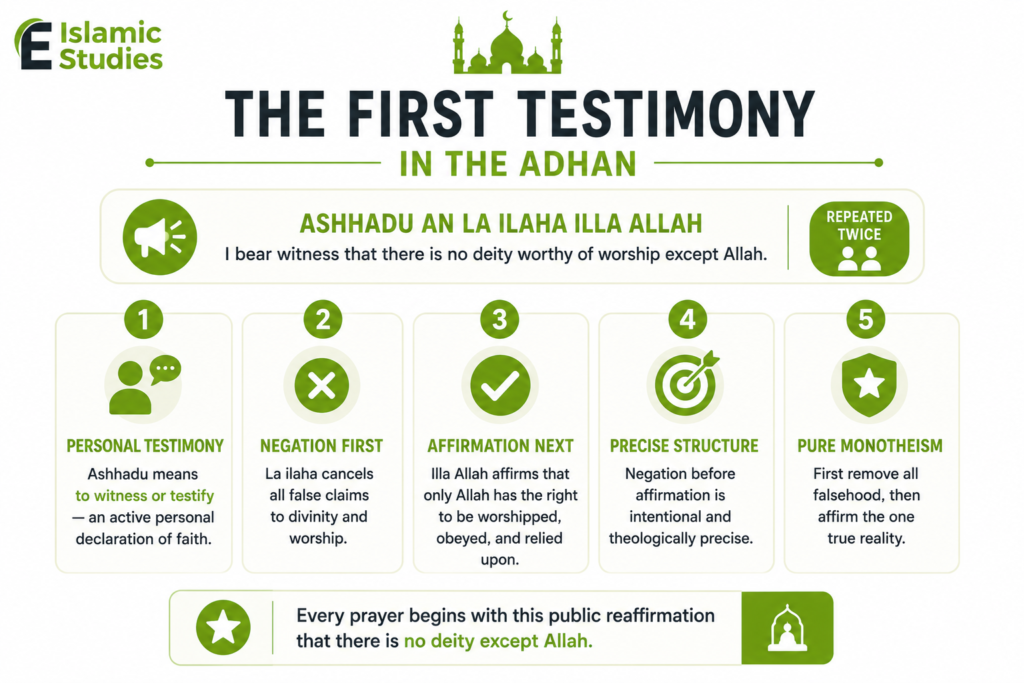
“أَشْهَدُ أَنْ لَا إِلَهَ إِلَّا اللَّهُ” Ashhadu an la ilaha illa Allah. “I bear witness that there is no deity worthy of worship except Allah.”
The word ashhadu comes from the Arabic root meaning to witness or testify — indicating that this is not a passive recitation but an active personal testimony. La ilaha establishes the negation first — canceling all false claims to divinity and worship.
Illa Allah then establishes the single affirmation — that only Allah holds the right to be worshipped, obeyed, and relied upon absolutely. Scholars emphasize that this structure — negation before affirmation — is intentional and theologically precise.
A Muslim does not simply say “Allah is God” but first sweeps away every false claim before affirming the one true reality.
Read also: Top 10 Benefits of Fasting in Islam – Body, Mind, and Soul
4- Ashhadu Anna Muhammadan Rasulullah — The Testimony of Prophethood
The third phrase of the adhan completes the shahada by adding its second half — the testimony that Muhammad, peace be upon him, is the Messenger of Allah. This phrase is also repeated twice, immediately following the testimony of tawheed, and the two together constitute the complete declaration of Islamic faith. No adhan is valid without both.
“أَشْهَدُ أَنَّ مُحَمَّدًا رَسُولُ اللَّهِ” Ashhadu anna Muhammadan Rasulullah. “I bear witness that Muhammad is the Messenger of Allah.”
This testimony carries profound implications beyond simply naming the Prophet. It establishes that the only valid path to knowing Allah, worshipping Him correctly, and understanding what He has commanded comes through the prophethood of Muhammad, peace be upon him.
Accepting this phrase means accepting that Islamic worship — including the prayer the adhan is calling people toward — must follow the way the Prophet taught, not personal interpretation or cultural custom. Scholars note that placing both testimonies together inside the adhan means that five times every day, the Muslim community publicly renews its dual commitment to Allah and to His Messenger simultaneously.
At E Islamic Studies Academy, the Learn Islam for Beginners course helps students understand the shahada, its two parts, and how this foundational declaration shapes every dimension of Islamic worship and daily life.

Understand your testimony more deeply today.
5- Hayya Alas Salah — Come to Prayer
After the declarations of faith, the adhan shifts from testimony to invitation. This phrase is the first direct call to action in the Islamic call to prayer lyrics — and it is directed personally at every Muslim within hearing range. It is repeated twice, and with it the muezzin turns to his right side when calling it in the traditional Sunnah method.
“حَيَّ عَلَى الصَّلَاةِ” Hayya alas salah. “Come to prayer.”
The word hayya is an Arabic imperative meaning come or hasten — carrying a sense of urgency that is deliberate. This is not a gentle suggestion but a direct call. The phrase alas salah directs that urgency specifically toward prayer — the most important act of worship a Muslim performs.
Scholars point out that this phrase is placed after the declarations of faith, not before them, because the invitation to prayer is only meaningful once the listener understands who they are praying to and through whose example they are praying.
The sequence of the adhan is therefore a complete theological argument: Allah is the Greatest, there is no god but Allah, Muhammad is His Messenger — therefore come to prayer.
See Our Islamic Studies Classes in Action
Take a look at a sample lesson and see how our interactive online classes help students learn Islamic Studies in a clear, engaging, and supportive environment.
Deepen Your Islamic Knowledge
Join our comprehensive online courses and learn from qualified scholars today.
Book Your Free Trial6- Hayya Alal Falah — Come to Success
The most theologically distinctive phrase in the entire adhan comes immediately after the call to prayer. Where Hayya alas salah calls the Muslim to a specific act, Hayya alal falah calls them to something far greater — total and comprehensive success in both this life and the next. This phrase is also repeated twice, and with it the muezzin turns to his left side in the Sunnah method.
“حَيَّ عَلَى الْفَلَاحِ” Hayya alal falah. “Come to success.”
The Arabic word falah is one of the richest words in the Quran and carries meanings that no single English word fully captures. It encompasses prosperity, triumph, salvation, flourishing, and eternal success.
When the Quran speaks of the believers who have attained falah, it refers to those who have succeeded not only in worldly terms but in the ultimate sense — earning the pleasure of Allah and entry into Paradise.
By including this word in the adhan, the call to prayer is making an extraordinary claim: that the path to every form of true success runs directly through the prayer being called. This phrase reframes prayer not as an obligation that demands something from the Muslim but as an invitation that offers them everything.
7- The Complete Adhan Lyrics in English — Full Sequence and Repetitions
Understanding the adhan words meaning requires seeing every phrase in its correct sequence alongside the number of times each is repeated. The following table presents the complete call to prayer words in Arabic with transliteration, English translation, and repetitions:
| Arabic | Transliteration | English Meaning | Repetitions | |
| 1 | اللَّهُ أَكْبَرُ | Allahu Akbar | Allah is the Greatest | 4 times |
| 2 | أَشْهَدُ أَنْ لَا إِلَهَ إِلَّا اللَّهُ | Ashhadu an la ilaha illa Allah | I bear witness that there is no deity worthy of worship except Allah | 2 times |
| 3 | أَشْهَدُ أَنَّ مُحَمَّدًا رَسُولُ اللَّهِ | Ashhadu anna Muhammadan Rasulullah | I bear witness that Muhammad is the Messenger of Allah | 2 times |
| 4 | حَيَّ عَلَى الصَّلَاةِ | Hayya alas salah | Come to prayer | 2 times |
| 5 | حَيَّ عَلَى الْفَلَاحِ | Hayya alal falah | Come to success | 2 times |
| 6 | اللَّهُ أَكْبَرُ | Allahu Akbar | Allah is the Greatest | 2 times |
| 7 | لَا إِلَهَ إِلَّا اللَّهُ | La ilaha illa Allah | There is no deity worthy of worship except Allah | 1 time |
The total number of phrases spoken in the standard adhan is fifteen. The adhan opens and closes with declarations of Allah’s greatness and oneness — forming a complete theological circle that begins and ends with tawheed. The call to prayer and the call to success sit at the center, flanked by testimony on one side and divine greatness on the other.
8- The Fajr Addition — As Salatu Khayrun Minan Nawm
The Fajr adhan — the call to the dawn prayer — contains one addition not found in any other adhan of the day. This phrase is inserted after Hayya alal falah and before the closing Allahu Akbar, and it carries its own distinct meaning that is specifically appropriate to the dawn hour when most people are asleep.
“الصَّلَاةُ خَيْرٌ مِنَ النَّوْمِ” As-salatu khayrun minan nawm. “Prayer is better than sleep.”
This addition was established through the Sunnah of the Prophet Muhammad, peace be upon him, specifically for the Fajr prayer. Its theological significance is direct: at the moment when the human body most strongly desires rest, the adhan names the competing temptation explicitly — sleep — and declares prayer superior to it.
Scholars note that this is the only phrase in the entire adhan that directly addresses a worldly comfort by name and places worship above it. It is therefore both an encouragement and a reminder that what waits in the prayer is worth more than what is being left behind in the bed.
At E Islamic Studies Academy, the Essential Islamic Courses cover the complete foundations of Islamic worship including prayer, adhan, and the practical Fiqh every Muslim needs to worship correctly.

Learn your worship with qualified scholars today.
9- How a Muslim Should Respond to Each Adhan Phrase
Understanding the adhan words meaning is only the first part of engaging with the call to prayer correctly. The Prophet Muhammad, peace be upon him, established that every Muslim who hears the adhan should repeat each phrase after the muezzin — with two specific exceptions.
This response transforms the listener from a passive audience into an active participant in the declaration of faith. The response to each phrase follows these rules:
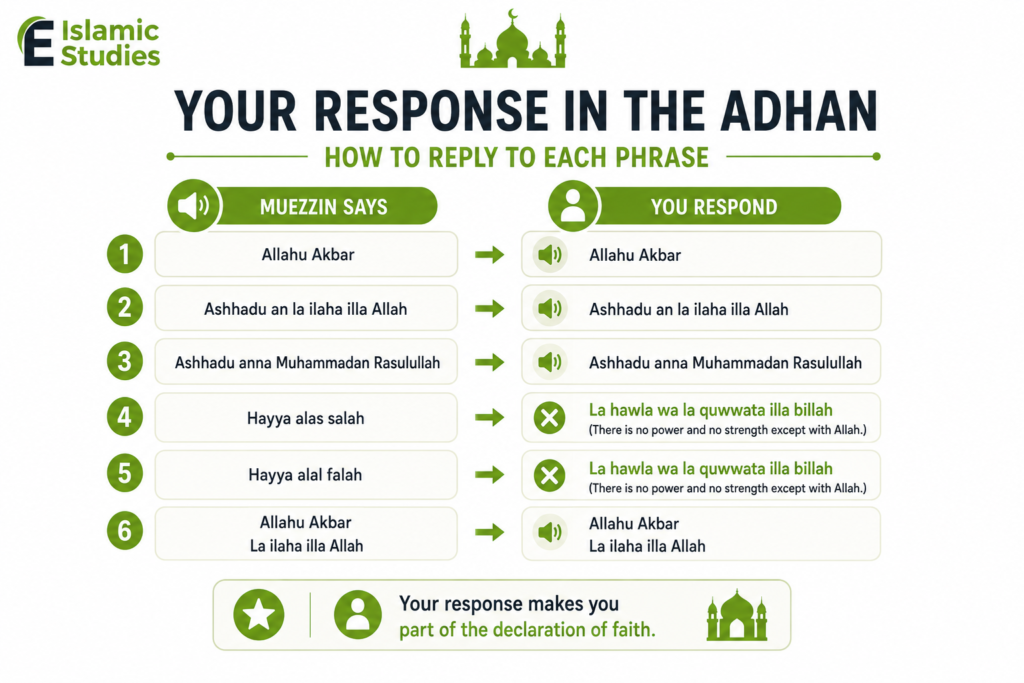
- For Allahu Akbar: repeat Allahu Akbar after the muezzin.
- For Ashhadu an la ilaha illa Allah: repeat the same phrase.
- For Ashhadu anna Muhammadan Rasulullah: repeat the same phrase.
- For Hayya alas salah: do not repeat the phrase — instead say La hawla wa la quwwata illa billah, meaning “There is no power and no strength except with Allah.”
- For Hayya alal falah: again say La hawla wa la quwwata illa billah.
- For the closing Allahu Akbar and La ilaha illa Allah: repeat them as stated.
The Prophet, peace be upon him, confirmed the reward attached to this response:
“مَنْ قَالَ حِينَ يَسْمَعُ النِّدَاءَ اللَّهُمَّ رَبَّ هَذِهِ الدَّعْوَةِ التَّامَّةِ وَالصَّلاَةِ الْقَائِمَةِ آتِ مُحَمَّدًا الْوَسِيلَةَ وَالْفَضِيلَةَ وَابْعَثْهُ مَقَامًا مَحْمُودًا الَّذِي وَعَدْتَهُ، حَلَّتْ لَهُ شَفَاعَتِي يَوْمَ الْقِيَامَةِ ”
Whoever after listening to the Adhan says, ‘Allahumma Rabba hadhihi-dda` watit-tammah, was-salatil qa’imah, ati Muhammadan al-wasilata wal-fadilah, wa b`ath-hu maqaman mahmudan-il-ladhi wa`adtahu’ [O Allah! Lord of this perfect call (perfect by not ascribing partners to You) and of the regular prayer which is going to be established, give Muhammad the right of intercession and illustriousness, and resurrect him to the best and the highest place in Paradise that You promised him (of)], then my intercession for him will be allowed on the Day of Resurrection”.
10- The Adhan Is an Act of Worship for the Listener and the Caller
The final dimension of adhan words meaning that every Muslim should internalize is that the adhan is not a one-way broadcast — it is a bilateral act of worship that simultaneously engages the muezzin who calls and the Muslim who hears and responds.
The Prophet Muhammad, peace be upon him, described the immense reward awaiting the muezzin who calls the adhan with sincerity:
“الْمُؤَذِّنُونَ أَطْوَلُ النَّاسِ أَعْنَاقًا يَوْمَ الْقِيَامَةِ”
The Mu’adhdhins will have the longest necks on the Day of Resurrection.
Scholars explain that “longest necks” refers to the elevated status and honor Allah will grant those who called people to prayer throughout their lives — they will be distinguished, recognized, and raised above others on the Day of Judgment.
For the listener, the Prophet established that repeating the adhan phrases and following them with the prescribed supplication earns the intercession of the Prophet himself on the Day of Resurrection.
This means that five times every day, every Muslim who hears the adhan and responds correctly is building a direct connection to prophetic intercession — one of the greatest gifts available to a believer in the hereafter.
At E Islamic Studies Academy, the Online Tafseer Course helps students connect the Quranic verses behind Islamic worship to their daily lives — understanding not just how to worship but why Allah designed every act of worship the way He did.

Connect your worship to your understanding today.
Watch a Sample Islamic Studies Class
See how our teachers explain Islamic concepts in an engaging and easy-to-understand way, helping students build knowledge and confidence.
Deepen Your Islamic Knowledge
Join our comprehensive online courses and learn from qualified scholars today.
Book Your Free TrialE Islamic Studies Academy Brings Qualified Islamic Knowledge to You
Thousands of Muslims worldwide want to understand their worship — not just perform it. They want to know what they are saying, why they are saying it, and how to engage with every act of Islamic worship with full awareness and correctness. E Islamic Studies Academy was built to make this accessible for every Muslim, everywhere in the world.
The academy offers one-on-one live sessions with qualified scholars grounded in classical Islamic sciences including Aqeedah, Fiqh, Sarf, Nahw, and Tafseer. Programs are structured from complete beginner foundations through to advanced traditional Alim-level scholarship. Dedicated courses exist for women, new converts, children, adult learners, and sisters who prefer female-led instruction.
All global time zones are covered, monthly progress reports are provided after every session, and a free trial class is available before any commitment is required.
Our Islamic Courses
- Islam Classes for Adults
- Islam Classes for Sisters
- Alimah Course for Ladies
- Islam Classes for Kids
- Learn Islam for Beginners
- Learning Islam for New Converts
Our Islamic Programs
- Islamic Distance Learning Programs
- Islamic Courses Workshops
- Intensive Islamic Course
- Islam Crash Course
- Learning Islam Level 1 Online
- Darse Nizami / Traditional Alim Courses
Register at E Islamic Studies Academy today.
Deepen Your Islamic Knowledge
Join our comprehensive online courses and learn from qualified scholars today.
Book Your Free TrialConclusion
The adhan words meaning is far richer than most Muslims realize. Every phrase is a precisely ordered theological declaration — from Allah’s transcendent greatness to the dual testimony of faith, from the urgent invitation to prayer to the promise of total success. Knowing the adhan lyrics in English and Arabic transforms five daily calls from background sound into a deeply conscious act of worship. Begin engaging with every phrase today.
Frequently Asked Questions
What is the adhan words meaning in simple English?
The adhan words meaning progresses from declaring Allah’s greatness to testifying to tawheed and prophethood, then inviting to prayer and success, and closing with Allah’s greatness and oneness again.
What are the adhan lyrics in English from beginning to end?
The adhan lyrics in English are: Allah is the Greatest, I bear witness there is no deity but Allah, I bear witness Muhammad is His Messenger, Come to prayer, Come to success, Allah is the Greatest, There is no deity but Allah.
What makes the Islamic call to prayer lyrics different from a regular announcement?
The Islamic call to prayer lyrics are a structured declaration of theological belief — each phrase carries a distinct creedal statement, making the adhan an act of worship rather than a simple announcement of prayer time.
What are the call to prayer words in Arabic for the Fajr prayer specifically?
The call to prayer words in Arabic for Fajr include one addition not in other adhans: As-salatu khayrun minan nawm, meaning “Prayer is better than sleep,” inserted after Hayya alal falah.
How should a Muslim respond to the adhan?
A Muslim should repeat each adhan phrase after the muezzin, except for Hayya alas salah and Hayya alal falah — for these two, the response is La hawla wa la quwwata illa billah.







Leave a Reply