 Learning Islam
Many Muslims recite the attahiyat in every prayer without fully understanding what each phrase means or why it holds such a central place in salah. The tashahhud is not simply a recitation that fills the sitting position — it is a complete declaration of faith, a greeting to the Prophet, a salutation to all righteous servants of Allah, and a renewed testimony of tawheed, all woven into a single powerful supplication.
This guide covers the complete attahiyat in Arabic with transliteration and meaning, the hadith evidence behind it, the correct body position, when to recite it, and the difference between the first and final tashahhud.
What Attahiyat and Tashahhud Mean
The word tashahhud comes from the Arabic root meaning testimony — specifically referring to the declaration of faith contained within the recitation. The word attahiyat — from the root meaning greetings or honor — is the opening word of the supplication itself and is commonly used as the name of the entire recitation in many Muslim communities, particularly in South and Southeast Asia.
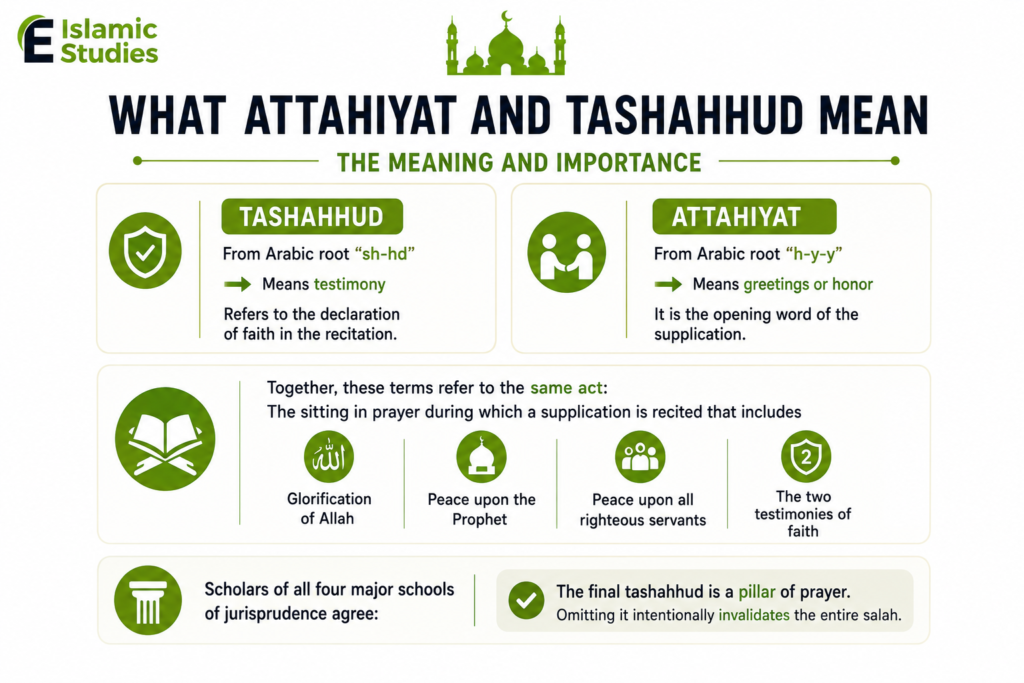
Together, these two terms refer to the same act: the sitting position in prayer during which a specific supplication is recited, combining glorification of Allah, peace upon the Prophet, peace upon all righteous servants, and the two testimonies of Islamic faith.
Scholars across all four major schools of jurisprudence consider the final tashahhud a pillar of prayer — meaning that omitting it intentionally renders the entire salah invalid.
Read also: Niyyah in Islam: Meaning, Importance, and How to Make It
The Hadith That Established the Tashahhud
The tashahhud was not composed by scholars or companions — it was taught directly by the Prophet Muhammad, peace be upon him, with a level of care that he himself described as equivalent to teaching the Quran. Ibn Abbas, may Allah be pleased with him, narrated:
“«كَانَ رَسُولُ اللَّهِ صَلَّى اللهُ عَلَيْهِ وَسَلَّمَ يُعَلِّمُنَا التَّشَهُّدَ كَمَا يُعَلِّمُنَا السُّورَةَ مِنَ الْقُرْآنِ»
” Kana Rasulullahi sallallahu ‘alayhi wa sallama yu’allimuna al-tashahuda kama yu’allimuna al-surata mina al-Quran.
“The Messenger of Allah used to teach us the tashahhud just as he used to teach us a surah from the Quran.”
This hadith carries a profound implication: every word and sequence of the tashahhud was taught precisely, not left to individual discretion. Ibn Mas’ud, may Allah be pleased with him, also narrated the origin of the tashahhud in a famous account preserved in Sahih Muslim.
He explained that the companions used to say various phrases of greeting to Allah during the sitting position of prayer, until the Prophet corrected them and taught the specific words of the tashahhud, saying: “When any one of you sits during the prayer, he should say: All services rendered by words, by acts of worship, and all good things are due to Allah…” and taught the complete text that Muslims recite today.
The scholars emphasize that the tashahhud has several authentic narrations reported from different companions. The version narrated by Ibn Mas’ud is the most widely used among Hanafi scholars, while the version narrated by Ibn Abbas is followed by many Shafi’i communities. Both are authentic and both are valid.
At E Islamic Studies Academy, the Islamic Classes for Adults teach the complete Fiqh of prayer — including the correct recitation, position, and rulings of the tashahhud — through structured one-on-one sessions with qualified scholars.

Learn your prayer correctly today.
Read also: Adhan Words Meaning: Complete Arabic and English Guide
See Our Islamic Studies Classes in Action
Take a look at a sample lesson and see how our interactive online classes help students learn Islamic Studies in a clear, engaging, and supportive environment.
Deepen Your Islamic Knowledge
Join our comprehensive online courses and learn from qualified scholars today.
Book Your Free TrialThe Attahiyat in Arabic — First Tashahhud
The first tashahhud is recited in the sitting position after the second rak’ah in prayers of three or four units. The following is the complete attahiyat in Arabic with transliteration and English meaning:
Arabic: “التَّحِيَّاتُ لِلَّهِ وَالصَّلَوَاتُ وَالطَّيِّبَاتُ، السَّلَامُ عَلَيْكَ أَيُّهَا النَّبِيُّ وَرَحْمَةُ اللَّهِ وَبَرَكَاتُهُ، السَّلَامُ عَلَيْنَا وَعَلَى عِبَادِ اللَّهِ الصَّالِحِينَ، أَشْهَدُ أَنْ لَا إِلَهَ إِلَّا اللَّهُ وَأَشْهَدُ أَنَّ مُحَمَّدًا عَبْدُهُ وَرَسُولُهُ”
Transliteration: At-tahiyyatu lillahi was-salawatu wat-tayyibat, as-salamu ‘alayka ayyuhan-nabiyyu wa rahmatullahi wa barakatuh, as-salamu ‘alayna wa ‘ala ‘ibadillahis-salihin, ashhadu an la ilaha illallah wa ashhadu anna Muhammadan ‘abduhu wa rasuluh.
English Meaning: “All greetings, prayers, and good things are for Allah. Peace be upon you, O Prophet, and the mercy of Allah and His blessings. Peace be upon us and upon the righteous servants of Allah. I bear witness that there is no deity worthy of worship except Allah, and I bear witness that Muhammad is His servant and Messenger.”
The Final Tashahhud — What Is Added
The final tashahhud is recited in the last sitting position of every prayer before the salam. It includes everything in the first tashahhud plus the Ibrahimiyya salawat — the prayer upon the Prophet and his family that completes the recitation.
The addition recited after the shahada in the final tashahhud:
Arabic: “اللَّهُمَّ صَلِّ عَلَى مُحَمَّدٍ وَعَلَى آلِ مُحَمَّدٍ كَمَا صَلَّيْتَ عَلَى إِبْرَاهِيمَ وَعَلَى آلِ إِبْرَاهِيمَ إِنَّكَ حَمِيدٌ مَجِيدٌ، اللَّهُمَّ بَارِكْ عَلَى مُحَمَّدٍ وَعَلَى آلِ مُحَمَّدٍ كَمَا بَارَكْتَ عَلَى إِبْرَاهِيمَ وَعَلَى آلِ إِبْرَاهِيمَ إِنَّكَ حَمِيدٌ مَجِيدٌ”
Transliteration: Allahumma salli ‘ala Muhammadin wa ‘ala ali Muhammadin kama sallayta ‘ala Ibrahima wa ‘ala ali Ibrahim, innaka Hamidun Majid. Allahumma barik ‘ala Muhammadin wa ‘ala ali Muhammadin kama barakta ‘ala Ibrahima wa ‘ala ali Ibrahim, innaka Hamidun Majid.
English Meaning: “O Allah, send Your mercy upon Muhammad and upon the family of Muhammad, as You sent Your mercy upon Ibrahim and upon the family of Ibrahim. Indeed You are Praiseworthy and Glorious. O Allah, bless Muhammad and the family of Muhammad, as You blessed Ibrahim and the family of Ibrahim. Indeed You are Praiseworthy and Glorious.”
Read also: What Is Bid’ah in Islam? Definition, Types, and Evidence
The following table summarizes the difference between the first and final tashahhud clearly:
| Element | First Tashahhud | Final Tashahhud |
| Attahiyat text | Yes | Yes |
| Shahada | Yes | Yes |
| Ibrahimiyya salawat | No | Yes |
| When recited | After 2nd rak’ah in 3 or 4 unit prayers | Last sitting of every prayer |
| Ruling | Sunnah according to majority | Pillar of prayer — obligatory |
What Each Phrase of the Attahiyat Means
Understanding the attahiyat in Arabic phrase by phrase reveals that it is not a single thought but a structured sequence of four distinct acts of honor and testimony:
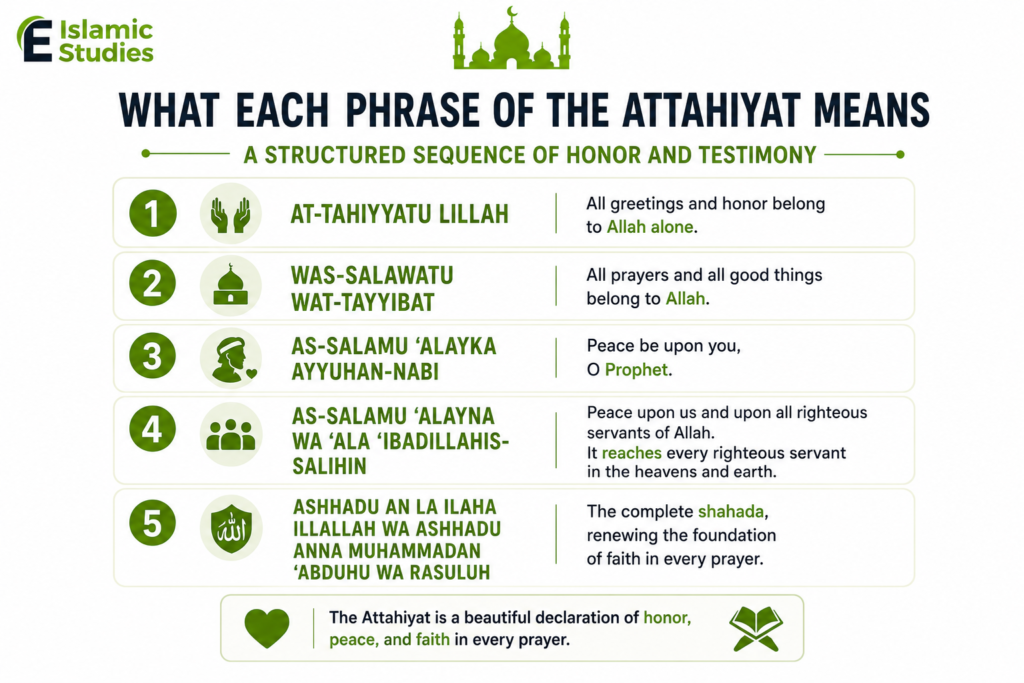
- At-tahiyyatu lillah — all greetings and honor belong to Allah alone. This opening declares that every form of respect, reverence, and glorification is owed exclusively to the Creator.
- Was-salawatu wat-tayyibat — all prayers and all good things belong to Allah. Every act of worship and every pure thing returns ultimately to Him.
- As-salamu ‘alayka ayyuhan-nabi — peace be upon you, O Prophet. This is a direct personal greeting to the Prophet Muhammad, peace be upon him, delivered by every Muslim in every prayer across the world and throughout history.
- As-salamu ‘alayna wa ‘ala ‘ibadillahis-salihin — peace upon us and upon all righteous servants of Allah. The Prophet confirmed in an authentic hadith that when a Muslim recites this phrase, it reaches every righteous servant in the heavens and the earth.
- Ashhadu an la ilaha illallah wa ashhadu anna Muhammadan ‘abduhu wa rasuluh — the complete shahada, renewing the foundational testimony of Islamic faith within every prayer.
Read also: What Is Istihsan in Islam? Definition, Types, and Evidence
How to Recite Tashahhud — Body Position and Sunnah Acts
Knowing how to recite tashahhud correctly includes not only the words but the proper body position and the specific Sunnah acts the Prophet demonstrated. These details are established in authenticated hadiths and agreed upon by scholars across the major schools:
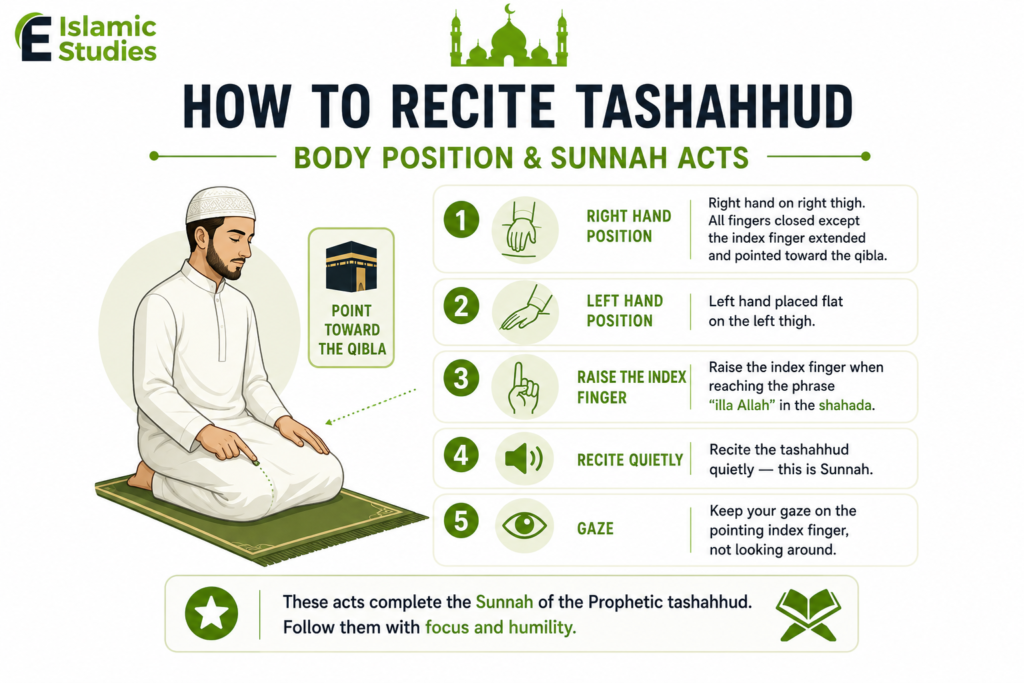
- The right hand is placed on the right thigh with all fingers closed into a fist, except the index finger which is extended and pointed toward the qibla.
- The left hand is placed flat on the left thigh.
- The index finger is raised at the moment of saying the shahada — specifically when reaching the phrase “illa Allah” in the testimony.
- The recitation is performed quietly — narrated explicitly as Sunnah by Abu Dawud with a sahih grading.
- The gaze during tashahhud is directed toward the pointing index finger, not looking around.
The Prophet, peace be upon him, demonstrated this hand position to his companions, and Abdullah ibn Umar specifically instructed others to follow it exactly as the Prophet did — a narration preserved in Sahih Muslim.
At E Islamic Studies Academy, the Learn Islam for Beginners course teaches the complete practical details of salah — including the correct position, recitation, and Sunnah acts of the tashahhud — for students who are just beginning their Islamic learning journey.
Read also: What Is Ijma in Islam? Definition, Types, and Evidence

Start learning your prayer the right way today.
What Happens If You Forget the Tashahhud
Islamic jurisprudence has precise rulings for situations where a Muslim forgets or is unsure about the tashahhud during prayer. Every Muslim who prays regularly will benefit from knowing these rulings:
- Forgetting the first tashahhud (in a three or four unit prayer) does not invalidate the prayer. The person continues and performs two prostrations of forgetfulness (sujud al-sahw) before the salam in compensation.
- Forgetting the final tashahhud and remembering before salam: the person returns to the sitting position, recites the tashahhud, and continues the prayer.
- Completing the salam without the final tashahhud: according to the Shafi’i school, the prayer must be repeated since a pillar was omitted. Other schools apply different rulings based on the specific circumstances.
- Reciting the attahiyat in a language other than Arabic is not valid — the tashahhud must be recited in Arabic as taught by the Prophet. A new Muslim who has not yet memorized it must continue learning and is not permitted to substitute it with a translation during the prayer itself.
Watch a Sample Islamic Studies Class
See how our teachers explain Islamic concepts in an engaging and easy-to-understand way, helping students build knowledge and confidence.
Deepen Your Islamic Knowledge
Join our comprehensive online courses and learn from qualified scholars today.
Book Your Free TrialE Islamic Studies Academy Teaches You to Pray Correctly
Thousands of Muslims worldwide want to pray with full correctness — knowing every word, every ruling, and every Sunnah act that makes their salah accepted by Allah. E Islamic Studies Academy provides one-on-one live sessions with qualified scholars grounded in classical Islamic sciences.
Programs are structured from complete beginner foundations through to advanced scholarship. Dedicated courses exist for women, new converts, children, adult learners, and sisters seeking female-led instruction. All global time zones are covered and a free trial class is available before any commitment.
Our Islamic Courses
- Islam Classes for Adults
- Islam Classes for Sisters
- Alimah Course for Ladies
- Islam Classes for Kids
- Learn Islam for Beginners
- Learning Islam for New Converts
Our Islamic Programs
- Islamic Distance Learning Programs
- Islamic Courses Workshops
- Intensive Islamic Course
- Islam Crash Course
- Learning Islam Level 1 Online
- Darse Nizami / Traditional Alim Courses
Register at E Islamic Studies Academy today.
Deepen Your Islamic Knowledge
Join our comprehensive online courses and learn from qualified scholars today.
Book Your Free TrialConclusion
The attahiyat and tashahhud are among the most profound moments in every prayer — a declaration of faith, a greeting to the Prophet, and a salutation to every righteous soul in the heavens and the earth, delivered five times every day. Learning its words, meaning, and correct recitation is not just about fulfilling a condition of prayer — it is about praying with understanding, presence, and connection to Allah.
Frequently Asked Questions
What is the attahiyat in Arabic and when is it recited?
The attahiyat is the supplication beginning with “At-tahiyyatu lillah” recited in the sitting position after the second rak’ah and in the final sitting of every prayer.
What is the tashahhud and is it obligatory?
The tashahhud is the complete recitation during the sitting position of prayer. The final tashahhud is a pillar of prayer — obligatory — while the first tashahhud in longer prayers is considered Sunnah by the majority of scholars.
How to recite tashahhud with the correct hand position?
Place the right hand on the right thigh with fingers closed, raise the index finger during the shahada pointing toward the qibla, and place the left hand flat on the left thigh.
What is the difference between the first and final tashahhud?
The first tashahhud contains the attahiyat text and shahada only. The final tashahhud adds the complete Ibrahimiyya salawat — the prayer upon the Prophet and his family — before the salam.
Related Articles
Learning Islam








Leave a Reply