 Learning Islam
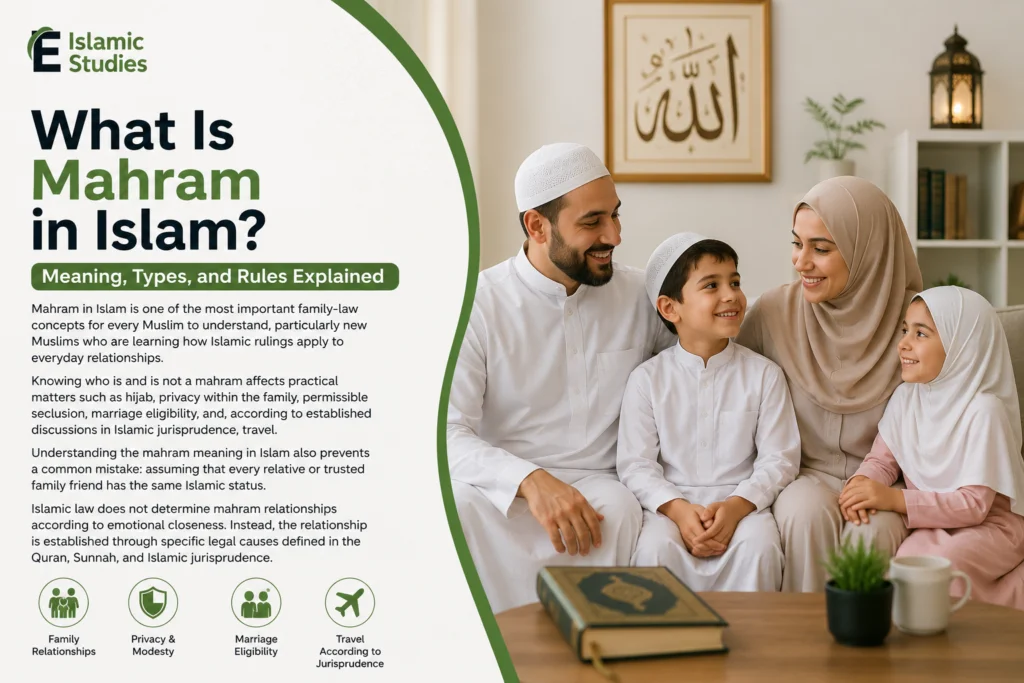
Mahram in Islam is one of the most important family-law concepts for every Muslim to understand, particularly new Muslims who are learning how Islamic rulings apply to everyday relationships.
Knowing who is and is not a mahram affects practical matters such as hijab, privacy within the family, permissible seclusion, marriage eligibility, and, according to established discussions in Islamic jurisprudence, travel.
Understanding the mahram meaning in Islam also prevents a common mistake: assuming that every relative or trusted family friend has the same Islamic status. Islamic law does not determine mahram relationships according to emotional closeness.
Instead, the relationship is established through specific legal causes defined in the Quran, Sunnah, and Islamic jurisprudence.
This guide explains the mahram definition in Islam, the three ways a mahram relationship can be established, which relatives are and are not mahram, and how these rulings affect everyday Muslim life.
By the end of the article, you should have a clearer framework for identifying mahram relationships and understanding when more detailed guidance from a qualified Islamic teacher may be necessary.
What You Will Learn
- The exact mahram meaning in Islam and how a mahram differs from an ordinary relative.
- The three ways mahram status is established: blood relation (nasab), breastfeeding (rada’ah), and marriage (musaharah).
- Which male relatives are mahram to a woman and which relatives including cousins remain non-mahram.
- How mahram status affects hijab, travel, and being alone together (khulwah).
- Why permanent prohibition of marriage is central to understanding the definition.
- Where to continue studying Islamic family rulings through structured Islamic education.
What Is Mahram in Islam? (Mahram Meaning and Definition)
Mahram (Arabic: محرم, plural: maharim / محارم) in Islamic law refers to a person whom another person is permanently forbidden to marry because of an established relationship recognized by Islamic law.
This permanent prohibition is the key principle that separates a genuine mahram relationship from relationships in which marriage is only temporarily prohibited or remains permissible.
As the jurist Ibn Nujaym explained, a woman’s mahram is one whom she is never permitted to marry because of a blood relationship, breastfeeding relationship, or marriage relationship. This provides a concise foundation for understanding the mahram definition in Islam.
The word permanently is especially important. A person does not become a mahram merely because marriage is currently impossible.
For example, a woman’s sister’s husband cannot marry her while he remains married to her sister, but this prohibition is not necessarily permanent. Therefore, he does not become her mahram simply because marriage between them is prohibited at that particular time.
When a genuine mahram relationship exists, Islamic law treats certain interactions differently from interactions between unrelated marriageable men and women.
However, mahram status should never be reduced to the idea of someone being “safe,” “close,” or “like family.” A trusted friend, family acquaintance, distant relative, or cousin does not become mahram through familiarity. The relationship must arise through one of the legally recognized causes explained below.
Students who want to understand how these principles fit into broader Islamic law can study them systematically through the academy’s Online Fiqh Course or the more specialized Fiqh of Marriage Course.
Start with a Free Trial at E Islamic Studies Academy

Why the Concept of Mahram Matters in Islam
The concept of mahram is closely connected to Islamic teachings concerning family boundaries, modesty, privacy, marriage, and interactions between men and women.
Instead of leaving these relationships undefined, Islamic law provides recognizable categories so Muslims can understand which rules apply in different family and social situations.
These boundaries are also connected to the broader Islamic concern for preserving dignity and honor (hifdh al-‘ird). Muslim jurists discuss the protection of honor alongside other fundamental objectives and interests protected by Islamic law.
In practical terms, knowing whether someone is mahram helps Muslims determine how rulings concerning hijab, khulwah, marriage, and certain forms of travel should be approached.
Islamic scholarship therefore distinguishes between a mahram and an ajnabi someone outside the relevant mahram relationship.
An ajnabi may be completely unrelated, but the category can also include relatives whom a person is legally permitted to marry, such as cousins.

For Muslims who want to understand these rulings as part of a complete framework rather than learning isolated answers online, Essential Islam Courses provide a structured route into foundational Islamic knowledge.
If these concepts are new to you, structured study can make them significantly easier to understand. Students can begin with Learn Islam for Beginners or explore Fiqh Class for New Muslims for guided instruction in practical Islamic rulings.
Start with a Free Trial at E Islamic Studies Academy

The Three Categories of Mahram in Islam
Islamic scholars generally explain mahram relationships according to three principal causes: blood relationship (nasab), breastfeeding (rada’ah), and relationships created through marriage (musaharah).
Understanding these three categories is usually more useful than memorizing individual names because it explains why marriage becomes permanently prohibited.
Each category has its own details and conditions. Blood relationships are normally the easiest to identify, while breastfeeding and marriage relationships may require greater care because the legal effect can depend on circumstances such as when breastfeeding occurred or whether consummation took place in a particular marriage.
1. Mahram by Blood Relation (Nasab)
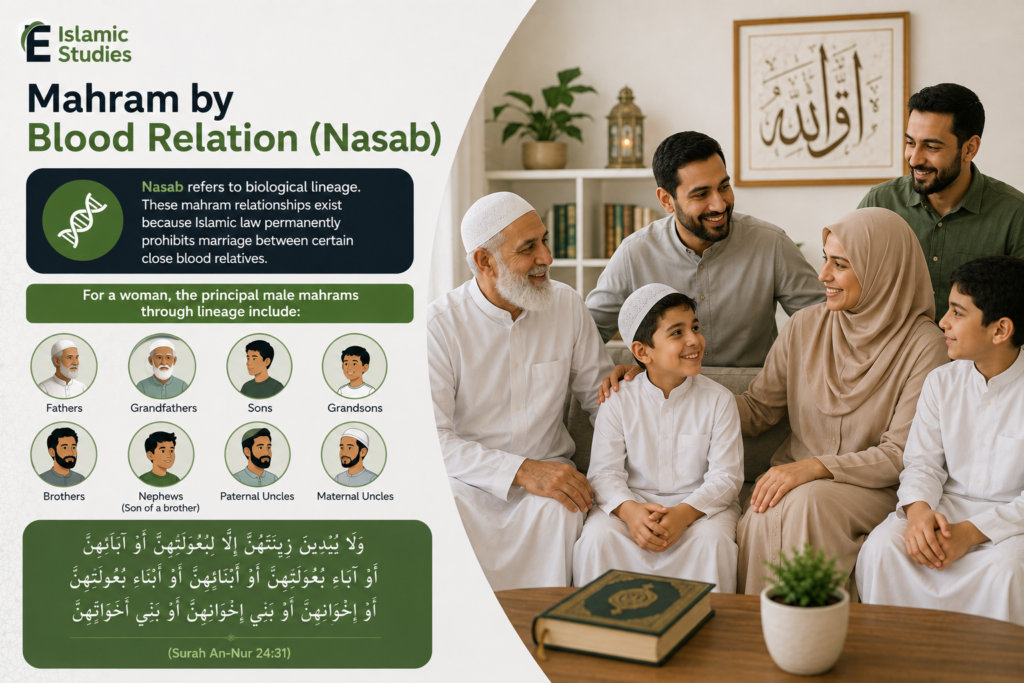
Nasab refers to biological lineage. These mahram relationships exist because Islamic law permanently prohibits marriage between certain close blood relatives.
For a woman, the principal male mahrams through lineage include her direct male ancestors, direct male descendants, brothers, certain nephews, and paternal and maternal uncles.
They include:
- Her father and grandfathers, however high in the lineage.
- Her son and grandsons, however far the direct line continues.
- Her full brother.
- Her paternal half-brother.
- Her maternal half-brother.
- Her brother’s sons and their male descendants.
- Her sister’s sons and their male descendants.
- Her paternal uncles.
- Her maternal uncles.
Many of these relationships appear explicitly in the Quran when Allah describes those before whom believing women may display what would otherwise be concealed from unrelated men:
وَلَا يُبْدِينَ زِينَتَهُنَّ إِلَّا لِبُعُولَتِهِنَّ أَوْ آبَائِهِنَّ أَوْ آبَاءِ بُعُولَتِهِنَّ أَوْ أَبْنَائِهِنَّ أَوْ أَبْنَاءِ بُعُولَتِهِنَّ أَوْ إِخْوَانِهِنَّ أَوْ بَنِي إِخْوَانِهِنَّ أَوْ بَنِي أَخَوَاتِهِنَّ
“And they should not display their adornment except to their husbands, their fathers, their husbands’ fathers, their sons, their husbands’ sons, their brothers, their brothers’ sons, or their sisters’ sons…”
Paternal and maternal uncles are not individually named in this portion of the verse, but classical Islamic jurisprudence includes them among a woman’s mahrams because marriage to one’s paternal or maternal uncle is permanently prohibited.
An important distinction should also be remembered here: the children of those uncles and a woman’s cousins do not share the same status. A paternal or maternal uncle is mahram, while his son ordinarily is not, because marriage between cousins is permissible.
Understanding distinctions like this becomes much easier when family law is studied systematically.
The Islam Classes for Adults cover foundational Islamic rulings within a guided learning environment rather than leaving students to piece together individual rulings on their own.
2. Mahram by Breastfeeding (Rada’ah)
Rada’ah refers to a legally recognized breastfeeding relationship. Islamic law gives qualifying breastfeeding relationships significant consequences: under the established Prophetic principle, relationships prohibited for marriage through lineage can also become prohibited through breastfeeding.
For example, when a qualifying breastfeeding relationship has been established, people who become equivalent to a milk-father, milk-brother, milk-uncle, or other corresponding milk-relative may acquire mahram status even though no biological relationship exists between them.
The precise conditions for establishing rada’ah are an area in which the schools of Islamic jurisprudence discuss important details.
These include the age during which breastfeeding produces the legal relationship and, according to different juristic positions, questions concerning the number or nature of feeds required.
Therefore, a complicated real-life breastfeeding case should not be decided merely by looking at a simplified family chart.
The underlying Prophetic principle is clearly established in the Sunnah:
«لَا تَحْتَجِبِي مِنْهُ، فَإِنَّهُ يَحْرُمُ مِنَ الرَّضَاعَةِ مَا يَحْرُمُ مِنَ النَّسَبِ»
“Do not veil yourself from him, for breastfeeding makes unlawful what blood relation makes unlawful.”
The narration concerns a breastfeeding relationship and demonstrates that rada’ah can create genuine family prohibitions rather than merely an informal bond. In other words, Islamic breastfeeding relationships can carry legal consequences relating to marriage and mahram status.
Because individual breastfeeding cases can become complicated particularly when several children and families are involved, students should learn both the general principle and the detailed position relevant to the school of jurisprudence they follow.
Those wanting deeper study can explore the academy’s Hanafi Fiqh Course,Maliki Fiqh Course, Shafi Fiqh Course, or Hanbali Fiqh Course to understand how detailed fiqh questions are analyzed within recognized scholarly traditions.

3. Mahram by Marriage (Musaharah)
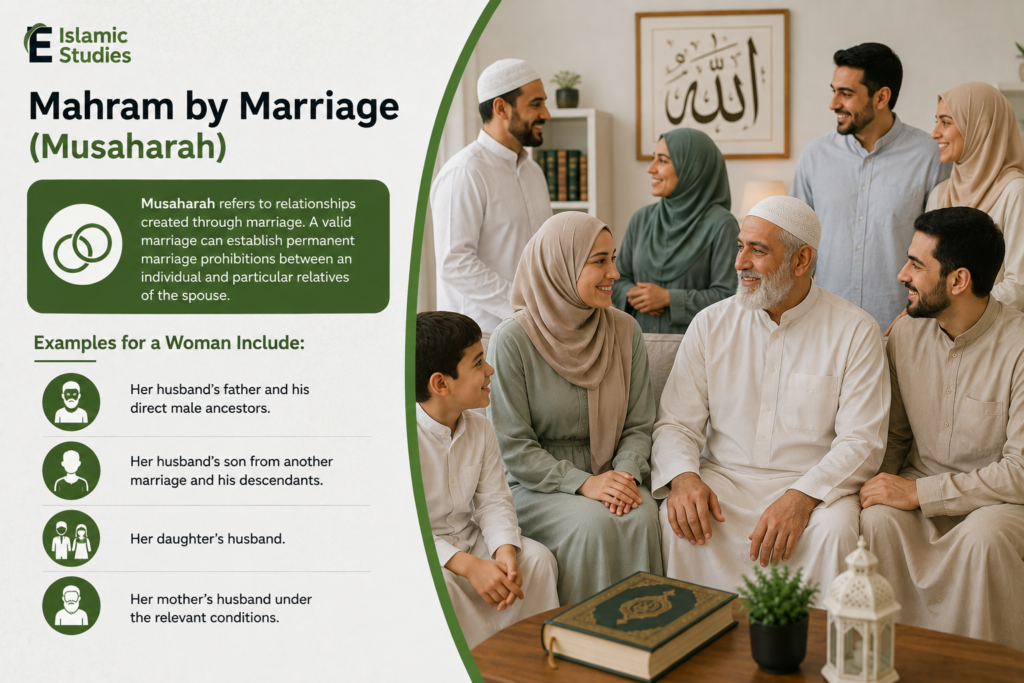
Musaharah refers to relationships created through marriage. A valid marriage can establish permanent marriage prohibitions between an individual and particular relatives of the spouse, creating mahram relationships even though there is neither a biological nor breastfeeding connection.
For a woman, examples can include:
- Her husband’s father and his direct male ancestors.
- Her husband’s son from another marriage and his descendants.
- Her daughter’s husband.
- Her mother’s husband under the relevant conditions.
These cases illustrate an important principle: marriage does not make every in-law a mahram. Only specific relationships recognized by Islamic law acquire permanent prohibition.
The timing of that prohibition can also differ. Some relationships become permanently prohibited through the marriage contract itself, whereas another relationship may depend upon consummation.
One important example concerns a man’s stepdaughter: the Quran connects the permanent prohibition with consummation of his marriage to her mother.
If you are studying marriage, engagement, mahram relationships, or other family rulings, the Fiqh of Marriage Course offers a more structured way to understand how these rulings connect.
Turn family questions into knowledge you can actually apply. Instead of relying on disconnected answers, learn the principles of Islamic family law with qualified teachers through E Islamic Studies Academy.
See Our Islamic Studies Classes in Action
Take a look at a sample lesson and see how our interactive online classes help students learn Islamic Studies in a clear, engaging, and supportive environment.
Deepen Your Islamic Knowledge
Join our comprehensive online courses and learn from qualified scholars today.
Book Your Free TrialMahram in Islam at a Glance
The easiest way to understand mahram relationships is to group them according to how the permanent prohibition of marriage is established. In Islam, this happens through three main causes: blood relation, breastfeeding, and marriage.
- A mahram by blood relation (nasab) includes close relatives such as a woman’s father, grandfather, son, grandson, brother, nephew, paternal uncle, and maternal uncle. These relationships are established through birth and lineage, and marriage between them is permanently prohibited.
- A mahram by breastfeeding (rada’ah) is created when a qualifying breastfeeding relationship is established according to Islamic law.This can make individuals such as a milk-father, milk-brother, or milk-uncle mahram in a manner similar to corresponding blood relatives. Because scholars discuss specific conditions concerning breastfeeding, individual cases may require guidance from a qualified teacher.
- A mahram by marriage (musaharah) includes specific relatives whose permanent marriage prohibition arises through a valid marriage, such as a father-in-law, son-in-law, stepson, or stepfather under the relevant conditions.
It is important to remember that not every in-law automatically becomes a mahram.
A useful rule for beginners is to ask: Is marriage between these two people permanently forbidden because of blood relation, recognized breastfeeding, or a specific marriage relationship? If the answer is unclear, the relationship should be checked rather than assumed.
Who Is Not Considered a Mahram in Islam
Knowing who is not a mahram is just as important as knowing who is. One of the most common misconceptions is that family familiarity automatically changes Islamic boundaries. It does not. Someone may have known a woman since childhood, regularly attend family gatherings, or be described socially as “like a brother” while still remaining non-mahram in Islamic law.
Cousins are an important example. A paternal cousin or maternal cousin is not a mahram merely because the families are closely connected. Since marriage between cousins is permissible in Islam, cousins remain within the category of people with whom marriage is legally possible.
A woman’s sister’s husband is another commonly misunderstood example. He is not her mahram. Although he cannot marry two sisters simultaneously, this is a temporary rather than permanent marriage prohibition.
If the marriage to her sister ended and the relevant legal conditions were completed, marriage could potentially become permissible.
Other examples can include:
- A friend’s husband.
- A husband’s brother.
- A sister’s husband.
- A male family friend.
- A distant relative who is not covered by the established mahram categories.
- A cousin from either the paternal or maternal side.
This distinction matters because rules concerning hijab and khulwah continue to apply with non-mahram relatives even when the relationship is socially close.
New Muslims in particular may encounter family structures that do not fit neatly into simplified examples. Learning Islam for New Converts provides a structured environment for learning how Islamic principles apply to real everyday situations.

How Mahram Status Affects Daily Life in Islam
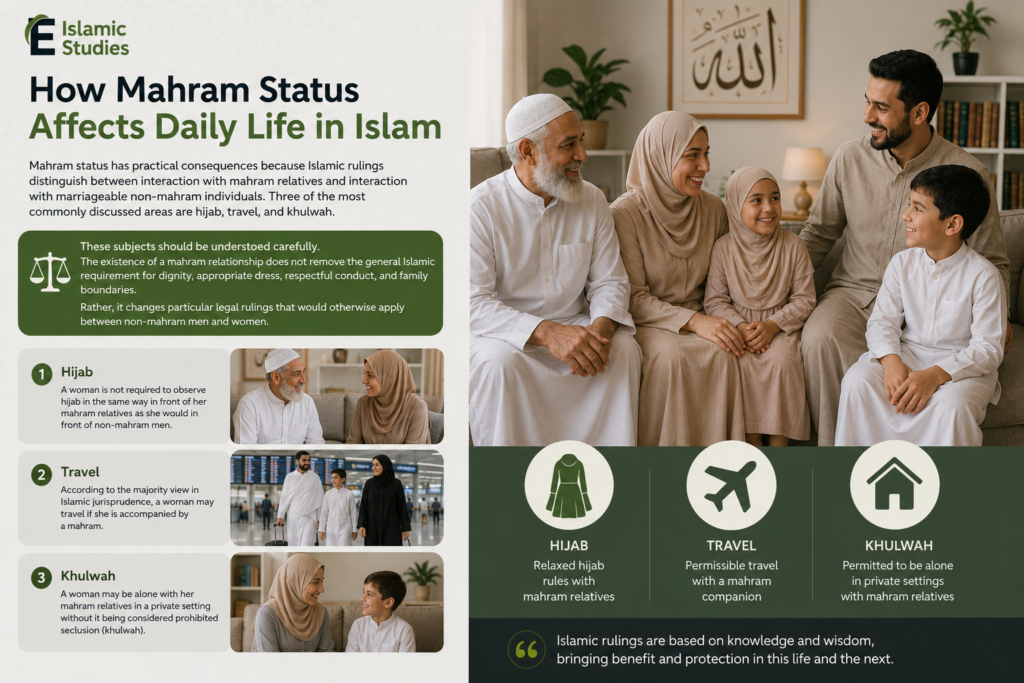
Mahram status has practical consequences because Islamic rulings distinguish between interaction with mahram relatives and interaction with marriageable non-mahram individuals. Three of the most commonly discussed areas are hijab, travel, and khulwah.
These subjects should be understood carefully. The existence of a mahram relationship does not remove the general Islamic requirement for dignity, appropriate dress, respectful conduct, and family boundaries.
Rather, it changes particular legal rulings that would otherwise apply between non-mahram men and women.
Hijab in Front of a Mahram
A Muslim woman is not required to observe hijab before her mahram in exactly the same manner required before unrelated marriageable men. Surah An-Nur identifies several categories of relatives before whom a woman may display adornment that she would ordinarily conceal from non-mahram men.
This does not mean that modesty disappears within the family. Islamic teachings continue to emphasize appropriate clothing, behavior, privacy, and dignity.
The distinction is that the rules governing what must be concealed from non-mahram men are not applied identically to genuine mahram relatives.
The Quranic basis appears in Surah An-Nur (24:31), which names husbands and several categories of close relatives in its discussion of adornment and modesty.
Because questions concerning hijab can involve more detail than a single rule, women seeking structured study can explore Islam Classes for Sisters or the more extensive Alimah Course for Ladies.

Traveling with a Mahram
The question of a woman’s travel and the presence of a mahram is based on authentic Prophetic narrations and has received detailed discussion in Islamic jurisprudence.
The hadith literature contains explicit instructions concerning travel without a mahram, while jurists have discussed how these narrations apply to different forms of travel and particular circumstances.
One well-known narration states:
«لَا تُسَافِرِ الْمَرْأَةُ إِلَّا مَعَ ذِي مَحْرَمٍ»
“A woman should not travel except with a mahram.”
Narrated by: Ibn ‘Abbas (may Allah be pleased with him)
Source: Sahih al-Bukhari and Sahih Muslim (agreed upon)
Rather than treating every modern travel question as identical, Muslims should distinguish between the authentic textual foundation of the ruling and the detailed juristic discussion concerning its application.
Circumstances such as the purpose and nature of a journey may form part of more detailed fiqh discussions, depending on the scholarly position being studied.
For that reason, anyone facing a specific travel situation should seek guidance from a qualified scholar rather than relying exclusively on a general article.
Students who want to understand why scholars sometimes reach different conclusions while working from the same Quran and Sunnah can explore the Comparative Fiqh Course.
Being Alone Together (Khulwah) with a Mahram
Khulwah generally refers to unlawful seclusion between a man and woman who are not mahram to one another in circumstances where they are privately alone.
Islamic teachings restrict such seclusion as part of the broader framework governing interaction between unrelated men and women.
A genuine mahram relationship changes this ruling because marriage between the two is permanently prohibited. Therefore, ordinary seclusion between genuine mahram relatives is not treated as prohibited khulwah in the same way as seclusion between non-mahram men and women.
A widely cited Prophetic warning states:
«أَلَا لَا يَخْلُوَنَّ رَجُلٌ بِامْرَأَةٍ إِلَّا كَانَ ثَالِثَهُمَا الشَّيْطَانُ»
“No man is ever alone with a woman except that Shaytan is the third one present.”
Narrated by: ‘Umar ibn al-Khattab (may Allah be pleased with him)
Source: Musnad Ahmad
The practical point is that familiarity does not cancel the ruling of khulwah. A cousin, brother-in-law, colleague, family friend, or other trusted individual remains non-mahram if no recognized mahram relationship exists.
Read Also: What Is Tawbah in Islam? Meaning, Conditions, and How to Repent
Continue Learning About Mahram and Islamic Family Rulings
Mahram rulings are one part of a much broader field of Islamic jurisprudence covering marriage, family relationships, modesty, responsibilities, worship, financial dealings, and everyday Muslim conduct.
Learning individual answers can solve an immediate question, but studying the principles behind those answers provides a much stronger foundation.
This is especially valuable for new Muslims. Concepts such as mahram, khulwah, hijab, marriage eligibility, and family rights are connected to one another.
When they are studied with a qualified teacher, students can understand not only what a ruling is but also the evidence, conditions, exceptions, and scholarly reasoning surrounding it.
E Islamic Studies Academy offers structured online classes designed to help students study Islamic jurisprudence, family rulings, and everyday Islamic practice progressively.
Whether you are a new Muslim building your first foundation or a long-term student who wants to move beyond scattered online information, guided learning can make difficult fiqh subjects much easier to understand and apply.
Don’t stop at knowing who your mahram is. Learn the Islamic principles that shape marriage, family life, worship, character, and everyday decisions.
Start with a Free Trial at E Islamic Studies Academy

Read Also: What Is Shirk in Islam? Meaning, Types, and Examples Explained
Deepen Your Understanding of Islamic Family Rulings
Understanding Islamic family law requires more than memorizing lists of permitted and prohibited relationships. A strong foundation comes from learning how Quranic evidence, authentic Sunnah, and established principles of fiqh work together.
This allows students to approach new situations with greater clarity instead of depending entirely on isolated answers.
E Islamic Studies Academy provides learning paths for beginners, adults, sisters, new converts, and students seeking more advanced Islamic studies.
Read Also: Dua After Adhan – A Complete Guide to Prayer After Azan
Watch a Sample Islamic Studies Class
See how our teachers explain Islamic concepts in an engaging and easy-to-understand way, helping students build knowledge and confidence.
Deepen Your Islamic Knowledge
Join our comprehensive online courses and learn from qualified scholars today.
Book Your Free Trial
Explore More Courses at E Islamic Studies Academy
Different students need different learning paths. A new Muslim may need a broad introduction to Islamic beliefs and practice, while another student may want detailed study of fiqh or a traditional curriculum. The academy’s courses are organized to support these different levels and goals.
Our Islamic Courses
These courses provide accessible routes into Islamic learning for different ages and levels. Adults and new Muslims can begin with foundational material, while sisters and advanced students can choose programs designed for more extensive and progressive study.
Learning Islam for New Converts
Conclusion
Understanding mahram in Islam gives Muslims a practical framework for navigating family relationships, modesty, marriage eligibility, privacy, and interactions between men and women. The most important principle to remember is that mahram status is based on a permanent prohibition of marriage, not simply closeness, trust, or family custom.
A mahram relationship can arise through three principal causes: blood relation (nasab), qualifying breastfeeding (rada’ah), and specific relationships created through marriage (musaharah).
Once that relationship has been correctly established, it affects practical rulings involving matters such as hijab and khulwah and also forms part of the classical Islamic discussion concerning women’s travel.
It is equally important to recognize relationships that do not create mahram status. Cousins, brothers-in-law, sisters’ husbands, family friends, and other familiar individuals can remain non-mahram despite being deeply integrated into family life.
For straightforward relationships, these principles provide a useful foundation. For complicated breastfeeding relationships, stepfamilies, marriage situations, or questions involving differences among jurists, guidance from a qualified scholar or teacher is the safer approach.
If you want to go beyond individual rulings and understand the wider system of Islamic family jurisprudence, begin structured study through the Online Fiqh Course or Fiqh of Marriage Course at E Islamic Studies Academy.
Frequently Asked Questions About Mahram in Islam
What does mahram mean in Islam?
A mahram is a person whom someone is permanently prohibited from marrying because of a recognized blood relationship, breastfeeding relationship, or marriage relationship. The permanence of the prohibition is essential to the definition.
Mahram status affects several practical Islamic rulings. For example, the rules of hijab and khulwah between genuine mahram relatives differ from those applying between marriageable non-mahram men and women.
Who is considered mahram in Islam?
For a woman, mahram relatives through blood include her father, grandfathers, sons, grandsons, brothers, nephews, paternal uncles, and maternal uncles.
Equivalent relationships may also arise through qualifying breastfeeding, while certain relatives created through marriage such as a father-in-law or son-in-law also become mahram.
The complete answer depends on the exact relationship, so it is more reliable to understand the three causes of mahram status nasab, rada’ah, and musaharah than to memorize a short list.
Is a cousin a mahram in Islam?
No. A paternal or maternal cousin is generally not a mahram because marriage between cousins is permissible in Islam.
This remains true even when cousins grow up together, are extremely close, or are treated socially like siblings.
Emotional closeness does not create legal mahram status, so the Islamic rules applicable to non-mahram interaction continue to apply.
How is mahram different from ajnabi in Islam?
A mahram is someone whom a person is permanently prohibited from marrying because of a recognized Islamic legal relationship. An ajnabi, in this context, is someone outside that mahram relationship and therefore potentially marriageable in principle.
A cousin is a useful example. Although a cousin is a blood relative, marriage between cousins is permitted, so a cousin remains non-mahram. This is why the ordinary rules concerning hijab and prohibited khulwah apply.
The distinction demonstrates one of the central principles of the entire subject: being related does not automatically mean being mahram.
Study Islamic family law with qualified teachers, ask questions about your own circumstances, and build knowledge you can confidently apply in everyday Muslim life.







Leave a Reply