Ghusl In Islam – Meaning, Types, And How To Perform It Step By Step
Have you ever stepped out of the shower wondering whether you missed something that could affect your prayer? Many Muslims, new and lifelong alike, feel unsure about the details of ghusl in Islam.
Ghusl in Islam is the full-body ritual bath that lifts major impurity and prepares you to stand before Allah in prayer. Once you separate what is required from what is Sunnah, it becomes simple.
In this guide, you will learn what ghusl means, when it is obligatory or recommended, the minimum valid method, and the complete method of the Prophet ﷺ as described by ʿĀʾishah (may Allah be pleased with her).
Key Takeaways: What You Will Learn
What ghusl in Islam means and its evidence from the Qur’an and Sunnah
The obligatory and recommended types of Islamic ritual bath
The minimum valid ghusl versus the complete Sunnah method
Practical tips for hair, braids, jewelry, and hard-to-reach areas
How the four Sunni schools differ on the obligatory acts
What Is Ghusl in Islam?
Ghusl (غُسْل) literally means “washing.” In Islamic law, it is washing the entire body with pure water, with the intention of removing major ritual impurity (al-ḥadath al-akbar).
Allah says: “And if you are in a state of ˹full˺ impurity, then take a full bath.” (Qur’an 5:6). Scholars cite this verse as the foundation of ghusl in Islam and its obligation.
Wuḍūʾ removes minor impurity, such as after using the toilet or sleeping. Ghusl in Islam removes major impurity caused by janābah, menstruation, or postpartum bleeding.
Why Does Ghusl Matter for Your Worship?
Because purity is a condition for valid prayer. A person in major impurity may not pray, perform ṭawāf, or touch the mushaf until they bathe. The Prophet ﷺ said:
Scholars such as Imam an-Nawawi explained that faith cleanses the heart of disbelief and sin, while ṭahārah cleanses the body of impurity, so the two complete each other. Purity is also a condition of prayer, so neglecting ghusl affects the most important pillar of a Muslim’s daily worship. Allah says:
“Surely Allah loves those who always turn to Him in repentance and those who purify themselves ” (Qur’an 2:222).
This verse comes right after the rulings on menstruation, which links it directly to purification. It names two people Allah loves: those who purify their hearts through repentance, and those who purify their bodies with water. So when you perform ghusl with sincere intention, you are doing something Allah loves.
For students who recite the Qur’an daily, understanding ghusl in Islam is the first step before opening the mushaf. That is why our students often start with Islamic studies for beginners to learn the basics of taharah.
Live Class in Action
Watch how our instructors interact with students in real time, focusing on interactive methods.
Deepen Your Islamic Knowledge
Join our comprehensive online courses and learn from qualified scholars today.
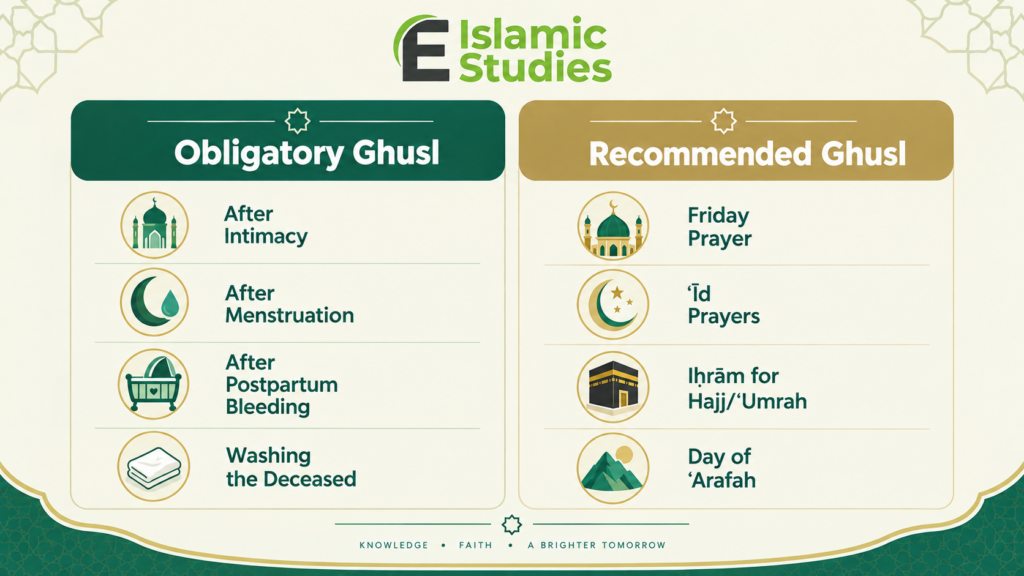
Scholars divide the types of Islamic ritual bath into two groups: obligatory baths required before worship, and recommended baths done for extra reward and cleanliness.
When Is Ghusl Obligatory?
Ghusl becomes obligatory in these situations:
After sexual intercourse, even without ejaculation.
After emission of semen with desire, whether awake or in a wet dream.
When menstruation (ḥayḍ) ends.
When postpartum bleeding (nifās) ends.
Washing the deceased Muslim, a communal duty on the living.
Many scholars, including the Ḥanbalī school, also require ghusl when a person embraces Islam, while others consider it recommended. Jaʿfarī (Shia) jurisprudence adds further cases, such as touching a dead body before it is washed.
When Is Ghusl Recommended?
Ghusl is recommended before the Friday (Jumuʿah) prayer, before the two ʿĪd prayers, when entering ihram for Hajj or Umrah, on the Day of Arafah, and after washing a deceased person. The Friday bath is strongly emphasized. Some scholars hold it obligatory based on the following hadith, but the majority view it as a confirmed Sunnah.
“Ghusl (taking a bath) on Friday is compulsory for every Muslim reaching the age of puberty” (al-Bukhārī),
Don’t just take our word for it—take a look inside! Watch the videos below to experience our engaging teaching methods and vibrant online classrooms firsthand.
Deepen Your Islamic Knowledge
Join our comprehensive online courses and learn from qualified scholars today.
Before you learn the steps of ghusl in Islam, it helps to know what makes it valid. Scholars describe two accepted forms of ghusl in Islam: a minimum form that removes major impurity, and a complete form that follows the Sunnah. Both are valid, but the complete form earns greater reward.
What Is the Minimum Valid Form of Ghusl?
The minimum valid form of ghusl in Islam has two parts: intention and washing the whole body once. Form the intention in your heart, then let water reach every part of your body, including the hair roots and skin folds.
Shaykh Ibn ʿUthaymīn explained that Allah only said “purify yourselves,” so whoever washes the entire body once has purified himself. Many scholars add rinsing the mouth and nose as part of this minimum.
What Can Make Ghusl Invalid?
Anything that stops water from reaching the skin. Remove waterproof nail polish, glue, paint, or thick makeup before you begin, because any dry spot means the ghusl is incomplete.
If you later realize a spot stayed dry, wash that spot. Many scholars say you do not need to repeat the whole ghusl, because continuity is not a condition in most schools.
How Do the Four Madhhabs Differ?
All four Sunni schools agree on the core of ghusl in Islam: water must reach the entire body. They differ mainly on intention, rinsing the mouth and nose, and rubbing the body:
School
Intention
Mouth and Nose
Special Emphasis
Hanafī
Sunnah
Obligatory
Water must reach every hair and pore
Malikī
Obligatory
Sunnah
Rubbing (dalk) and continuity are obligatory
Shafiʿī
Obligatory
Sunnah
Water must reach all skin and hair
Hanbalī
Obligatory
Obligatory
Intention is a condition of validity
You are not required to follow one madhhab blindly. Follow a qualified scholar you trust, or study fiqh with a teacher who explains the evidence, as students do in structured Islamic Studies classes.
Ghusl Steps in Islam: The Complete Sunnah Method
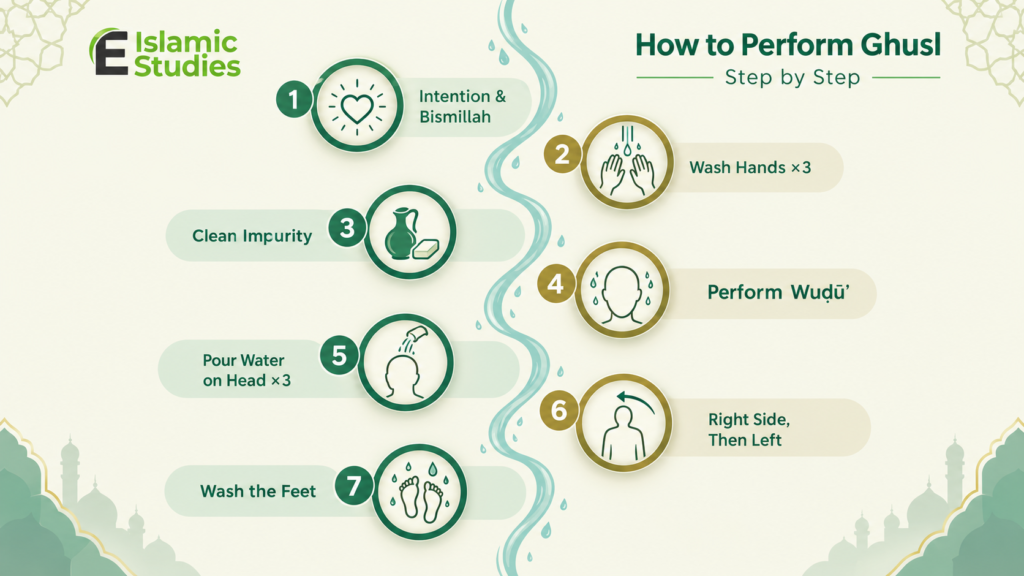
The complete method comes from ʿĀʾishah. She said that when the Prophet ﷺ bathed from janābah, he washed his hands, performed wudu as for prayer, ran his fingers through his hair, poured water over his head three times, and then washed the rest of his body (al-Bukhārī and Muslim).
Make the Intention and Say, Bismillah: The first step to do ghusl is to make an intention (niyyah). Intend in your heart that this bath removes major impurity for the sake of Allah, without saying it aloud. Then say “Bismillāh.”
Wash Your Hands Three Times: Wash both hands up to the wrists three times before putting them into a container or using them on the body.
Clean the Private Parts: Use the left hand to wash away any discharge or impurity from the private parts. Then wash your hands well, using soap if available.
Perform a Complete Wudu: Perform wuḍūʾ as you would for prayer: rinse the mouth and nose, wash the face and arms, and wipe the head. You may leave washing the feet until the end, as Maymūnah described.
Pour Water Over the Head Three Times: Run wet fingers through your hair so water reaches the scalp, then pour water over your head three times. The Prophet ﷺ began with the right side of the head, then the left.
Wash the Right Side, Then the Left: Pour water over the right side of your body, then the left. Rub with your hands and check the armpits, navel, behind the ears, between the fingers and toes, and behind the knees.
Wash the Feet If You Delayed Them: If you left your feet out of wudu, move slightly and wash them now. At this point, your ghusl in Islam is complete and valid.
Practical Tips for a Complete Ghusl
Small details often cause the most worry, especially for women and new Muslims. These tips cover the points learners ask us about most.
Do Women Need to Undo Their Braids?
No. Umm Salamah asked the Prophet ﷺ about her tightly braided hair, and he said it was enough to pour three handfuls of water over her head, then over her body. What matters is that water reaches the scalp.
Umm Salama reported: I said: Messenger of Allah, I am a woman who has closely plaited hair on my head; should I undo it for taking a bath, because of sexual intercourse? He (the Holy Prophet) said: No, it is enough for you to throw three handfuls of water on your head and then pour water over yourself, and you shall be purified. (Muslim)
What About Rings, Earrings, and Piercings?
Move or rotate rings, earrings, and nose rings so water reaches the skin beneath them. If a ring is tight, take it off to be sure.
Parents can make this easier by teaching children about purification early. In our kids’ Islamic Studies classes, we explain taharah step by step in a gentle, age-appropriate way.
Learn Your Deen with Confidence Through Live Islamic Studies Classes
Purity prepares your body for worship; knowledge prepares your heart. At eIslamic Studies, our qualified teachers guide kids and adults through the essentials of Islam in live one-on-one sessions.
Instead of piecing together answers from scattered sources, you learn from teachers who explain each ruling with its evidence from the Qur’an and Sunnah. You can ask the questions that feel awkward to ask elsewhere and get clear answers in a private, respectful setting.
Join our Islamic Studies classes to learn the fiqh of purification, prayer, and daily worship from authentic sources, or enroll your child in our Islamic Studies for Kids program for gentle, age-appropriate lessons. Every lesson fits your level and schedule.
Book your trial class today, meet your teacher, and get a learning plan made for you. Take your first step toward worshipping Allah with knowledge and certainty.
Deepen Your Islamic Knowledge
Join our comprehensive online courses and learn from qualified scholars today.
Ghusl in Islam is a full-body ritual bath that removes major impurity and restores your ability to pray, perform ṭawāf, and touch the muṣḥaf. It is required after janābah, menstruation, and postpartum bleeding.
A valid ghusl needs only two things: sincere intention and water reaching the whole body. The complete Sunnah method adds handwashing, wuḍūʾ, washing the head three times, and starting with the right side.
Small details complete the picture: women do not need to undo their braids, rings and earrings should be moved so water reaches the skin, and anything that blocks water must be removed first. Where the madhhabs differ, follow a trusted scholar and worship with peace of mind.
The takeaway message about ghusl in Islam is simple: learn the obligatory parts, follow the Sunnah as much as you can, and do not let doubt overwhelm you. Purity is half of faith, and every careful ghusl is an act of worship.
FAQs
Here are quick answers to the questions people ask most about ghusl in Islam.
Can I perform ghusl without wudu?
Yes. Ghusl is valid without wuḍūʾ as long as water reaches the entire body with the right intention. Doing wuḍūʾ first is Sunnah and brings extra reward, but it is not a condition.
Does ghusl replace wudufor prayer?
Yes. According to the majority of scholars, an obligatory ghusl also covers wuḍūʾ. You can pray straight afterward unless something breaks wuḍūʾ during or after the bath, such as touching the private parts.
Can I recite the Qur’an before doing ghusl?
No. The majority of scholars hold that a person in janābah should not recite the Qur’an or touch the muṣḥaf until they bathe. Scholars differ on whether a menstruating woman may recite from memory, so ask a trusted teacher.
How soon must I perform ghusl after janābah?
You do not have to bathe immediately, but you must do it before the time of the next prayer runs out. The Prophet ﷺ sometimes slept in a state of janābah after performing wuḍūʾ.
Is a normal shower enough for ghusl?
Yes, if you make the intention for ghusl and water reaches your entire body, including the hair roots. A shower without that intention is only cleaning, not a ritual bath.
 Learning Islam







Leave a Reply