 Learning Islam
Have you ever been on a long journey or stuck in a hospital bed and wondered how to pray without water? Islam answered that question 1,400 years ago.
Tayammum in Islam is dry ablution: a purification with clean earth that replaces wudu or ghusl when water is missing or unsafe to use. It keeps every Muslim connected to Salah, wherever life takes them.
In this guide, you will learn its meaning, its proofs, the valid reasons for it, and exactly how to do it. Every ruling on tayammum in Islam here comes from classical scholarship and trusted fatwa references.
Key Takeaways: What You Will Learn
- The meaning of tayammum in Islam and its proof from the Quran, Sunnah, and scholarly consensus
- The four main situations where dry ablution is permitted
- A simple step-by-step method based on the hadith of Ammar ibn Yasir
- What breaks tayammum and when you must return to water
- Clear answers to common questions, such as praying several prayers with one tayammum
Tayammum in Islam: A Mercy and Ease for the Ummah
Allah never burdens a soul beyond its capacity. Tayammum in Islam reflects this principle beautifully: it removes hardship while keeping the worshipper’s link to prayer unbroken.
Evidence from the Quran and the Sunnah
The legitimacy of tayammum is established by the Quran, the Sunnah, and the consensus of scholars. The clearest proof comes in Surah Al-Ma’idah, where Allah allows purification with clean earth when water cannot be found. Allah says:
فَلَمْ تَجِدُوا۟ مَآءً فَتَيَمَّمُوا۟ صَعِيدًا فَتَيَمَّمُوا۟ صَعِيدًا طَيِّبًا
“…and you find no water, then seek clean earth ” (Al-Ma’idah 5:6). A similar command appears in Surah An-Nisa 4:43.
The Sunnah confirms this ruling and shows how wide Allah’s mercy is. The Prophet ﷺ described the earth itself as a means of purification for his Ummah, available wherever the time for prayer arrives. The Prophet ﷺ said:
“ جُعِلَتْ لِيَ الأَرْضُ مَسْجِدًا وَطَهُورًا أَيْنَمَا أَدْرَكَ رَجُلٌ مِنْ أُمَّتِي الصَّلاَةَ صَلَّى ”
“The earth has been made for me a place of prostration and a means of purification, so wherever a man of my Ummah is when the time for prayer comes, let him pray.’ (An-Nasa’i).
Its meaning is also narrated in Bukhari and Muslim
Is Tayammum Unique to This Ummah?
Yes. The Prophet ﷺ listed purification with earth among the special gifts given to him and not to earlier prophets. This makes tayammum in Islam a distinctive mark of the final message.
Live Class in Action
Watch how our instructors interact with students in real time, focusing on interactive methods.
Deepen Your Islamic Knowledge
Join our comprehensive online courses and learn from qualified scholars today.
Book Your Free TrialWhat Is Tayammum? Meaning and Definition
Before the steps, understand the word itself, because the definition shapes every other ruling of tayammum in Islam.
Linguistic and Legal Meaning
In Arabic, tayammum (تيمم) means “to intend” or “to head toward” something. The same root appears in Al-Baqarah 2:267.
In the Shariah, tayammum in Islam means heading for clean earth (sa’id tayyib) to wipe the face and hands with it, with the intention of making prayer permissible. Imam ash-Shanqiti gives this definition in Adwa’ al-Bayan.
Does Tayammum Lift Ritual Impurity?
According to many scholars, including Ibn Taymiyyah, Ibn Baz, and Ibn Uthaymeen, tayammum in Islam lifts impurity temporarily until water becomes available. The Prophet ﷺ called the earth “tahur” (a purifier), just as he described water.
In practice, this means you may do everything that wudu or ghusl allows, such as obligatory and voluntary prayers and tawaf. The Shafi’i and Maliki schools, however, see it as only permitting prayer, so they require a new tayammum for each obligatory prayer.
Tayammum In Islam: When Is It Allowed?
Tayammum in Islam is permitted only when there is a valid excuse. Scholars mention four main reasons.
1. No Water Is Available
This applies to travellers and residents alike, after a reasonable search. If water is cut in your building but a neighbour has some, seek it first.
Ibn Hazm added that if reaching nearby water puts your safety or belongings at risk, or makes you lose your travel companions, you are treated as someone without water.
2. Illness or Injury
If water would worsen an illness, delay healing, or harm a wound, you may use earth instead. Ibn Abbas gave this ruling for people with wounds and smallpox.
This also covers a patient too weak to move who has no one to bring water, as Ibn Qudamah noted. The decision should rest on experience or a trustworthy doctor’s advice.
3. Extreme Cold With No Way to Heat Water
Amr ibn al-As made tayammum on a freezing night, and the Prophet ﷺ approved (Abu Dawud). In Canadian homes, warm water is a tap away, so cold alone is no excuse; this fits cases like winter camping or a power outage.
4. Water Is Needed for Drinking
If your limited water is needed for your thirst, a companion’s, or an animal’s, keep it and use earth. Imam Ahmad advised giving thirsty people water rather than using it for wudu.
Protecting life comes before using water for purification, because preserving the soul is one of the highest aims of Islamic law. This applies even when the thirst is expected later in the journey.
Experience Our Classrooms
Don’t just take our word for it—take a look inside! Watch the videos below to experience our engaging teaching methods and vibrant online classrooms firsthand.
Deepen Your Islamic Knowledge
Join our comprehensive online courses and learn from qualified scholars today.
Book Your Free TrialHow to Perform Tayammum Step by Step
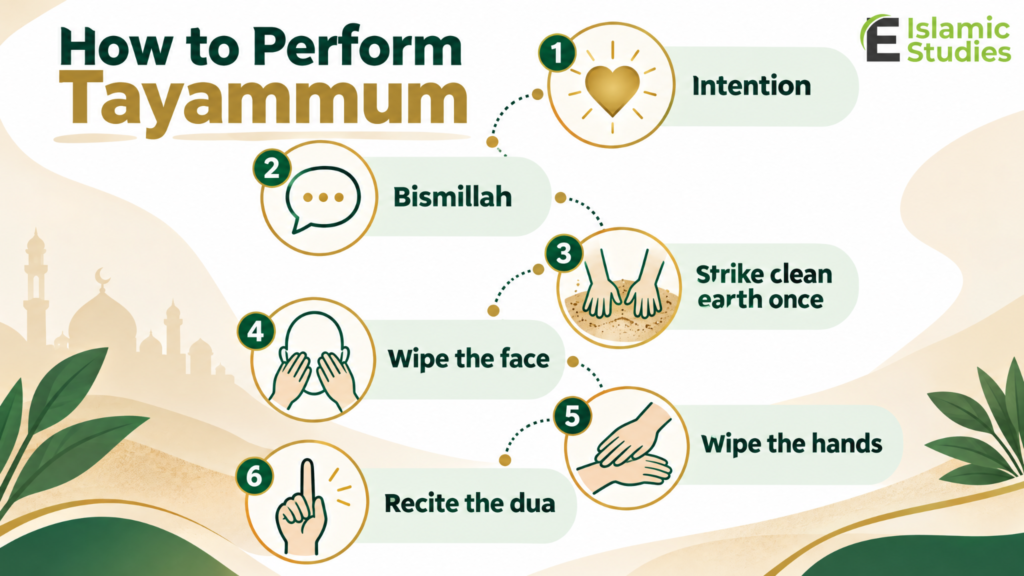
Now to the practical part of tayammum in Islam. This method follows the hadith of Ammar ibn Yasir, where the Prophet ﷺ said:
” إِنَّمَا كَانَ يَكْفِيكَ ” . وَضَرَبَ النَّبِيُّ ـ صلى الله عليه وسلم ـ بِيَدَيْهِ إِلَى الأَرْضِ ثُمَّ نَفَخَ فِيهِمَا وَمَسَحَ بِهِمَا وَجْهَهُ وَكَفَّيْهِ .
“It would have been enough for you to do this,” then struck the ground once and wiped his face and hands (Bukhari and Muslim).
- Make the Intention (Niyyah) and Say “Bismillah”: The first step is to intend in your heart and make the intention (niyyah) that you are purifying yourself for prayer. The intention is not spoken aloud. Begin with the name of Allah, as you would before wudu.
- Strike Clean Earth Once: Strike clean earth, sand, or a dusty stone lightly with both palms, then blow or shake off the excess dust.
- Wipe Your Face: Wipe your whole face once with both palms, from the forehead to the chin.
- Wipe Your Hands: Wipe the back of your right hand with your left palm, then the back of your left hand with your right palm, up to the wrists. Most narrations mention the face first, while one narration in Bukhari mentions the hands first; Ibn Taymiyyah accepted both.
- Recite the Dua After Wudu: After finishing, say the same remembrance said after wudu: “Ash-hadu an la ilaha illallah, wa ash-hadu anna Muhammadan ‘abduhu wa rasuluh.”
Knowing these small acts of worship and their rulings makes a real difference. In our Islamic studies programs, kids and adults learn the fiqh of purification and prayer, along with the daily adhkar that complete them.
Important Rulings of Tayammum in Islam
Performing tayammum correctly is only half of the picture; knowing the rulings of tayammum in Islam protects your prayer from common mistakes. Below are the questions our students ask most often, from choosing the right surface to knowing exactly when your tayammum ends.
Which Surfaces Are Valid?
The stronger view on tayammum in Islam allows anything from the earth’s surface: soil, sand, stone, and clay. Ash, cement, and gypsum are excluded, and a wall or carpet is valid only if dust is on it.
This view is based on the Quranic word “sa’id,” which scholars explain as the surface of the earth. The Prophet ﷺ and his companions travelled through sandy and rocky land, and there is no report that they carried soil with them for tayammum.
What Breaks Tayammum?
Tayammum in Islam is broken by everything that breaks wudu, anything that requires ghusl, finding water if you lacked it, and the end of the illness or excuse that permitted it.
So once water is found, or a patient recovers enough to use it, the concession ends. The Prophet ﷺ said clean earth is a Muslim’s purifier even for ten years, but once water is found, let it touch the skin (At-Tirmidhi).
What If You Find Water After Praying?
You do not repeat the prayer. Two companions faced this; the Prophet ﷺ told the one who did not repeat,
” أَصَبْتَ السُّنَّةَ ”
“You followed the Sunnah” (Abu Dawud).
If water appears before or during prayer, use it. If you find water before you start praying, your tayammum ends and you must make wudu first. If water appears in the middle of the prayer, many scholars say you should stop, purify yourself with water, and then start the prayer again.
Strengthen Your Worship and Learn Your Deen With Us
Knowing the rulings of tayammum in Islam is the first step; reciting the verses that teach them is the next. Our online Tajweed circles help you read the Quran correctly.
Our certified teachers work with kids and adults in live one-on-one classes. Choose a time that suits your schedule. Every lesson is built on authentic sources and explained in simple language, so you understand the reason behind each ruling.
You can ask your teacher questions directly and get clear answers you can apply right away. Whether you are a new Muslim, a parent, or a sister seeking deeper knowledge, there is a course designed for you.
Our Islamic Courses
- Islam Classes for Adults
- Islam Classes for Sisters
- Alimah Course for Ladies
- Islam Classes for Kids
- Learn Islam for Beginners
- Learning Islam for New Converts
Choose a time that suits your schedule and learn at your own pace. Book your free trial lesson now.
Deepen Your Islamic Knowledge
Join our comprehensive online courses and learn from qualified scholars today.
Book Your Free TrialConclusion
Tayammum in Islam is a mercy from Allah that keeps no Muslim cut off from prayer. It is proven by the Quran, the Sunnah, and the consensus of scholars, and it is permitted only for a valid excuse.
The method of tayammum in Islam is simple: intend, say Bismillah, strike clean earth once, then wipe your face and hands. It replaces both wudu and ghusl, and it ends as soon as water is found or the excuse disappears.
The key takeaway: Islam is a religion of ease, and every ruling serves your connection with Allah. Learn these acts properly, and let your understanding grow alongside your Quran recitation.
FAQs
Here are clear answers to the questions people most often ask about tayammum in Islam.
Can You Pray Several Prayers With One Tayammum?
Yes. Many scholars, including Ibn Baz, say yes, as long as it is not broken. The Shafi’i and Maliki schools, however, require a new tayammum for each obligatory prayer.
Can I do tayammum on a wall or tiled floor?
Yes. Only if there is dust on it. A clean painted wall, tiles, or carpet without dust is not valid for tayammum in Islam, according to most scholars.
Does tayammum replace ghusl after janabah?
Yes. If you cannot use water, tayammum in Islam replaces ghusl for janabah or menstruation. Once water becomes available and usable, you must take a full ghusl.
Can I do tayammum because the water is cold?
No. Tayammum in Islam allows this only if you cannot heat the water and you truly fear harm. Discomfort alone is not an excuse while warm water is available.
How many strikes are needed in tayammum?
The authentic hadith of Ammar ibn Yasir mentions one strike for the face and hands. Hanafi and Shafi’i scholars hold two strikes, one for the face and one for the arms.
Is tayammum valid if I am in a hurry and water is nearby?
No. Tayammum in Islam is a concession for real inability; if you can use water, you must make wudu, even if the prayer time is about to end.







Leave a Reply