 Learning Islam
Many Muslims hear the word ihsan in the famous Hadith of Jibril, yet few understand what it truly demands of the believer.
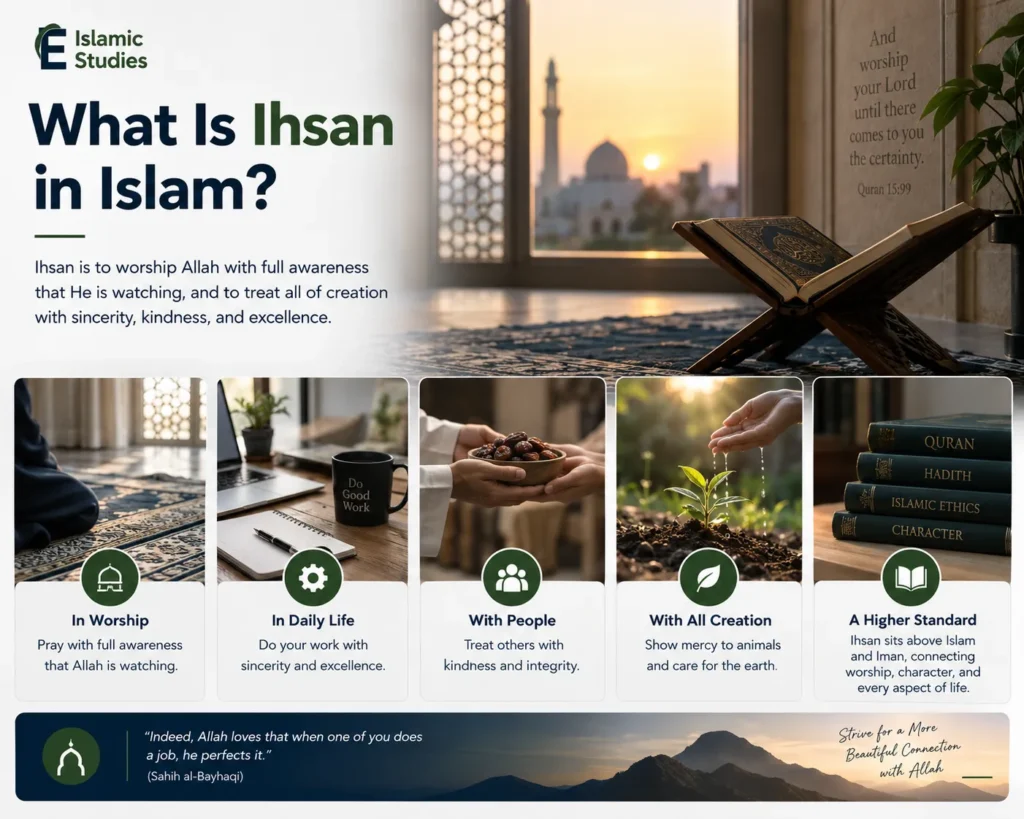
Ihsan in Islam refers to a state of spiritual excellence in which a person worships Allah with full awareness that He is watching, and treats all of creation with sincerity, kindness, and skill.
This concept sits at the very top of the Islamic faith, above simple submission (Islam) and belief (Iman). Understanding what is ihsan helps a Muslim move from mechanical worship toward a living, conscious relationship with Allah, present in prayer, work, family life, and even how animals are treated.
At E Islamic Studies Academy, this concept is taught as part of a wider journey of Islamic learning, connecting belief, worship, and character into one coherent path.
Take Away — What You Will Learn
- The precise meaning of ihsan and how it differs from Islam and Iman.
- The Quranic verses and hadith that establish ihsan as a core Islamic concept.
- The three levels of the din: Islam, Iman, and Ihsan.
- The two categories of ihsan: toward Allah and toward His creation.
- Practical steps to cultivate ihsan in daily worship and dealings.
What Is Ihsan in Islam?
Ihsan (الإحسان) is an Arabic word that means excellence, perfection, or doing what is beautiful. In Islamic terminology, ihsan is the quality of performing acts of worship and daily dealings with sincerity, full attentiveness, and the awareness that Allah is always watching.
The word comes from the Arabic root h-s-n, the same root that gives husn (beauty) and hasan (good). Scholars describe ihsan as the inner dimension of faith that gives Islam and Iman their life and spirit.
Ihsan is not a separate ritual or a sixth pillar. It is the quality of sincerity and excellence that should be present inside every act of worship, from prayer and fasting to how a person speaks to their parents or treats an animal.
Ihsan in the Quran
The Quran mentions ihsan and its related forms repeatedly, presenting it as a central quality of sincere faith and righteous character.
Rather than limiting a believer to doing only what is technically required, the Quran encourages Muslims to pursue a higher standard of goodness acting with excellence, generosity, sincerity, and consideration for others.
The Quran’s repeated emphasis on ihsan therefore shows that Islamic character is not built merely around avoiding wrongdoing.
A believer is encouraged to actively seek what is better and more pleasing to Allah, even when doing so requires patience, personal sacrifice, or giving more than the minimum expected.
Ihsan transforms obedience from simply fulfilling duties into a conscious effort to perform them in the best and most sincere manner possible.
إِنَّ اللَّهَ يَأْمُرُ بِالْعَدْلِ وَالْإِحْسَانِ وَإِيتَاءِ ذِي الْقُرْبَىٰ وَيَنْهَىٰ عَنِ الْفَحْشَاءِ وَالْمُنكَرِ وَالْبَغْيِ ۚ يَعِظُكُمْ لَعَلَّكُمْ تَذَكَّرُونَ
“Indeed, Allah orders justice and good conduct and giving to relatives and forbids immorality and bad conduct and oppression. He admonishes you that perhaps you will be reminded.”
This verse places ihsan directly alongside justice as a divine command, showing that fairness alone is the minimum standard, while ihsan is the higher, more generous standard Allah asks believers to reach.
وَأَحْسِنُوا إِنَّ اللَّهَ يُحِبُّ الْمُحْسِنِينَ
“And do good; indeed, Allah loves the doers of good.”
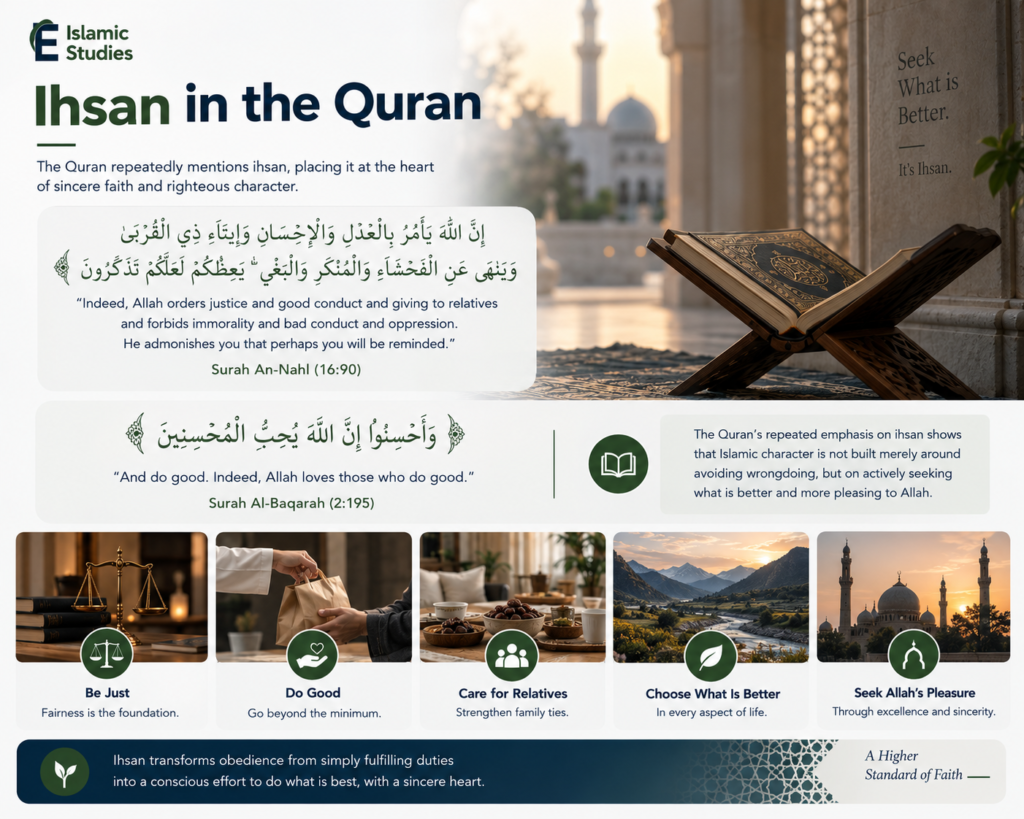
Taken together, these verses show that ihsan is not an optional extra for a few advanced worshippers. It is a quality Allah loves and repeatedly commands throughout the Quran.
See Our Islamic Studies Classes in Action
Take a look at a sample lesson and see how our interactive online classes help students learn Islamic Studies in a clear, engaging, and supportive environment.
Deepen Your Islamic Knowledge
Join our comprehensive online courses and learn from qualified scholars today.
Book Your Free TrialIhsan in the Sunnah: The Hadith of Jibril
The clearest explanation of ihsan comes from the well-known Hadith of Jibril. The angel Jibril appeared to the Prophet ﷺ in the form of a man and asked him about Islam, Iman, and Ihsan in front of his companions.
«الْإِحْسَانُ أَنْ تَعْبُدَ اللَّهَ كَأَنَّكَ تَرَاهُ، فَإِنْ لَمْ تَكُنْ تَرَاهُ فَإِنَّهُ يَرَاكَ»
“Ihsan is to worship Allah as though you see Him, and if you do not see Him, then indeed He sees you.”
This single sentence defines the entire concept: ihsan means acting, worshipping, and dealing with others as if you could see Allah directly, and when that awareness fades, remembering that He still sees you at every moment.
The Three Levels of the Religion: Islam, Iman, and Ihsan
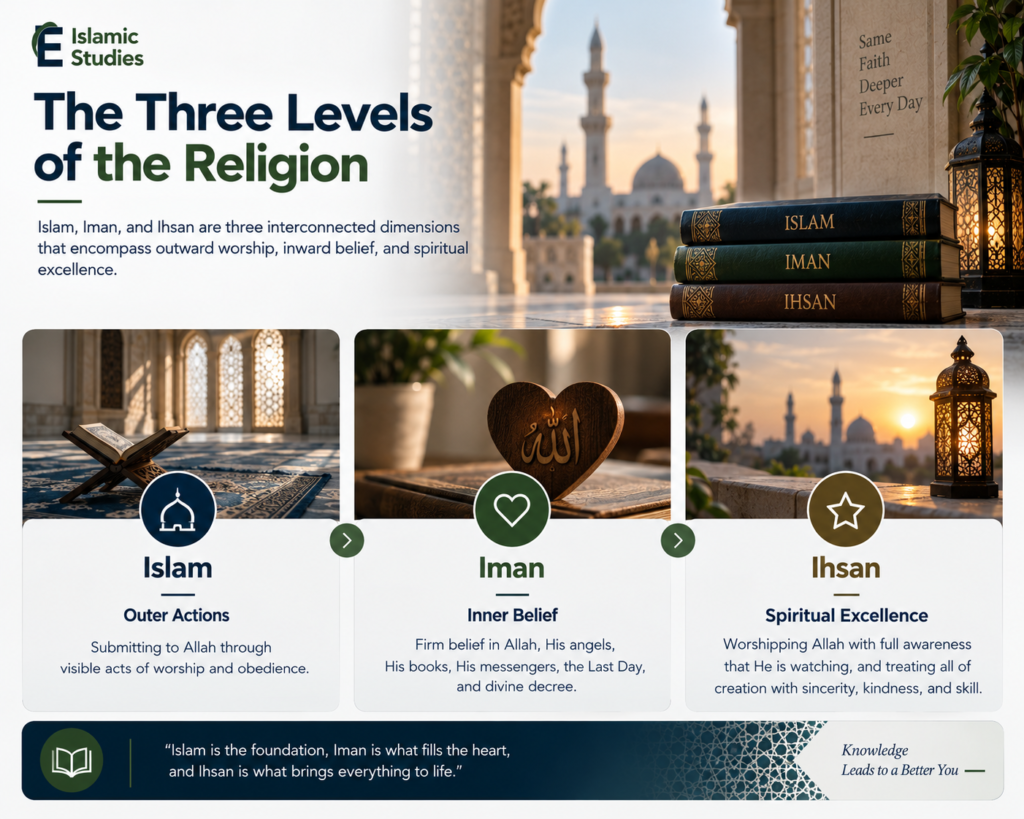
Islamic teachings describe religious life through three interconnected dimensions: Islam, Iman, and Ihsan. Together, they encompass outward worship, inward belief, and spiritual excellence.
Understanding the relationship between these three helps explain how a Muslim progresses beyond simply performing religious duties toward developing sincere faith, awareness of Allah, and excellence in worship and character.
Islam: Submission Through Action
Islam is the outward level of the religion, expressed through the five pillars: the testimony of faith, prayer, zakah, fasting Ramadan, and Hajj for those who are able. It is the visible, practical foundation of a Muslim’s life.
Iman: Belief of the Heart
Iman is the internal level of belief, covering faith in Allah, His angels, His books, His messengers, the Last Day, and divine decree. It is the conviction that gives meaning to the outward acts of Islam.
Ihsan: Excellence and Awareness of Allah
Ihsan is the highest level, where belief and action are joined by sincerity and constant awareness of Allah. A person at this level does not merely perform the acts of Islam; they perform them with presence of heart, as though standing before Allah Himself.
| Level | Focus | Example |
| Islam | Outward submission and practice | Praying, fasting, giving zakah |
| Iman | Inward belief and conviction | Believing in Allah, the angels, and the Last Day |
| Ihsan | Sincerity and awareness of Allah | Praying as though seeing Allah, or knowing He sees you |
The Two Types of Ihsan in Islam
Ihsan influences both a Muslim’s relationship with Allah and their relationship with His creation. Scholars commonly explain it through two broad categories: ihsan in worship, which involves sincerity, attentiveness, and awareness of Allah, and ihsan toward creation, which appears through kindness, fairness, mercy, and excellent conduct.
Together, these two dimensions show that ihsan is not limited to acts of worship but extends into the way a believer lives and treats others every day.
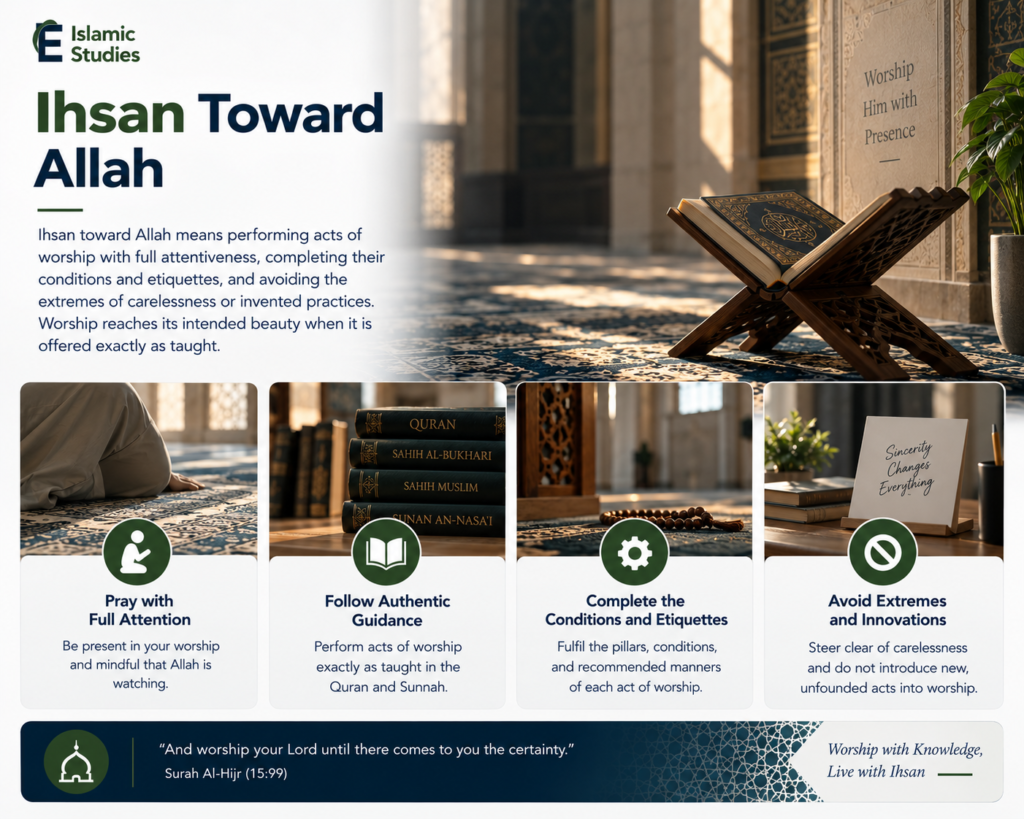
Ihsan Toward Allah
Ihsan toward Allah means performing acts of worship with full attentiveness, completing their conditions and etiquettes, and avoiding the extremes of carelessness or invented practices. Worship reaches its intended beauty when it is offered exactly as taught, not altered according to personal taste.
For this reason, scholars caution against introducing new, unfounded acts into worship. You can read more about this related caution in our article on bidah in Islam, which explains why sincerity in worship depends on following authentic guidance.
Ihsan Toward Creation
Ihsan toward creation covers kindness to parents, relatives, orphans, the poor, neighbors, travelers, and even animals. The Quran links belief in Allah directly to how a person treats the people and creatures around them.
عَنْ شَدَّادِ بْنِ أَوْسٍ رضي الله عنه قَالَ: ثِنْتَانِ حَفِظْتُهُمَا عَنْ رَسُولِ اللَّهِ ﷺ، قَالَ:
«إِنَّ اللَّهَ كَتَبَ الْإِحْسَانَ عَلَى كُلِّ شَيْءٍ، فَإِذَا قَتَلْتُمْ فَأَحْسِنُوا الْقِتْلَةَ، وَإِذَا ذَبَحْتُمْ فَأَحْسِنُوا الذَّبْحَ، وَلْيُحِدَّ أَحَدُكُمْ شَفْرَتَهُ، فَلْيُرِحْ ذَبِيحَتَهُ».
“Verily, Allah has decreed excellence (ihsan) in all things. So when you kill, kill well, and when you slaughter, slaughter well. Let each of you sharpen his blade and let him spare suffering to the animal he slaughters.”
This hadith shows how far-reaching ihsan is meant to be. If excellence is required even in something as final as slaughtering an animal, it is certainly required in ordinary daily interactions with people.
You can read a full explanation in our article on istihsan in Islam.
Read Also: What Is Istighfar in Islam?
Read Also: What Is Riya in Islam?
Why Ihsan Matters in a Muslim’s Life
Ihsan protects worship from becoming an empty routine. A prayer performed with ihsan is different in quality from one performed absentmindedly, even if the outward movements look identical.
Ihsan also raises the standard of everyday conduct. Work, business, family relationships, and even small acts like greeting a neighbor all become forms of worship when approached with sincerity and excellence.
Because ihsan is rooted in the constant awareness of Allah, it naturally guards a person against showing off, cutting corners, or treating good deeds as a mere formality.
Study Islamic jurisprudence at the highest level today.
How to Cultivate Ihsan in Daily Life
Reaching the level of ihsan is a gradual process built on knowledge, sincerity, and consistent practice. The following steps can help.
- Learn the correct basics of worship so that acts of Islam are performed as intended, not guessed at.
- Work on purifying the heart from arrogance, showing off, and heedlessness.
- Pause before worship and consciously remember that Allah is watching.
- Extend excellence to ordinary dealings: speech, work, family life, and even patience in traffic.
- Teach ihsan to children early, so awareness of Allah becomes part of their character, not just their vocabulary.
Solid foundational knowledge makes this process far easier. The beginner Islamic classes at E Islamic Studies Academy walk new and returning students through the essentials of worship step by step, so ihsan is built on a correct understanding rather than guesswork.
Because ihsan is ultimately a matter of the heart, many students also benefit from structured tazkiyah (self-purification) studies, which focus specifically on removing spiritual diseases like heedlessness, pride, and insincerity.
Parents who want to instill this awareness early can also explore the Islamic classes for kids, designed to introduce young learners to worship, character, and the awareness of Allah in an age-appropriate way.
Read Also: What Is Baraka in Islam?
Ihsan and Related Islamic Terms
Ihsan is sometimes confused with similarly spelled Arabic terms from Islamic scholarship. It is worth briefly distinguishing between them.
Istihsan is a separate, technical term used in Islamic legal theory to describe a jurist’s preference for one legal ruling over another for a stronger underlying reason. It is a tool of jurisprudence, not a spiritual state.
Ihsan is also connected, though not identical, to ijtihad, the scholarly effort to derive rulings on matters not explicitly addressed in the Quran and Sunnah.
Scholars applying ijtihad still aim to reach conclusions with sincerity and excellence, which is why the two concepts often appear together in works of Islamic law. Our article on ijtihad in Islam explains this process in more depth.
Finally, understanding ihsan also helps clarify its opposite state. Where ihsan describes conscious excellence in faith, our article on kafir in Islam explains the term used for disbelief, giving useful contrast for students studying Islamic terminology as a whole.
Read Also: What Is Tawakkul in Islam?
Watch a Sample Islamic Studies Class
See how our teachers explain Islamic concepts in an engaging and easy-to-understand way, helping students build knowledge and confidence.
Continue Learning About Ihsan and Islamic Spirituality
Understanding ihsan is only the first step. Applying it consistently in worship, family life, and daily conduct is best supported by structured learning and guidance from qualified teachers.
Explore the courses at E Islamic Studies Academy to continue this journey.
Our Islamic Essentials Courses
- Essential Islam Courses
- Online Tafseer Course
- Islamic History Course
- Tazkiyah Course
- Online Qirat Course
- Quran Tafseer Classes for Beginners — Introductory Interpretation
- Online Tafseer Classes in English
- Self-Paced Tafseer Course — Flexible Learning Programs
- Aqidah Course — Islamic Creed and Theology Classes
- Online Seerah Course — Life of Prophet Muhammad Classes
- Akhlaq Course — Islamic Ethics and Character Development
Deepen Your Islamic Knowledge
Join our comprehensive online courses and learn from qualified scholars today.
Book Your Free TrialConclusion
Ihsan in Islam is the quality of excellence and sincerity that completes both belief and practice. It sits above Islam and Iman as the level at which a Muslim worships Allah with the awareness that He is always watching, and treats every part of creation accordingly.
From the Hadith of Jibril to the Quran’s repeated command to do good, ihsan touches every dimension of a Muslim’s life: prayer, family, work, speech, and even how animals are treated. Building this quality takes knowledge, sincerity, and consistent practice over time.
Frequently Asked Questions
What does ihsan mean in Islam?
Ihsan means excellence and sincerity in worship and conduct. It is worshipping Allah as though you see Him, and if you cannot see Him, remembering that He sees you, as explained in the Hadith of Jibril.
What is the difference between Islam, Iman, and Ihsan?
Islam is outward submission through the five pillars, Iman is inward belief in the six articles of faith, and Ihsan is the sincerity and awareness of Allah that gives both Islam and Iman their true depth.
What are the two types of ihsan?
Scholars describe ihsan toward Allah, meaning excellence in worship, and ihsan toward creation, meaning kindness and fairness toward parents, relatives, neighbors, the poor, and even animals.
Is ihsan obligatory in Islam?
Ihsan is a required inward quality of sincere worship, though its precise scope is a matter scholars have detailed in different ways. Aspiring to it is consistently encouraged throughout the Quran and Sunnah.
How can I practice ihsan every day?
Practicing ihsan daily starts with learning correct worship, working on sincerity of the heart, remembering Allah’s awareness during actions, and extending kindness and excellence to ordinary interactions with people.







Leave a Reply