 Learning Islam

Hasad in Islam refers to blameworthy envy: a condition of the heart in which a person resents a blessing that Allah has granted to someone else and may wish for that blessing to disappear.
It is more than simply noticing that another person has something desirable. Hasad becomes spiritually dangerous when another person’s success, knowledge, wealth, beauty, family life, status, or religious achievement produces resentment rather than gratitude to Allah and goodwill toward the person who has been blessed.
Islam treats hasad as one of the diseases of the heart because its effects can extend far beyond a passing emotion. When envy is repeatedly entertained and encouraged, it can distort the way a person thinks about Allah’s decree, damage relationships, encourage unhealthy comparison, and eventually lead to backbiting, hostility, unfair criticism, or attempts to undermine the person being envied.
The problem therefore does not begin only when someone acts upon envy; the heart itself requires attention before resentment develops into outward wrongdoing.
At the same time, Islam does not teach that every desire for something another person has is sinful.
There is an important distinction between hasad, in which a person resents another person’s blessing, and ghibtah, in which someone wishes to receive a similar blessing without wanting anything to be taken away from the other person.
What You Will Learn
- Understanding hasad properly requires more than translating the word as “envy.” By the end of this guide.
- understand the Islamic definition of hasad, how blameworthy envy differs from healthy aspiration.
- the relationship between hasad and the evil eye.
- the Quranic and Prophetic warnings against envy.
- the causes and effects of hasad.
- practical ways to seek Allah’s protection while working toward genuine purification of the heart.
What Is Hasad in Islam?
Hasad is commonly defined by Muslim scholars as resentment toward a blessing Allah has bestowed upon another person, especially when that resentment includes wanting the blessing to disappear.
Ibn al-Qayyim discussed hasad as a serious spiritual illness because the envier is not merely reacting to another person’s possessions or achievements. At a deeper level, the heart is reacting negatively to something Allah Himself has distributed according to His knowledge and wisdom.
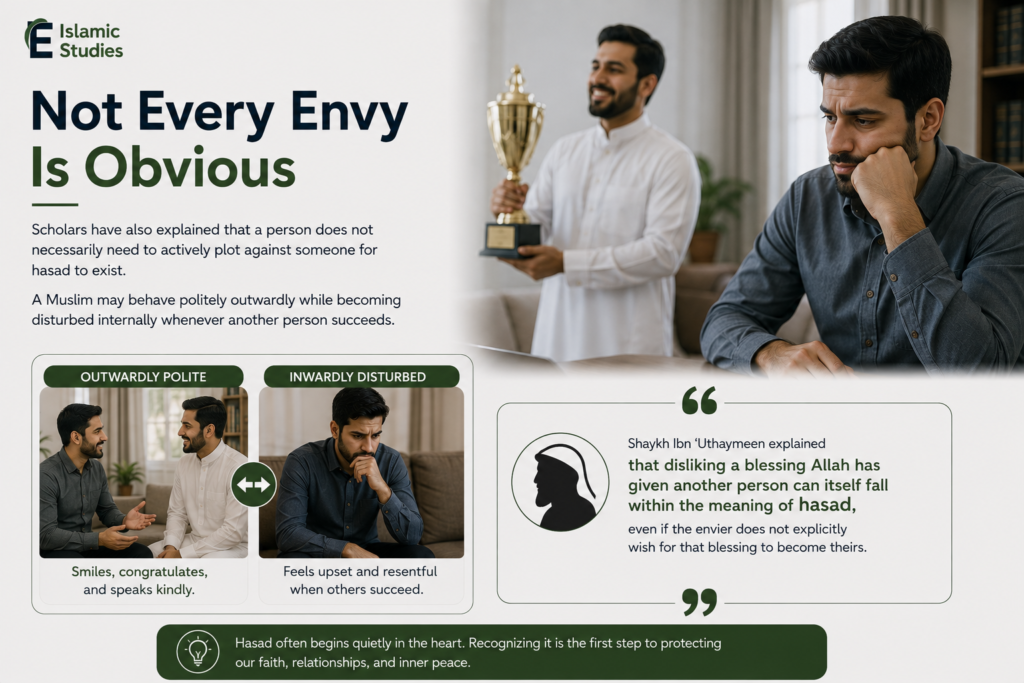
Scholars have also explained that a person does not necessarily need to actively plot against someone for hasad to exist. A Muslim may behave politely outwardly while becoming disturbed internally whenever another person succeeds.
Shaykh Ibn ‘Uthaymeen explained that disliking a blessing Allah has given another person can itself fall within the meaning of hasad, even if the envier does not explicitly wish for that blessing to become theirs.
This is why hasad belongs to the broader category of diseases of the heart. Islam does not regulate visible actions alone; it teaches believers to cultivate sincerity, gratitude, humility, contentment, and trust in Allah.
The importance of the inner condition is emphasized when Allah describes the Day of Judgment as a day on which wealth and children will not benefit a person except the one who comes to Him with a sound heart in Surah Ash-Shu‘ara 26:88–89.
For Muslims who want to move beyond isolated definitions and study how Islamic belief, worship, and character connect, the academy’s Essential Islam Courses provide a broader structured foundation in the Islamic sciences.

Hasad vs. Ghibtah: What Is the Difference?
Not every desire for something another person possesses is hasad. Islamic scholarship distinguishes between blameworthy envy and ghibtah, a form of positive aspiration in which a person sees goodness in someone else and asks Allah for something similar without wanting that person to lose what they have.
This distinction prevents Muslims from wrongly assuming that all ambition, admiration, or desire for improvement is spiritually unhealthy.
- Hasad occurs when another person’s blessing itself becomes objectionable to you.
You may want it removed, transferred to you, diminished, or simply feel unhappy that the person possesses it.
- Ghibtah is different because the heart still wants good for the other person.
You see their blessing, appreciate it, and ask Allah to grant you similar goodness from His bounty.
For example, seeing someone who has memorized the Quran and thinking, “I hope Allah enables me to memorize the Quran as well,” is not blameworthy envy.
Likewise, seeing someone spending generously in charity and wishing Allah would give you enough wealth to perform similar acts of goodness can become motivation toward righteousness rather than resentment.
The distinction appears clearly in the authentic hadith narrated by Abdullah ibn Mas‘ud (RA):
لَا حَسَدَ إِلَّا فِي اثْنَتَيْنِ: رَجُلٌ آتَاهُ اللَّهُ مَالًا فَسَلَّطَهُ عَلَى هَلَكَتِهِ فِي الْحَقِّ، وَرَجُلٌ آتَاهُ اللَّهُ حِكْمَةً فَهُوَ يَقْضِي بِهَا وَيُعَلِّمُهَا.
“There is no envy except in two cases: a person whom Allah has given wealth and enabled to spend it in the truth, and a person whom Allah has given wisdom, so he judges by it and teaches it.” Narrated by: Abdullah ibn Mas‘ud (RA) | Sahih al-Bukhari 1409 and Sahih Muslim.
Scholars such as Imam An-Nawawi explained that “hasad” in this particular context refers to ghibtah rather than prohibited envy.
The believer sees someone using Allah’s blessings for good and wishes for the ability to perform similar deeds while continuing to want the other person’s blessing to remain.
A useful test is therefore to ask yourself: “Would I still want Allah to preserve this person’s blessing even if I never received the same thing?” If the answer is yes, the feeling is much closer to ghibtah than hasad.
See Our Islamic Studies Classes in Action
Take a look at a sample lesson and see how our interactive online classes help students learn Islamic Studies in a clear, engaging, and supportive environment.
Deepen Your Islamic Knowledge
Join our comprehensive online courses and learn from qualified scholars today.
Book Your Free TrialHasad vs. Al-‘Ayn: What Is the Difference?
Hasad and al-‘ayn, commonly translated as the evil eye, are closely related concepts in Islamic teachings, but they are not identical.
Confusing the two can lead either to dismissing an established Islamic teaching or, at the other extreme, becoming unnecessarily suspicious of people whenever something difficult happens.
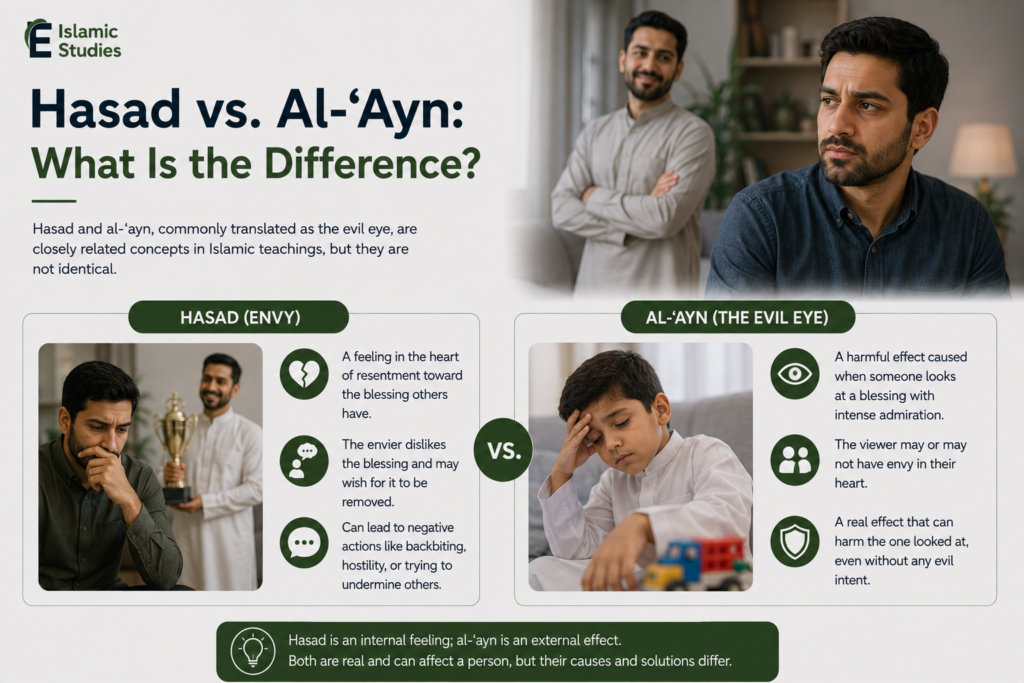
Hasad primarily describes envy within the heart. A person becomes aware of another person’s blessing and feels resentment toward it. Al-‘ayn refers to the harmful effect associated with an envious or strongly admiring gaze, which can occur only by Allah’s permission.
Classical scholars therefore described hasad as broader: a person may envy someone whom they have not recently seen or even someone living far away, whereas discussions of al-‘ayn deal specifically with the harmful effect associated with seeing or admiring a blessing.
Ibn al-Qayyim discussed how the two concepts overlap without becoming completely interchangeable. This is one reason the Quran teaches Muslims to seek refuge from “the evil of an envier when he envies” in Surah Al-Falaq.
The practical distinction matters. Islam affirms the reality of al-‘ayn, but this belief should not turn ordinary setbacks into accusations.
The believer takes authentic means of protection, maintains tawakkul, and avoids claiming that a particular person caused the evil eye without evidence.
Evidence for Hasad in the Quran
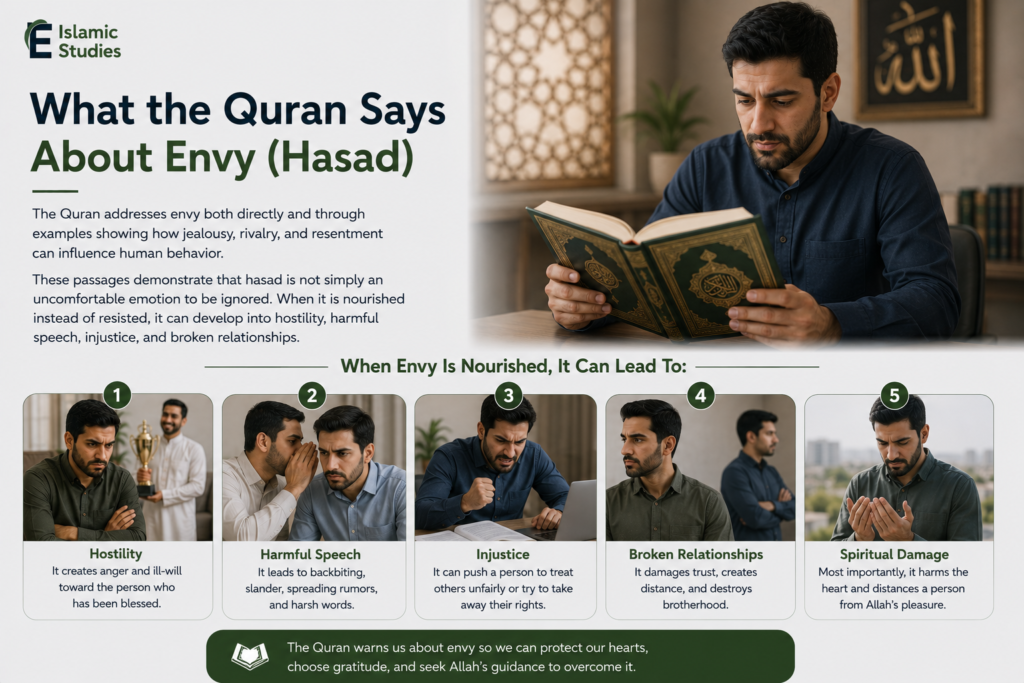
The Quran addresses envy both directly and through examples showing how jealousy, rivalry, and resentment can influence human behavior. These passages demonstrate that hasad is not simply an uncomfortable emotion to be ignored.
When it is nourished instead of resisted, it can develop into hostility, harmful speech, injustice, and broken relationships.
Surah Al-Falaq: Seeking Refuge From the Envier
The clearest Quranic instruction concerning hasad appears at the end of Surah Al-Falaq, where Allah teaches believers to seek refuge in Him from several forms of evil and specifically mentions the envier.
The passage teaches that protection begins with turning to Allah rather than attempting to control every person, circumstance, or hidden intention around us.
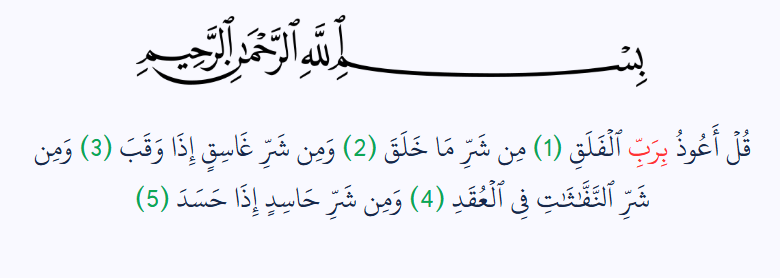
قُلْ أَعُوذُ بِرَبِّ الْفَلَقِ * مِنْ شَرِّ مَا خَلَقَ * وَمِنْ شَرِّ غَاسِقٍ إِذَا وَقَبَ * وَمِنْ شَرِّ النَّفَّاثَاتِ فِي الْعُقَدِ * وَمِنْ شَرِّ حَاسِدٍ إِذَا حَسَدَ
“Say, ‘I seek refuge in the Lord of daybreak, from the evil of that which He created, and from the evil of darkness when it settles, and from the evil of the blowers in knots, and from the evil of an envier when he envies.’”
Classical commentators noted that the final verse directs Muslims specifically to seek Allah’s protection from the harm envy may produce.
This does not mean that every momentary jealous feeling automatically harms another person. Rather, it emphasizes what may develop when envy is allowed to grow and influence behavior.
For the person experiencing hasad internally, the passage also offers a personal lesson: envy should not be accepted merely because it began inside the heart. It should be identified and treated before it becomes speech, hostility, or injustice.
Students who want to understand how Quranic passages are interpreted within their broader linguistic and scholarly context can study through Online Tafseer Course or continue through Online Tafseer Classes in English.
Surah Yusuf: Prophet Ya‘qub’s Caution and Tawakkul
The story of Prophet Ya‘qub (AS) provides an important example of balancing reasonable precaution with complete reliance upon Allah.
When his sons were preparing to enter the city, he instructed them not to enter through a single gate, while immediately reminding them that his advice could not protect them independently of Allah’s decree.
وَقَالَ يَا بَنِيَّ لَا تَدْخُلُوا مِنْ بَابٍ وَاحِدٍ وَادْخُلُوا مِنْ أَبْوَابٍ مُتَفَرِّقَةٍ وَمَا أُغْنِي عَنكُم مِّنَ اللَّهِ مِن شَيْءٍ إِنِ الْحُكْمُ إِلَّا لِلَّهِ عَلَيْهِ تَوَكَّلْتُ وَعَلَيْهِ فَلْيَتَوَكَّلِ الْمُتَوَكِّلُونَ
“And he said, ‘O my sons, do not enter from one gate but enter from different gates; and I cannot avail you against Allah at all. The decision is only for Allah; upon Him I have relied, and upon Him let those who rely place their reliance.’” Surah Yusuf 12:67
Ibn Kathir mentioned the interpretation that Ya‘qub (AS) was concerned about the evil eye because his sons were numerous and striking in appearance.
What matters particularly for this subject is the balance in the verse: he took a sensible precaution while affirming that the precaution itself possessed no independent power.
This balance remains essential today. Islam neither teaches Muslims to disregard reasonable precautions nor encourages obsessive fear of envy and the evil eye.
Surah Al-Qalam and Hostile Stares
Another passage frequently discussed in connection with the evil eye appears in Surah Al-Qalam. The verse describes the intensity with which the disbelievers looked toward the Prophet ﷺ when they heard the revelation, alongside their hostile accusation against him.
وَإِن يَكَادُ الَّذِينَ كَفَرُوا لَيُزْلِقُونَكَ بِأَبْصَارِهِمْ لَمَّا سَمِعُوا الذِّكْرَ وَيَقُولُونَ إِنَّهُ لَمَجْنُونٌ
“And indeed, those who disbelieve would almost make you slip with their eyes when they hear the message, and they say, ‘Indeed, he is mad.’”
Ibn Kathir included this verse in his discussion of evidence related to the evil eye. The surrounding context also demonstrates how intense hostility toward someone whom Allah has favored can distort judgment and behavior.
Deepen Your Islamic Knowledge
Join our comprehensive online courses and learn from qualified scholars today.
Book Your Free TrialEvidence for Hasad in the Sunnah
The Sunnah reinforces the Quranic warnings against envy while also giving Muslims practical guidance for protecting relationships and purifying the heart.
The Prophet ﷺ did not treat hasad as an insignificant private feeling because a repeatedly nourished internal condition eventually influences assumptions, speech, conduct, and relationships.
The Prophet ﷺ Commanded Muslims Not to Envy One Another
The Prophet ﷺ placed envy alongside hatred, abandonment, and broken brotherhood, showing that hasad is closely connected with wider social damage. The command is not merely to avoid obvious acts of sabotage but to resist the internal resentment that makes such behavior increasingly likely.
لَا تَبَاغَضُوا، وَلَا تَحَاسَدُوا، وَلَا تَدَابَرُوا، وَكُونُوا عِبَادَ اللَّهِ إِخْوَانًا.
“Do not hate one another, do not envy one another, do not turn away from one another, and be, O servants of Allah, brothers.” Narrated by: Anas ibn Malik (RA)
Sahih al-Bukhari 6076 and Sahih Muslim 2559.
The placement of envy beside hatred and broken relationships is significant. Hasad rarely remains entirely isolated when it is deliberately fed.
It begins shaping how someone interprets another person’s actions, how they speak about them, and whether they can genuinely celebrate their success.

The Evil Eye Is Real
Islamic teachings affirm the reality of al-‘ayn while simultaneously maintaining the central doctrine that nothing escapes Allah’s decree.
The strongest way to understand the evil eye is therefore not through superstition or fear, but through the framework of qadar and tawakkul.
الْعَيْنُ حَقٌّ، وَلَوْ كَانَ شَيْءٌ سَابَقَ الْقَدَرَ سَبَقَتْهُ الْعَيْنُ، وَإِذَا اسْتُغْسِلْتُمْ فَاغْسِلُوا
“The evil eye is real, and if anything were to precede the divine decree, the evil eye would precede it; and if you are asked to wash, then wash.” Sahih Muslim 2188.
The hadith does not mean that the evil eye can overcome Allah’s decree. Rather, scholars explained that its wording emphasizes the seriousness of al-‘ayn while preserving the fundamental Islamic principle that everything ultimately occurs within Allah’s qadar.
Belief in the evil eye should therefore increase reliance upon Allah, not produce paranoia about friends, relatives, colleagues, or strangers.
Making Du‘a for Barakah When You Admire Something
One of the most useful Prophetic responses to admiration is to ask Allah to place blessing in what you have seen. This redirects the heart immediately: instead of allowing admiration to slide into comparison and resentment, the believer consciously asks Allah to preserve the good He has granted.
When a Muslim sees something impressive in another person, the healthier response is therefore not “Why do they have this?” but “May Allah bless them, and may Allah grant me from His bounty.” This shift is one of the simplest practical ways of turning comparison into ghibtah.
Deepen Your Islamic Knowledge
Join our comprehensive online courses and learn from qualified scholars today.
Deepen Your Islamic Knowledge
Join our comprehensive online courses and learn from qualified scholars today.
Book Your Free TrialThe Different Ranks and Forms of Hasad
Hasad does not always appear with the same intensity. Sometimes it begins as discomfort when another person receives attention, success, knowledge, wealth, or praise. In more serious forms, the person actively wishes for the blessing to disappear.
Recognizing these differences helps a Muslim identify envy before it reaches its most destructive stage.
One form occurs when a person wants another individual’s blessing removed even though they themselves would gain nothing from its disappearance. Another occurs when the envier wants the blessing removed specifically so that they can obtain it.
A further form can develop through rivalry: a person initially wants to reach the same level as someone else but becomes increasingly resentful when they are unable to do so.
These attitudes differ from ghibtah. A Muslim may see someone knowledgeable, generous, successful in a halal profession, devoted to worship, or blessed with a good family and sincerely ask Allah for similar goodness while still wanting the original person to flourish.
That is why the most revealing question is often not, “Do I want what this person has?” but, “Would I be happy for Allah to preserve and increase their blessing even if I never received the same thing?”
Readers who want to continue building their understanding of Islamic terminology and legal methodology can also explore What Is Bid‘ah in Islam?, Ijma in Islam, and Qiyas in Islam.
What Causes Hasad?
Hasad rarely develops without deeper causes. The visible trigger may be another person’s promotion, marriage, wealth, beauty, knowledge, popularity, children, academic achievement, or religious progress, but the underlying problem often involves the way the heart understands qadar, status, competition, entitlement, and self-worth.
1. Weakness in Accepting Allah’s Decree
One major cause of envy is weakness in accepting al-qadar. Continuous comparison can gradually make a person behave internally as though Allah’s distribution of opportunities, wealth, appearance, family circumstances, or abilities is unfair.
Strengthening faith in Allah’s wisdom corrects this mindset. Another person receiving a blessing does not reduce Allah’s ability to provide for you. His bounty is not a limited resource that must be competitively divided between His servants.
2. Rivalry and Constant Comparison
Hasad frequently intensifies between people who see themselves as direct competitors. Siblings may compare parental attention, colleagues may compare promotions, students may compare grades, businesses may compare growth, and people engaged in religious work may even compare knowledge, followers, teaching ability, or influence.
When another person’s achievement begins to feel like evidence of your own failure, resentment can develop quickly. Healthy competition asks, “How can I improve?” Hasad asks, “Why should they be ahead of me?”
3. Arrogance and Love of Status
Arrogance is another significant cause of hasad. Someone who believes they should always be the most knowledgeable, successful, respected, wealthy, attractive, or influential may find another person’s superiority difficult to tolerate.
Love of status intensifies the problem because the goal is no longer simply to possess something beneficial. The person wants to remain unrivaled. Consequently, even another Muslim’s genuine success may feel threatening.
4. A Heart That Dislikes Good for Others
In its deeper form, envy may arise because the soul has become accustomed to self-centeredness.
Instead of simply desiring good, it has difficulty witnessing good reach others. This condition cannot always be corrected through a single reminder; it often requires sustained tazkiyah, regular self-examination, repentance, gratitude, and deliberate practice in wanting good for other people.
The Tazkiyya Course at E Islamic Studies Academy focuses specifically on spiritual purification and the development of character, making it particularly relevant for Muslims who want to study diseases of the heart beyond surface-level definitions.
The Harmful Effects of Hasad
Hasad harms the person carrying it even before it affects anyone else. It can deprive the heart of contentment, turn another person’s happiness into a source of distress, and create a pattern in which every comparison becomes emotionally exhausting.
When envy then moves into speech and action, its effects extend to the envied person and eventually to families and communities.
Effects of Hasad on the Envier
The envier may become trapped in constant comparison. Another person’s promotion becomes painful, their marriage becomes irritating, their knowledge becomes threatening, and even their religious growth becomes something to criticize rather than admire.
This makes hasad uniquely destructive. The person being envied may be completely unaware of the resentment and continue enjoying Allah’s blessing, while the envier repeatedly experiences frustration and dissatisfaction.
The spiritual correction begins by remembering that every blessing ultimately belongs to Allah. He gives, withholds, increases, delays, and tests according to His wisdom.
Resenting someone else’s blessing cannot alter Allah’s decree; it only damages the state of the heart carrying the resentment.
Effects of Hasad on the Envied Person
When envy moves beyond internal feelings, it can produce tangible injustice. An envier may backbite someone, spread rumors, dismiss their accomplishments, interfere with relationships, sabotage opportunities, or deliberately search for faults that can be publicized.
Allah warns against unjustly harming believing men and women in Surah Al-Ahzab 33:58. An internal struggle with envy can therefore never justify harming another person.
At the same time, Muslims should avoid automatically accusing specific individuals of causing the evil eye. Belief in al-‘ayn should lead toward authentic protection and reliance upon Allah rather than unsupported suspicion.
Effects of Hasad on the Muslim Community
At a communal level, hasad destroys trust and brotherhood. Families may divide over wealth and attention, friendships may deteriorate because one person cannot tolerate another’s progress, and communities can become dominated by rivalry instead of cooperation.
The damage becomes particularly serious when envy enters religious spaces. Muslims should not resent another believer’s Quran memorization, knowledge, teaching ability, charitable influence, or growth in worship.
Such blessings should inspire ghibtah: a desire to become better while asking Allah to increase the other person in goodness.
Islam therefore redirects competition away from bringing others down and toward competing in righteous deeds.

How to Protect Yourself From Hasad and Treat Envy
Treating hasad requires more than repeating a phrase whenever jealousy appears. Because envy is fundamentally a disease of the heart, its cure involves changing the way a believer understands Allah’s decree, other people’s blessings, and their own relationship with worldly success.
1. Seek Allah’s Protection
One of the most important forms of protection is regularly seeking refuge in Allah through Surah Al-Falaq and Surah An-Nas while maintaining authentic morning and evening adhkar.
The point of these practices is not to make a Muslim preoccupied with hidden threats but to strengthen awareness that Allah alone ultimately protects His servants.
For someone personally struggling with envy, seeking refuge must also be accompanied by repentance and self-examination.
The Muslim should resist repeatedly checking another person’s life, searching for their faults, criticizing their success, or inventing reasons why they supposedly do not deserve what Allah has given them.
Read Also: What Is Haya in Islam?
2. Make Du‘a for the Person You Envy
One of the most powerful ways of resisting hasad is to deliberately make du‘a for the person toward whom you feel envy. Ask Allah to bless what He has given them, increase them in what is good, and protect that blessing. Then ask Allah from His bounty for yourself.
This directly contradicts the demand of the envious soul. The nafs want the other person to lose; you deliberately ask Allah to increase them.
The nafs want to interpret their success as your deprivation; you remind yourself that Allah can provide for both of you. With repetition, resentment can gradually be redirected toward ghibtah.
Read Also: What Is Sabr in Islam?
3. Strengthen Taqwa and Tawakkul
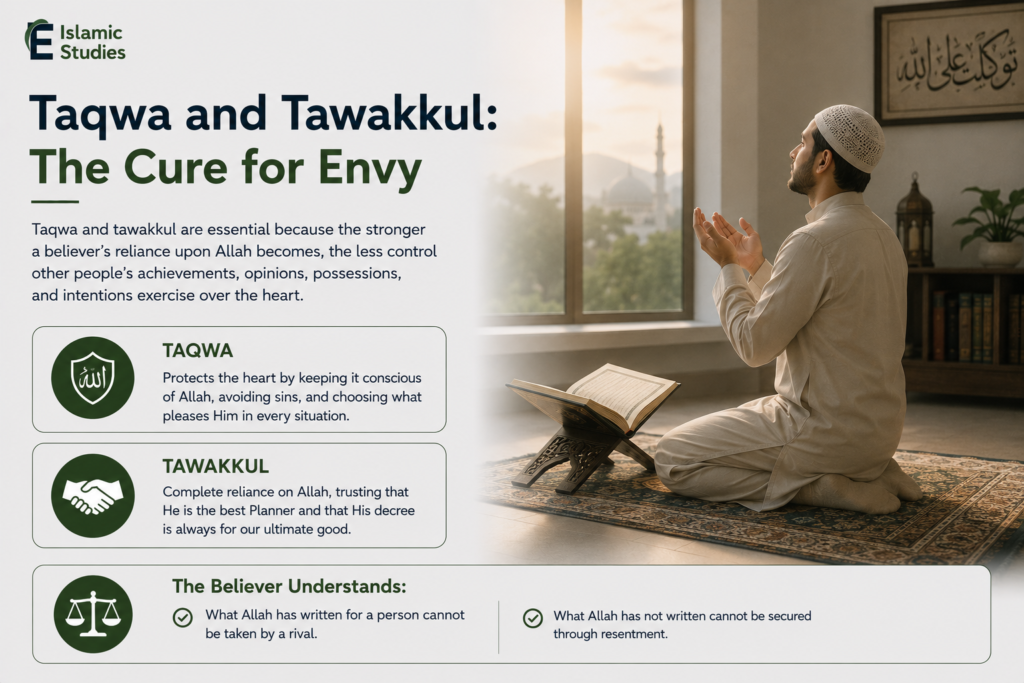
Taqwa and tawakkul are essential because the stronger a believer’s reliance upon Allah becomes, the less control other people’s achievements, opinions, possessions, and intentions exercise over the heart.
The believer learns that their provision is not decided by another person’s promotion, popularity, marriage, wealth, followers, or abilities. What Allah has written for a person cannot be taken by a rival, and what Allah has not written cannot be secured through resentment.
4. Practice Charity and Deliberate Goodness
Charity and acts of goodness can help train the soul away from selfishness and excessive attachment to status. Giving teaches the heart that goodness is not something to hoard, while helping others trains a person to feel happiness when benefit reaches someone besides themselves.
Repentance addresses the sins that weaken the heart, while patience and good character prevent another person’s envy from dragging a Muslim into retaliation or similar wrongdoing.
Allah teaches believers to respond to evil with what is better and to seek refuge in Him when provoked by Shaytan in Surah Fussilat 41:34–36.
5. Be Sensible About Sharing Blessings
Discretion about blessings can sometimes be wise. The example of Prophet Ya‘qub (AS) demonstrates that reasonable precaution does not contradict tawakkul. Muslims are not religiously obligated to publicize every achievement, possession, financial gain, family matter, or personal blessing.
However, discretion should never turn into obsessive fear. A person should not begin interpreting every viewer, relative, friend, or social interaction as a potential source of harm. Precaution remains subordinate to tawakkul, not a replacement for it.
Read Also: What Is Kibr in Islam?
6. Work on the Root Diseases of the Heart
Recurring envy often requires deeper work than simply suppressing individual jealous thoughts. A person may need to examine arrogance, insecurity, attachment to status, constant comparison, dissatisfaction with qadar, or an excessive dependence on the praise of other people.
Structured study of tazkiyah can be especially useful here because Islamic purification is not limited to identifying diseases of the heart.
It also focuses on cultivating the qualities that replace them: gratitude instead of resentment, humility instead of arrogance, sincerity instead of reputation-seeking, contentment instead of constant comparison, and genuine love of good for others instead of rivalry.
Students seeking a broader study path alongside spiritual development can also explore the Intensive Islamic Course, which combines several foundational Islamic sciences in a structured curriculum.

Watch a Sample Islamic Studies Class
See how our teachers explain Islamic concepts in an engaging and easy-to-understand way, helping students build knowledge and confidence.
Deepen Your Islamic Knowledge
Join our comprehensive online courses and learn from qualified scholars today.
Book Your Free TrialDeepen Your Islamic Knowledge and Start Purifying the Heart
Recognizing hasad is valuable, but identifying a spiritual disease is not the same as treating it. Lasting change requires learning how the heart works, identifying the thoughts and habits that feed envy, and intentionally replacing them with gratitude, tawakkul, humility, sincerity, and love of good for others.
At E Islamic Studies Academy, you can deepen your understanding of Islam through structured learning with qualified teachers who help you move beyond simply knowing Islamic concepts to understanding how they apply to your faith, character, and everyday life.
Start strengthening your relationship with Allah and working toward a healthier heart today.
Our Islamic Courses
- Islam Classes for Adults
- Islam Classes for Sisters
- Alimah Course for Ladies
- Islam Classes for Kids
- Learn Islam for Beginners
- Learning Islam for New Converts
Our Islamic Programs
- Islamic Distance Learning Programs
- Islamic Courses Workshops
- Intensive Islamic Course
- Islam Crash Course
- Learning Islam Level 1 Online
- Darse Nizami / Traditional Alim Courses
Explore E Islamic Studies Academy And Book Your Free Trial Class Now.

Conclusion
Hasad in Islam is not simply wanting something another person possesses. Its blameworthy form occurs when the heart resents a blessing Allah has given another person or wants that blessing to disappear.
This distinguishes hasad from ghibtah, in which a believer wishes for similar goodness while sincerely wanting the person who already possesses it to remain blessed.
Hasad is also related to, but distinct from, al-‘ayn. The Sunnah confirms the reality of the evil eye while teaching Muslims to respond through du‘a, remembrance of Allah, reliance upon Him, and prayer for barakah rather than fear, superstition, or baseless accusations.
For the person experiencing envy, the most important struggle takes place within the heart. Strengthening belief in Allah’s decree, making du‘a for others, developing gratitude, asking Allah for His bounty through halal means, repenting from resentment, and refusing to act upon jealousy can gradually transform hasad into healthier aspiration.
Ultimately, another person’s blessing is not evidence that Allah has forgotten you. The believer learns to ask Allah from His limitless bounty while sincerely wanting good for others, knowing that the One who blessed them is fully capable of blessing you as well.
Frequently Asked Questions
What Is the Difference Between Hasad and Ghibtah?
Hasad involves resenting another person’s blessing or wanting it to disappear, whereas ghibtah means seeing something good another person possesses and wishing Allah would grant you something similar without wanting anything taken away from them.
Ghibtah may even become praiseworthy when it motivates a Muslim toward beneficial knowledge, worship, generosity, Quran memorization, charity, or other righteous deeds. The key question is whether you still sincerely want Allah to preserve the other person’s blessing.
Is Hasad Considered a Major Sin in Islam?
Hasad is strongly condemned in the Quran and Sunnah and has been treated by scholars as a serious disease of the heart.
However, an involuntary passing feeling should be distinguished from deliberately nurturing envy, approving of it, repeatedly thinking about it, speaking because of it, or harming someone as a result.
When an envious feeling appears unexpectedly, the Muslim should resist rather than cultivate it, seek forgiveness, and deliberately choose thoughts and actions that oppose the envy.
What Is the Difference Between Hasad and the Evil Eye?
Hasad is fundamentally envy or resentment toward another person’s blessing, whereas al-‘ayn refers to the evil eye and the harm that may occur by Allah’s permission. The concepts overlap but are not identical.
A person can experience hasad without necessarily causing al-‘ayn, which is why Muslims should avoid assuming that every envious individual has harmed someone through the evil eye.
How Can a Muslim Protect Themselves From Hasad and the Evil Eye?
A Muslim can seek protection by regularly reciting Surah Al-Falaq and Surah An-Nas, maintaining authentic morning and evening adhkar, strengthening taqwa and tawakkul, and using the protective du‘as taught in the Sunnah.
Sensible discretion about personal blessings may also be appropriate, but it should remain balanced and should never develop into paranoia or constant suspicion of others.
What Should I Do If I Feel Envious of Someone?
Recognize the feeling without feeding it. Ask Allah to bless the other person and increase them in good, seek forgiveness for yourself, remind yourself that Allah distributes blessings according to His wisdom, and ask Allah for His bounty through halal means.
Deliberately refusing to backbite, criticize, stalk, compare, or search for faults is also essential. Over time, the goal is to transform the feeling into ghibtah by sincerely wanting goodness for both yourself and the person you originally envied.
Can a Person Cause the Evil Eye to Affect Themselves?
Prophetic teachings concerning barakah include the importance of attributing blessings to Allah and asking Him to bless what a person sees and admires, including blessings connected to oneself and one’s possessions.
A Muslim should therefore avoid excessive self-admiration, remember that every blessing comes from Allah, make du‘a for its preservation, and maintain gratitude rather than becoming absorbed in pride over what they possess.
Related Articles
Learning Islam








Leave a Reply