 Learning Islam
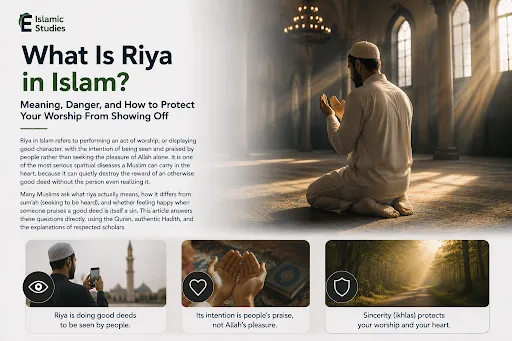
Riya in Islam refers to performing an act of worship, or displaying good character, with the intention of being seen and praised by people rather than seeking the pleasure of Allah alone.
It is one of the most serious spiritual diseases a Muslim can carry in the heart, because it can quietly destroy the reward of an otherwise good deed without the person even realizing it.
Many Muslims ask what riya actually means, how it differs from sum’ah (seeking to be heard), and whether feeling happy when someone praises a good deed is itself a sin. This article answers these questions directly, using the Quran, authentic Hadith, and the explanations of respected scholars.
By the end of this article, you will understand the linguistic and religious meaning of riya, why the Prophet Muhammad صلى الله عليه وسلم warned his companions about it so strongly, how it affects the acceptance of good deeds, and practical ways a Muslim can protect their worship from it.
What You Will Learn
- The exact meaning of riya in Islam and how it differs from sum’ah.
- What the Quran says about showing off in worship.
- The authentic Hadith warns about riya and hidden shirk.
- The difference between blameworthy riya and permissible joy at being praised.
- Practical steps to protect your intention (niyyah) and worship from riya.
What Does Riya Mean in Islam?
Riya is an Arabic word derived from ru’yah (رؤية), meaning “to see.” In Islamic terminology, riya means abandoning sincerity in an act of worship by directing part of the intention toward being seen or admired by other people, instead of seeking Allah alone.
The scholar Al-Jurjani defined it in his book At-Ta’rifat as “leaving sincerity in a deed by paying attention to something other than Allah while performing it.”
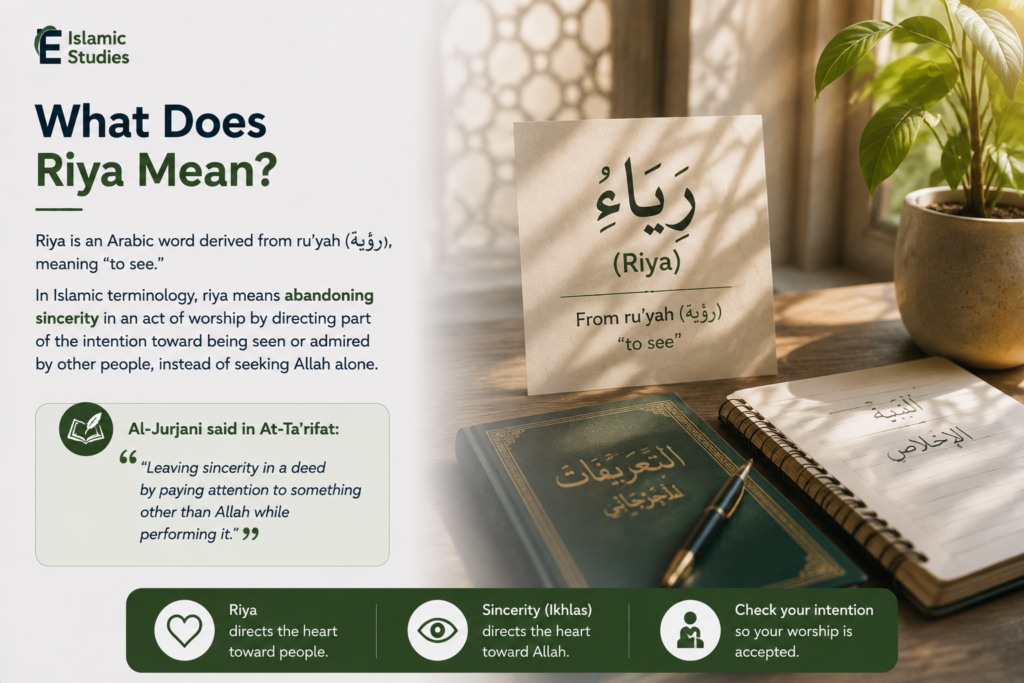
Other early scholars described riya in slightly different but related ways. Al-Muhasibi, in Ar-Ri’ayah li Huquq Allah, described riya as a worshipper’s desire to draw people’s attention through his obedience to his Lord.
Muhammad ibn Abd al-Malik al-Daylami described it as showing obedience to people so that they think well of the one performing it. All these definitions point to the same core problem: the deed is outwardly directed to Allah, but part of the heart’s real purpose is to gain human approval.
Riya vs Sum’ah: What Is the Difference?
Riya and sum’ah are closely related but not identical. Riya comes from the root meaning “to see,” and it applies to actions that people can visually witness, such as praying longer in front of others or giving charity openly so that people notice. Sum’ah comes from the root meaning “to hear,” and it applies to speech or reports of good deeds that a person wants others to hear about, such as making sure people are told about a deed that was done privately so that it is talked about afterward.
Both share the same underlying problem, which is seeking praise from people instead of, or alongside, seeking the pleasure of Allah.
Whether you’re looking for Islamic education for yourself or your children, E Islamic Studies School offers lessons designed to make learning clear, practical, and accessible from anywhere.

Why Is Riya Considered a Serious Danger in Islam?
Riya is classified by Islamic scholars as a form of shirk al-asghar (minor shirk), also called shirk khafi (hidden shirk), because it involves associating something other than Allah namely, the desire for people’s praise with an act that should be purely for Allah.
Unlike major shirk, which takes a person out of the fold of Islam, minor shirk does not remove someone from Islam, but it is extremely dangerous because it can enter the heart quietly, without the person noticing, and it directly damages the sincerity that Allah requires in worship.
The Prophet Muhammad صلى الله عليه وسلم warned his companions about riya more than he warned them about many other sins, describing it as more feared for his ummah than even the Dajjal (the False Messiah).
This warning shows how seriously riya is treated in Islamic teaching, precisely because it is subtle and can affect even sincere-looking acts of prayer, charity, knowledge, and jihad.
عَنْ مَحْمُودِ بْنِ لَبِيدٍ رضي الله عنه، أَنَّ رَسُولَ اللَّهِ ﷺ قَالَ:
«إِنَّ أَخْوَفَ مَا أَخَافُ عَلَيْكُمُ الشِّرْكُ الْأَصْغَرُ».
قَالُوا: وَمَا الشِّرْكُ الْأَصْغَرُ يَا رَسُولَ اللَّهِ؟ قَالَ: «الرِّيَاءُ، يَقُولُ اللَّهُ عَزَّ وَجَلَّ لَهُمْ يَوْمَ الْقِيَامَةِ إِذَا جُزِيَ النَّاسُ بِأَعْمَالِهِمْ: اذْهَبُوا إِلَى الَّذِينَ كُنْتُمْ تُرَاءُونَ فِي الدُّنْيَا، فَانْظُرُوا هَلْ تَجِدُونَ عِنْدَهُمْ جَزَاءً».
“The thing I fear most for you is minor shirk.” They said, “What is a minor shirk, O Messenger of Allah?” He said, “Riya (showing off). Allah, the Mighty and Sublime, will say to them on the Day of Resurrection when people are being recompensed for their deeds: Go to those for whom you were showing off in the world, and see whether you find any reward with them.”
Narrated by: Mahmud ibn Labid (رضي الله عنه)\ Musnad Ahmad
See Our Islamic Studies Classes in Action
Take a look at a sample lesson and see how our interactive online classes help students learn Islamic Studies in a clear, engaging, and supportive environment.
Deepen Your Islamic Knowledge
Join our comprehensive online courses and learn from qualified scholars today.
Book Your Free TrialWhat Does the Quran Say About Riya?
The Quran addresses riya (showing off) as a serious spiritual problem because it changes the purpose behind an act of worship. A deed may appear righteous outwardl such as giving charity, praying, or helping another person but its spiritual value depends greatly on why it is being performed.
When an act that should be directed toward Allah becomes a means of seeking admiration, praise, reputation, or social recognition, the intention behind that act has been corrupted.
This is why the Quran does not limit its guidance to what believers do outwardly. It repeatedly directs attention toward the heart, sincerity, and the motive behind righteous actions. Riya is particularly dangerous because the outward deed itself may look good. Other people may praise the person performing it, while the real spiritual problem remains hidden within the intention.
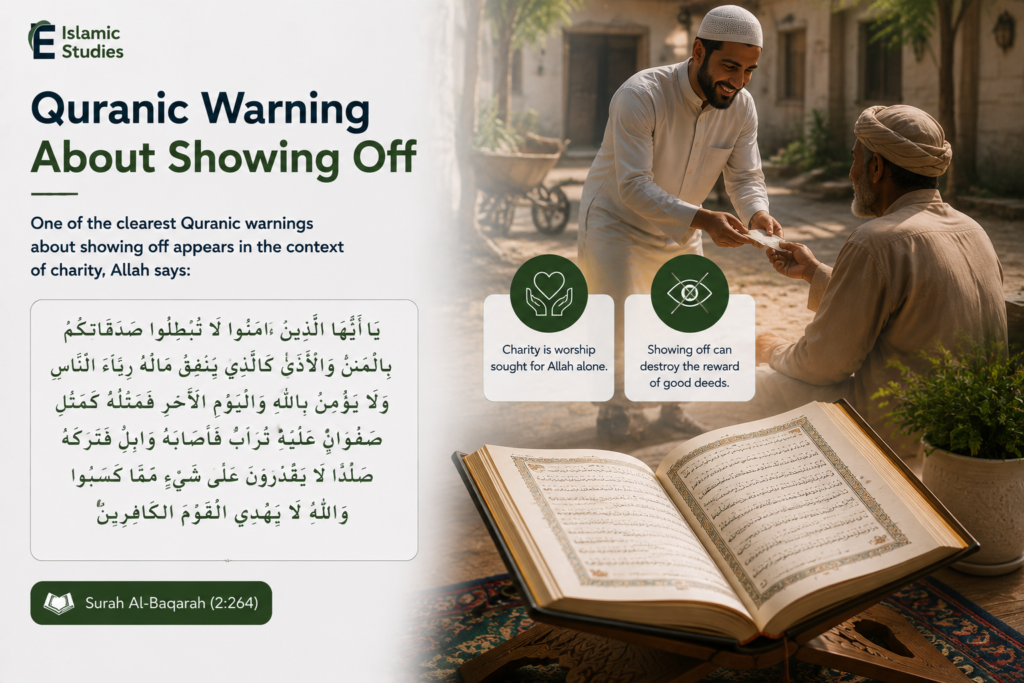
One of the clearest Quranic warnings about showing off appears in the context of charity. Allah says:
يَا أَيُّهَا الَّذِينَ آمَنُوا لَا تُبْطِلُوا صَدَقَاتِكُم بِالْمَنِّ وَالْأَذَىٰ كَالَّذِي يُنفِقُ مَالَهُ رِئَاءَ النَّاسِ وَلَا يُؤْمِنُ بِاللَّهِ وَالْيَوْمِ الْآخِرِ فَمَثَلُهُ كَمَثَلِ صَفْوَانٍ عَلَيْهِ تُرَابٌ فَأَصَابَهُ وَابِلٌ فَتَرَكَهُ صَلْدًا لَا يَقْدِرُونَ عَلَىٰ شَيْءٍ مِّمَّا كَسَبُوا ۖ وَاللَّهُ لَا يَهْدِي الْقَوْمَ الْكَافِرِينَ
“O you who have believed, do not invalidate your charities with reminders or injury as does one who spends his wealth [only] to be seen by the people and does not believe in Allah and the Last Day. His example is like that of a large smooth stone upon which is dust and is hit by a heavy rain that leaves it bare. They are unable [to keep] anything of what they have earned. And Allah does not guide the disbelieving people.” Surah Al-Baqarah (2:264)
This verse compares the deed of a person who gives charity purely to be seen to a smooth rock covered in a thin layer of dust: as soon as heavy rain falls, the dust is washed away completely, leaving nothing behind.
In the same way, an act of charity performed for riya leaves the person with no reward at all in the sight of Allah, no matter how impressive it looked to onlookers.
The Quran also describes riya as a defining trait of hypocrisy in prayer.
إِنَّ الْمُنَافِقِينَ يُخَادِعُونَ اللَّهَ وَهُوَ خَادِعُهُمْ وَإِذَا قَامُوا إِلَى الصَّلَاةِ قَامُوا كُسَالَىٰ يُرَاءُونَ النَّاسَ وَلَا يَذْكُرُونَ اللَّهَ إِلَّا قَلِيلًا
“Indeed, the hypocrites [think to] deceive Allah, but He is deceiving them. And when they stand for prayer, they stand lazily, showing [themselves to] the people and not remembering Allah except a little.”
Scholars explain that this verse describes people whose prayer has no real connection to the heart. They stand for prayer without energy or presence, and the only reason they perform it visibly is so that believers around them assume they belong to the community of the sincere.
This is why riya is so tied to the condition of the heart rather than the outward form of worship.
Read Also: Niyyah in Islam: Why Intention Matters in Every Act of Worship
The Hadith of the Three People Punished for Riya
One of the most detailed and sobering warnings about riya (showing off) appears in the hadith of three people whose outward deeds seemed to represent some of the greatest forms of righteousness: a man who fought courageously, a man who acquired and taught religious knowledge and recited the Quran, and a wealthy man who spent generously.
From an outward perspective, their actions appeared extraordinary. Yet the hadith reveals that the true value of these deeds was determined not merely by what they did, but by why they did it.
عَنْ أَبِي هُرَيْرَةَ قَالَ: سَمِعْتُ رَسُولَ اللَّهِ ﷺ يَقُولُ:
«إِنَّ أَوَّلَ النَّاسِ يُقْضَى يَوْمَ الْقِيَامَةِ عَلَيْهِ رَجُلٌ اسْتُشْهِدَ، فَأُتِيَ بِهِ فَعَرَّفَهُ نِعَمَهُ فَعَرَفَهَا، قَالَ: فَمَا عَمِلْتَ فِيهَا؟ قَالَ: قَاتَلْتُ فِيكَ حَتَّى اسْتُشْهِدْتُ.
قَالَ: كَذَبْتَ، وَلَكِنَّكَ قَاتَلْتَ لِأَنْ يُقَالَ جَرِيءٌ، فَقَدْ قِيلَ.
ثُمَّ أُمِرَ بِهِ فَسُحِبَ عَلَى وَجْهِهِ حَتَّى أُلْقِيَ فِي النَّارِ.
وَرَجُلٌ تَعَلَّمَ الْعِلْمَ وَعَلَّمَهُ وَقَرَأَ الْقُرْآنَ، فَأُتِيَ بِهِ فَعَرَّفَهُ نِعَمَهُ فَعَرَفَهَا، قَالَ: فَمَا عَمِلْتَ فِيهَا؟ قَالَ: تَعَلَّمْتُ الْعِلْمَ وَعَلَّمْتُهُ وَقَرَأْتُ فِيكَ الْقُرْآنَ.
قَالَ: كَذَبْتَ، وَلَكِنَّكَ تَعَلَّمْتَ الْعِلْمَ لِيُقَالَ عَالِمٌ، وَقَرَأْتَ الْقُرْآنَ لِيُقَالَ هُوَ قَارِئٌ، فَقَدْ قِيلَ.
ثُمَّ أُمِرَ بِهِ فَسُحِبَ عَلَى وَجْهِهِ حَتَّى أُلْقِيَ فِي النَّارِ.
وَرَجُلٌ وَسَّعَ اللَّهُ عَلَيْهِ وَأَعْطَاهُ مِنْ أَصْنَافِ الْمَالِ كُلِّهِ، فَأُتِيَ بِهِ فَعَرَّفَهُ نِعَمَهُ فَعَرَفَهَا، قَالَ: فَمَا عَمِلْتَ فِيهَا؟ قَالَ: مَا تَرَكْتُ مِنْ سَبِيلٍ تُحِبُّ أَنْ يُنْفَقَ فِيهَا إِلَّا أَنْفَقْتُ فِيهَا لَكَ.
قَالَ: كَذَبْتَ، وَلَكِنَّكَ فَعَلْتَ لِيُقَالَ هُوَ جَوَادٌ، فَقَدْ قِيلَ.
ثُمَّ أُمِرَ بِهِ فَسُحِبَ عَلَى وَجْهِهِ ثُمَّ أُلْقِيَ فِي النَّارِ».
Abu Hurairah (may Allah be pleased with him) reported that the Messenger of Allah ﷺ said:
“The first of people against whom judgment will be pronounced on the Day of Resurrection will be a man who died as a martyr. He will be brought, and Allah will make him recognize His blessings, and he will recognize them. Allah will say: ‘What did you do with them?’ He will say: ‘I fought for Your sake until I was martyred.’ Allah will say: ‘You have lied. You fought so that it might be said that you were courageous, and that was said.’ Then he will be commanded to be dragged on his face until he is thrown into the Fire.
Then there will be a man who studied knowledge, taught it, and recited the Quran. He will be brought, and Allah will make him recognize His blessings, and he will recognize them. Allah will say: ‘What did you do with them?’ He will say: ‘I studied knowledge, taught it, and recited the Quran for Your sake.’ Allah will say: ‘You have lied. You studied knowledge so that it might be said that you were a scholar, and you recited the Quran so that it might be said that you were a reciter, and that was said.’ Then he will be commanded to be dragged on his face until he is thrown into the Fire.
Then there will be a man whom Allah had made wealthy and had given every kind of wealth. He will be brought, and Allah will make him recognize His blessings, and he will recognize them. Allah will say: ‘What did you do with them?’ He will say: ‘I left no way in which You love wealth to be spent without spending it for Your sake.’ Allah will say: ‘You have lied. You did this so that it might be said that you were generous, and that was said.’ Then he will be commanded to be dragged on his face and thrown into the Fire.”
Narrated by: Abu Hurairah (رضي الله عنه)– Sahih Muslim
This narration is often cited by scholars to demonstrate that even the most outwardly impressive deeds fighting for Islam, teaching religious knowledge, and giving generously carry no reward if the underlying intention was to gain a reputation among people rather than to seek Allah’s pleasure.
At E Islamic Studies Academy, the Essential Islamic Courses teach the foundational knowledge of Aqeedah including iman, kufr, and their relationship.

Effects of Riya on a Muslim’s Deeds
Riya affects a Muslim’s worship in several serious ways, and understanding these consequences is part of what makes avoiding riya so important in daily practice.
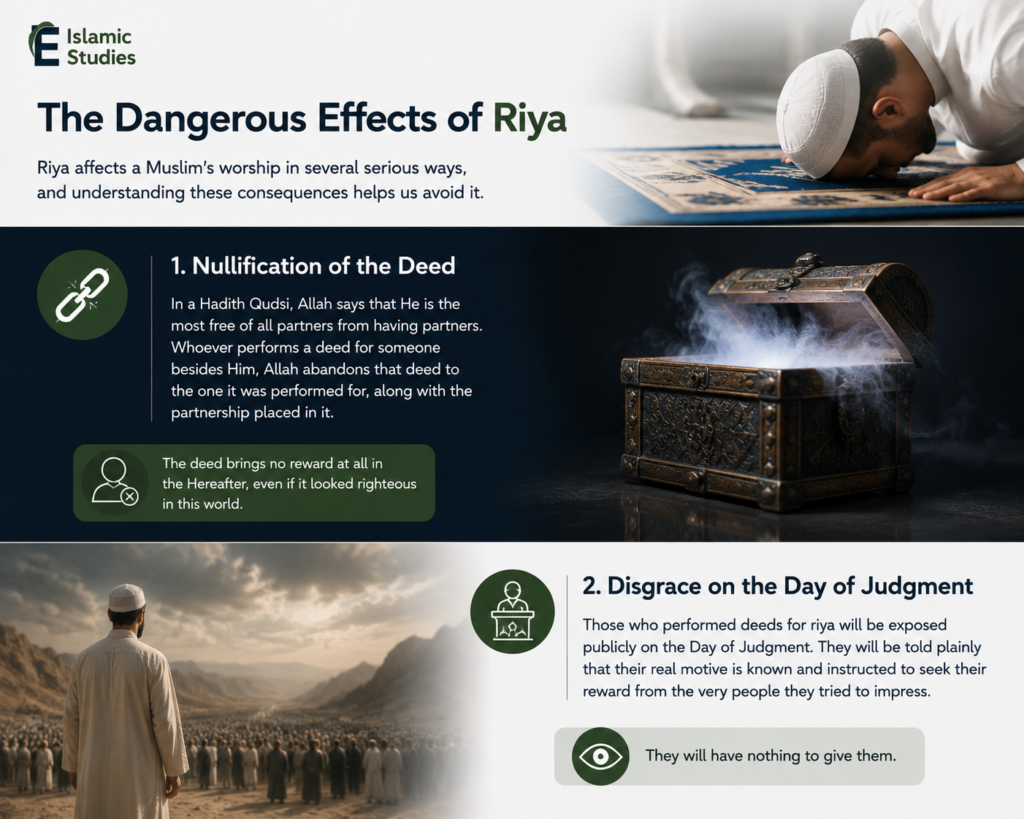
- The first effect is the nullification of the deed itself. In a well-known Hadith Qudsi, Allah says that He is the most free of all partners from having partners, so whoever performs a deed for someone else besides Him, Allah abandons that deed to the one it was performed for, along with the partnership placed in it.
This means the deed brings no reward at all in the Hereafter, even though it may have looked righteous in this world.
- The second effect is disgrace on the Day of Judgment. As shown in the Hadith about the three people, those who performed deeds for riya will be exposed publicly, told plainly that their real motive is known, and instructed to seek their reward from the very people they tried to impress, who will have nothing to give them.
It is important to note that riya does not necessarily nullify every deed a person has ever done. Scholars explain that riya invalidates the specific deed in which it occurred, not a person’s entire record of worship, unless riya becomes a general and repeated feature of how someone worships.
Take a look at a sample lesson and see how our interactive online classes help students learn Islamic Studies in a clear, engaging, and supportive environment.
Types of Riya: Hidden and Apparent
Riya can appear in actions or in words, and scholars distinguish between these two expressions even though both are rooted in the same problem of insincerity.
Riya in action includes things like deliberately lengthening one’s prayer when others are watching, or giving charity in a visible manner so that it is noticed, with the specific goal of being seen as devout or generous.
Riya in speech, often called sum’ah, includes talking about one’s fasting, charity, or religious study in a way designed to make sure others hear about it and think well of the person.
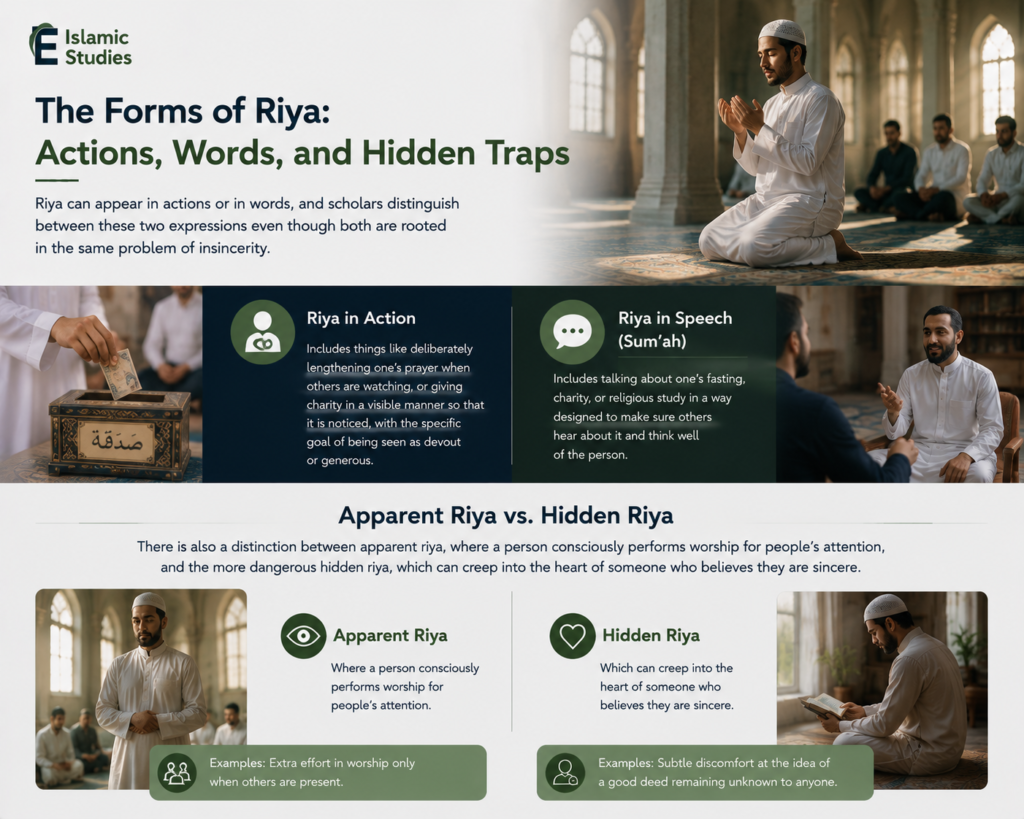
There is also a distinction between apparent riya, where a person consciously performs worship for people’s attention, and the more dangerous hidden riya, which can creep into the heart of someone who believes they are sincere.
Hidden riya might show itself as extra effort in worship only when others are present, or as subtle discomfort at the idea of a good deed remaining unknown to anyone.
Read Also: What Is Kafir in Islam? Meaning and Explanation
Is All Joy at Being Praised Considered Riya?
Not every positive feeling about being recognized for a good deed is sinful riya. This is an important nuance that many Muslims overlook, often out of excessive worry rather than genuine scholarly concern.
The scholar Ibn Qudamah explained that the traces of hidden riya are numerous and cannot be fully enumerated, and that whenever a person notices a difference in how they act depending on whether they are being watched, this contains some element of riya.
However, he clarified that not every such trace nullifies the reward or corrupts the deed entirely, since the matter requires careful distinction rather than blanket judgment.
Ibn Qudamah further explained that joy at being recognized divides into two categories. The praiseworthy kind occurs when a person’s true intention was to hide the good deed and seek Allah alone, but Allah chooses to make it known to others anyway.
In this case, the person’s happiness comes from recognizing Allah’s kindness in concealing their sins and revealing their good deeds, not from craving people’s admiration for its own sake.
The blameworthy kind occurs when the joy comes specifically from knowing that people’s high opinion, praise, and favors will follow because the deed became known.
Read Also: What Is Ihsan in Islam?
The Hadith of Abu Dharr on Good News in This World
An important distinction in understanding riya is the difference between doing a righteous deed in order to receive praise and receiving praise after performing a righteous deed sincerely for Allah.
The first can fall under riya because human admiration forms part of the person’s motive, while the second does not automatically damage the sincerity of the deed.
This distinction is supported directly by an authentic hadith narrated by Abu Dharr (may Allah be pleased with him), in which the Prophet ﷺ was specifically asked about a person who performs a good deed and is subsequently praised by people for it.
Abu Dharr (may Allah be pleased with him) reported
عَنْ أَبِي ذَرٍّ رضي الله عنه قَالَ: قِيلَ لِرَسُولِ اللَّهِ ﷺ: أَرَأَيْتَ الرَّجُلَ يَعْمَلُ الْعَمَلَ مِنَ الْخَيْرِ وَيَحْمَدُهُ النَّاسُ عَلَيْهِ؟ قَالَ:
«تِلْكَ عَاجِلُ بُشْرَى الْمُؤْمِنِ».
Abu Dharr (may Allah be pleased with him) reported that it was said to the Messenger of Allah ﷺ:
“What do you think of a man who does a good deed and people praise him for it?” He ﷺ replied, “That is the believer’s glad tidings received in this world.”
Narrated by: Abu Dharr (رضي الله عنه) -Sahih Muslim
This Hadith shows that Islam does not deny a believer the natural comfort of knowing they are seen well by others, as long as the original intention behind the deed was sincere and directed to Allah alone.
Build your Aqeedah with qualified scholars today.

Read Also: What Is Baraka in Islam?
Does Riya Apply to Worldly Matters, Not Just Worship?
The prohibition of riya is specifically tied to acts of pure worship, such as prayer, charity, fasting, and recitation of the Quran, where the entire purpose of the act is devotion to Allah.
Seeking status, respect, or a good reputation in worldly matters, such as one’s profession, business dealings, or areas of worldly knowledge like engineering or medicine, is treated differently by Islamic scholars.
Imam Al-Ghazali, in his book Ihya Ulum al-Din, explained that seeking a good standing among people through worldly means is not automatically forbidden, in the same way that seeking wealth is not automatically forbidden.
He compared status (jah) to wealth, noting that a small, necessary amount that protects a person from harm and difficulty is generally praiseworthy, just as it was for Prophet Yusuf (عليه السلام), who asked to be placed in charge of the storehouses of the land, describing himself as trustworthy and knowledgeable.
Al-Ghazali warned, however, that excessive craving for status, like excessive craving for wealth, can distract the heart from remembrance of Allah and the Hereafter, and can be even more dangerous than the love of money because the temptation of status is often more subtle.
Read Also: Voluntary Fasting Days in Islam
How Can a Muslim Protect Themselves From Riya?
Protecting the heart from riya begins with strengthening one’s understanding of ikhlas (sincerity), which is the direct opposite of riya. Ikhlas means intending one’s actions purely for the sake of Allah, without seeking any worldly benefit such as praise, status, or admiration from people.
A Muslim who trains themselves to renew this intention before and during acts of worship builds strong protection against riya over time.
Practically, scholars recommend performing some acts of worship privately whenever possible, so that the habit of sincerity is reinforced away from the eyes of others.
Acts of voluntary worship that are naturally private, such as extra prayers at night or fasting on ordinary days without announcing it, are especially valuable in training the heart to seek Allah’s pleasure rather than human approval.
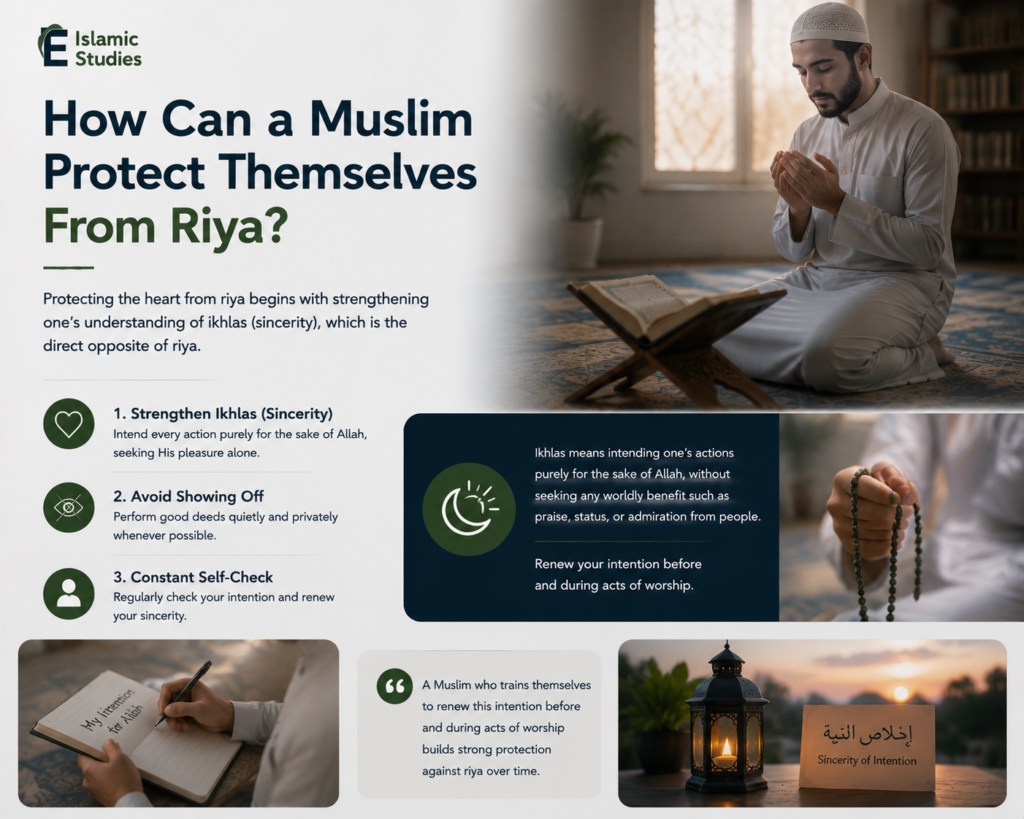
Regularly remembering that Allah sees every action, and that ultimately it is His pleasure and reward that matter, is another practical protection.
The Prophet صلى الله عليه وسلم taught his companions a specific supplication asking Allah for protection from associating anything with Him knowingly, and seeking forgiveness for whatever is done unknowingly.
Reciting such supplications, along with honest self-reflection about one’s real motives in worship, are among the most recommended ways scholars have described for guarding the heart against riya.
Read Also: What Is Shukr in Islam?
Deepen Your Islamic Knowledge
Join our comprehensive online courses and learn from qualified scholars today.
Understanding tazkiyah, the purification of the heart, is closely connected to overcoming riya, since riya is fundamentally a disease of the heart rather than a flaw in the outward form of worship.
Structured study of tazkiyah, along with foundational Islamic classes designed for beginners and those returning to their faith, can give a Muslim the tools needed to recognize and gradually remove riya from their acts of worship.
Read Also: What Is Tawakkul in Islam?
Watch a Sample Islamic Studies Class
See how our teachers explain Islamic concepts in an engaging and easy-to-understand way, helping students build knowledge and confidence.
Deepen Your Islamic Knowledge
Join our comprehensive online courses and learn from qualified scholars today.
Book Your Free Trial
Ready to build a stronger foundation in Islamic knowledge at E Islamic Studies Academy
Choose the learning path that matches your level, study directly with qualified teachers, and get the opportunity to ask about the real-life situations that a general article cannot fully address.
Different students need different learning paths. A new Muslim may need a broad introduction to Islamic beliefs and practice, while another student may want detailed study of fiqh or a traditional curriculum. The academy’s courses are organized to support these different levels and goals.

Our Islamic Essentials Courses
Islamic family rulings make more sense when they are studied alongside the wider Islamic sciences.
Tafseer helps students understand Quranic guidance in context, aqidah develops their understanding of Islamic belief, seerah provides the Prophetic context, and tazkiyah and akhlaq connect legal knowledge with spiritual and ethical development.
- Essential Islam Courses
- Online Tafseer Course
- Islamic History Course
- Tazkiyah Course
- Online Qirat Course
- Quran Tafseer Classes for Beginners
- Online Tafseer Classes in English
- Self-Paced Tafseer Course
- Aqidah Course
- Online Seerah Course
- Akhlaq Course
Conclusion
Riya in Islam means performing an act of worship, wholly or partly, to be seen and praised by people rather than to seek the pleasure of Allah alone.
It is classified as hidden or minor shirk because it introduces something other than Allah into an act that should belong to Him completely, and both the Quran and authentic Hadith warn believers strongly against it, describing how it can nullify the reward of prayer, charity, knowledge, and even martyrdom.
At the same time, Islam does not condemn a believer for feeling comforted when their sincere good deeds become known to others, as long as the original intention was for Allah alone.
The real safeguard against riya lies in nurturing sincerity (ikhlas), performing some acts of worship privately, and regularly checking one’s true motives, so that every act of worship is directed to the One who alone deserves it.

Frequently Asked Questions
What does riya mean in Islam?
Riya means performing an act of worship or good deed with the intention of being seen and praised by people, instead of, or alongside, seeking Allah’s pleasure alone. It comes from the Arabic root meaning “to see.”
Is riya considered a major sin in Islam?
Riya is classified by scholars as shirk al-asghar (minor shirk), also called hidden shirk. It does not remove a person from Islam, but it is treated as extremely serious because it can nullify the reward of the deed it affects.
What is the difference between riya and sum’ah?
Riya relates to actions people can see, such as praying visibly to be noticed. Sum’ah relates to speech or reports people hear, such as making sure others are told about a good deed. Both share the same underlying problem of seeking human praise instead of Allah’s pleasure.
Does riya nullify all of a person’s good deeds?
Riya nullifies the specific deed in which it occurs, according to scholars, rather than erasing a person’s entire record of worship, unless riya becomes a repeated and general pattern in how someone worships.
Is it riya to feel happy when people praise a good deed I did?
Not necessarily. If the original intention was sincere and directed to Allah, and the happiness comes from recognizing Allah’s kindness rather than craving people’s admiration, this is considered a permissible and even praiseworthy feeling, as explained by scholars such as Ibn Qudamah.
How can I protect my worship from riya?
Renewing sincere intention (niyyah) before acts of worship, performing some acts of worship privately, regularly remembering that Allah sees all actions, and honestly reflecting on one’s true motives are among the practical steps scholars recommend for guarding against riya.







Leave a Reply